On November 22, 2026, the foreign investment bank Nomura published a comprehensive report on the global storage industry. Analysts CW Chung, Eon Hwang, and YJ Kim pointed out in the report that innovations in artificial intelligence are accelerating, but regulatory risks regarding the construction of data centers in the U.S. and abroad are also accumulating simultaneously.
The strength of computing demand continues to exceed market expectations. Recently, artificial intelligence made substantial progress on the Riemann Hypothesis, a mathematical problem that has been unresolved for over 160 years, marking the first significant advancement in decades. Over the past year, the rental price of Nvidia's H100 computing chip has increased by about 50%.
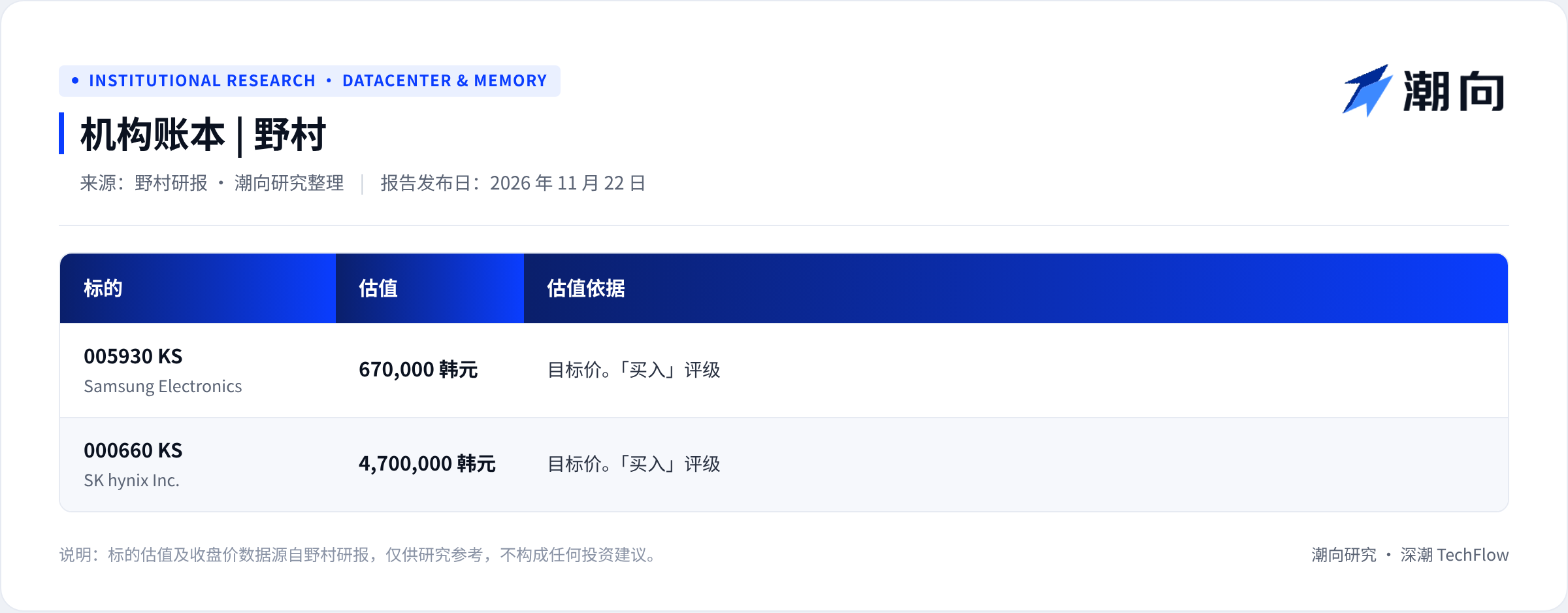
However, uncertainties at the policy level are suppressing valuations in the semiconductor sector. Nomura maintains a "buy" rating for Samsung Electronics (005930 KS) and SK Hynix (000660 KS), with target prices of 670,000 KRW and 4,700,000 KRW, respectively.
Four Major Regulatory Variables Overlap, Data Center Expansion Under Pressure
Nomura has identified four core factors currently affecting global data center construction policies and business variables. These variables are altering the rollout pace of computing infrastructure over the next two years.
The first variable is the tightening of state-level regulations following the U.S. midterm elections. Some newly elected governors promised during their campaigns to suspend approvals for new data centers and reduce tax incentives, with Texas becoming a focal point for the market. However, Texas' elected governor has already acknowledged that ongoing projects cannot be halted, and the Texas Commission on Environmental Quality (TCEQ) has resumed issuing environmental permits for data centers as of November 13, 2026.
The second variable is the chip export restriction bill targeting China. The U.S. Senate's National Defense Authorization Act (NDAA) for fiscal year 2027 includes three bills: the AI Oversight Act, the Chip Security Act, and the Remote Access Security Act. On November 12, 2026, three committee chairpersons in the House further urged the inclusion of all four bills, including the MATCH Act, in the final version.
The third variable is the new remote access regulations from the U.S. Department of Commerce's Bureau of Industry and Security (BIS). This rule was announced on November 16, 2026, and officially took effect on November 19, 2026. The new regulation requires that data centers providing computing power to companies headquartered in D:5 countries (including China) or Macau must apply for a license to purchase advanced chips.
Additionally, data center chips exported to Indonesia, Malaysia, Singapore, Thailand, and Brazil also require a license, excluding companies headquartered in the U.S.
The fourth variable is the latest statement from U.S. President Trump during a press conference on November 20, 2026. Trump mentioned a possible restriction on U.S. companies building data centers overseas or taxing them. Nomura points out that this statement currently lacks supporting tax rates, timelines, and legal mechanisms, making the likelihood of implementation low to moderate.
Moreover, following the resignation of Nvidia's CEO on November 12, 2026, the company's client financing strategy has become more conservative. The interim CEO has set the capital allocation priorities as stock buybacks, vendor prepayments, committed investments, and finally client financing.
Tech Giants Actively Seek to Break the Deadlock, State Approval Delays Controlled Within Three Months
In response to community resistance and electricity concerns at the state level in the U.S., tech giants have taken several measures to hedge the risks of approval delays.
Residents' complaints about rising electricity costs and water consumption by data centers were the core reasons previously brought up by local politicians to propose suspending approvals. To address this, Google announced on November 5, 2026, that it would fully cover the electricity costs for its facility in Wyoming. OpenAI also released a community agreement on the same day, while Google, Meta, and Microsoft jointly formed the Responsible Data Center Alliance with the World Wildlife Fund.
In terms of site selection strategy, tech companies are accelerating their shift towards approval-friendly regions. On November 17, 2026, Effingham County, Georgia, unanimously approved OpenAI's site plan. On November 19, 2026, Eddy County, New Mexico, approved tax incentives for Google's Rancho project and rejected a proposal to suspend new construction.
Brownfield redevelopment has become another path to circumvent approval bottlenecks. Homer City, Pennsylvania, is transforming a decommissioned coal-fired power plant into a data center, having obtained air quality permits for power generation. Other abandoned industrial sites, such as the Ashland steel mill in Kentucky, are also on the tracking list for data center transformation.
Based on the industry's countermeasures, Nomura's scenario calculations assume that even with the tightening of state-level regulations impacting 41% of newly added capacity in the U.S., project commencement may be delayed by six months, but accelerated construction once approved could shorten the actual production delay to an average of three months.
In an Extreme Scenario, New Computing Capacity in 2028 May Shrink by 28.3%
Nomura has constructed a four-tiered regulatory scenario model to quantitatively assess the impacts of different policy combinations on the global installed capacity of new data centers.
In the baseline scenario unaffected by regulatory interference, the global installed capacity of new data centers is expected to rise from 14.4 gigawatts (GW) in 2025 to 29.7 GW in 2026. By 2027, it is expected to reach 45.8 GW and further increase to 60.3 GW in 2028.
In scenario one (only considering the tightening of U.S. state-level regulations), the new capacity for 2027 remains at 45.8 GW, decreasing to 56.4 GW in 2028, a reduction of 6.4% compared to the baseline scenario.
In scenario two (adding chip export restrictions to China and blocking smuggling channels, excluding the smuggling scale that accounts for 2.5% of Nvidia's shipments), new capacity for 2027 and 2028 decline to 45.1 GW and 55.6 GW, respectively, down 1.5% and 7.8% from the baseline.
In scenario three (adding BIS's new remote access regulations, removing confirmed Chinese demand and 70% of uncertain demand from regulated Southeast Asian and Latin American countries), new capacity for 2027 decreases to 43.0 GW, and in 2028, it decreases to 52.7 GW, a reduction of 6.1% and 12.5% from the baseline, respectively.
In the most extreme scenario four (adding restrictions on U.S. companies building new data centers overseas, assuming a 50% reduction in overseas projects in 2027 and a complete halt in 2028), new global capacity in 2027 will fall to 39.5 GW, while in 2028, it will drop to 43.2 GW, a significant reduction of 13.7% and 28.3% from the baseline, respectively.
Regulatory Impacts Transmitted to Storage Side, DRAM Shortage Mitigates Short-Term Declines
Changes in data center installed capacity will directly affect the demand for upstream storage chips. Nomura's model shows that data centers will account for 65% and 75% of total global storage demand in 2027 and 2028, respectively.
The calculations show that under scenarios one to three, global total storage demand in 2028 will decline by 3.8%, 4.7%, and 7.5% compared to the baseline. Nomura believes that due to the sustained strong demand for domestic data centers in the U.S., the actual impact of the first three regulatory scenarios on the storage supply-demand landscape is quite limited.
However, if the most extreme scenario four is realized (i.e., comprehensive restrictions on U.S. companies building factories overseas), global total storage demand will decline by 6.8% in 2027 and will expand to a 16.9% decline in 2028, making it difficult to avoid short-term price corrections in the storage market.
Currently, the storage subsector has shown a clear differentiation pattern. Due to weak demand in consumer electronics and slowdowns in shipments to China caused by local regulations, some NAND flash prices have already shown signs of falling.
In contrast, DRAM memory remains in a state of severe supply shortage. Nomura further points out that even in the event of an extreme scenario, storage manufacturers would quickly cut capital expenditures to reduce supply. At the same time, U.S. companies may accelerate domestic data center construction, and previously forced to lower hardware configurations due to storage shortages, consumer electronics and AI devices will also restore specifications, thereby significantly cushioning the actual degree of oversupply.
Long-term Contract Prices Create a Safety Net, Storage Leaders' Valuations Reflect Pessimistic Assumptions
In terms of pricing mechanism, long-term agreements (LTAs) with storage manufacturers provide strong bottom protection for performance. Currently, the non-long-term contract spot portion accounts for 30% to 50% of total shipments, while long-term contract prices, although pegged to fluctuations in spot prices, have a lower price bound.
Nomura estimates that storage manufacturers currently have an operating profit margin of about 80%. Even in the worst-case market price downturn scenario, when long-term contract prices reach the lower bounds of their ranges from 2027 to 2028, storage manufacturers' operating profit margins can still maintain a high level of 60% to 70%.
From the perspective of the industry chain's profit and loss patterns, if overseas data center construction encounters obstacles, the shortage of computing supply will drive cloud service and GPU leasing prices higher, benefiting cloud service providers first. Conversely, if the expansion of data centers and storage is delayed, the order demand for semiconductor equipment manufacturers will be lower than market expectations.
For storage chip manufacturers, the recent stock price correction has already fully priced in the long-term risks. Nomura's sensitivity analysis indicates that even if it assumes that the average selling price of DRAM and NAND will plummet by 70% from current expectations in 2028, the dynamic price-to-earnings ratios for Samsung Electronics and SK Hynix in 2028 would only be between 8 times to 11 times.
Specifically, under the extreme stress test of a 70% drop in storage prices in 2028, Samsung Electronics' common stock average price-to-earnings ratio for the entire year would be 8.4 times, and the price-to-book ratio would be 1.0 times; SK Hynix's average price-to-earnings ratio for the whole year would be 11.1 times, and the price-to-book ratio would be 1.1 times. Nomura believes that the current valuation levels provide sufficient safety margins for both storage giants.
Institutional Accounts
Fixed Statement Regarding Research Report Content (Brokerage Views, Not Chao Xiang Research Views)
This article is a compilation and interpretation of a third-party brokerage research report by Chao Xiang Research. The ratings, target prices, earnings forecasts, and related judgments cited in this text are the views of the brokerage's analysts, representing the stance of their affiliated institution and not representing the views of Chao Xiang Research, nor do they constitute any investment advice.
The market has risks; decisions must be made independently. This article should not be used as the basis for buying or selling any securities.
免责声明:本文章仅代表作者个人观点,不代表本平台的立场和观点。本文章仅供信息分享,不构成对任何人的任何投资建议。用户与作者之间的任何争议,与本平台无关。如网页中刊载的文章或图片涉及侵权,请提供相关的权利证明和身份证明发送邮件到[email protected],本平台相关工作人员将会进行核查。