Author: David, Deep Tide TechFlow
Deep Tide Guide:
Solana trader Ansem's associated wallet concentrated on dumping the eponymous token, exchanging it for approximately 17,600 SOL, worth around 1.25 million USD at the reported price. Lookonchain subsequently reported that the related address transferred approximately 2.15 million USDC to Arbitrum, involving funds from the sale of various Meme coins, which cannot be directly equated to the proceeds from ANSEM sales alone. The community is passionately debating whether "he is embezzling or has truly been hacked," while a question from Frank DeGods pushed this micro-drama further: "What if this happened to Satoshi Nakamoto?"
From the loss of 70 million meme coin chips to the early bitcoins speculated to belong to Satoshi and the quantum shadows, the most fragile assumption in the crypto market is the belief that dormant chips will never awaken. This means that, in the face of cold-blooded matching engines and liquidity abyss, the existence of hackers is irrelevant; betrayal and disaster appear on the same bill for a market crash, with no difference.
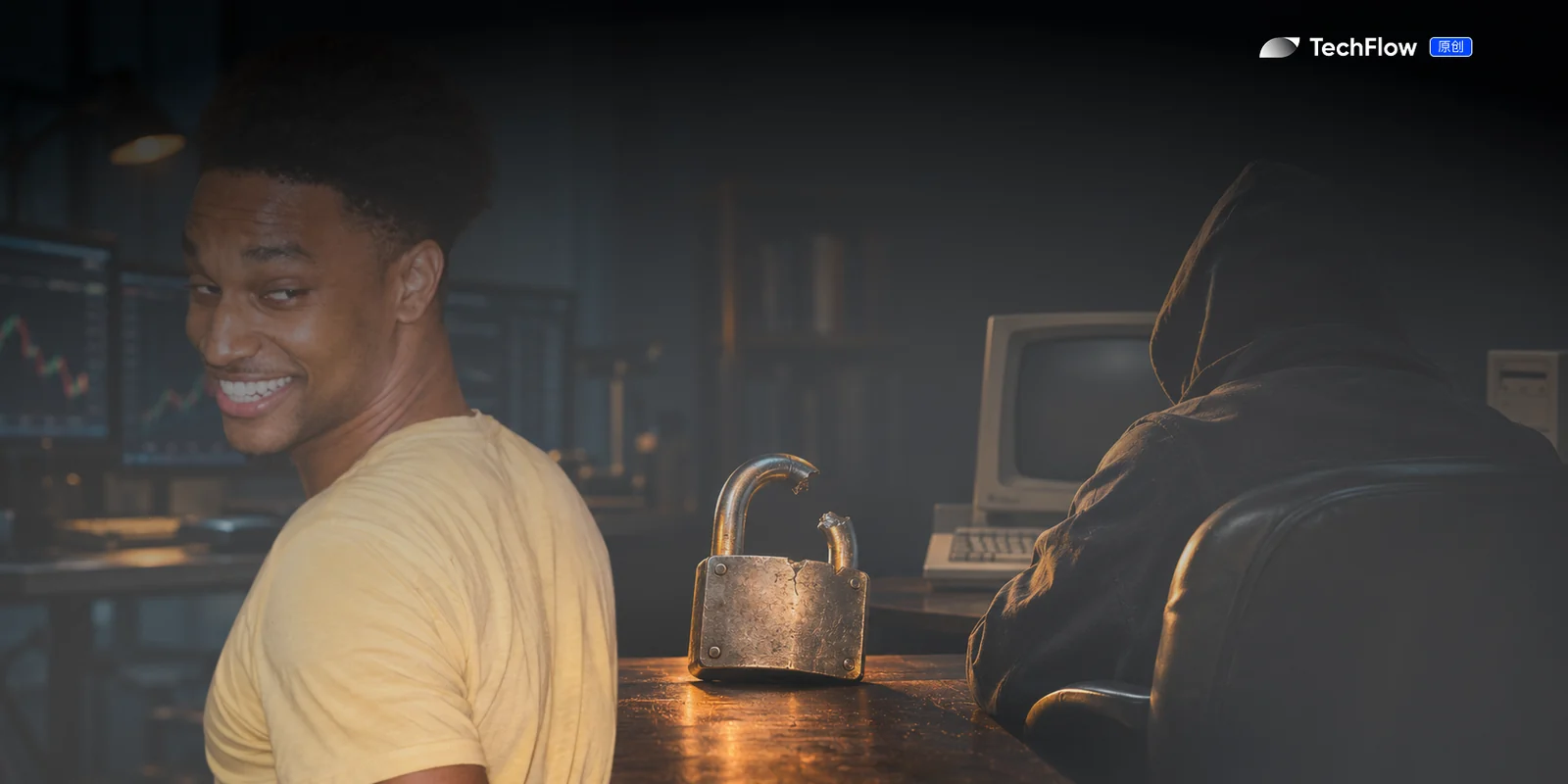
Ansem and Satoshi Nakamoto are clearly two different kinds of people. But the massive chips they left on the chain face the same possibility of being pulled into the abyss by gravity.
One is an active modern speculator in the spotlight, relying on Twitter for attention and liquidity games; the other is a pioneer who has achieved success and completely retreated into the mist of cryptography.
Logically, they should not be discussed together in any serious context.
However, the recent abnormal wallet sell-off, combined with discussions in the crypto industry about the risks of quantum computing, has made the dimensional wall seem less obvious.
According to on-chain monitoring reports, Ansem's associated wallet sold approximately 70.8 million ANSEM in batches, exchanging it for about 17,600 SOL, worth around 1.25 million USD at the reported price. Lookonchain subsequently stated that the funds from the sale of related Meme coins were transferred to an address starting with 0xAC33 on Arbitrum, amounting to approximately 2.15 million USDC. The assets and funding ranges covered by these two sets of numbers are different and cannot be written as 17,600 SOL directly exchanged for 2.15 million USDC. ANSEM dropped significantly during the sale, with early monitoring indicating a drop of about 60% in an hour; these are records from the time of the event.
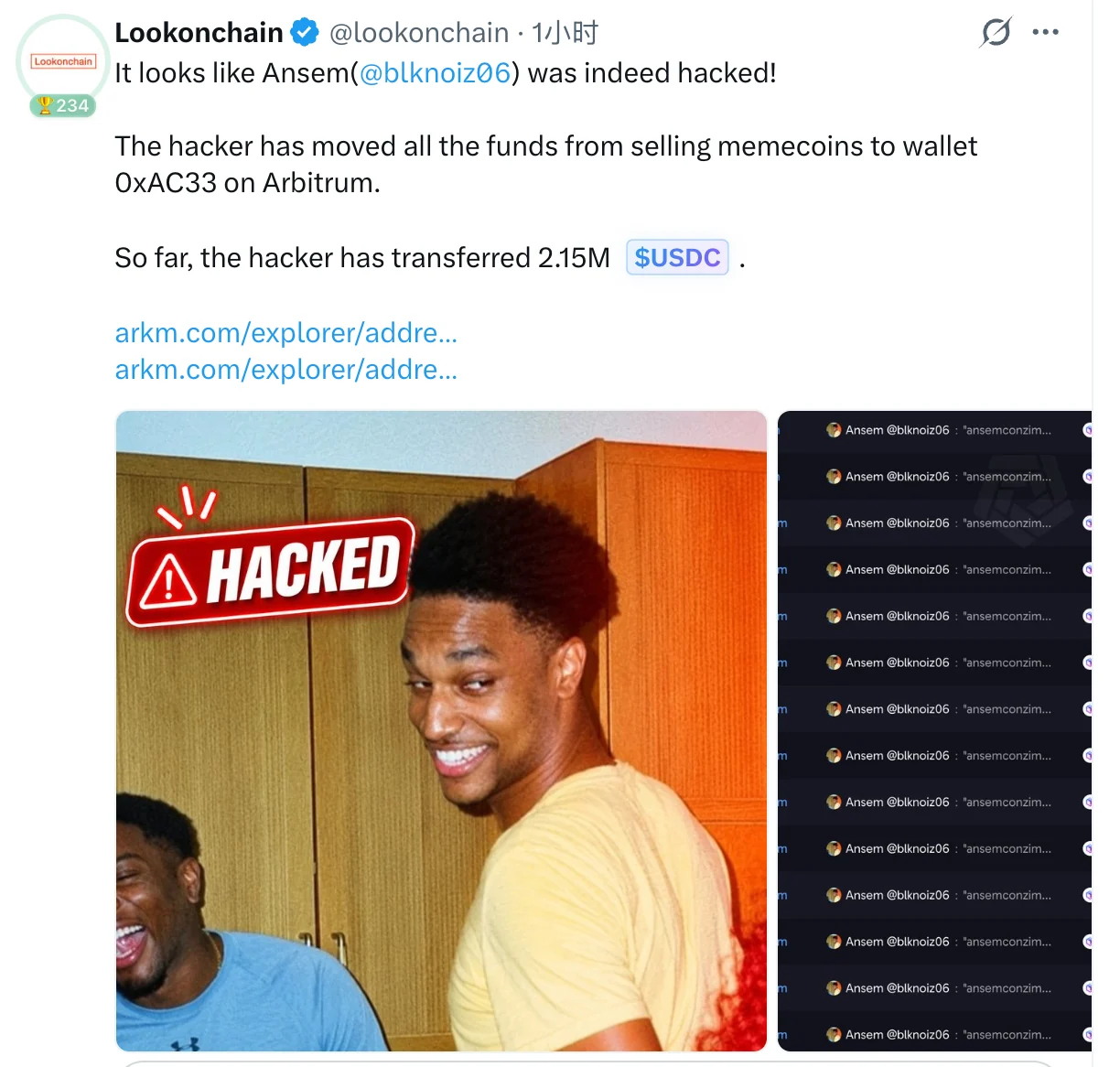
Subsequently, the familiar plot unfolded step by step.
Ansem later stated that his Pump wallet had been attacked, initially suspecting it was related to unauthorized access to the Bullpen account, which had previously imported Solana private keys; the specific attack path has yet to be confirmed. On-chain analyst MLM raised a contrary judgment, stating that about an hour before the sale began, an old wallet he had previously marked as Ansem had transferred funds to the receiving address. The wallet still holds approximately 16.7 million ANSEM, which has become a detail of debate within the community.
Currently, crypto Twitter in English is still debating "was it a hacker theft, or a self-theft and performance by Ansem," while Frank DeGods' post prompted me to think of a deeper question:
"Now, imagine if they did the same to Satoshi?"
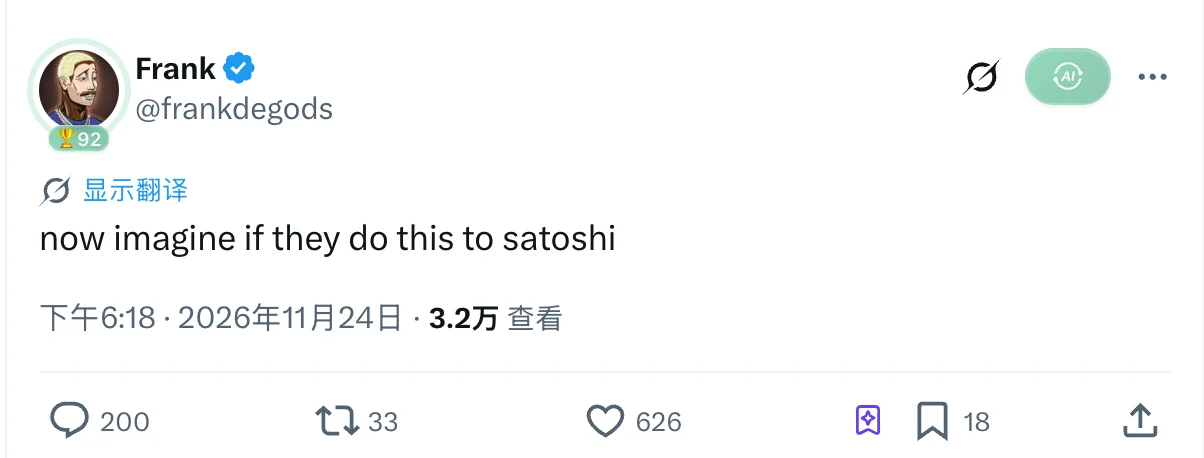
In recent years, holders have seen too many incidents starting with abnormal wallet transfers.
So from the outcome, whether a coin is stolen by hackers, self-directed performance for cover, or if Satoshi's BTC is truly compromised by quantum computing, the market crash is ultimately indiscriminate.
Self-theft and Theft are Equivalent on the Market
When one holds too many coins, they often fall into a moral obsession in despair.
For instance, if I hold ANSEM, I urgently want to clarify whether Ansem is innocent, as if this were truly an external hacker attack, then the 75% asset shrinkage in my account could gain some sacred comfort; whereas if this was a self-directed performance, this loss would turn into an unforgivable scam.
However, automated market maker pools never have a moral sense.
In the depths of all order book matches, there is no field to record the mindset of the private key holder of this signed transaction. It does not care whether the person operating the keyboard is a hacker, whether this is a premeditated cash-out, nor does it care if retail investors are kept in the dark.
Nonetheless, the angry accusations in the community are certainly not baseless.
On-chain analyst MLM (@mlmabc) pointed out that about an hour before the sale began, a wallet he had marked as Ansem a year ago had transferred funds to the subsequently receiving address, leading him to suspect it was not a hacker attack. This judgment contradicts Ansem's claim, as the mere association of addresses is not enough to prove who controlled the private keys at the time of the incident.
Moreover, after smashing 70.8 million coins in three waves, cashing out 17,600 SOL, it just so happened to leave 16.7 million tail inventory untouched.
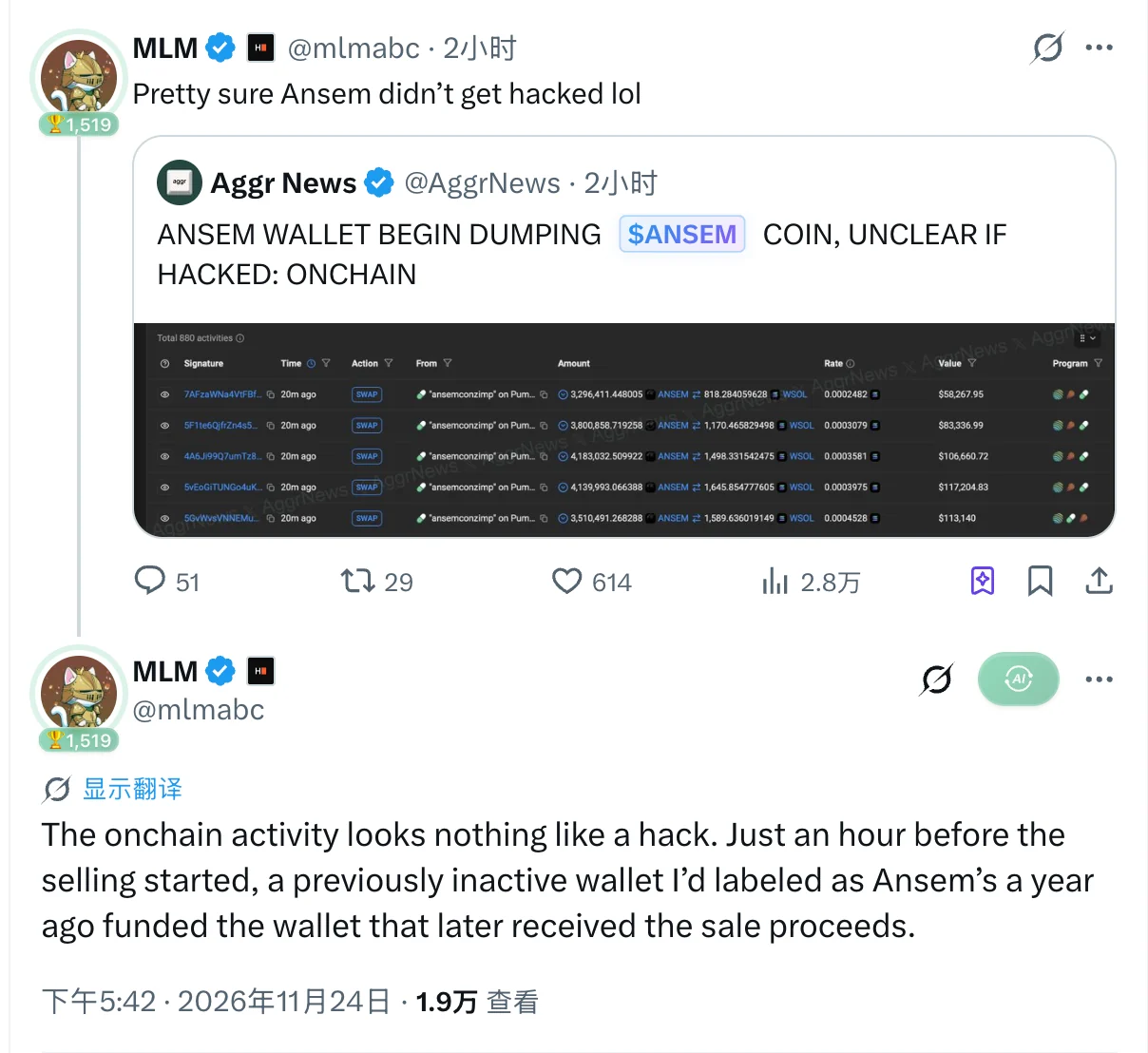
Until more evidence emerges, self-selling and private key theft remain competing explanations.
Because we have seen too many examples where "hacker intrusion" and "private key leakage" were used as a guise for self-theft. Dumping chips at little cost to believers and then declaring on Twitter "I was hacked" can wash profits into safe pockets as well as attempt to maintain a semblance of victimhood in the public opinion arena; this is a script many KOLs are adept at executing.
But the problem is that oftentimes, self-theft and theft by others are hard to distinguish from the outcome.
When the market crashes and liquidity exits the pools, in a Memecoin wasteland with no legal contracts or recourse mechanisms, it is difficult for any institution to process victims' refund appeals. Seeking a refund from them? That’s a lengthy and arduous task.
On a physical level, whether it's a performance or a hack, the devastation caused to each holder is entirely equivalent.
Satoshi's Public Key in the Sun, Quantum Ghosts in the Shadows
I am not trying to absolve Ansem, nor do I believe that those hidden in the shadows should go unpunished.
Just that if we follow Frank's rhetorical question to shift focus away from the controversy of this Solana token, we can think of a more distant and challenging scenario:
Satoshi and the quantum computing hanging over Bitcoin.
The reason people argue so heatedly about Ansem is that he is a living person. There is greed, self-interest, and the motivation to cash out at any moment to improve life, so all the losses and anger can be logically poured into a moral judgment of "he is stealing from himself."
But what about Satoshi?
If those early bitcoins long thought to belong to Satoshi and have been dormant for years begin to move in large numbers one early morning, the market is likely to first bear the shock. Yet the transfer itself can only prove that someone can generate a valid signature, it cannot determine that quantum cracking has occurred. The original holder's reactivation of assets, traditional methods of private key leakage, and potential future cryptographic attacks all need to be investigated separately.
This is a discussion of an hypothesis: if future quantum computing capabilities are sufficient to break existing signature algorithms, what risks will early coins whose public keys have been exposed face?
Then, when you hold Memes, you will automatically gain a deterrent of "theater being stolen and crashing," while when you hold BTC, you will automatically gain a deterrent of "long-term quantum computing FUD."
These two types of debuffs are the Damocles' sword hanging overhead, and this is the risk that holders must bear.
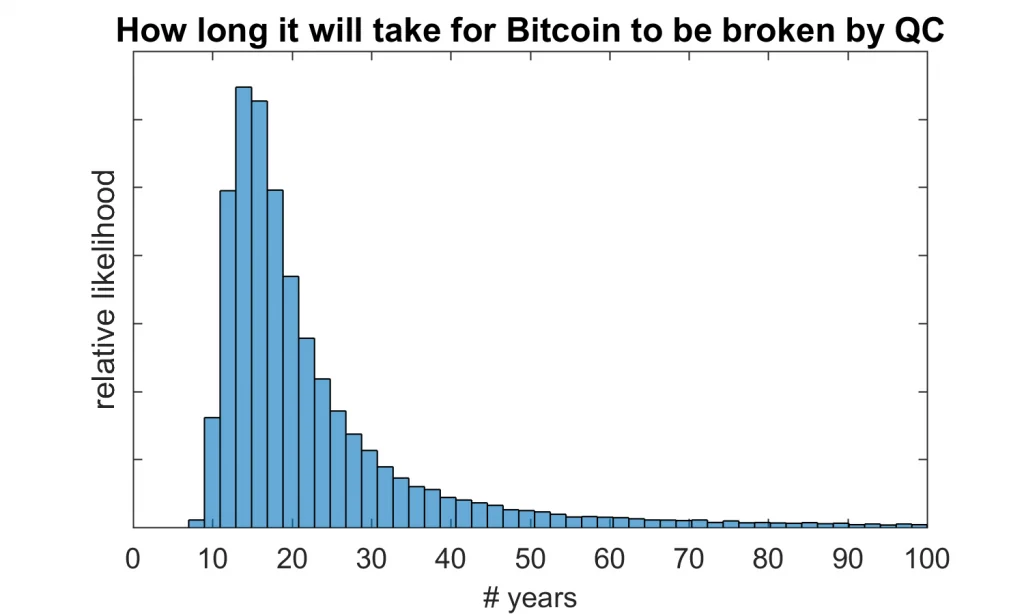
Original accompanying image: Diagram of quantum risk time distribution. The research source and starting year are not indicated, and should not be used as a basis for predicting cracking time.
Since every ultimate threat objectively exists, does that mean you will not hold coins at this time? Will you directly leave the market today out of fear that quantum computing will break Bitcoin?
Clearly not.
Recently, Sun Yuchen discussed this topic during an interview, and his attitude was quite interesting. He admitted that due to advancements in AI algorithms and the risks of quantum computing, his long-term view on Bitcoin has turned cautious, even slightly bearish, and he calculated:
He expressed concern during the interview that some long-dormant bitcoins that cannot proactively migrate to new security solutions may create selling pressure when cryptography faces challenges in the future. This is his risk prediction and does not imply that these private keys have been compromised.
But interestingly, he also candidly stated in the interview that he has not sold a single Bitcoin from his core holding.
Beliefs remain beliefs, and holdings remain holdings.
The vast majority of people do not hurriedly leave the market not because they deny the existence of risk, but because they understand a fundamental investment principle: Facing such systemic, long-term risks, blindly panicking and cutting losses is as extremely inadvisable as burying one's head in the sand pretending not to see.
Jump Out of Gossip Noise, Enter "Bunker Mode"
Shifting focus back to the present, you will find that continuing to argue about whether Ansem's actions were self-theft or theft is an incredibly draining activity.
In an era where AI is rapidly evolving, social engineering attacks are commonplace, and North Korean hacker Lazarus can repeatedly breach leading centralized institutions, a leak of hot wallet private keys or a celebrity seemingly staging a self-performance sell-off is no longer the highest priority for security in the crypto industry.
A truly mature holder should care about something else:
When the worst-case extreme scenario arises, does your own asset and position have the strongest defense measures in place?
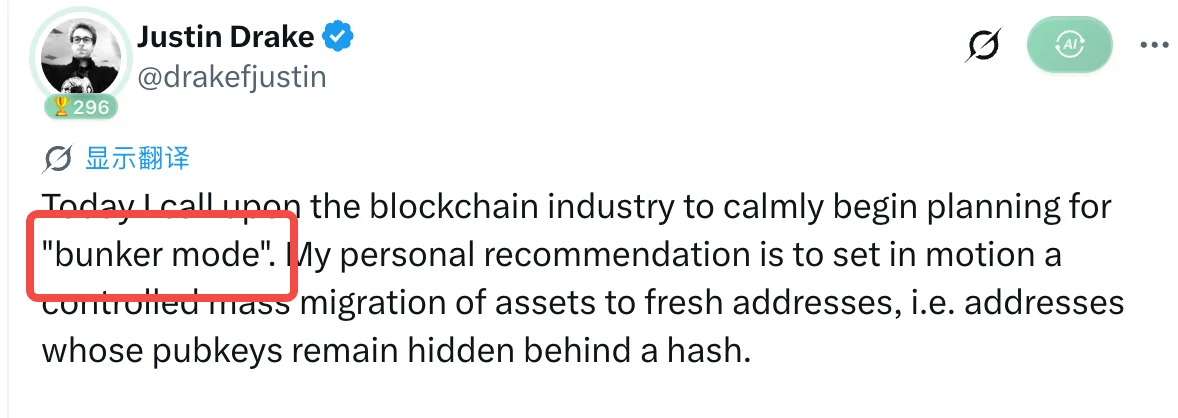
Ethereum researcher Justin Drake has called for the industry to calmly start planning for "Bunker Mode," proposing an orderly migration to new addresses where public keys remain hidden in hashes. This suggestion has specific technical prerequisites and does not imply that all new addresses provide the same level of protection.
For every person with real money gambling in the market, "Bunker Mode" is not an empty phrase; it corresponds to tangible operational rules.
First, completely abandon any luck-based approach and conditionally enforce physical level cold isolation.
According to Ansem's public statement, he initially suspected the attack was related to the Bullpen account that had previously imported Solana private keys; this is the judgment of the person involved, and the specific attack path is still to be confirmed.
Large long-term assets should not share the same hot wallet private keys with browser plugins or daily interactions. Offline security of keys, checking transaction information on hardware wallets, and designing multi-signature permissions reasonably can reduce some operational risks and single-point theft risks; these measures themselves will not grant existing signature algorithms resistance to quantum capabilities.
Second, distinguish address types to minimize unnecessary public key exposure.
For P2PKH and P2WPKH addresses, where public keys have not been publicly disclosed elsewhere, on-chain usually only shows the public key hash when the funds are unspent, and only reveals the public key upon spending. However, early P2PK outputs directly include public keys, and Taproot (P2TR) outputs also disclose public keys, making it impossible to judge solely based on "never having transferred out." The specific structures can be referenced in Bitcoin's BIP 141 and BIP 341.
Avoiding address reuse helps reduce public key exposure for some address types, but "switching to a new address" is not a universal solution against quantum threats. Research from Google Quantum AI also distinguishes between reducing address exposure and migrating to post-quantum cryptographic solutions. Hash protection can reduce certain attack opportunities, but it does not imply future quantum computing can do absolutely nothing against it.
Third, prepare for the worst in position allocation.
Never bet your life's savings on the moral self-discipline of any single centralized entity, single founder, or even any single smart contract. For Memecoins that depend on a single person's reputation, use disposable funds that can go to zero anytime; for core assets like Bitcoin that carry macro consensus, make sure to leave adequate legal tender cash flow buffers to cope with extreme volatility and systemic black swans.
A true belief in crypto is clearly not about closing your eyes and praying that hackers and quantum crises will never happen.
It means you clearly see through human greed and the possible flaws in technology, yet still choose to sit at the card table; but at the same time, you have built high walls for your assets and changed to new locks that have never been exposed.
Do not gamble on anyone's morals, nor turn a blind eye to any potential threats. In this era filled with uncertainty, only those who prepare for the worst have the potential to enjoy the ultimate future that comes to fruition.
免责声明:本文章仅代表作者个人观点,不代表本平台的立场和观点。本文章仅供信息分享,不构成对任何人的任何投资建议。用户与作者之间的任何争议,与本平台无关。如网页中刊载的文章或图片涉及侵权,请提供相关的权利证明和身份证明发送邮件到[email protected],本平台相关工作人员将会进行核查。