
On November 22, 2026, the foreign investment bank Bernstein released its latest research report. The analyst Robin Zhu's team officially upgraded the rating of Pinduoduo (PDD.US) from "Market Perform" to "Outperform."
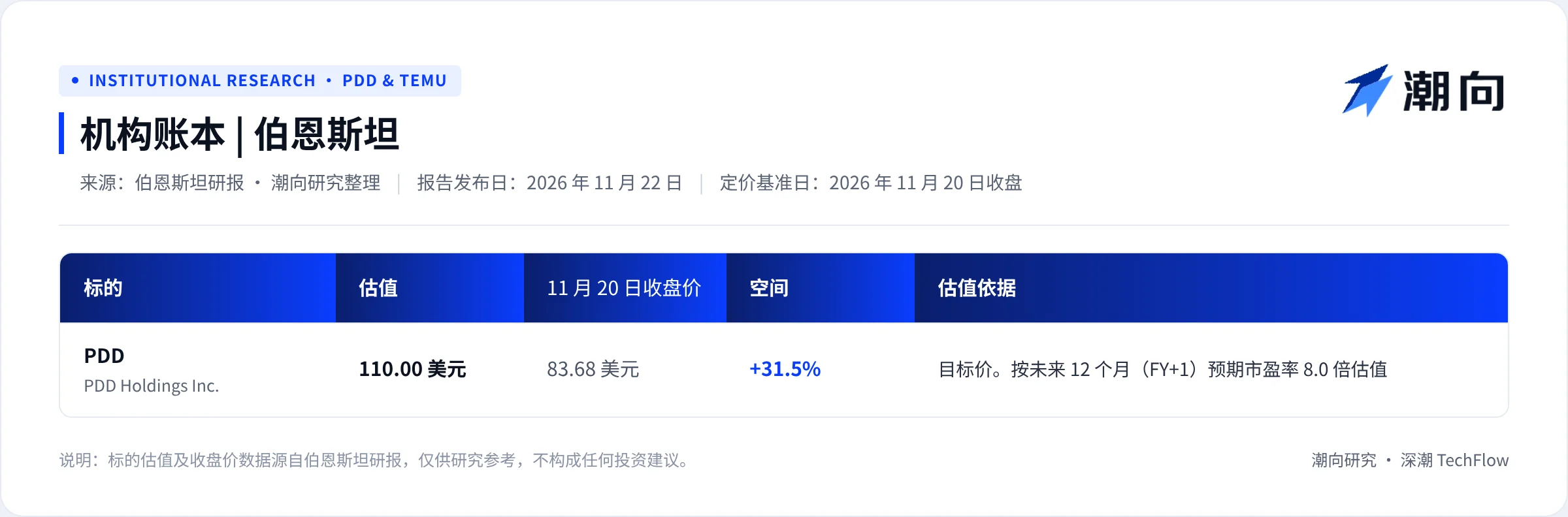
Bernstein also maintained the target price of Pinduoduo at $110.00. Based on the closing price of $83.68 on November 20, 2026, this target price corresponds to a potential upside of 31%.
In the past year, Pinduoduo's stock price has shown weak performance. As of November 20, 2026, Pinduoduo has dropped a cumulative 25.9% over the past 12 months, underperforming the S&P 500 index by 31.6 percentage points. This upgrade in rating marks a reaffirmation by major foreign institutions of the inflection point in Pinduoduo's fundamentals.
Stock Price Stagnation for Four Years, Billions in Overseas Increment Not Priced In
Since the end of 2022, Pinduoduo's stock price has nearly returned to its original point after experiencing extreme fluctuations. At the end of 2022, its cross-border e-commerce platform Temu was still in its early stages.
However, over four years, Temu has grown into a massive business with an annual gross merchandise value (GMV) nearing $100 billion. Bernstein estimates that Temu's GMV is expected to reach $92 billion in 2026.
Meanwhile, Pinduoduo's stock price has long been constrained by a lack of communication and geopolitical regulatory concerns. About a year ago (November 19, 2025), Bernstein downgraded its rating due to slowing growth and management's refusal to communicate with investors.
In the report on November 22, 2026, Bernstein stated that the market's pessimistic expectations for Pinduoduo have been fully reflected in the valuation. Currently, Pinduoduo's stock price corresponds to a forward P/E ratio of only 6.9 times for 2027 (adjusted to 6.8 times), which is the lowest level among the Chinese internet stocks covered by the firm.
Consumption Pressure Continues, Main Site’s Low-Price Mindset Outperforms
Bernstein believes that China's macro consumption environment in 2027 is likely to be similar to that of 2026. In the firm's model assumptions, the growth rate of China's narrow retail sales of consumer goods in 2027 is only 1%, with the overall growth of the e-commerce industry expected to be between 3% to 5%.
Against the backdrop of widespread pressure on consumer budgets, the high cost-performance positioning of Pinduoduo's main site has significant defensive attributes. Compared to fierce competition among peers in the existing markets, Pinduoduo's focus on lower-tier markets and rural infrastructure results in facing less direct competition.
The base effect will also help Pinduoduo show more favorable year-on-year data in the upcoming quarters. After experiencing a low growth cycle from the second half of 2025 to 2026, the revenue growth of online marketing services (OMS) has begun to show signs of recovery in the third quarter of 2026.
Bernstein predicts that Pinduoduo’s domestic main site GMV will achieve a year-on-year growth of 8.6% in 2027, significantly outperforming the overall e-commerce market. As the monetization rate (Take Rate) of the main site stabilizes, online marketing service revenue will also maintain a high single-digit growth.
Additionally, the management's attitude during the earnings call has shown a positive shift. After several quarters of silence in a "waiting and observing" manner, management has resumed substantial communications regarding business details and market conditions, effectively alleviating institutional investors' information anxiety.
Negative Impact of EU and US Regulations Comes to an End, Temu Moves Towards $100 Billion Milestone
In terms of overseas operations, the tariff and package regulatory policies that have troubled Temu in the past two years are gradually becoming clearer. Bernstein points out that with American import regulations stabilizing and European package and customs charging policies taking effect, the global regulatory environment’s marginal impact on Temu has significantly weakened.
Looking back at mid-2025, the sharp fluctuations in US tariff policies forced Temu to suspend local marketing campaigns briefly, causing a temporary decline in user activity in the US market. However, after Temu resumed its campaigns, the US market quickly stabilized and has now become a highly mature "core" market for Temu.
The European market underwent similar growing pains in mid-2026. Affected by new parcel and customs fees, Sensor Tower data shows that Temu's daily active users (DAU) in Europe halved from mid-2026’s peak of over 30 million to around 16.5 million.
However, high-frequency data monitored by Bernstein indicates that Temu's European DAU and session durations have shown signs of stabilization. The firm expects that European customs clearance and tax costs will eventually be passed on to end consumers over time, without triggering similar dramatic fluctuations as experienced in the 2025 US market.
In emerging markets like Latin America and the Middle East, Temu continues to maintain strong expansion momentum. Currently, the Latin American market contributes approximately 15% of Temu's global GMV, and in the Middle Eastern market, Temu's user base has reached parity with local giants such as Amazon and noon.
Overall, Bernstein estimates that Temu's global GMV will grow by 16.3% from $92 billion in 2026 to $107 billion in 2027, and further increase to $120 billion in 2028.
Customer Acquisition Shifts to Retention Driven, Marketing Contraction Releases Profit Flexibility
As Temu reaches critical user scale in major global terminal markets, its growth logic is shifting from "aggressively acquiring new users" to "monetizing existing users."
Data from Sensor Tower shows that Temu's global new app downloads have gradually declined since peaking in 2025, but the platform's 90-day rolling monthly active user (MAU) retention rate has remained stable at over 80%. The highly engaged user base has allowed the platform to significantly reduce external customer acquisition budgets.
Monitoring data from Pathmatics reveals that Temu's global digital advertising spending has decreased after peaking at over $140 million per month in 2024, with average monthly expenditures falling back to the $50 million to $60 million range in the third quarter of 2026.
Due to the dual impact of reduced overseas customer acquisition and adjustments to domestic accounting standards, Pinduoduo Group's overall sales and marketing expense ratio reached around 23.4% in the third quarter of 2026 (estimated based on chart trends), setting a new low since 2024.
In terms of logistics costs, international air freight prices in 2026 remain high, with total freight rates between Shanghai to Los Angeles and New York maintaining in the range of $6 to $8 per kilogram. Bernstein believes that the high oil prices and shipping costs in 2026 set a high baseline for logistics costs, and cost pressures are expected to ease marginally in 2027.
Regarding Temu's profitability, Bernstein asserts that achieving a 1% to 2% operating profit margin depends entirely on management's balance between "profit release" and "growth investments." The company will continue to invest in its self-operated business (such as "new brand" related supply) and logistics infrastructure at home and abroad.
Revenue and Profit Show Robust Dual Growth, 2027 Revenue Forecast Up to 479.3 Billion Yuan
Based on the dual drivers of steady performance at its main site and Temu's expansion, Bernstein has updated its financial forecast model for Pinduoduo for the next three years.
On the revenue side, Bernstein predicts Pinduoduo's total revenue for 2026 will be 449.03 billion yuan, a year-on-year increase of 4.0%. Total revenue for 2027 is expected to reach 479.29 billion yuan, a year-on-year increase of 6.7%; and in 2028, it is forecasted to grow to 510.84 billion yuan, a year-on-year increase of 6.6%.
On the profit side, Bernstein estimates that Pinduoduo's Group Non-GAAP operating profit in 2026 will be 110.93 billion yuan, a year-on-year increase of 8.2%, corresponding to a profit margin of 24.7%. The Non-GAAP operating profit for 2027 is projected to grow by 6.7% to 118.31 billion yuan, with the profit margin remaining at 24.7%.
By 2028, as scale effects become more pronounced, Non-GAAP operating profit is expected to jump by 18.6% to 140.30 billion yuan, with the profit margin increasing to 27.5%.
In terms of net profit attributable to the parent company, Non-GAAP net profit for 2026 is anticipated to be 102.75 billion yuan, recovering to 123.46 billion yuan in 2027, and further reaching 143.61 billion yuan in 2028. The corresponding Non-GAAP earnings per ADS (EPADS) for 2026 to 2028 are estimated to be 69.52 yuan, 81.80 yuan, and 92.70 yuan respectively.
Cash on Hand Exceeds 500 Billion, Shareholder Returns Potential Revaluation Option
Pinduoduo's balance sheet still maintains a very high margin of safety. By the end of 2025, the company's cash and cash equivalents reached 422.31 billion yuan, with no long-term or short-term interest-bearing debts.
Bernstein's model forecasts that by the end of 2026, Pinduoduo's cash and cash equivalents will increase to 504.33 billion yuan, further rising to 634.64 billion yuan by the end of 2027, while maintaining a zero interest-bearing debt status.
Regarding the market's keen focus on substantial cash dividends or stock repurchase issues, Bernstein maintains restraint in its baseline scenario. The firm believes that, at this stage, discussions regarding shareholder returns are likely to remain theoretical, and the company is not expected to easily change its capital allocation habit of not paying dividends or repurchasing shares in the short term.
However, Bernstein simultaneously emphasizes that the current P/E ratio of 6.9 times for 2027 completely does not account for any anticipated shareholder returns, and should management show any positive movement regarding dividends or repurchases in the future, Pinduoduo's stock price is likely to experience a significant valuation re-rating.
In the current environment where global tech stocks are affected by fluctuations in the semiconductor cycle and the Chinese internet sector is facing multiple headwinds, Pinduoduo's low valuation combined with robust cash flow offers investors a rare defensive growth allocation option.
Institutional Ledger
Fixed Note on the Research Report Content (Brokerage Opinion, Not Tide Trend Research Opinion)
This article is a整理与解读 of third-party brokerage research reports by Tide Trend Research. The ratings, target prices, earnings forecasts, and related judgments quoted in this article represent the views of the brokerage's analysts only, reflecting the positions of their respective institutions and not representing the views of Tide Trend Research, nor does it constitute any investment advice.
The market has risks, and decisions should be independent. This article should not be used as the basis for buying or selling any securities.
免责声明:本文章仅代表作者个人观点,不代表本平台的立场和观点。本文章仅供信息分享,不构成对任何人的任何投资建议。用户与作者之间的任何争议,与本平台无关。如网页中刊载的文章或图片涉及侵权,请提供相关的权利证明和身份证明发送邮件到[email protected],本平台相关工作人员将会进行核查。