
Written by: Michael Egorov, Founder of Curve Finance and Yield Basis
Translated by: Chopper, Foresight News
For a long time, people have had a natural approach to on-chain foreign exchange: moving from top to bottom. Banks tokenize currencies, large financial institutions move their foreign exchange businesses on-chain, and institutional liquidity naturally follows.
What is the end result? On-chain foreign exchange will slowly grow until it resembles traditional foreign exchange. But things might not happen this way.
In fact, there are more and more signs indicating that on-chain foreign exchange will develop in the completely opposite direction: from bottom to top.
Stablecoins like the Brazilian digital currency BRZ or licensed institution Monerium's EURe can be redeemed quickly on-chain and easily transferred from digital wallets to bank accounts. DeFi users exchanging them in decentralized exchange pools create quite healthy trading activity.
This type of market has grown in real-time next to a very practical need: direct conversion between digital currencies and fiat currencies.
This is just an early example, but the use cases and demand are already real enough. Data from Keyrock shows that most on-chain stablecoin trading related to emerging market currencies falls between $1,000 and $10,000. Compared to institutional scales, such amounts are small, but that is precisely where the key lies.
It illustrates that the market is developing towards "on-chain foreign exchange services for actual payment needs," rather than just serving big players.
"Small" Does Not Mean "Useless"
Individuals and businesses need to transfer funds between different currencies, and they are obviously unwilling to wait for large traditional financial institutions to move their foreign exchange businesses on-chain.
A common assumption about on-chain foreign exchange is that a market must first have enormous liquidity to be truly useful. However, this does not entirely hold true in practice.
As long as there are people who need to exchange dollars for euros, Swiss francs, or other currencies, even if the pool is small, these transactions can be handled and serve real economic purposes.
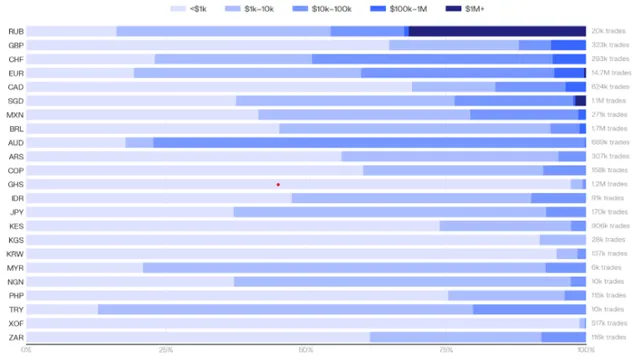
Stablecoin DEX trading volume. Source: Keyrock Research
On-chain foreign exchange does not need to expand first to be useful; it will instead develop because there are real users.
In fact, stablecoins are following this path. They originated from a relatively niche use case in cryptocurrency, and today we know they are part of a broader financial infrastructure.
Recent data shared by Chainalysis shows that cross-border activities involving stablecoins have grown nearly 80% year over year. This nearly 80% growth in just one year proves that demand and activity are continuously rising. There is no reason for on-chain foreign exchange not to follow the same path.
Users Do Not Care How Big the Market Is
This is the most practical side of the issue. On-chain foreign exchange clearly cannot quickly compete directly with the global foreign exchange market; that will take several more years. But a more interesting question is: whose problems can it solve, especially for those who put their money on-chain.
Today, you can exchange dollar stablecoins for euro stablecoins or other alternatives on-chain and easily use those funds for payments. In fact, doing this is often cheaper than using traditional international bank transfers.
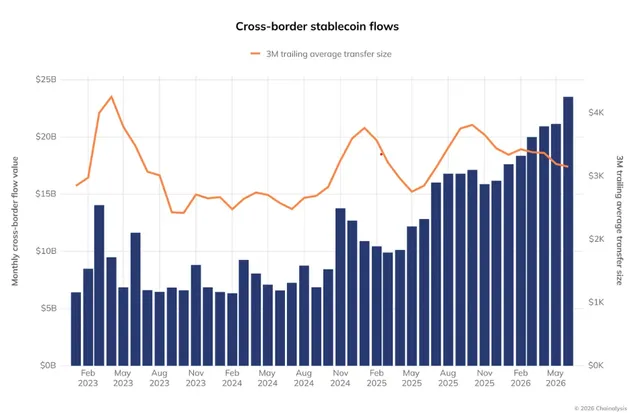
Cross-border stablecoin flow. Source: Chainalysis
On-chain foreign exchange follows the same logic. A fintech company or crypto card company does not need to rebuild the entire institutional market; it only needs to efficiently transfer customers' funds between currencies.
When someone wants to pay in another currency, doing the exchange adds costs to the business, as it typically goes through Visa or Mastercard, which charge about 1% in fees.
In this regard, on-chain exchanges are a better option. If a user's money is already on the blockchain, exchanging dollar stablecoins for euro stablecoins can be done directly, without the need for any additional intermediary, making it faster and cheaper.
Banks will likely still be important "entrances" and "exits," meaning places where digital money interacts with the real world. Issuing and redeeming local currency, accessing bank accounts, handling compliance, etc., will be areas where banks continue to lead.
However, when money is truly on-chain, many traditional "intermediary steps" can be eliminated directly, resulting in greater efficiency.
From the perspective of a user who just wants to transfer money out with as few complications as possible, this is a very positive improvement. Whether the overall market is large or small is irrelevant in this scenario.
Demand is Only Part of the Problem
Of course, there is a "but."
Real demand is crucial, but it will not magically solve liquidity issues. The challenge is not just creating an EUR/USD or CHF/USD pool but making them economically sustainable.
This is precisely where automated market makers can play a role. Traditional market makers may feel that providing liquidity for a small foreign exchange market is not worthwhile, as trading volume may not even cover operating costs.
Automated liquidity changes this equation because software can continuously provide liquidity without requiring market makers to manage each trade manually.
Imagine two dollar stablecoins, USDC and Tether. In the eyes of traditional exchanges, exchanging one dollar stablecoin for another may seem like a rather boring business, as both are worth around $1 with little price volatility for trading.
However, if there is indeed a demand for such swaps, automated market makers can create a pool for users to exchange directly. Each transaction gives liquidity providers a small fee, and when enough people need the same exchange, a market that seems unattractive to traditional market makers can persist.
This adoption is certainly not explosive growth, but slow, natural growth is not a bad thing either. Sometimes new markets only need a small group of people who "cannot solve their problems with existing infrastructure." If these users can make the market economically viable, liquidity will grow accordingly.
免责声明:本文章仅代表作者个人观点,不代表本平台的立场和观点。本文章仅供信息分享,不构成对任何人的任何投资建议。用户与作者之间的任何争议,与本平台无关。如网页中刊载的文章或图片涉及侵权,请提供相关的权利证明和身份证明发送邮件到[email protected],本平台相关工作人员将会进行核查。