1. Will the Binance hacking incident make traditional financial markets more cautious about entering the cryptocurrency space, further depleting the already insufficient liquidity in the crypto sphere? Various security issues have emerged this year, involving hardware wallets, hot wallets, and centralized exchanges. Will traditional large funds, which are particularly sensitive to security concerns, slow down their pace?
Various security incidents this year, including the Binance hack, will undoubtedly lead to negative perceptions of the crypto ecosystem in the short term and may cause hesitation among external capital toward the crypto ecosystem.
However, in the long run, the impact of these events will dissipate. What will truly influence external funding entering this ecosystem, in my opinion, is whether the ecosystem can generate new business models and practical applications—this is what I have been looking forward to over the years and is also a key criterion for my assessment of the long-term trend of the entire crypto ecosystem, especially regarding the long-term price performance of crypto assets.
Moreover, I always believe there is no need to pay too much attention to the short-term movements of external funds. The vast majority of funds (whether retail or institutional, whether internal or external) are profit-driven and have never been the key force or fundamental motivation in driving the development of a technological ecosystem.
Therefore, I generally do not pay attention to public opinion, and I am currently not too concerned about the movements of large capital. Their inherent short-term profit-seeking nature dictates that once the crypto ecosystem becomes profitable, their speed of entry will surpass anyone else's, and their speed of withdrawal will be faster than flipping a book.
I assess the core driving force and source of power in an ecosystem by looking at whether the team and core strengths are still diligently working and sitting on the sidelines during the ecosystem's lowest and most torturous moments. As long as these forces remain, innovation will accumulate, and the foundation will be solidified; one day, new flowers and fruits will surely reappear.
As long as this point does not change, I am not worried at all.
In the current crypto ecosystem, I am very satisfied with the situation of these core strengths, which also reassures me.
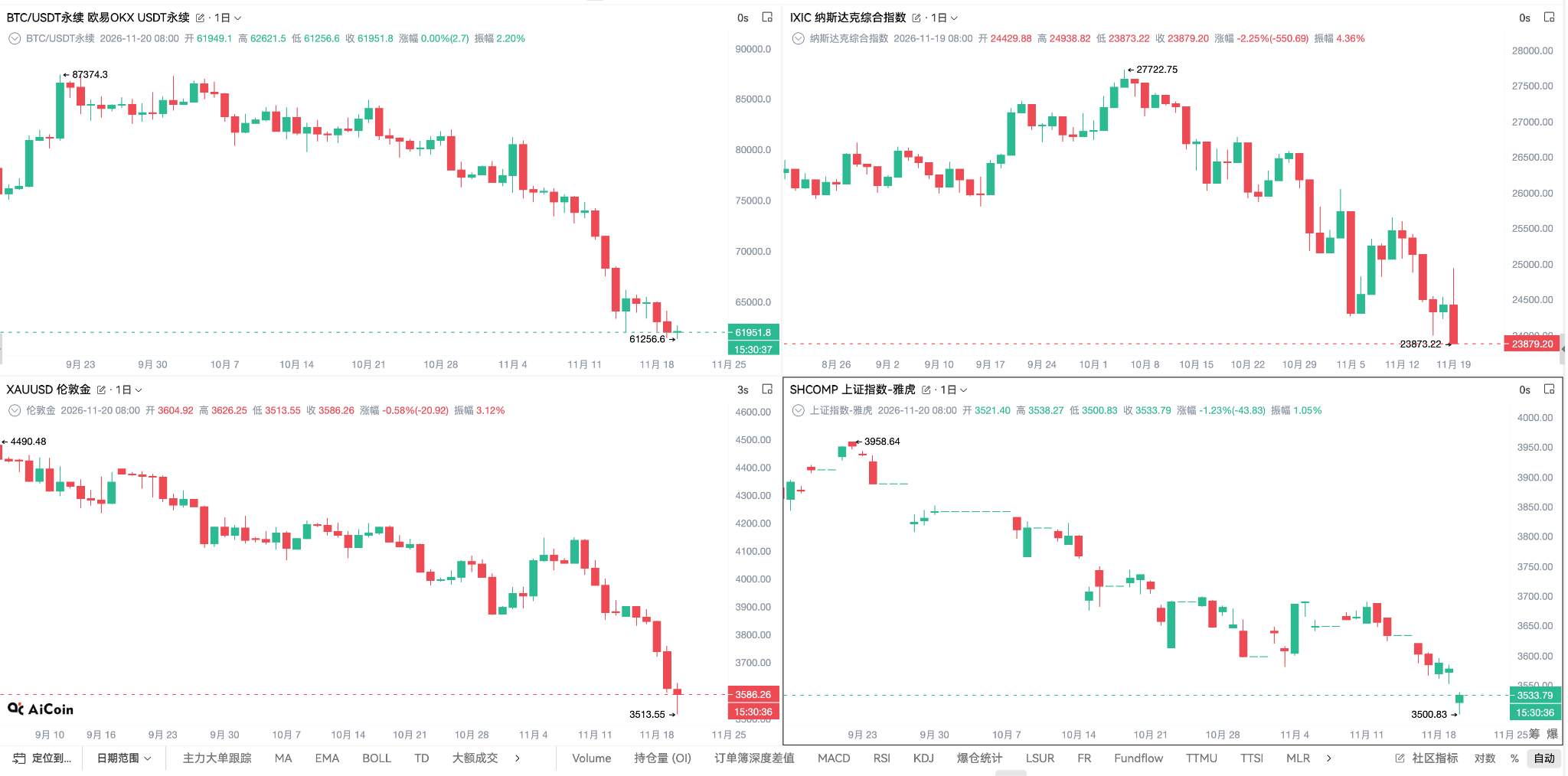
2. I remember you mentioned in a previous article that the A-shares need to reach 4000 before the end of the year, or else it would be dangerous. Now it is November, but the A-shares have dropped to 3600 points, and retail investors are losing a lot.
That was not an article I wrote this year, but one I wrote last year, and I published similar articles several times last year. You can check my article records from last year.
What I stated last year was that the Shanghai Composite Index must reach at least 4000 points before the end of last year. However, reaching 4000 points was merely the least bad scenario; ideally, it should reach 6000 points by the end of last year to be of any effect, and naturally, the higher, the better.
Indeed, the Shanghai Composite Index did reach 4000 points before the end of last year, but it did not reach 6000 points. As for the current situation, how the economy is developing, and how individuals perceive the macro and micro aspects, I believe everyone has their own authentic feelings without needing to look at various data.
The comment mentioned that retail investors are losing significantly.
I guess most of those who have sustained such heavy losses are those who bought individual stocks or did not understand valuations in the technology and innovation sector.
If they had purchased large indices, such as the Shanghai Composite, CSI 300, or various comprehensive indices like the CSI A500, they would not have experienced such severe losses—because even from the highest points, the most significant drop in these indices is just slightly over 20%.
If the losses are due to individual stocks or tech innovation, I have seen many such examples in various stock groups, and these participants often complain:
They say the A-shares are "when the index rises, individual stocks do not; when the index falls slightly, individual stocks fall significantly," and then group members start to disclose their heavily losing individual stocks.
I often see such complaints. Since we cannot change the broader environment, I think it is better to find reasons within oneself:
If these participants see for years that the individual stocks they invested in far outperform the index, why do they repeatedly insist on their stock selection?
If one is good at stock picking, their individual stocks would have outperformed the index long ago; how could they continually complain about the poor performance of the stocks they selected?
If one clearly knows their stock-picking ability is poor, why do they insist on selecting stocks rather than just buying indices?
Or why not simply and honestly put the money in the bank for a fixed deposit?
免责声明:本文章仅代表作者个人观点,不代表本平台的立场和观点。本文章仅供信息分享,不构成对任何人的任何投资建议。用户与作者之间的任何争议,与本平台无关。如网页中刊载的文章或图片涉及侵权,请提供相关的权利证明和身份证明发送邮件到[email protected],本平台相关工作人员将会进行核查。