Author: Ding Mao, 36Kr
Editor: Zhang Fan, 36Kr
Anthropic is set to officially land on the US stock market on November 19.
According to the final issuance pricing, the company is issuing 980 million shares at a price of $83 per share, raising a total of $81.34 billion, corresponding to a fully diluted valuation of about $1.49 trillion.
However, compared to the high expectations of the market before, Anthropic's final listing price has been somewhat restrained. At the beginning of October, the market discussed its valuation potentially reaching $2 trillion, but the actual issuance valuation was adjusted down by about 25% from the peak.
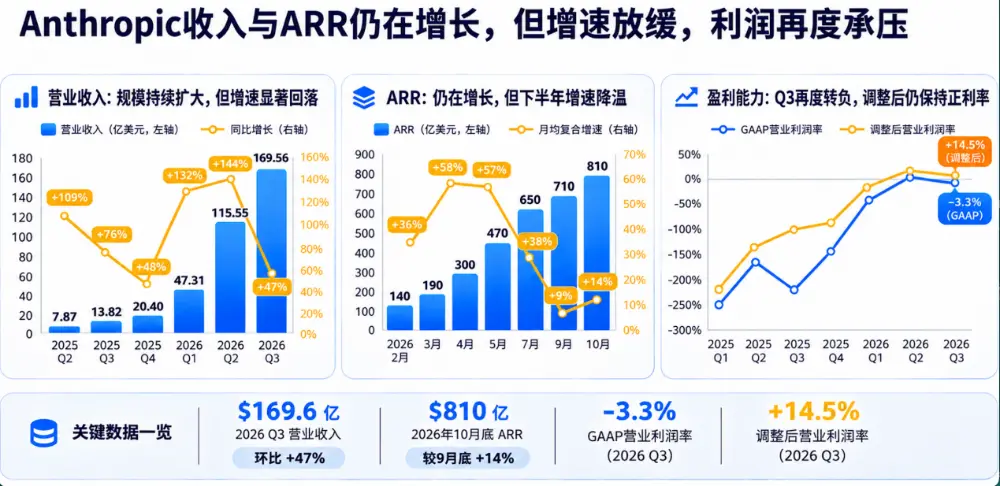
The valuation adjustment is influenced by both fundamental pressures and changes in the market environment. On one hand, an increase in short-term computing power investments in the third quarter pushed the company back into operational losses, with quarterly revenue growth rates dropping from 144% in the second quarter to 47%. Since the second half of the year, the ARR growth rate has significantly slowed, prompting the market to reassess the sustainability of its high growth; on the other hand, since November, factors such as the US midterm elections and leadership changes at Nvidia have led to continuous adjustments in the US stock market, resulting in a decrease in risk appetite for the AI sector, which has also exerted pressure on the company's valuation pricing.
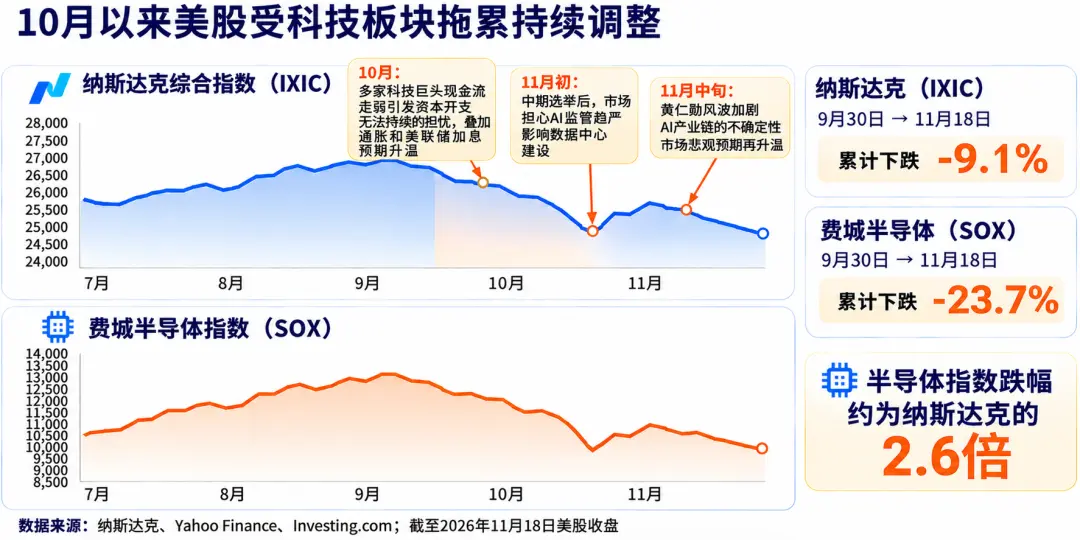
Even though the valuation has declined, the market's enthusiasm for subscriptions has not diminished. Anthropic's final issuance price remains above the previous upper limit of the inquiry range of $70-78, and the issuance scale has expanded from 825 million shares to 980 million shares. The market's chase has even been reflected in the grey market trading ahead of the official listing. According to Bloomberg, the related over-the-counter transactions and derivatives pricing for Anthropic prior to the official listing commanded a premium of about 20%-26% over the issuance price, peaking at around $105.
Industrial capital's bet on Anthropic is equally aggressive.
In addition to the public offering, industry giants such as Google, Nvidia, AMD, Broadcom, Micron, Microsoft, and TSMC also participated in a total of $26 billion in directed placements. Among them, Google and Nvidia each subscribed for $10 billion, AMD for $2.5 billion, Broadcom, Micron, and Microsoft each $1 billion, and TSMC $500 million. Together with the public offering, Anthropic's total financing this time has reached about $107.34 billion, surpassing SpaceX to become the largest IPO by fundraising scale in US stock market history.
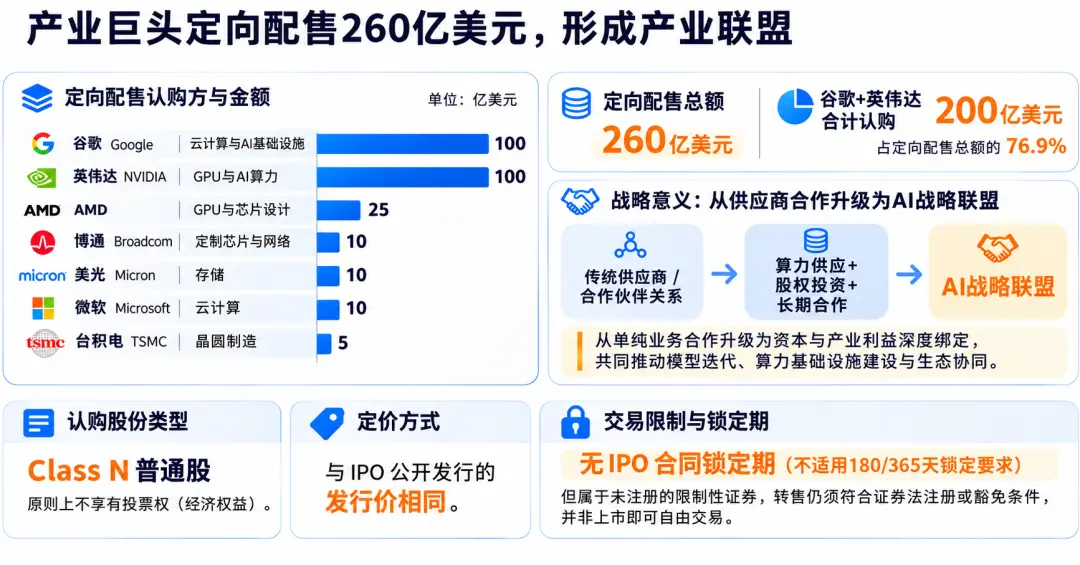
This means that Anthropic's listing has transformed from a simple capital market financing into a deep alliance around the AI industry chain. From GPUs, chip design, storage, wafer manufacturing to cloud computing, key giants in the industry have established deep strategic cooperation with Anthropic through equity investment. For Anthropic, this not only provides huge financial support but also helps to enhance the stability of its future computing power supply, infrastructure construction, and technology cooperation.
It is worth noting that while bringing in huge industrial capital, Anthropic has also ensured the strategic dominance of the founding team through a special governance structure.
The recent departure of Jensen Huang has made the market more sensitive to the stability of management and strategic continuity in AI companies. Especially for large model companies that are still in a rapid expansion phase, if the ownership is dispersed and the founding authority is weakened after going public, it will undoubtedly affect the continuity of long-term strategic investments.
In contrast to Nvidia's passive situation, before listing, the seven co-founders controlled 50.1% of the voting shares of the company through Class F special stock, while the long-term benefit trust holds the power to appoint and remove the majority of board members. This means that even if a large number of industrial giants are introduced or ownership becomes further dispersed after the IPO, the founding team can still maintain a majority voting power, reducing external shareholders' interference in the company's long-term operational decisions, and laying the foundation for the continuity of strategy during high growth periods.
01 What incremental information is available in fundamentals?
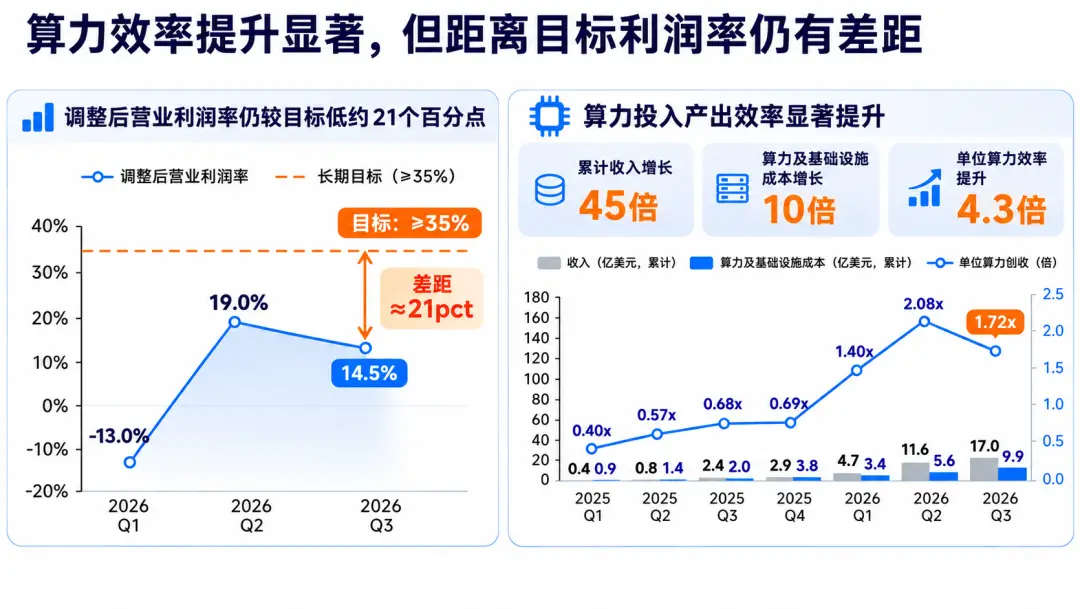
In the revised prospectus, Anthropic proposed a long-term profit target of achieving an adjusted operating profit margin of over 35%, but did not specify a timetable. Moreover, this margin does not account for ongoing costs such as equity incentives, and does not equal GAAP profit.
From the current performance perspective, in the third quarter of 2026, Anthropic's adjusted operating profit margin was 14.5%, leaving about a 21 percentage point gap from the long-term target of 35%. However, the company's efficiency in terms of computing power investment output has significantly improved. From Q1 2025 to Q3 2026, quarterly revenue increased by more than 45 times, while computing power and infrastructure costs only increased by about 10 times, equivalent to a more than fourfold increase in revenue generated per dollar of computing cost.
Despite this, to achieve the long-term profit target, Anthropic still needs to meet three conditions: (1) Reduce the computing power and infrastructure cost ratio to 45%-50%; (2) Reduce sales and marketing and partnership cost ratio to 7%-10%; (3) Reduce adjusted personnel and other cost ratio to 7%-10%.
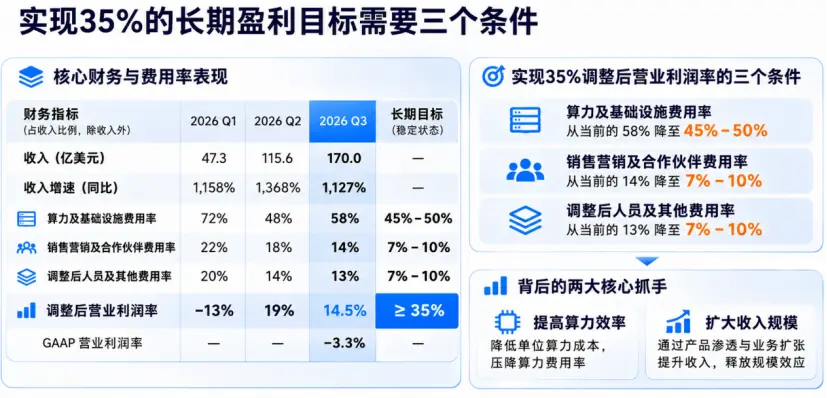
The core behind this is twofold: first, to continuously improve computing efficiency and reduce unit costs; second, to expand revenue scale and release operational leverage through economies of scale.
In terms of computing efficiency, the previous article "How does Anthropic prove that computing power can pay off?" has already introduced the company's cost reduction paths through multi-chip strategies and computing power multipliers, and will not be repeated here.
What is noteworthy this time is how Anthropic plans to enlarge its revenue scale in the future? According to the disclosed roadshow, future growth strategies can be categorized into two points:
First, the value extraction from existing customers. As Claude extends from programming to office and other scenarios, Anthropic promotes single customer spending growth through "platform + product" cross-selling. As of the end of September, the company’s net revenue retention rate reached 900%; most enterprise customers are using the platform and at least one product simultaneously, a significant increase from 30% in Q4 2025. At the same time, the company has covered over 50% of the Fortune 500 companies, but spatially, these customers' spending on Claude represents less than 0.1% of their total expenses. Assuming this expands to 1% in the future, it still indicates a tenfold penetration potential.

Second, the expansion of business boundaries. Anthropic is extending from programming, knowledge work into more fields such as cybersecurity, life sciences, and embodied intelligence. On the eve of its listing, it showcased products like Claude Cowork and Claude Meetings that compete with Microsoft, while also releasing Claude Fable 5.2 to demonstrate robotic control capabilities and compare performance with cutting-edge models like GPT-6 Astra.
Although these businesses still belong to long-term options, they narratively pull the company from an independent AI lab towards a "general AI platform" spanning models, programming, office, research, and even the physical world, opening up imaginative space for the future.

In summary, Anthropic's profit path has gradually become clear: relying on model leadership, product matrix, and scenario expansion to drive revenue growth, and then releasing profits through computing efficiency cost reduction and economies of scale.
However, there is a harsh precondition behind this: model leadership, revenue growth, and computing efficiency improvement must be realized synchronously to form a sustainable positive cycle, but currently, this logic has not formed a closed loop. Whether new scenarios can replicate the high growth of programming remains to be seen; while computing efficiency has improved, it is easily disturbed by new computing investments, with the unit computing revenue dropping from 2.08 times to 1.72 times in the third quarter; more importantly, there is a huge gap between the existing revenue scale and long-term computing commitments, and the time frames are significantly misaligned, making self-sustaining cash flow insufficient to support computing expansion and still relying on external financing.
In other words, Anthropic has already validated the possibility of high growth and phase profitability, but has not yet completed the closed loop from revenue, profit release to cash flow self-sufficiency. This means that before achieving long-term profit goals, the company still needs to navigate a lengthy transitional period of maintaining high growth alongside negative free cash flows and sustained pressure from large computing investments.
02 How will the first day play out?
Since Anthropic's story is clear, how will its first day performance unfold after landing in the secondary market?
According to statistics from the University of Florida, in traditional IPOs in the US from 1980 to 2025, only 16.5% of the stocks closed below their issuance price on the first day, while 13% remained flat. This means that over the past forty years, more than 70% of IPOs in US stocks achieved positive returns on the first day.
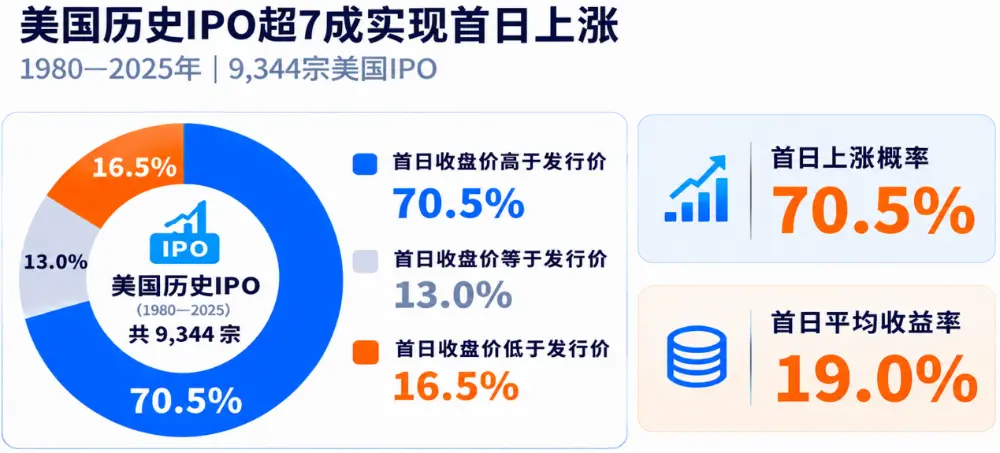
In the most notable "super IPO" group, the "undefeated on the first day" rule is even more pronounced. Statistics show that in the top ten super IPOs in US stock history, the winning rate on the first day reached 90%; except for Uber, which recorded a slight dip on its first day, all other nine giants achieved price increases, most recording double-digit increases.
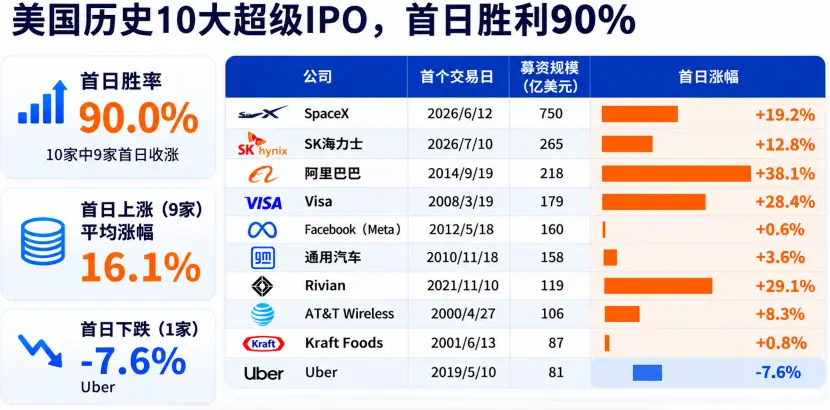
This phenomenon results from the US stock issuance mechanism and institutional games. Large IPOs usually form an issuance price through inquiries and institutional placements, and underwriters aim to balance the issuance valuation with secondary market demand, leaving a certain discount space in pricing to retain buyer premiums for post-listing trading; at the same time, super IPOs are scarce, and the limited initial float in the early listing stage easily creates a supply-demand imbalance driven by concentrated buying. Even if market fluctuations occur after opening, the lead underwriters can also utilize mechanisms like the “green shoe mechanism” to mitigate short-term volatility.
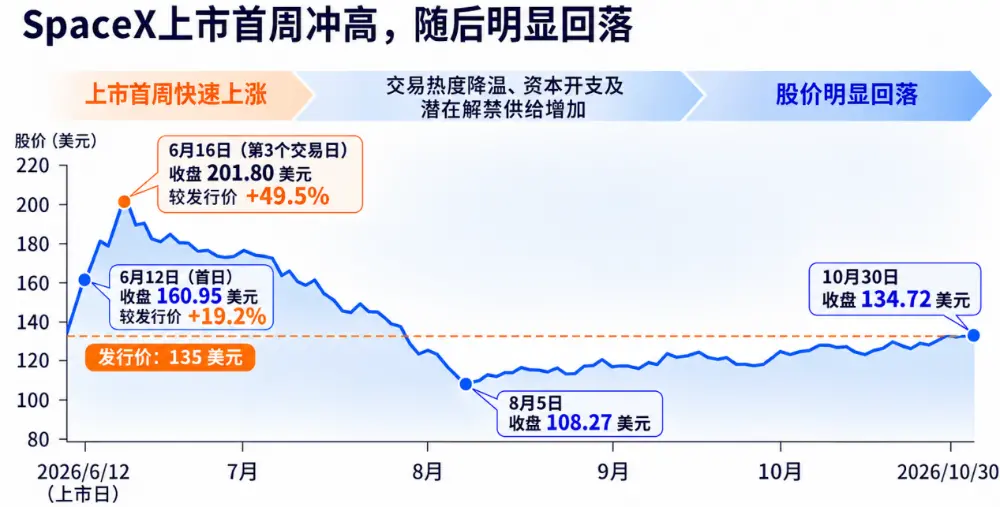
A typical example is SpaceX, which was listed in June. At that time, SpaceX was issued at $135, soaring 19% on the first day and spiking about 50% on the third trading day compared to the issuance price; only after the trading heat gradually cooled down and potential unlocked supply increased did the stock price fall.
Looking back, the initial surge after its listing did not entirely rely on fundamental revaluation and emotive drives; the extremely high retail participation, relatively tight initial float, and the passive fund demand from index inclusion expectations all played a role in driving it up.
Nowadays, Anthropic is replicating a similar listing ecosystem.
According to reports, Anthropic's initial public offering shares account for approximately 6% of the fully diluted equity. Meanwhile, it is expected to be included in at least six major indices such as Nasdaq 100 within 5-15 trading days after its listing. Based on institutional estimates, index funds could bring about $19 billion in passive allocation demand, equivalent to 23% of the public offering share scale. This means that ordinary investors, index funds, and arbitrage funds of early layouts could all potentially create a buy-side resonance during the early stage of listing.
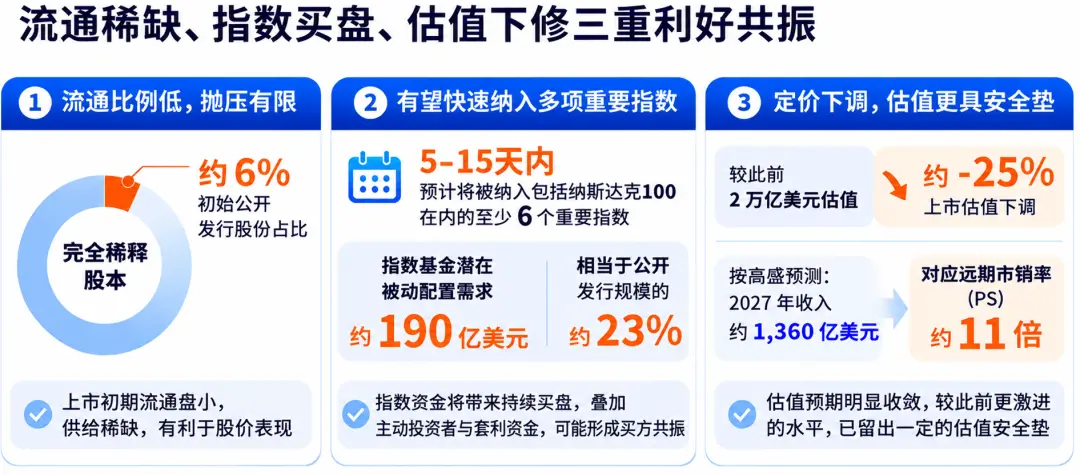
Additionally, Anthropic's issuance pricing also created a safety margin for its first-day performance. Compared to the market-discussed $2 trillion valuation, the listing valuation has been somewhat constrained. Meanwhile, assuming an ARR of $810 billion as of October, the corresponding price-to-sales ratio is 18 times; if based on Goldman Sachs' estimate of the company's revenue of about $136 billion in 2027, the corresponding forward price-to-sales ratio is about 11 times, which also leaves a certain valuation safety cushion compared to previous market expectations.
03 Who bears the risks?
Although it is highly probable that the first day will continue the "undefeated" tradition, it does not mean that Anthropic's landing in the secondary market will be without concerns.
On the contrary, in the early stages of listing, the market is trading on the rarity of technology giants and the crowdedness of short-term chips. Just as SpaceX fell back after surging 50% in the first three trading days in June, once the capital frenzy recedes, the market will start to consider the real risks facing Anthropic.
The first level of risk is the β risk brought to the AI industry chain by the macro policy cycle. As the US midterm elections settle, uncertainties around AI regulation, approval of large data center construction, and subsidies for computing infrastructure are heating up. Before specific regulatory details are established, the market tends to trade on the most pessimistic expectations in advance. This means that even if Anthropic's own operations do not change, increased volatility in the AI sector may still drag down post-listing stock performance.
The second level of risk is whether large models are a good business. Anthropic's prospectus proves that large models can make money, but it does not provide an answer to the more concerning question for investors of whether this is a good business.
Currently, the company's revenue growth is still insufficient to absorb the expanding computing spending commitments, and its own funds cannot cover the huge computing procurement commitments. As of the end of September, the company's computing commitments have exceeded $900 billion, with an expected payment of $70.7 billion in the next 12 months, while cash, cash equivalents, and short-term investments during the same period were only $131.8 billion. In other words, long-term computing commitments are equivalent to 6.8 times the current cash reserves, with future payments accounting for 54% of cash reserves.
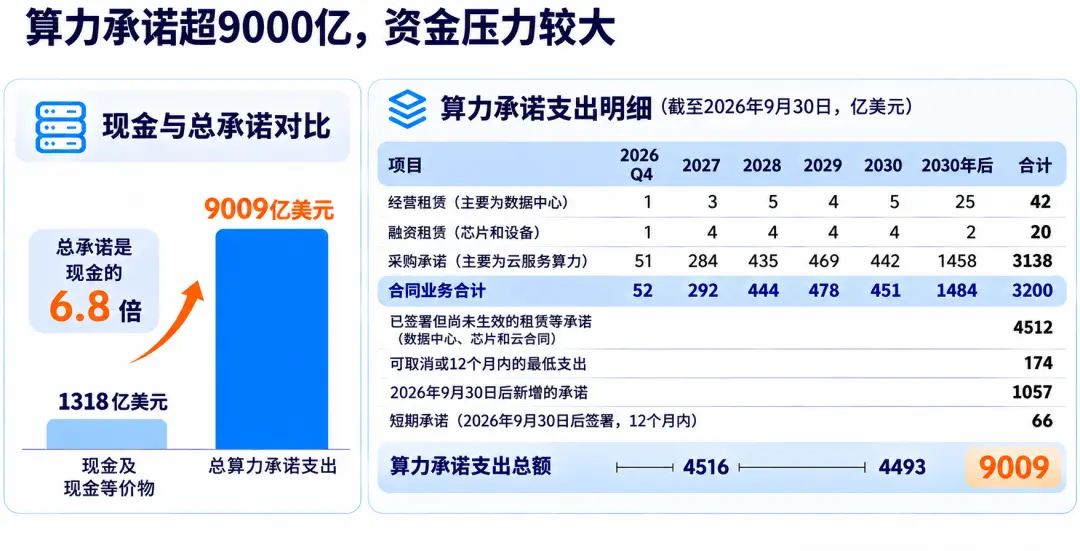
In other words, even if future revenue maintains high growth, the company will still face tremendous financial pressures. This is also a key reason why institutions like Goldman Sachs predict that the company's free cash flow will remain negative until 2030.
At the same time, even if economies of scale can improve computing efficiency and enhance the profit curve, the company's cost optimization is not monotonously decreasing. In the third quarter, due to increased short-term computing procurement, the computing cost ratio rebounded to 58.2%, causing GAAP operating margin to go negative again, indirectly indicating that its profitability is not stable.
Therefore, the expectations of institutions for the company’s high growth are largely based on the linear assumption that the financing environment remains stable, models are leading, and that computing investments can drive revenue growth. If in the future the financing environment tightens, or if computing investments do not yield, the positive cycle of "computing expansion - model leadership - revenue growth" will be broken. Against a backdrop where high valuations have already reflected part of the high growth, the probability of the company falling into a "Davis Double Whammy" is also increasing.
Moreover, it is worth noting the chip game behind the super IPO.
From the trading arrangements, this IPO plans to leave 15%-20% of the allocation for retail investors. Referring to SpaceX's issuance trend, significantly increasing retail participation has become the new normal for large tech company listings.
However, lowering the thresholds for retail participation does not mean pricing equality. In the real game, institutional investors not only have information transparency and pricing power but also anchor placements in the primary market to acquire chips at relatively favorable issuance prices; in contrast, most ordinary investors can only rush into the secondary market to buy at inflated prices during the most fervent market sentiment.
This increases the probability of the "winner's curse": the hotter the deal, the higher the retail participation, and the more intense the competition for subscriptions in popular IPOs, the easier it is for the mid- to long-term performance post-listing to be unsatisfactory. Because good companies do not necessarily mean good stocks; stock trading also heavily depends on the timing and cost of purchases, aside from the company's growth prospects. When everyone thinks they’ve "snatched up a scarce asset," statistically, this can well be the moment they are most willing to pay the highest premium.
In other words, the dividends released by a stock's price increase on the first day of the IPO are never evenly shared among all participants. Institutional investors enjoying the privilege of low-price allocations already have a safety cushion, but retail investors chasing high premiums in the secondary market under conditions of information asymmetry are bearing the majority of the downside risks post-listing.
From this perspective, increasing the proportion of retail allocations broadens the reservoir of super IPOs, helping them successfully complete their listings, but it also exposes more ordinary investors to high volatility risks.
Additionally, it is interesting that while Anthropic paints a picture of high growth and high profitability in the trillion-dollar blueprint for the next decade, the seven co-founders collectively cashed out about $1.96 billion during the IPO phase. Although the proportion is manageable, it similarly serves as a wake-up call for investors.
Beyond the spotlight, what perhaps deserves the market’s attention is who ultimately pays for this trillion-dollar IPO once the first-day profit effect fades and passive fund buying retreats.
免责声明:本文章仅代表作者个人观点,不代表本平台的立场和观点。本文章仅供信息分享,不构成对任何人的任何投资建议。用户与作者之间的任何争议,与本平台无关。如网页中刊载的文章或图片涉及侵权,请提供相关的权利证明和身份证明发送邮件到[email protected],本平台相关工作人员将会进行核查。


