Freezing hackers' money relies on the voluntary actions of a few companies.
Written by: Jon Reiter
Translated by: Chopper, Foresight News
After Binance experienced a hack exceeding $6 billion, several centralized platforms quickly took action to freeze assets, trying to avoid losses for users and exchanges. Ironically, digital asset holders can only rely on a handful of traditional companies to protect their assets. This also raises a thought-provoking question: how can these platforms occasionally use discretion to safeguard assets align with their usual laissez-faire attitude towards sanctions and minor hacking incidents?
These questions are interesting. However, this article will explore a perplexing issue within this debate: would the outcome of the Binance theft have been different if the Clarity Act had been in effect at that time? Of course, the Act has not been passed, and its chances of passing in the short term are slim. Yet, it is still worth speculating on how this legislation might operate. This is a hypothetical exercise with reference value. The legal system cannot conduct double-blind controlled experiments, so such thought experiments are the best method available to us.
First, let's look at the public statements of two individuals with entirely different positions. Senator Cynthia Lummis, a supporter of the crypto industry, and Amanda Fischer, the policy director and COO of Better Markets, who holds an anti-crypto stance. The two engaged in a fierce public debate, and we will first quote their statements before breaking them down.
Perspectives
The day after the hack, Lummis publicly stated: "Yesterday, hackers stole over $6 billion from Binance in less than 4 hours, marking the largest theft in history. The Clarity Act could provide legal protections for crypto businesses, enabling them to freeze suspicious transactions the moment law enforcement requests it. Every minute of delay could mean permanent loss of funds."
Fischer quickly rebutted, claiming Lummis's statement was inaccurate, citing a passage from the original text of the Act: "This statement is incorrect. The Clarity Act requires stablecoin issuers to execute freezes based on court orders. For relevant terms regarding exchanges, see section (1)."
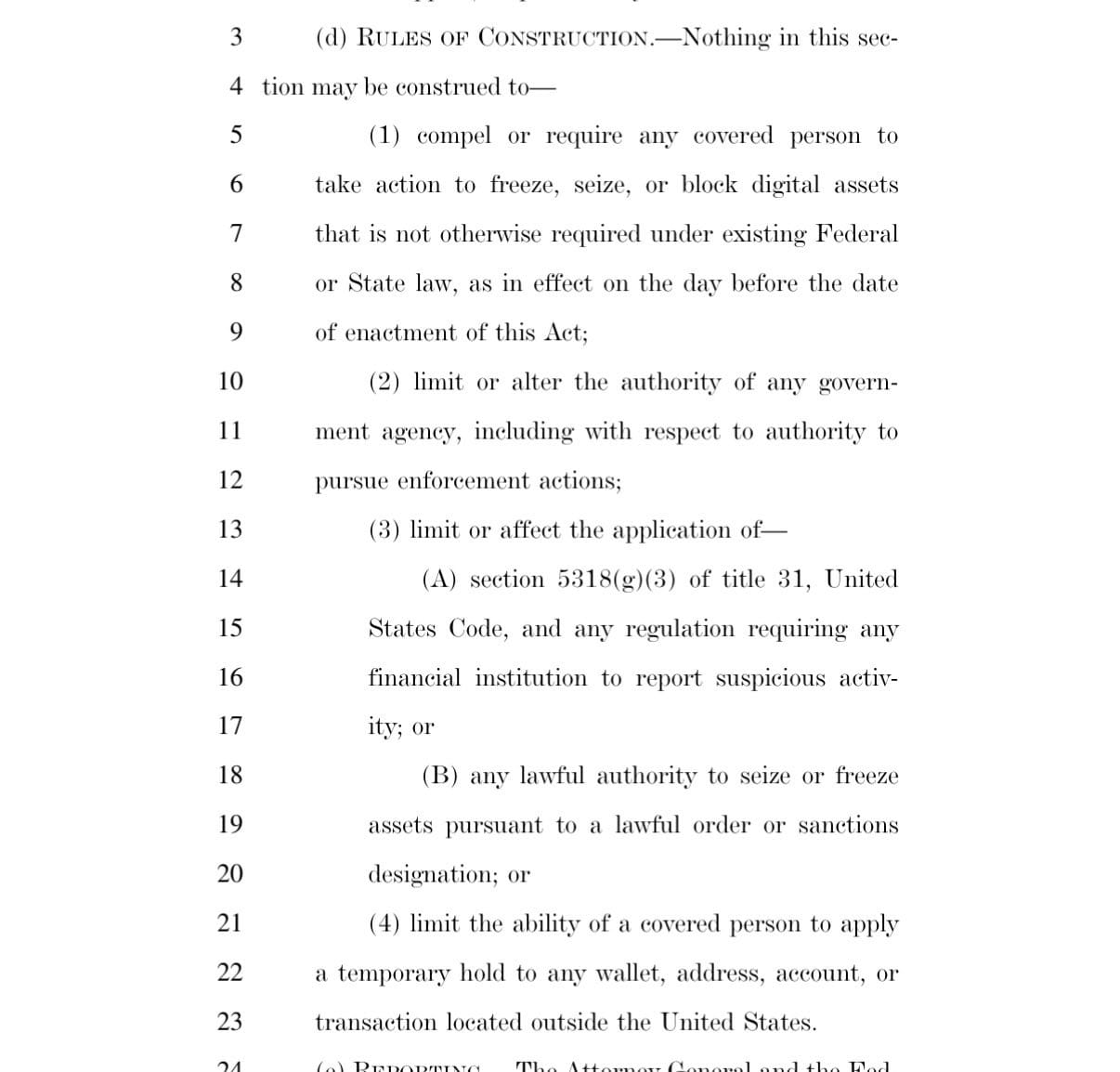
Lummis then responded: "You are shifting the concept; what you quoted was a reserved clause. This clause merely preserves the effectiveness of existing financial and sanctions laws and does not negate the rest of that chapter. You misunderstood the key points of the Clarity Act; Binance falls under the category of digital asset service providers and will be classified as a constrained entity. No law can eliminate all criminals, but the Clarity Act can provide better tools for combating crime, enabling faster actions. Your side voted against it, and you must bear the consequences."
Neither interpretation is likely to receive substantial judicial scrutiny, and our probability of acceptance is low. However, we can still derive a lot of information from the boundaries of this debate.
Core Controversy
First, we need to clarify one issue: do these rules apply to Binance? Binance is not an American company. When it reached a settlement with the U.S. government in 2023, Binance promised to withdraw entirely from the U.S. market. Binance indeed has a very small U.S. subsidiary, which is clearly subject to U.S. law. But its size is so small that it is nearly irrelevant. The discussion isn't about Binance U.S. (Binance.US), which hardly garners attention. This article does not discuss the impact of the Clarity Act on Binance U.S. because its potential impact is limited to the size of Binance U.S. operations, which is negligible.
Therefore, Lummis's assertion that "the Clarity Act would classify Binance as a constrained entity because it is a digital asset service provider" is difficult to support. The Clarity Act will not place all global digital asset service providers under U.S. jurisdiction. Only the portion of Binance that operates legally in the U.S. will need to comply with U.S. rules. This segment is minimal, falling outside the scope of this discussion and insufficient to change the situation.
The most favorable interpretation is: Lummis imagined a parallel world—where the Clarity Act is enacted, and Binance operates compliantly in the U.S., subject to the Act. In this hypothetical scenario, her assertion holds because the U.S. does indeed have jurisdiction. However, her initial claim was that the Clarity Act would provide legal protections for crypto businesses, enabling them to immediately freeze suspicious transactions upon receiving notifications from law enforcement. If Binance were already operating under a compliant framework in the U.S., cooperating with U.S. law enforcement wouldn't be seen as an achievement. The passage of the Act wouldn't naturally lead to cooperation and compliance; the real watershed moment is when Binance voluntarily accepts this regulatory system. Once this prerequisite is fulfilled, it is established at the time of Binance accepting regulation, not when the hacker attack occurs and law enforcement requests a freeze.
Returning to the real world, after the theft, Binance proactively undertook some shutdown measures, pausing withdrawals for about two days. Whether or not this legal protection exists is entirely irrelevant to Binance in reality. Even if the Clarity Act were passed, Binance would not choose to accept U.S. jurisdiction voluntarily. Lummis's argument lacks several key prerequisites and is difficult to stand.
Fischer's rebuttal direction aligns with our judgment but takes a different approach. She points out that these asset-freezing legal protection clauses mainly target stablecoin issuers rather than exchanges. We agree that stablecoin issuers are indeed the key subjects discussed in the Clarity Act, and the provisions concerning non-issuing service providers are expressed in more obscure and complex terms.
Senate draft clause 305 does indeed allow stablecoin issuers and digital asset service providers to take temporary freezing measures on suspicious transactions upon receiving written requests from law enforcement and to be exempt from private lawsuits (safe harbor clause). However, we believe this debate has deviated from the core.
Lummis asserts that once the Act is passed, it will be easier for service providers to freeze funds; Fischer rebuts that the Act may not extend such protections to the relevant platforms (or Binance itself). Our view is that Circle, Tether, and the Arbitrum Security Committee swiftly froze funds without relying on a formal legal process, making it difficult to argue that additional legal protections would bring about any change.
To illustrate, if someone is attacked and retaliates in self-defense, whether self-defense can constitute a legitimate defense depends on various conditions across different jurisdictions. Suppose there is a pending bill that explicitly recognizes such behavior as lawful self-defense. Supporters of the bill might use this case to lobby legislators. But what if the involved parties are unaware of this bill and indifferent to related news? The bill, regardless of whether it is pending, just passed, or was rejected, would have no impact on the action itself. When Binance, Circle, Tether, and the Arbitrum Security Committee took action to freeze, they did not rely on protections provided by the Clarity Act. Perhaps after the bill is enacted, they could act 15 minutes faster? No one can say for sure. What is certain is that the bill will not bring about disruptive changes; Lummis's statement clearly exaggerates its effects.
Law Enforcement Requests, Entirely Voluntary
Circle has long publicly claimed that it will not freeze funds without a court order or similar documentation. However, it is apparent that this policy is not applicable in all scenarios anymore. The Arbitrum Security Committee has unilaterally frozen assets for the second time without any legal process. Meanwhile, another major freezing entity, Tether, has long relied on principles of voluntariness, non-precedential action, discretion, and efforts to cooperate when considering law enforcement's freezing requests.
The legal relationship between Circle and Arbitrum is quite complex, making long-term effects difficult to predict. However, no one would consider Tether to be the type of company that requires comprehensive legal basis and all procedural documentation before taking action.
Do not forget that these platforms froze tens of billions of dollars in assets without formal legal documentation. In the parallel world imagined by Lummis, they might gain more legal protections, or perhaps not. But in the context of this event, would that truly make a difference? It doesn't seem so.
Onshore and Offshore
Let's assume for a moment that Fischer's view is valid, and that these freezing rules only apply to stablecoins. Even so, they only bind stablecoins under U.S. jurisdiction. Thus, the Act may affect Circle, and many members of the Arbitrum Security Committee are U.S. entities, potentially subjecting them to repercussions. However, similar to Binance, Tether is considered an offshore entity. The U.S. cannot unilaterally declare Tether under U.S. jurisdiction and expect compliance. The U.S. can certainly try to do this; we can break down this game.
Tether's case explains this issue well. The U.S. openly relies on Tether's voluntary assistance. Reports and our research indicate that Tether frequently refuses requests from U.S. officials or asks for more information before making decisions. The U.S. can attempt to force Tether to comply, for example, by suing Tether in a U.S. court under a certain legal theory, claiming jurisdiction, and observing the outcome.
The U.S. can also impose sanctions on Tether, issue threats of sanctions, or declare that if Tether does not comply as required, it will sever its ties to the U.S. economic system. FinCEN previously shut down MEXC and had earlier addressed Huione.
Of course, it is possible for the U.S. to lose a lawsuit. Or even if it wins the case and FinCEN takes action, Tether might continue to operate as usual. This would be a significant setback for the U.S.; many other institutions would conclude that the risk of defying a request from the U.S. government is low. Regardless of how one views the U.S. government and the U.S. economy, it is not a closed, centralized system; courts do not always win, and all market participants do not unquestioningly obey government directives.
We have reason to believe that there is consideration of pros and cons within the U.S.: Tether's voluntary cooperation is already an acceptable outcome, and it is not worth the risk of a major defeat to force compliance. Our private communications with multiple parties support this judgment. Even if the probability of loss is low, consider the legal team responsible for this case. If they expend significant negotiation leverage during this litigation and still lose the case, their future careers will be challenging. Of course, they might secure numerous speaking invitations at offshore financial centers.
Thus, even if the Clarity Act is passed, it is unlikely to change this weighing logic. Lummis's view is untenable: whether the Clarity Act or other similar acts, it is challenging to have a substantial impact on offshore entities like Binance and Tether. They may choose to move to the U.S. and accept a new regulatory framework, or they may not. No one can predict. "If the bill passes, X will happen" is a proposition that can at least be modeled and tested; but "If the bill passes, and Binance or Tether moves to the U.S., X will happen" is almost equivalent to a science fiction scenario. The gap between reality and this assumption is too vast, and all related speculations are equally difficult to verify.
Conclusion
In short, Lummis's judgment is disconnected from reality, while Fischer overly focuses on attacking the industry-supported Act, neglecting the real core issue: the U.S. government does not have as strong control in this field as imagined. This is not a problem unique to the U.S.; a recent article from the Royal United Services Institute (RUSI) in the UK also discussed this trend in detail. It is not just the power of the U.S. government that is diminishing; governments and their supporting institutions worldwide are losing influence, while some private entities are rising in discourse. How the future unfolds remains to be seen. Our only firm viewpoint is that only by recognizing the ongoing power transfer can substantive discourse potentially be preserved in subsequent processes.
The Binance hacking incident provides a real lesson for policymakers: in these emergency fund handling scenarios, governments are not a core component of emergency response; codified laws have very limited roles within this financial domain. This is not a matter of "judicial processes being slow." Slow response in freezing funds equates to failure. The current system relies on the voluntary actions of largely unregulated private entities striving to cooperate. This is the reality. Currently, there is no discernible strong incentive to cause these platforms to voluntarily relinquish their practical autonomy in handling funds and accept government regulation.
免责声明:本文章仅代表作者个人观点,不代表本平台的立场和观点。本文章仅供信息分享,不构成对任何人的任何投资建议。用户与作者之间的任何争议,与本平台无关。如网页中刊载的文章或图片涉及侵权,请提供相关的权利证明和身份证明发送邮件到[email protected],本平台相关工作人员将会进行核查。


