Quantum computing does not yet pose a real threat, but it is forcing blockchain to redesign its account authorization, key management, and asset migration mechanisms.
Written by: imToken
If one day a quantum computer can derive a private key from a publicly exposed key on the chain in a very short time, can the security system of encrypted assets based on cryptography established today still hold?
For a long time, discussions in the cryptocurrency industry about quantum computing have mostly remained at the theoretical level, acknowledging that mainstream blockchains like Bitcoin and Ethereum widely use elliptic curve cryptography, which may be broken by quantum computers with sufficient computational power in the distant future.
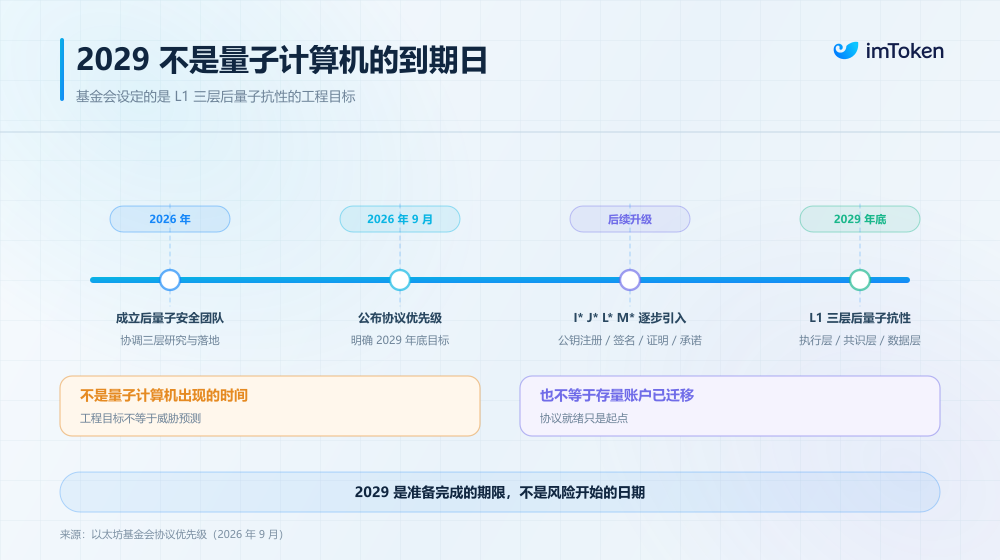
In fact, by 2026, this topic has officially entered the engineering implementation stage—the Ethereum Foundation has established a dedicated post-quantum security research team and has set the engineering goal of achieving post-quantum resistance across the execution layer, consensus layer, and data layer by the end of 2029 in its latest protocol planning.
For an open network with hundreds of millions of accounts, massive asset scales, and complex application ecosystems, changing the cryptographic system is far from a simple software upgrade.
Especially from the perspective of ordinary users, the real challenge often lies not in "how to generate a new quantum-resistant private key" but in how to safely and seamlessly control existing accounts and assets during the change of signature algorithms.
1. What is the real threat of quantum computing?
To understand the impact of quantum computing on encrypted assets, we first need to break down and analyze the security system of blockchain.
Currently, Ethereum relies on four types of cryptographic components to maintain its operations, serving account, consensus, data availability, and application layer verification, each solving different problems and exposed to quantum computing risks unequally:
- ECDSA: The elliptic curve digital signature algorithm used by ordinary user accounts to prove ownership of transactions;
- BLS: The signature algorithm used by Ethereum's PoS consensus layer, capable of efficiently aggregating votes from hundreds of thousands of validators into a single signature;
- ZK-proof systems: Zero-knowledge proof systems used by applications such as Rollups;
- KZG: The polynomial commitment scheme used for Blob and Rollup data availability (DA) verification;
Among these, ECDSA and BLS, which are based on the elliptic curve discrete logarithm problem, are the most at risk.
It is well known that for traditional computers, deriving a private key from a public key is virtually impossible, but a fault-tolerant quantum computer running Shor's algorithm can theoretically solve the elliptic curve discrete logarithm problem in polynomial time, thereby compromising the security of public-key cryptography based on related mathematical assumptions like ECDSA and BLS.
Once the private key is recovered, the attacker does not need to steal the mnemonic or break the wallet client; they can directly forge legitimate signatures to transfer assets. Similarly, verifier keys, protocol multi-signature management permissions, and cross-chain bridge control keys also face similar long-term tests.
In contrast, hash functions like Keccak-256 are more resilient against quantum computing. Grover’s algorithm can provide quadratic speedup but does not directly convert it from an exponential security problem into a polynomial-time solvable problem like Shor's algorithm does.
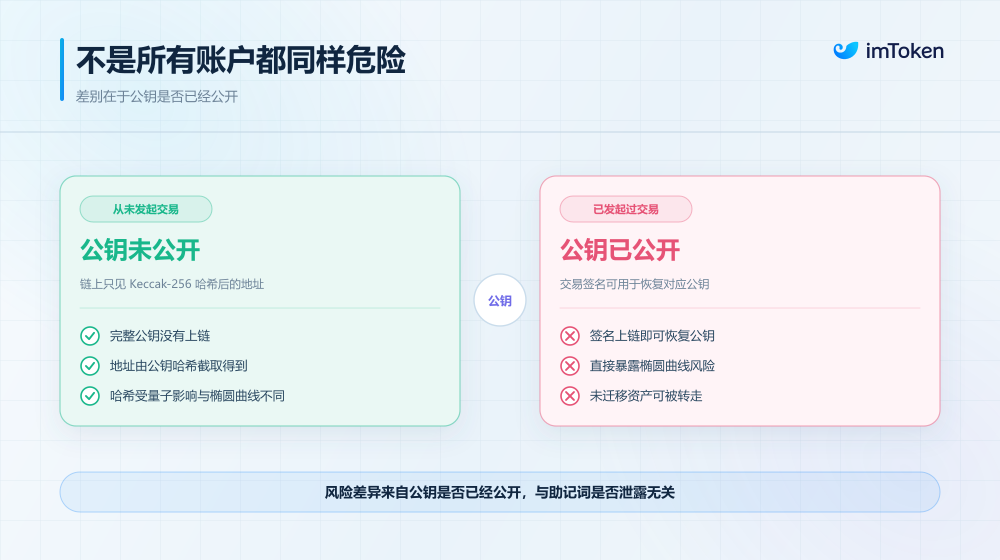
This also raises a commonly overlooked key detail: not all Ethereum accounts are at equal risk in the face of quantum threats.
The address of a standard Ethereum EOA is derived from a public key hashed with Keccak-256.
Therefore, if your cold wallet has never initiated any on-chain transaction and has never publicly signed off-chain, then on-chain records will contain only the hashed address, and the full public key has never been exposed, remaining protected by hash one-wayness; however, if that address has initiated even a single transfer or contract authorization, the attacker can restore the full public key from the publicly available transaction signature, making it directly exposed to the risk of future attacks on elliptic curves.
Of course, at this stage, no quantum computers capable of breaking cryptography have emerged globally, and ordinary users need not panic and hastily transfer their assets.
The Ethereum Foundation's post-quantum team has repeatedly emphasized that a fault-tolerant quantum computer that poses a real threat still needs to overcome a large hardware scale and quantum error correction engineering gap (see further reading “What does quantum computing threaten? A user guide to the post-quantum era in Crypto”).
But the problem is that cryptographic migration itself takes years; if preparation does not begin until the threat actually appears, it might be too late.
2. What preparations is Ethereum making?
In 2026, the Ethereum Foundation established a dedicated Post-Quantum Security team to coordinate post-quantum cryptography research and engineering implementation at the protocol layer.
Rather than simply seeking a new signature algorithm, Ethereum is attempting to advance the upgrade of the cryptographic system from three directions: the execution layer, consensus layer, and data layer.
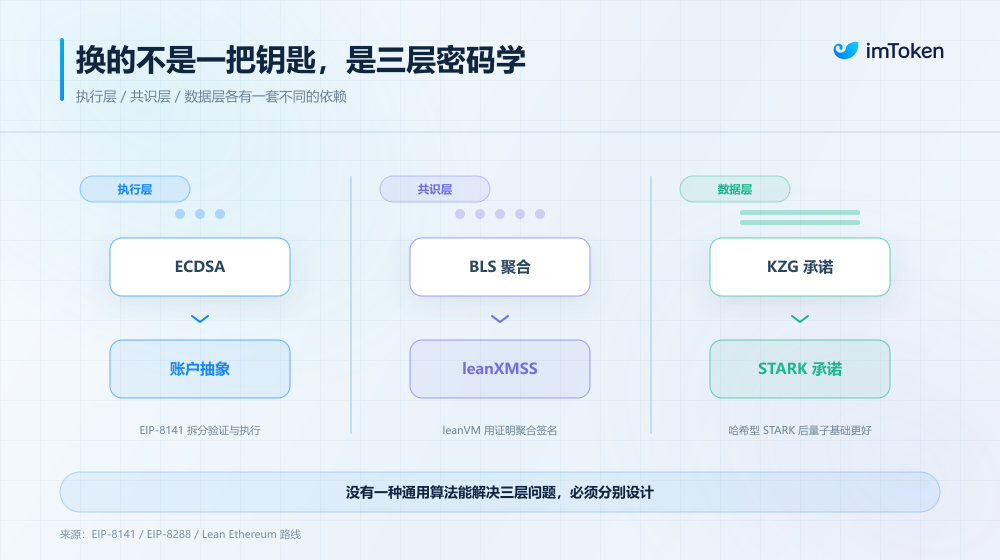
1. Execution layer: Unbinding accounts from a single private key permanently
For ordinary users, the most direct changes come from the execution layer.
The traditional Ethereum EOA account authorization logic is relatively fixed, with users generating signatures via secp256k1 private keys, and the network verifying the legitimacy of the signatures through ECDSA.
This design is simple enough and has been long validated, yet it binds the identity of the account highly to a specific signature system. If ECDSA is no longer secure in the future, users will need to change their signature algorithms, but simply changing to a new private key often means generating a new account address, and existing assets, contract interaction records, and application relationships may also need to be migrated.
This is evidently not an ideal solution.
To break this chain, Ethereum is accelerating the advancement of native account abstraction, with the most representative being EIP-8141 (see further reading “Native account abstraction + quantum threat resistance: Why hasn't EIP-8141 become Ethereum Hegotá's flagship?”).
It tries to separate transaction validation, actual execution, and gas payment into different execution steps, allowing accounts to determine the validity of a transaction through programmable logic, thereby helping accounts gradually detach from a fixed reliance on the ECDSA private key and facilitating native key rotation while leaving room for introducing different signature verification algorithms in the future.
At the same time, Ethereum is also studying post-quantum signature verification precompilations to allow smart contracts and account verification logic to efficiently natively validate new types of signatures.
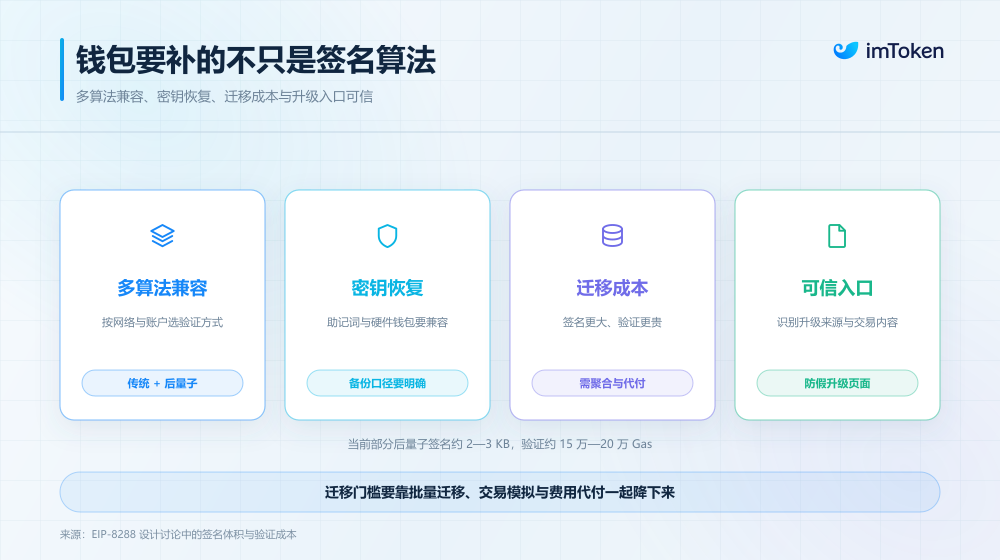
But this is only the first step. Since post-quantum signatures are typically much larger than traditional ECDSA/BLS signatures, Ethereum also needs to address the data and computational cost challenges associated with this. For example, EIP-8288 has suggested utilizing recursive STARK aggregation to compress the validation results of numerous post-quantum signatures into more compact proofs, thus reducing the on-chain data and verification burden.
2. Consensus layer: Using hash signatures to replace traditional BLS
Beyond the execution layer, the consensus layer is critical to the underlying PoS operating mechanism of the Ethereum network.
Currently, the PoS consensus heavily relies on the aggregation properties of BLS signatures, and directly replacing them with ordinary post-quantum signatures would significantly increase the P2P network propagation, storage, and verification costs due to the large signature size.
To address this, Ethereum's Lean Ethereum roadmap has proposed two noteworthy technical directions.
- leanXMSS: A hash-based post-quantum signature scheme planned to replace the BLS signatures currently used by validators, fundamentally eliminating dependence on elliptic curves;
- leanVM: An ultra-simple zero-knowledge virtual machine designed for the efficient aggregation of post-quantum signatures, attempting to compress a large number of validators' hash signatures into compact proofs through techniques like recursive STARK, while ensuring quantum resistance and upholding the consensus performance baseline;
This indicates that there is no "one size fits all" universal algorithm for post-quantum upgrades; the consensus among validators and ordinary user wallets needs to match the most suitable cryptographic tools.
3. Data layer: KZG and ZK proofs also need to consider quantum security
In addition to account signatures and validator signatures, the data layer also faces long-term challenges.
Ethereum has used the KZG polynomial commitment mechanism extensively in recent years, especially concerning blob and rollup data availability. However, the security of KZG depends on mathematical assumptions related to elliptic curve pairing, so it also needs to address the future impacts of quantum computing.
Additionally, at the application layer, certain ZK proofs utilized by systems like Rollup also face similar issues, particularly some SNARKs reliant on elliptic curve pairings, whose security assumptions may also be affected by Shor's algorithm. In contrast, STARKs built on hash functions do not depend on the elliptic curve discrete logarithm assumption, thus exhibiting better post-quantum security attributes.
This means that post-quantum migration is not only a problem for Ethereum L1 but will also need to gradually extend to L2, Rollup, and various on-chain applications.
From the timeline perspective, the Ethereum Foundation, in the protocol priorities announced in September 2026, clearly stated the goal of achieving post-quantum resistance for Ethereum L1 at the execution layer, consensus layer, and data layer by December 2029. Subsequent upgrade nodes will also gradually introduce infrastructure like post-quantum public key registration, signature verification, consensus proof, and data commitment.
This will be a long-term project involving the entire ecosystem.
3. How to safely facilitate asset migration for users?
If the first two parts discuss how Ethereum addresses underlying cryptographic issues, then what is most worthy of attention for ordinary users is how should our wallets operate when the existing signature system needs an upgrade?
This matter is far more complex than simply regenerating a new private key.
The first issue to address is the account identity problem.
For traditional EOAs, there is a direct mathematical correlation between account addresses and public keys. If users opt to use a new post-quantum key system, they typically need to generate a new account identity and transfer their existing assets over.
However, this brings a series of problems. In addition to ETH and ERC-20 tokens, users may also hold NFTs, deposits, and positions in DeFi protocols, as well as assets on different L2 networks, and some applications record permissions, points, historical interactions, and identity relationships based on user addresses.
If every cryptographic upgrade necessitates a new account address, users will have to reprocess these assets and application relationships, and the migration cost will be very high.
Therefore, the importance of account abstraction is highlighted—it can separate the account identity from the underlying signature keys as much as possible, allowing the account to use programmable verification logic to determine who has the right to control the assets.
Theoretically, this means users will have the opportunity to change underlying signature algorithms while retaining their original account addresses, without needing to move all assets to another address.
This is also one of the abilities that EIP-8141 aims to provide.
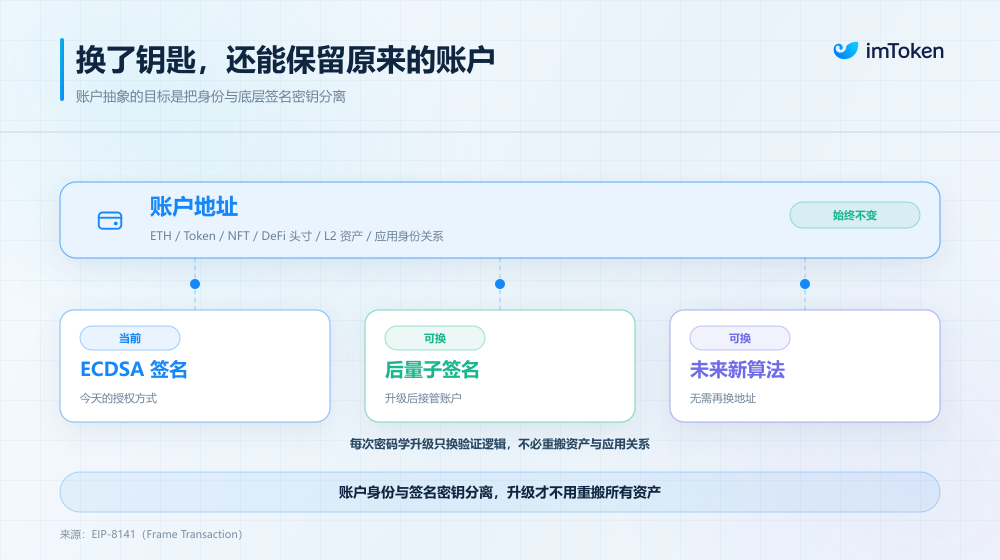
Next is the migration between old and new keys. An ideal migration process should be initiated by the user who actively authorizes the new post-quantum key to take over the account while the existing cryptographic system remains secure.
For instance, the wallet can first generate a new post-quantum key in a secure environment and then authorize the update of the account's verification rules through a valid signature from the existing account.
If the original ECDSA private key is still secure, this process can proceed as per normal account upgrade flow. However, if a quantum computer is already capable of cracking the existing private key, the situation becomes entirely different.
At this point, both attackers and legitimate users may possess the ability to forge signatures for the original account, making it difficult for the system to determine who the legitimate owner is based solely on the old key.
This underscores the importance of early migration.
Additionally, there is a more challenging category of accounts—those that have not been used for a long time, have lost private keys, or whose owners are completely unaware that their wallets need upgrading. These accounts may still hold substantial assets but cannot proactively complete the migration.
Regarding these assets, whether they should be allowed to remain at the original address or whether to take measures such as freezing through protocol governance remains a topic of debate.
Finally, and easily overlooked, is that secure migration itself must not become a new attack entry point.
As the entire industry begins to discuss quantum threats, attackers may likely exploit users’ panic to create so-called “quantum security upgrades,” “private key verification,” or “asset migration” pages to induce users to input mnemonics or sign malicious authorizations.
Thus, in the future, wallets not only need to provide migration tools but must also enable users to clearly identify the source of upgrades, validate transaction content, and confirm what assets are controlled by the new authorization logic.
Final Thoughts
From today’s perspective, quantum computing is still far from being able to directly threaten the cryptographic systems of mainstream blockchains.
However, this does not mean the industry can ignore it.
The post-quantum roadmap that Ethereum is advancing actually indicates that the future of blockchain security should not be built on the assumption that a particular cryptographic algorithm will never be broken, but rather on the capability of the entire system to undergo continuous upgrades and secure migrations.
For ordinary users, the role of wallets will also evolve as a result.
In the past, the core function of wallets was to help users generate, safeguard, and utilize private keys; in the future, they will also need to help users understand account risks, manage keys across different cryptographic systems, and safely complete account upgrades when necessary.
This is not just a change of signature algorithms, but an evolution of wallets from tools for private key management to foundational infrastructures for long-term asset security management.
At least today, users do not need to hastily migrate assets due to quantum computing, but for wallet developers and the entire cryptocurrency industry, the real time to prepare ahead has already begun.
免责声明:本文章仅代表作者个人观点,不代表本平台的立场和观点。本文章仅供信息分享,不构成对任何人的任何投资建议。用户与作者之间的任何争议,与本平台无关。如网页中刊载的文章或图片涉及侵权,请提供相关的权利证明和身份证明发送邮件到[email protected],本平台相关工作人员将会进行核查。


