Author: Bu Shuqing, Wall Street News
NVIDIA will release its quarterly earnings report on Tuesday local time (Wednesday early morning Beijing time), but this time, the numbers themselves have taken a backseat. Jensen Huang's sudden departure has turned what was supposed to be a routine earnings release into one of the most closely watched moments on Wall Street in decades—what the market truly wants to know is whether NVIDIA can continue its grand narrative about AI without him.
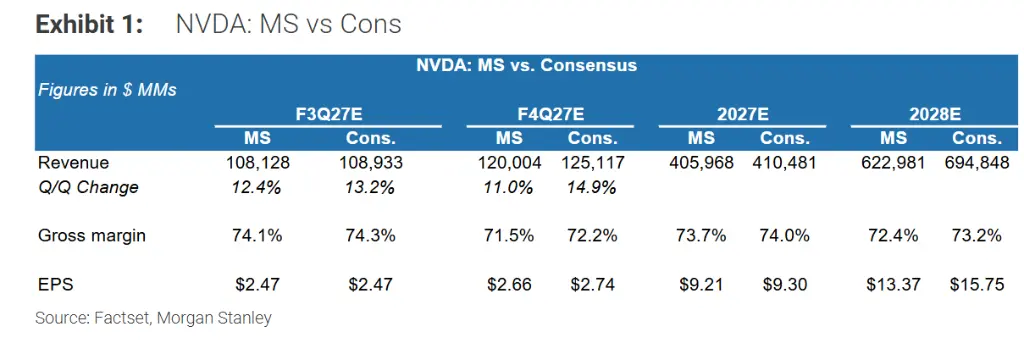
The market expects NVIDIA's revenue for the third fiscal quarter to reach $109 billion, with earnings expected to grow by 90%.
Jensen Huang resigned as President, CEO, and Board member of NVIDIA on November 12 due to the company's board investigating an extramarital affair; subsequently, two additional reports of extramarital affairs involving NVIDIA employees surfaced. The company then appointed Chief Financial Officer Colette Kress as interim CEO, but a permanent successor remains undecided.
Since the news broke, NVIDIA's stock price has fallen approximately 22% since October 29, with a decline of about 25% over the past month, bringing its valuation to a 15-year low, with a forward P/E ratio of about 11 times.
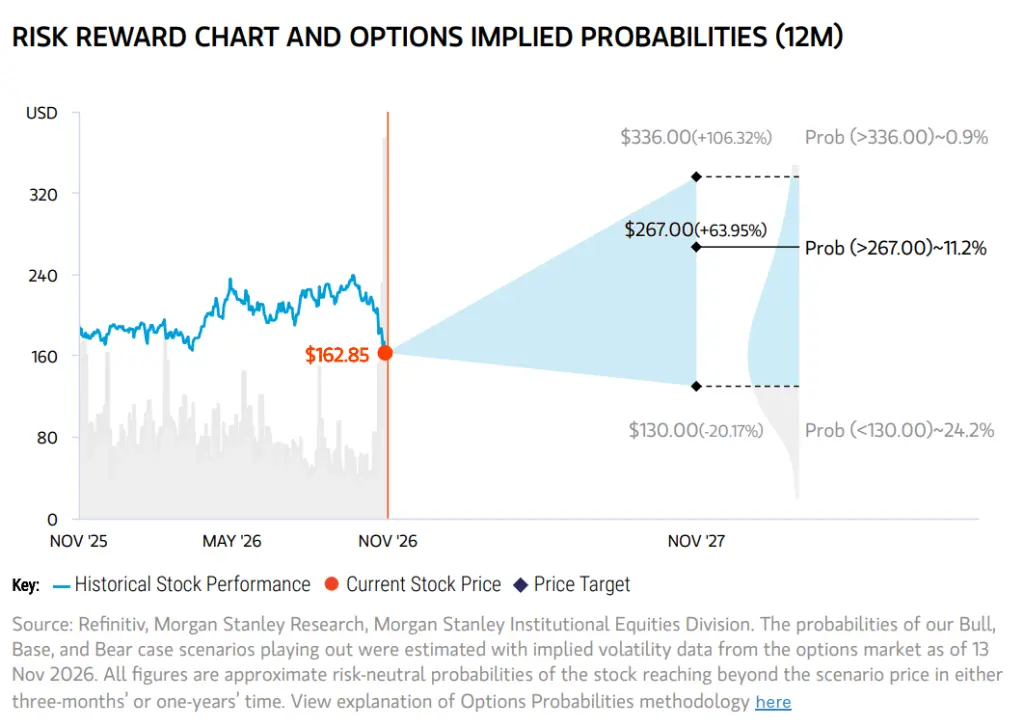
In this context, HSBC downgrades NVIDIA's rating from "Buy" to "Hold," significantly cutting the target price from $365 to $170; Morgan Stanley, however, maintains an "Overweight" rating with a target price of $267, but admits uncertainty over whether the company will provide guidance for next year's performance in this earnings report.
Morningstar analyst Brian Colello stated that "If NVIDIA's performance is below expectations or guidance is weak, we would be shocked," but he also noted that this quarter's fundamentals "are somewhat secondary."
The performance is expected to be strong, but guidance is uncertain
From a purely financial perspective, NVIDIA's fundamentals this quarter are not in doubt.
HSBC expects NVIDIA's third fiscal quarter (ending October 2026) revenue to be $113 billion , above the management's midpoint guidance of $108 billion and market expectations, with non-GAAP earnings per share expected to be $2.55, about 3% above the consensus estimate.
Morgan Stanley also stated that their channel survey shows business remains strong, even though certain projects in Southeast Asia have slowed, supply is still unable to meet demand.
However, the market is more concerned about whether the company can reaffirm the medium- and long-term goals previously announced under Jensen Huang's leadership—including a revenue growth guidance of about 70% for FY2028 and a customer demand prediction close to a 100% year-on-year increase.
Morgan Stanley points out that its current revenue growth forecast for FY2028 is 52%, lower than the company's guidance of 70%, and believes this figure sufficiently reflects downside risks, but given the interim CEO's appointment and other uncertainties, it is unclear whether the company will provide guidance for next year in this earnings report. D.A. Davidson analyst Gil Luria indicated that management is likely to remain cautiously restrained when responding to questions related to Jensen Huang.
Succession issues dominate market sentiment; valuation reset is not over
Jensen Huang's departure signifies much more for NVIDIA than a typical CEO transition.
Over the past thirty years, he transformed NVIDIA from a startup idea in a California restaurant into a core company in AI infrastructure worth over $4 trillion, shaping the company's unique competitive advantages with his foresight regarding technology trends and a flat management style—according to HSBC's report, Jensen Huang directly managed over 60 direct reports, with many decisions made by him personally.
After Colette Kress took over as interim CEO, the long-term succession plan remains unclear, and NVIDIA's board has initiated a search process for both internal and external candidates.
HSBC believes that until a permanent successor is identified and demonstrates the ability to execute the current product roadmap, there is limited room for stock price reevaluation. The bank significantly lowered the target P/E ratio from 25 times to 11 times (matching the current valuation trough) and clearly stated that the formal handover of the CEO and related organizational adjustments are expected to have no substantial impact on the company's product development or competitive position before 2028.
Mark Malek, Chief Investment Officer at Siebert Financial, stated, "'Interim' means that the real decision has yet to come, the investigation is still ongoing, and Tuesday's earnings call has thus become the most crucial one in the company's history."
Three core issues: demand, supply, and export controls
Apart from succession issues, analysts and investors will focus on three aspects.
AI demand and financing prospects: Morgan Stanley notes that after the midterm elections, the Democrats have achieved victories on multiple anti-data center platforms, with concerns over land, power, and infrastructure bottlenecks rising significantly. SoftBank (a partner in NVIDIA's PORTS-Pike project) has reported a $3.7 billion write-down on power equipment. Additionally, emerging cloud computing companies like CoreWeave, Nebius, and IREN collectively forecast approximately $100 billion in capital expenditures for 2027, but their combined market value has shrunk by about $38 billion over the past month, indicating that a tightening financing environment poses potential risks to NVIDIA’s long-tail customer base.
Progress in Rubin platform mass production: This quarter is NVIDIA's first large-scale shipping quarter for products based on the Rubin architecture, previously expected to account for about 20% ($20 billion) of data center revenue. Morgan Stanley points out that the key testing partner KYEC has lowered its performance guidance for two consecutive quarters, partly because the ramp-up of Rubin is slower than expected, but analysts believe this will not have a significant impact on NVIDIA's revenue confirmation this quarter.
Export control risks: HSBC conducted a sensitivity analysis on this. Based on the regional revenue distribution over the past six quarters, the U.S. accounts for about 69%, while other countries and regions account for about 31%. If a comprehensive export ban is implemented on other regions (which would result in a loss of about 11% of revenue), HSBC estimates that FY2028 earnings per share would decrease by about 13% compared to the baseline scenario, with earnings per share of $13.57 in a bear market scenario, which is about 14% lower than the current market consensus.
The conference call itself will be cautiously worded, unlikely to have "sparks"
Several analysts expect that this conference call will be one of the most closely monitored in NVIDIA's history, but the actual information content may be disappointing.
StoneX analyst Cody Acree remarked, "Clearly, the attention will be higher, but I don’t think there will be more substance to discuss; they won’t respond to the specifics of Jensen Huang's resignation." Interactive Brokers' chief strategist Steve Sosnick warned, "There are countless uncomfortable questions that can be thrown at NVIDIA, and the wrong answers will be penalized."
It is noteworthy that Jensen Huang did not give an opening statement during earnings conference calls in the past, but actively participated in the Q&A session and was known for his macro narrative on the transformative impacts of AI. Morgan Stanley pointed out that under the new management structure, such broad expressions of excitement about AI might be more restrained on the margin.
Gabelli Funds portfolio manager Hendi Susanto holds a relatively optimistic view, believing that NVIDIA is no longer solely reliant on one executive, "The fast innovation culture he created has been integrated into NVIDIA's engineers and product roadmap, and at least over the next two years, we do not see a significant impact on NVIDIA's roadmap."
免责声明:本文章仅代表作者个人观点,不代表本平台的立场和观点。本文章仅供信息分享,不构成对任何人的任何投资建议。用户与作者之间的任何争议,与本平台无关。如网页中刊载的文章或图片涉及侵权,请提供相关的权利证明和身份证明发送邮件到[email protected],本平台相关工作人员将会进行核查。


