
Written by: Little Pancake
A wave of sharp declines has sent cryptocurrency investors back into a deep bear state.
Many still hold onto a belief: if Bitcoin falls through, if altcoins die out, top exchanges like Binance will have nothing to eat and will eventually have to step in to save the market.
This may be a rapidly failing fantasy.
The crypto industry is undergoing an extremely covert crisis, with threats no longer coming from external regulations or hacker attacks, but from the industry's core power centers: the exchanges themselves.
As altcoins fall into a prolonged winter of liquidity exhaustion, trading platforms are ceding core positions on their shelves to Nvidia, Tesla, and the S&P 500 Index in order to maintain fee income.
Cryptocurrency exchanges are undertaking a commercial migration of “de-cryptofication” themselves.
Leading on-chain entity takes the lead: 30% of Hyperliquid's territory is now "U.S. stocks"
Observing the shift in focus of exchanges, the decentralized perpetual contract leader Hyperliquid is the first to successfully navigate this model.
One year ago, Hyperliquid was still a pure cryptocurrency casino.
The turning point occurred after the HIP-3 protocol upgrade, when the platform allowed third-party deployers to launch perpetual contracts for individual stocks, stock indices, commodities, and forex, enabling these traditional assets to share the same USDC margin account as Bitcoin contracts.
Traders voted with their real money.
Datawallet and on-chain statistics indicate that by the end of Q3 2026, Hyperliquid's 30-day trading volume for perpetual contracts reached $216.9 billion, with external builders-operated stocks, commodities, and index markets accumulating over $548 billion in total transactions, stabilizing at around 30% share of total trading volume.
During the trading peak in July 2026, the non-crypto assets' transaction share surged to 51%, directly surpassing cryptocurrency itself.
Changes in the position structure indicate the same issue.
In Hyperliquid's open contracts, the proportion of real-world assets (RWA) soared from 6% at the beginning of the year to 24%.
Within stocks and commodities, individual stock perpetual contracts accounted for as much as 67%, with U.S. tech giants like Nvidia (NVDA) becoming the most active targets for on-chain capital, and the platform even launched all-weather pre-market contracts for unlisted private companies like SpaceX and Anthropic.
The "U.S. Stock Revolution" of Centralized Giants
After the on-chain protocols successfully established a business model, centralized exchanges (CEX) followed suit faster than anyone anticipated.
According to statistics released by CryptoQuant, from the end of February to the end of October 2026, the trading volume of tokenized stocks across 16 major global exchanges exploded.
Binance alone recorded approximately $676 billion in tokenized stock transactions during this period, occupying nearly 60% of the market's average daily share, with a peak single-day transaction reaching $12.1 billion.
Zooming in on the past week, this structural reversal is even more shocking.
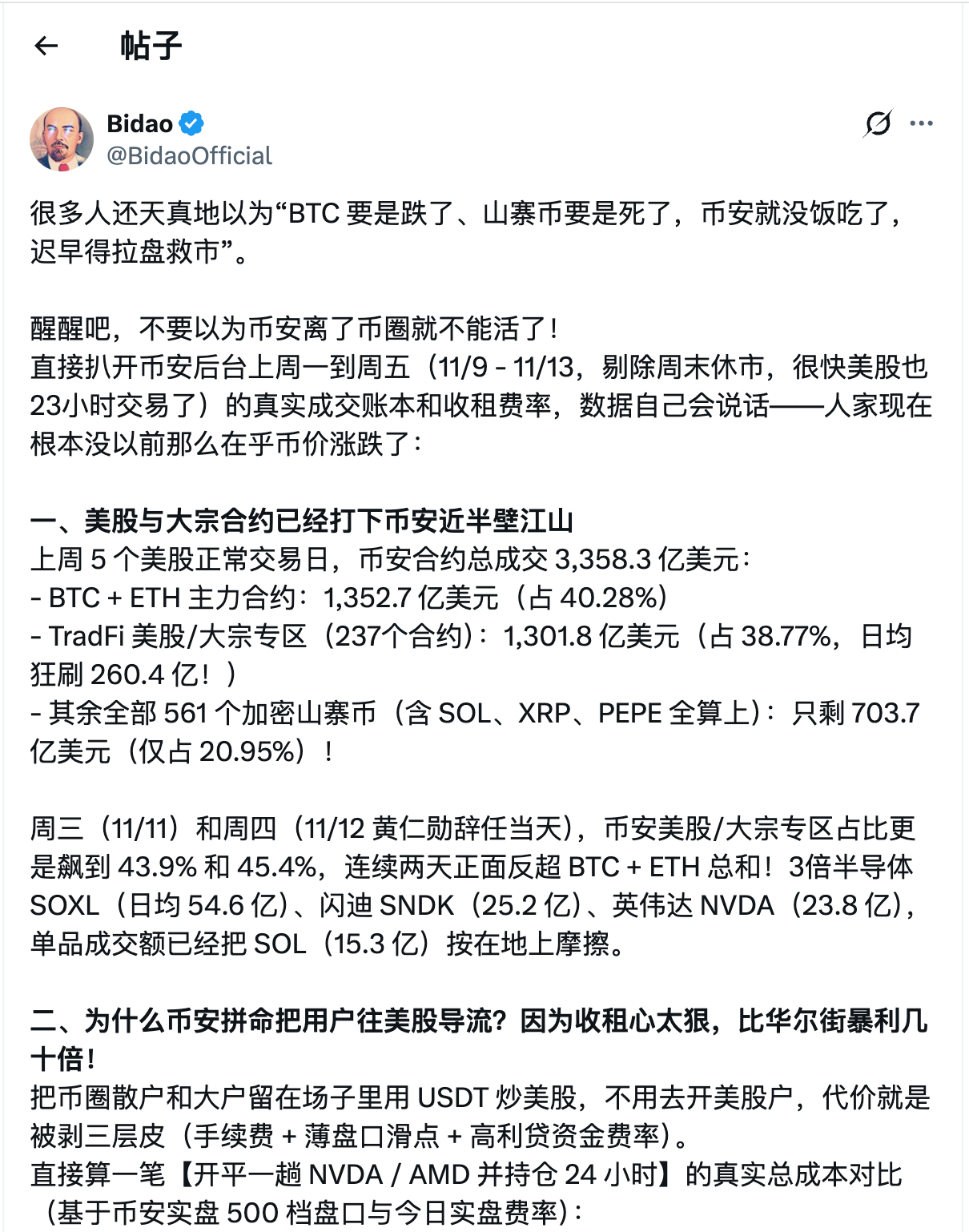
According to statistics from crypto KOL Bidao, during the normal trading days of U.S. stocks from November 9 to 13 (excluding weekends), Binance's total contract trading volume reached $335.83 billion, and the internal structure underwent dramatic changes:
- BTC and ETH main contracts: Transacted $135.27 billion, accounting for 40.28%.
- TradFi U.S. stocks and commodities sector (237 contracts): Transacted $130.18 billion, reaching a proportion of 38.77%, with an average daily trading volume of $26.04 billion.
- All remaining 561 altcoins (covering all mainstream and popular tokens like SOL, XRP, PEPE, etc.): A total transaction of only $70.37 billion, with the share dropping to 20.95%.
The combined trading volume of the 561 altcoins is only a fraction of what is in the U.S. stocks and commodities sector.
On Wednesday (November 11) and Thursday (November 12), the trading share in Binance's U.S. stock and commodity sector skyrocketed to 43.9% and 45.4%, respectively, surpassing the total of BTC and ETH over the two days.
Specifically, the three-time leveraged semiconductor ETF (SOXL) reached an average daily trading volume of $5.46 billion on Binance, while SanDisk (SNDK) reached $2.52 billion and Nvidia (NVDA) reached $2.38 billion.
The single-day liquidity of these traditional U.S. stock targets has already left behind SOL, which has an average daily transaction of $1.53 billion.
Big exchanges like OKX and Bybit are also aggressively expanding their U.S. stock offerings.
In July 2026, OKX unified the tokenized stock order book, launching spot and contracts for over 40 U.S. stock targets at once; Bybit utilized its TradFi and gold-forex sectors to establish an all-weather trading channel to trade individual U.S. stocks, the Nasdaq 100 index, and spot gold with USDT margin.
This has kept many high-frequency traders who previously only dealt with altcoins within the traditional asset markets.
The U.S. stock tokens, once regarded as fringe embellishments in bull markets, have now become established entry points on major exchanges.
The Twilight of Altcoins
From a trader's perspective, this change is reshaping the entire market's flow of funds.
In trading rooms in Shenzhen or Singapore, quantitative teams and retail traders once focused on waiting for a public blockchain ecosystem to explode are now simultaneously looking at Bitcoin and Nvidia's candlestick charts on trading software.
In the same margin account, funds can chase the rise of U.S. tech stocks at 2 AM and switch back to Bitcoin for swings by 8 AM, without needing to withdraw cash or navigate through lengthy settlement periods of fiat banks.
When the most critical trading channels tilt all research resources, liquidity incentives, and traffic entrance to U.S. stocks, gold, and oil, a drastic structural differentiation is occurring within cryptocurrencies.
Bitcoin, with its spot ETF and institutional reserves, remains the stabilizing force in the crypto world; Ethereum and top public chains like Solana still have a place due to their infrastructure properties.
However, the vast majority of altcoins outside the top twenty by market capitalization are losing their last stronghold for survival.
For the past decade, there has been a covert symbiotic relationship between cryptocurrency exchanges and altcoin projects: exchanges need altcoins to create high volatility and wealth myths to attract retail investors to leverage, while projects need the liquidity of top exchanges to complete distribution and exits.
Whenever the market is in a downturn, all parties expect exchanges to stimulate the market through new listings, market-making incentives, or even price protection.
Now, this symbiosis has completely collapsed.
A large number of highly valued, low-circulating altcoins hit their peak upon listing, consuming retail investors' principal and trust, with market makers unwilling to provide depth, leading to volume stagnation.
For exchanges, operating hundreds of ignored altcoins not only produces meager fees but also requires constant vigilance against project team absconding, exposure of wash trading, and regulatory and public opinion risks from community protections.
In contrast, assets like Nvidia, Tesla, semiconductor ETFs, and gold are intrinsically driven by global-level financial reports and macro events, offering real and intense volatility, always attracting gamblers in both bullish and bearish bets, and carrying no risks of project teams fleeing with funds.
When exchanges discover that keeping USDT within their systems to trade U.S. stocks yields stable cash flows that are several times higher than altcoins and completely unaffected by the cryptocurrency bull and bear cycles, the survival of 560 altcoins has fallen to the very bottom of the platform's commercial priorities.
Abandon the fantasy.
免责声明:本文章仅代表作者个人观点,不代表本平台的立场和观点。本文章仅供信息分享,不构成对任何人的任何投资建议。用户与作者之间的任何争议,与本平台无关。如网页中刊载的文章或图片涉及侵权,请提供相关的权利证明和身份证明发送邮件到[email protected],本平台相关工作人员将会进行核查。


