"Ethereum will become quite valuable."
Written by: Eric, Foresight News
In 2017, during the explosive bull market of cryptocurrency.
Recently, Huang Renxun, who has topped headlines worldwide, stated during Nvidia's earnings call that "cryptocurrency and blockchain will exist for a long time, and (the scale) will become very large... GPUs are well positioned in this regard."
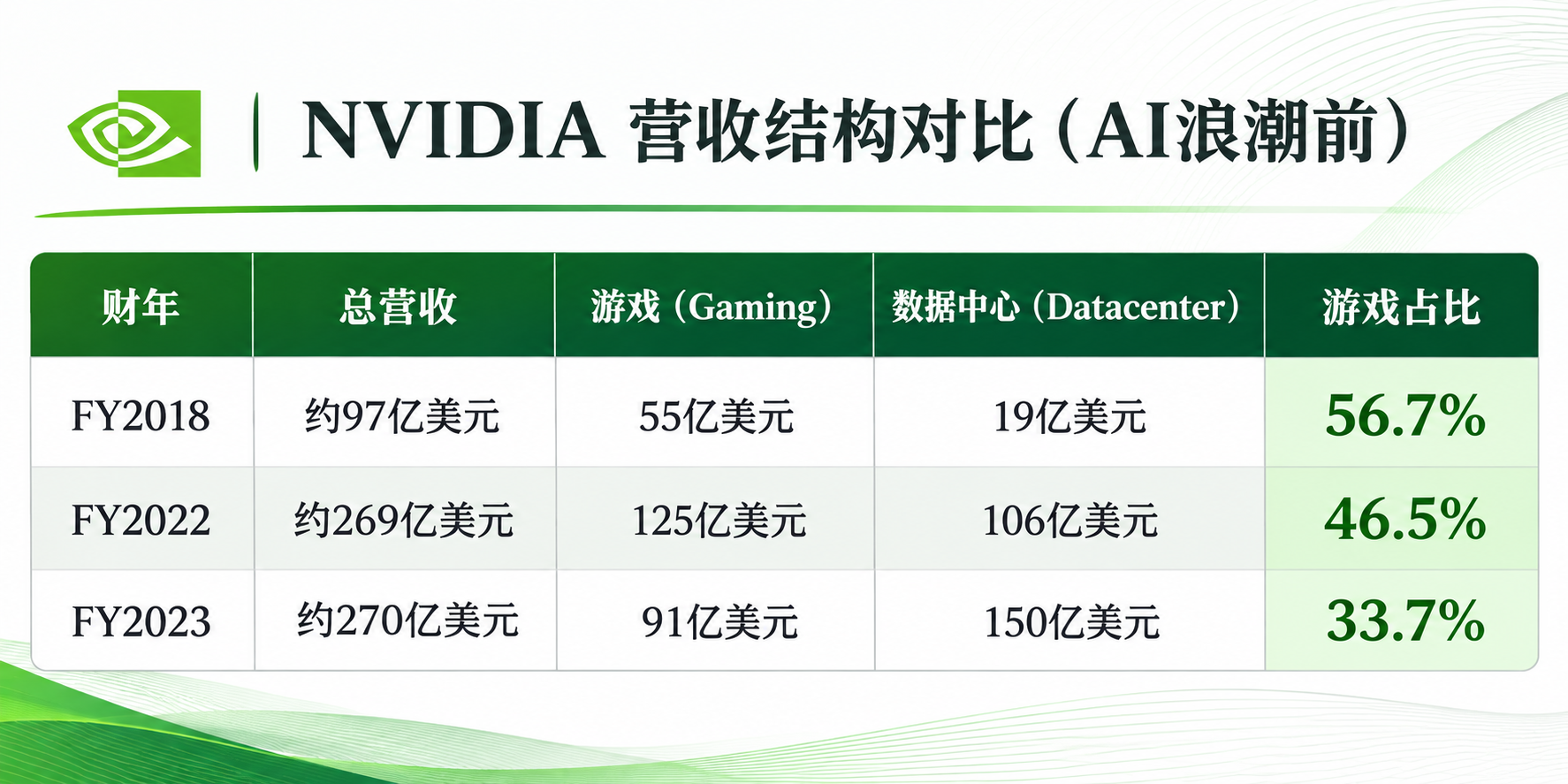
According to Nvidia’s annual earnings data, by 2023, the revenue share of the data center segment in Nvidia's chip business finally surpassed gaming for the first time. Prior to this, gaming graphics cards and professional visualization tools were Nvidia's main businesses, but during those years, the relatively insignificant Ethereum mining repeatedly disrupted Nvidia's stock price.
The Ethereum Bear Market Cost Nvidia $20 Billion
In March 2018, Huang Renxun had just celebrated his 55th birthday. In an interview with CNBC's "Mad Money," he reiterated what he had said in the previous year’s earnings call: "Cryptocurrency will exist. The world will have a way of value exchange that is very low in friction and cost, and this way will exist for a long time."
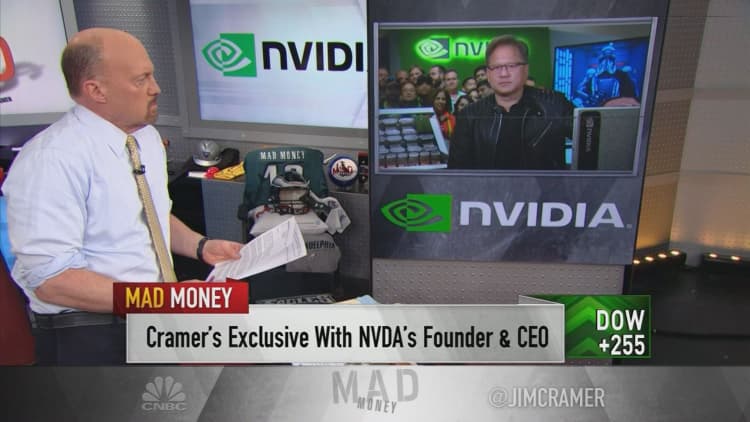
He also stated, "Blockchain will exist for a long time; it will become a brand new form of fundamental computing. I expect that blockchain and cryptocurrency will become important drivers of GPU development."
During those two years, JPMorgan's CEO publicly called Bitcoin a fraud and stated he would fire employees trading in Bitcoin; Buffett also repeatedly indicated that cryptocurrency would have a "bad ending"; AMD benefited more or less from the mining business, but cautiously stated that "mining will not be a long-term growth driver."
Looking back now, Huang Renxun can be considered a "small Musk."
In 2016 and 2017, thanks to rapid growth in gaming and data center businesses, Nvidia's stock price rose by 224% and 81% in those two years. However, just as Huang was reveling in the surprises cryptocurrency could bring him, the shock arrived first. In 2018, cryptocurrency prices collapsed across the board, with Bitcoin dropping from nearly $20,000 to under $4,000, and Ethereum even falling from a four-digit number back to double digits.
In August 2018, Nvidia reported its mid-term financial results, revealing that cryptocurrency-related product revenue plummeted from $289 million in the previous quarter to just $18 million. The company explicitly stated that the contribution from cryptocurrency in the second half of the year could be negligible, and Nvidia's stock price fell by about 5% in after-hours trading. In November that year, Nvidia released its Q3 earnings report, with revenue falling short of expectations, and more importantly, provided guidance for the next quarter that was significantly below Wall Street's expectations (about $2.7 billion vs. an expected $3.4 billion). Huang Renxun clearly attributed the reasons to a "crypto hangover" that was longer and more severe than anticipated.
The day after this earnings report, Nvidia's stock price fell approximately 19% from the previous trading day’s closing. A mining business that accounted for only a single-digit percentage of total revenue made Nvidia's market value evaporate by more than $20 billion in a single day.
From "Becoming the Past" to "Dedicated Mining Machines"
In March 2019, Huang Renxun attempted to completely distance Nvidia from cryptocurrency at a press conference in Tel Aviv, Israel. He stated to the media that Nvidia "never planned for cryptocurrency; cryptocurrency found us, it has become the past." He acknowledged that cryptocurrency technology has value in its own right to some extent and even hoped that the future blockchain world could find algorithms with lower computation intensity so that GPUs would no longer be a battleground for miners.
Clearly, Huang Renxun was badly hurt by the volatile nature of cryptocurrency. But just two years later, things took another turn.
In the second half of 2020, the price of Ethereum surged, and Nvidia's gaming graphics cards once again became highly sought after by miners. The RTX 30 series was hard to find, and players complained of being pushed out of the market. News about internet cafes being completely occupied for mining purposes became common. However, because of the previous bear market, miners struggled to find stable channels for bulk supply, leading to skyrocketing retail prices, with e-commerce platforms facing long-term shortages. Gamers either had no graphics cards to use or ended up buying 'mining cards' that had already been stripped clean. Social media was filled with anger towards Nvidia.
Huang Renxun realized that merely pretending cryptocurrency did not exist was no longer a solution. In February 2021, Nvidia officially launched the Cryptocurrency Mining Processor, or CMP series. This was a set of devices designed specifically for professional mining, lacking display output, optimized for airflow, and supporting high-density multi-card deployment.
This might not have been Huang Renxun reconciling with cryptocurrency but rather hoping that the main business would not be affected. Evidence for this is that Nvidia implemented driver-level limitations on the RTX 3060, roughly halving its Ethereum mining power through the LHR mechanism, attempting to physically separate gamers and miners into two channels.
At that time, Huang Renxun could make the Ethereum mining community tremble with just one order. Although Bitmain also had Ethereum miners and AMD's graphics cards had even higher mining efficiency, Nvidia's machines were always the first choice in terms of supply and product stability.
Initially, the market reacted enthusiastically to CMP. In the first quarter of fiscal year 2021, CMP series revenue exceeded $155 million. Nvidia was optimistic about reaching $400 million in the next quarter, but the reality did not fully meet this ambition, with actual revenue for the second quarter being about $266 million. By the third quarter, this number decreased further to $105 million.
Cumulatively, CMP brought about $526 million in revenue for Nvidia during the entire cycle, with the Canadian mining company Hut 8 placing an order with Nvidia for CMP equipment worth $30 million. Later, Nvidia even launched a more high-end CMP 170HX, with an Ethereum hash rate of about 164 MH/s, priced over $4,000, but with very limited supply, acting more like an experimental product aimed at top mining farms.
With the launch of dedicated mining machines, Huang Renxun's attitude towards cryptocurrency underwent another 180-degree turnaround. During an interview with VentureBeat at Computex 2021, when asked if he was excited about Ethereum transitioning to proof of stake (PoS), he gave an affirmative answer. In his view, Ethereum had established its position, with reliability and credibility, with many applications relying on its network's operation, hence the shift to PoS was a natural upgrade.
He believed that Ethereum had high long-term value, with transaction processing speeds expected to significantly increase, and he openly stated that cryptocurrency would continue to exist. He also mentioned that the current hype around Ethereum might cool down in a year, but the phenomenon of crypto mining itself would not disappear. Additionally, he remarked that the reason Ethereum chose GPUs was that GPUs constituted the world's largest programmable distributed supercomputer network.
By September 2022, the Ethereum merge that made Huang Renxun "excited" was completed, and GPU mining demand collapsed overnight. Global mining farms shut down, a large number of second-hand graphics cards flooded the market, and the once hard-to-find situation instantly reversed into inventory backlog. Nvidia's Chief Financial Officer was forced to admit in the subsequent earnings report that the Ethereum merge had a negative impact on the demand for some products.
However, starting in 2022, the data center business began to gradually become Nvidia's core, and the discontinuation of mining products did not significantly impact Nvidia. It was also after this that Nvidia officially parted ways with cryptocurrency.
AI and Crypto
If Huang Renxun doesn't face any issues, we may see a third turnaround in the future.
Payments based on x402 and stablecoins have been recognized as the best solution for Agent payments currently, and the "AI + Crypto" project currently has a place in the Web3 market. In March of this year, at the NVIDIA GTC 2026 conference, All-In Podcast host Chamath Palihapitiya asked Huang Renxun for his view on Bittensor training low-parameter large models through distributed computing power. Huang Renxun stated that this is a modern version of "Folding@home," and mentioned that open-source/decentralized models and closed-source models are in a "complementary relationship."
Huang Renxun's endorsement caused the TAO token to surge over 20% in a short time, and many people on X expressed their surprise that Huang Renxun had inadvertently endorsed a crypto project.
With the continued development of AI, stablecoins or other cryptocurrencies might genuinely become the currency for transactions between agents in the silicon age. Huang Renxun, who could have continued to elaborate on this topic, will most likely no longer be in the position of Nvidia's CEO when this topic comes up in the future, and he will not stand on the stage built by Nvidia.
免责声明:本文章仅代表作者个人观点,不代表本平台的立场和观点。本文章仅供信息分享,不构成对任何人的任何投资建议。用户与作者之间的任何争议,与本平台无关。如网页中刊载的文章或图片涉及侵权,请提供相关的权利证明和身份证明发送邮件到[email protected],本平台相关工作人员将会进行核查。


