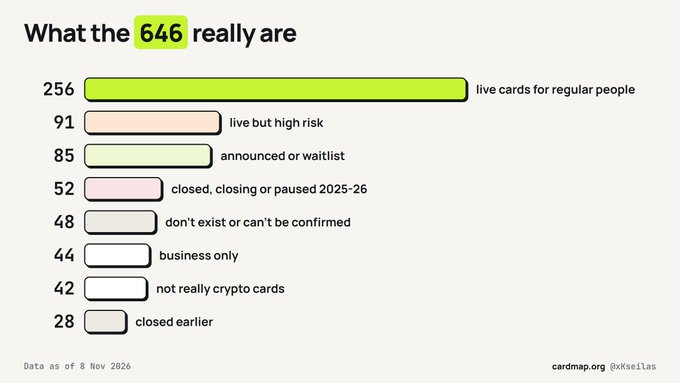
Out of 646 cards, only 109 can be rated. The discrepancy between high cashback promotions and actual costs and issuer risks is significant.
Written by: @xKseilas
Translated by: AididiaoJP, Foresight News
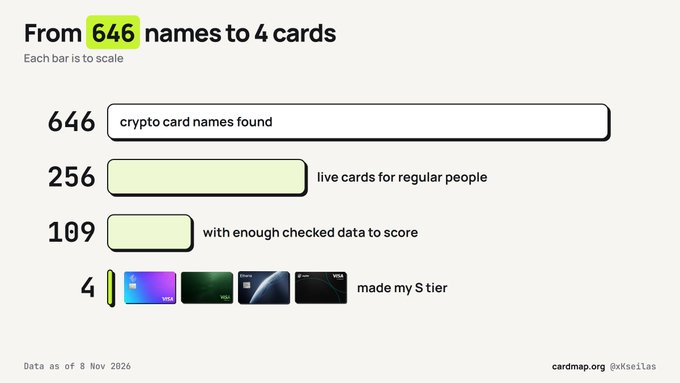
Data is current as of November 8, 2026. The author researched a total of 646 crypto cards available.
Among the 646 cards, only 256 are truly suitable for ordinary people to apply for and use actively. There are 91 cards that are live but pose high risks, such as those without identity verification, sold through Telegram bots, or with opaque issuers, thus not recommended for regular users. Additionally, 85 cards are merely announced or still under development, 52 cards have been closed, are set to close, or will be paused between 2025 and 2026, and 48 cards could not be verified or found. Among the remaining 114 cards, 44 are solely for businesses, 42 are not considered real crypto cards, and 28 were closed before 2025.
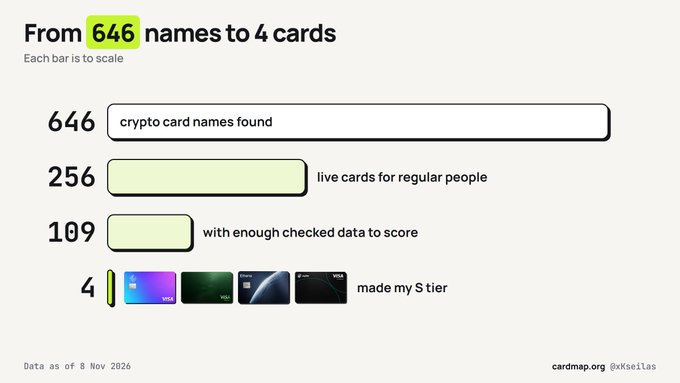
Of the 109 cards that have enough verifiable data, they were rated based on actual costs, real cashback, security, coverage, and daily usability. Grade S is above 72 points, with only 4 cards achieving this rating. Grade A is between 64 to 71.9 points, Grade B is between 55 to 63.9 points, Grade C is between 45 to 54.9 points, and Grade D is below 45 points.
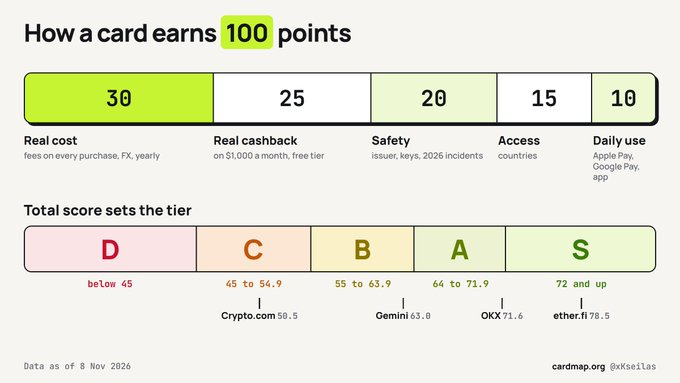
1. Let's first look at the conclusion: Only four cards are Grade S
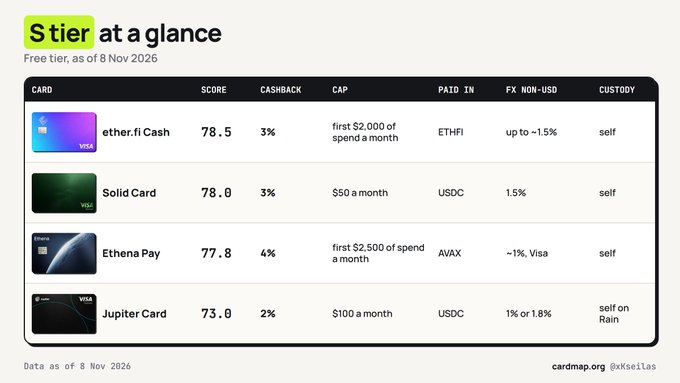
The four Grade S cards share common features: either they are self-custodial, have low fees, or offer redeemable cashback, but each comes with a cost.
ether.fi Cash (78.5 points): Best overall and also best for self-custody. Self-custody means crypto assets are kept in wallets controlled by the user. It is a Visa card issued by Third National under Visa's auspices.
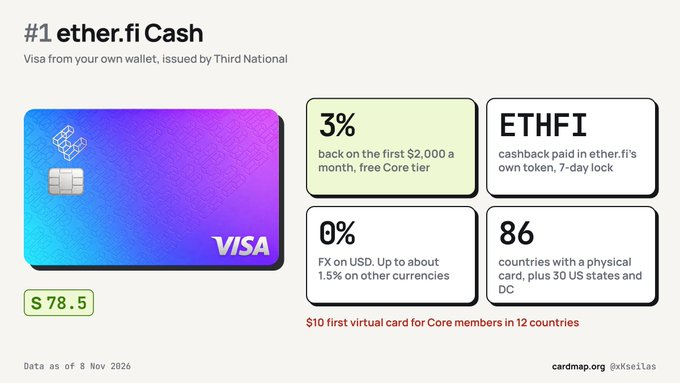
The free Core tier offers 3% cashback on the first $2000 spent monthly, paid in ether.fi’s own token ETHFI, locked for 7 days. The 3% cashback for euro spending only covers the first €800 per month. There are no foreign exchange fees for dollar spending; other currencies add 0.5% to the base rate, with a total maximum of approximately 1.5% based on the cardholder agreement with a base rate of 1%.
It covers 86 countries and regions, with Belgium and Ireland offering only virtual cards, while in the U.S., it is available across 30 states and Washington D.C. India, Indonesia, Turkey, and the Netherlands are not included. For users from 12 countries, the first virtual card in the Core tier costs $10, while the physical card charges $50. Accounts that remain inactive for 6 months may see unclaimed rewards expire.
Solid Card (78.0 points): Ideal for those seeking stablecoin cashback without using company tokens. It is a free virtual Visa, self-custodial, issued by Rain or Wirex by region.
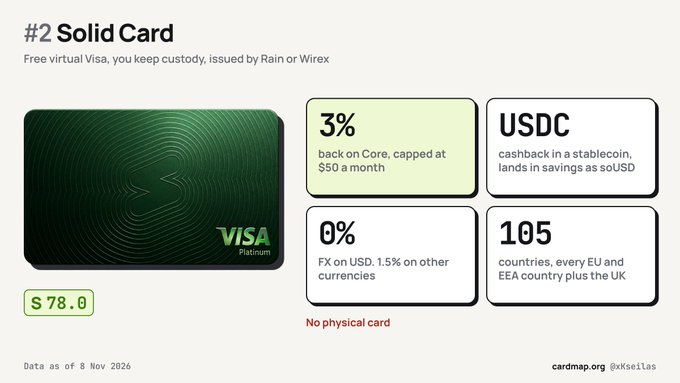
In the Core tier, it offers 3% cashback with a monthly cap of $50, paid in USDC. The Prime tier has an annual fee of $199, or you can lock 70,000 FUSE tokens for 12 months, offering 4% cashback with a monthly cap of $100; the Ultra tier requires locking 600,000 FUSE for 5% cashback with a $200 monthly cap. There are no foreign exchange fees for dollar spending; other currencies incur 1.5%. It covers 105 countries and over 30 U.S. states but lacks a physical card, and the credit model is still in early testing, limited to cards issued by Wirex.
Ethena Pay (77.8 points): Highest cashback. It is a Visa card issued by Third National and operated by Rain. It uses crypto assets as collateral to offer a credit limit with a 0% annual interest rate; the issuer does not custody the collateralized crypto assets.
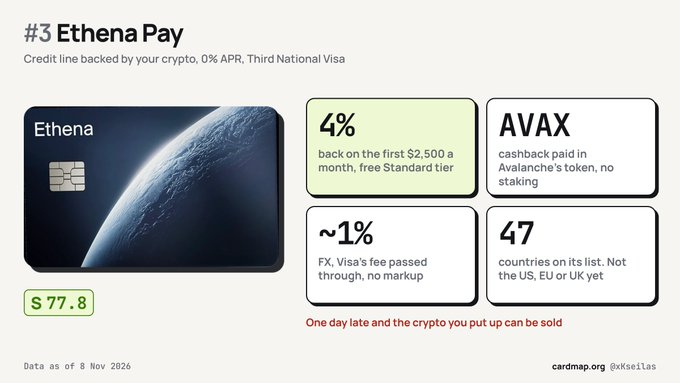
The free Standard tier offers 4% cashback on the first $2500 spent monthly, then 1% up to $4000, with no cashback on spending under $1. Cashback is paid in AVAX. The Pro tier offers 4.5% cashback, up to $8000; the VIP tier offers 5%, with a cap of $20,000, making the "maximum 5%" exclusive to VIPs. Foreign exchange fees are passed through at Visa's rates, about 1%, with no markup. ATM withdrawals incur a $1 fee plus 0.65%.
It is available in 47 countries, primarily in Latin America, the Caribbean, Asia, and Africa. The U.S., EU, UK, Switzerland, and Canada are listed as coming soon. The biggest risk is that if a repayment is late by one day, the collateralized crypto assets may be sold, with late fees of up to $40.
Jupiter Card (73.0 points): Allows spending only what is deposited. It is a Visa card issued by Rain or DCS by country.
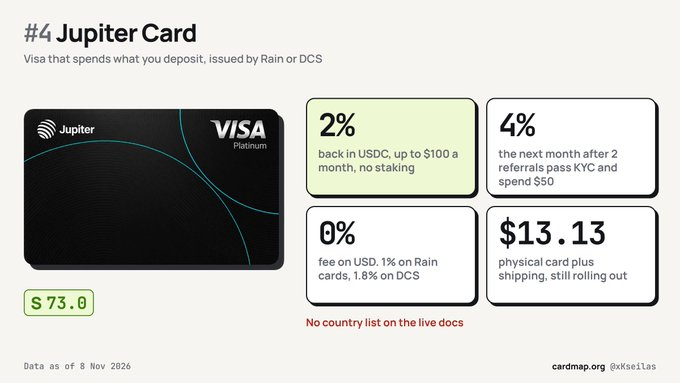
Offers 2% cashback, paid in USDC, with a monthly cap of $100, no staking required, and no annual fee. During a natural month, if two referrals are made, both verified and each spend $50, the cashback for the following month increases to 4% with a cap of $200. No fees for dollar spending; for non-dollar spending, Rain cards incur a 1% fee and DCS cards incur a 1.8% fee. The physical card costs $13.13 plus shipping and is still being rolled out. The Rain card is self-custodial, while the DCS card is held by DCS for balances; existing documents do not specify which countries use which issuer; DCS cards cannot be used for ATM withdrawals.
2. Regional favorites
The author selected the highest-rated card for each region based on the issuer's own list of countries. If a card misses a large market, a supplementary card covering those markets will be included.
United States: ether.fi Cash, covering 30 states and Washington D.C. For cashback on Bitcoin, choose Coinbase One Card.
European Union and UK: ether.fi Cash covers the UK and most of the European Economic Area, but does not include the Netherlands, Finland, or Estonia, with Belgium and Ireland offering only virtual cards. In these countries, choose Solid, which lists all EU and EEA countries plus the UK.
Latam: ether.fi Cash, covering Brazil, Mexico, Argentina, Colombia, Chile, Peru, etc. Solid is an alternative.
Asia: ether.fi Cash covers Hong Kong, Japan, South Korea, Singapore, Taiwan, Thailand, among others. Solid is an alternative, also listing Indonesia, Pakistan, and Vietnam.
Africa: Solid lists 10 African countries, including Nigeria, Kenya, Egypt, and South Africa. Ethena Pay is an alternative, covering 8 of those, excluding Nigeria and South Africa.
Travel and low fees: OKX Card. In the EEA and Norway, it charges no foreign exchange fees, only a 0.1% spread; U.S. cards do not charge foreign transaction fees.
3. Grade A: Low fees and cashback with limitations
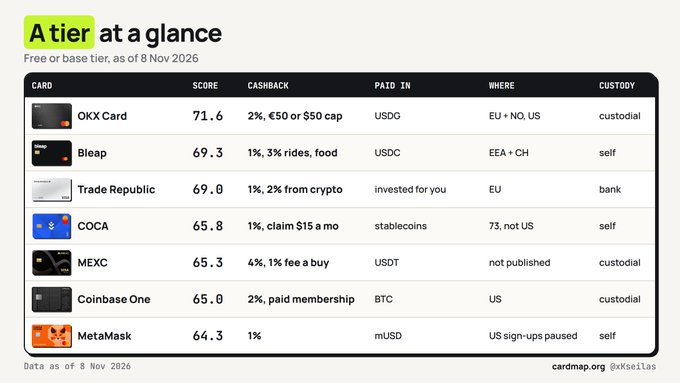
OKX Card (71.6 points): Offers virtual Mastercard for the EEA, covering the EU and Norway. OKX does not charge foreign exchange fees, with only a 0.1% spread when converting stablecoins to fiat. Cashback applies only to USDG payments: ordinary users get 2%, with a monthly cap of €50, paid in USDG; 4% to 10% requires an OKX VIP level, with a minimum asset threshold of $100,000.
The U.S. version launched in early November 2026, issued by WebBank as a virtual secured charge card: collateralizing stablecoins, then repaying with spending. Not available in New York, Massachusetts, and U.S. territories. The Classic tier offers 2% cashback with a cap of $50 per month, limited to USDG spending and requiring auto repayment; higher tiers allow for up to $1500 monthly cashback cap. No foreign exchange fees, no annual fees. The downside is custody, and only virtual cards are available; unpaid U.S. spending will be repaid by selling the collateralized stablecoins.
Bleap Card (69.3 points): Suitable for EEA and Switzerland. Self-custodial Mastercard debit card issued by Unlimit EU. No issuance fees, monthly fees, or foreign exchange fees, with spending at Mastercard's rates. Most spending earns 1% USDC cashback, with travel and food delivery offering 3%, and a monthly cap of €3000. Latvia issued it a MiCA license on June 25, 2026, covering crypto exchange services, but not the card itself.
Note: "Up to 20%" is limited to specified subscriptions with a small cap; the homepage still advertises a 2% promo for restaurants, which ended on May 31, 2026. Countries such as Italy and Spain in the EEA may not have launched yet. U.S. residents and nationals are not eligible. Android rating is 3.3, iOS is 4.6, with complaints primarily about registration codes and duplicate identity verification.
Trade Republic Card (69.0 points, rewards card): A debit card regulated by Germany's BaFin. Card payments have no foreign exchange fees, while ATM withdrawals over €100 are free; under that, there is a €1 fee. Card payments earn 1% Saveback, but you must have an active savings plan; using crypto holdings increases it to 2%, with a monthly cap of €1500. Each crypto payment counts as a sale, which may be taxable. Rewards are always invested for you. EU only. Virtual cards are free, physical cards cost €5 or €50 once.
COCA Card (65.8 points): Available in 73 countries, excluding the U.S., issued by Wirex. Self-custodial, documents claim zero annual fees, while physical cards of the lower tier cost $5. No staking earns 1%; to earn 3% to 8%, you need to stake 300 to 30,000 COCA tokens and must wait 30 days to reclaim tokens after leaving the tier. The free tier can only claim $15 monthly, with the rest rolling over, while unclaimed rewards expire after 12 months. Trustpilot rating is 2.9 with 30 reviews, recent complaints include missing deposits and slow support. It promises "direct currency pairs" with zero foreign exchange fees, but does not specify which currency pairs.
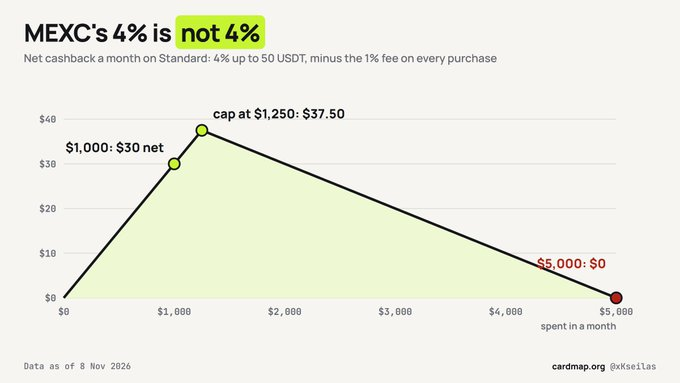
MEXC Card (65.3 points): Virtual Visa. The commission-free promotional launch ended on September 30, 2026; the Global card now charges $1 per transaction. Cashback is paid in USDT, received within three days. Standard tier offers 4% cashback, with a monthly cap of 50 USDT. Premier offers 6% cashback, with a cap of 150; Elite offers 10% cashback, with a cap of 800. In the Standard tier, spending $1000 earns $40 cashback, after a $10 service fee, netting around 3%. The 4% cashback requires activating “VVIP Standard,” with the tier derived from MEXC's M-Score; once spending hits $1250, a 1% fee continues to apply. MEXC claims to issue cards, but no cooperating bank has been disclosed.
Coinbase One Card (65.0 points, rewards card): U.S. Amex credit card issued by First Electronic Bank, U.S. only. No annual fees, no foreign transaction fees, but requires a paid Coinbase One membership. Earns 2% cashback in Bitcoin; holding $10,000, $50,000, and $200,000 in Coinbase increases it to 2.5%, 3%, and 4% respectively. Higher rates apply only to the first $10,000 spent each month. Coinbase One Basic annual fee is priced at $49.99; spending has an annual interest rate of 19.74% to 29.74%.
MetaMask Card (64.3 points): Self-custodial Mastercard issued by Monavate. Eligible spending earns 1% mUSD, which is MetaMask's dollar stablecoin. Free virtual card has no annual fee; native stablecoins incur no fees; merchants abroad incur a 1% fee; stablecoins that are neither native currency nor merchant currency incur a 0.5% fee; other crypto assets like wETH incur a 0.875% fee. Currently, new registrations in the U.S. are paused; Metal orders have been paused since June 2, 2026; cards issued before September 28, 2026, in the UK will be deactivated on December 29. The U.S. pause deducted coverage points in the rating.
4. Grade B: Usable, but don’t focus solely on cashback
Most Grade B cards are usable but lose points in terms of cashback, coverage, downtimes, or custody.
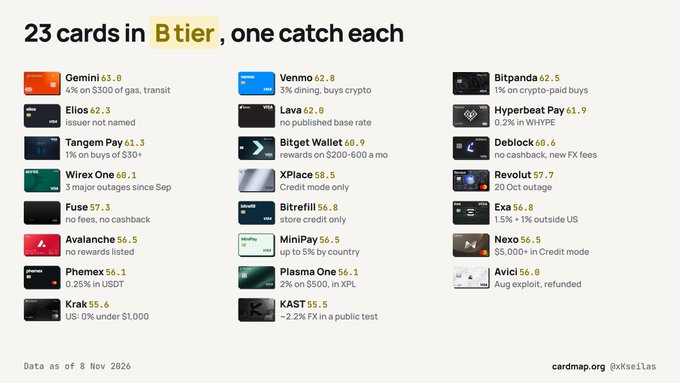
Gemini Credit Card (63.0, rewards card): U.S. WebBank Mastercard, no annual fees, no foreign exchange fees; 1% base rate, 4% on gas, charging, and public transport for the first $300 monthly, paid in Bitcoin, etc.; category discounts are time-limited. Trustpilot features complaints regarding being carded or reduced limits despite timely repayments.
Venmo Credit Card (62.8, rewards card): Synchrony Visa, no annual fees, no foreign exchange fees; new accounts earn 1% base rate, 3% on dining and entertainment; cashback can be automatically used to buy crypto without transaction fees, but the price includes the spread.
Bitpanda Card (62.5): Eurozone Visa debit; earns 1% only when paying with crypto, cashback is in the same currency; Visa's foreign exchange markup applies.
Elios (62.3): Self-custodial Visa debit; promotes 3% cashback for the first $1000 spent, then 1%, paid in USDC, promotions may vary; the issuing entity is not publicly stated.
Lava (62.0): Third National secured card, backed by dollar balances held in Lava; no annual fees, no foreign exchange fees; partner merchants offer up to 5% cashback in Bitcoin, base rate not disclosed.
Hyperbeat Pay (61.9): 0.2% WHYPE cashback, with higher balances and larger spending earning up to 1%; approximately 49 countries, including 35 U.S. states.
Tangem Pay (61.3): Free Basic tier earns 1% USDC cashback, with a monthly cap of $100, limited to spending above $30, in-store at European Economic Area merchants is not allowed; foreign currency incurs 1.5%.
Bitget Wallet Card (60.9, downgraded from A): Available in over 50 countries, excluding the U.S.; earns 2%, new users earn 3%, paid in BTC, tokenized gold or stocks, USDC; however, it only covers $200 to $600 monthly spending per country, leading to the downgrade; card balances are held by the card issuer, with no issuing entity disclosed.
Deblock (60.6): Free Standard tier has no cashback; the rate sheet as of October 13, 2026, states that non-euro payments during weekdays incur a 0.5% fee, and on weekends 1%; any card payments exceeding €1000 within 30 days are uniformly charged at 1%.
Wirex One (60.1): Free plan offers 0.5% cashback in USD, maximum 8% requires a $50,000 portfolio and 10% in WPAY tokens; 73 countries excluding the U.S.; independent open beta tests from June to September 2026 showed forex rates close to the mid-market; significant card downtimes were recorded on September 30, October 10, and November 2, marking it down to grade B.
XPlace (58.5): Third National self-custodial Visa; cashback is only available in the Credit mode, where crypto loans are used for spending, earning 0.5% to 2% USDC, capped monthly from $10 to $250.
Revolut (57.7, bank card): Spend crypto balances; UK Standard offers £1000 free exchanges monthly, then 1%; personal plans in the UK do not offer crypto cashback; on October 20, 2026, Google Cloud went down, impacting payment, ATM, and logins in the UK and Europe for several hours.
Fuse (57.3): Lead Bank virtual prepaid Visa, with no fees, ATM, or cashback; available in the U.S. excluding New York and Alaska, plus 17 countries in Latin America and Africa.
Bitrefill Card (56.8): EU Wallester card, no fees; deposits get 1% cashback plus spending cashback of 1%, only for Bitrefill store credits.
Exa (56.8): Free virtual Visa, no cashback; outside the U.S. incurs a 1.5% foreign exchange fee plus a 1% cross-border fee.
Avalanche Card (56.5): No card fee, foreign transactions incur a 1% fee, no rewards presented.
MiniPay (56.5): Free self-custodial virtual Visa on the Gnosis Pay platform, with continuing partner applications; up to 5% cashback by country, capped at $100 USDT or USDC monthly.
Nexo (56.5): Cashback is only available in Credit mode with crypto assets exceeding $5000, paid in NEXO or BTC; only for European residents.
Phemex (56.1): Free virtual Mastercard in the EEA, custodial, offering 0.25% USDT cashback; conversion spread not published.
Plasma One (56.1): Lite tier offers 2% cashback for the first $500 spent each month, thereafter 0.1%, paid in XPL; Lite foreign exchange incurs a 1% rate, plus about 1% for Visa.
Avici (56.0): Secured Visa credit card with no cashback; by the end of August 2026, a contract vulnerability on Solana affected 1685 Avici users, totaling about $500,859; Avici claimed to have refunded fully by the end of August, with costs borne by Rain.
Krak by Kraken (55.6): U.S. residents with an average balance under $1000 receive 0% cashback, foreign exchange is at Visa's rate plus 1%; in the UK and EEA, average balances of £200 or €200 earn 0.5%, with no foreign exchange fees; reports of downtimes on October 7 and 13, 2026.
KAST (55.5): Standard is free, earning 1.5% cashback for monthly spending under $2000; foreign exchange rates unpublished, independent public tests in September 18, 2026, showed rates exceeding the mid-market by 2.2%; points program stopped on November 30, converted to non-tradable Pioneer Units; Trustpilot rating is 2.8 with 280 reviews, recent complaints include frozen funds and verification issues.
5. Grade C/D and blacklisted cards
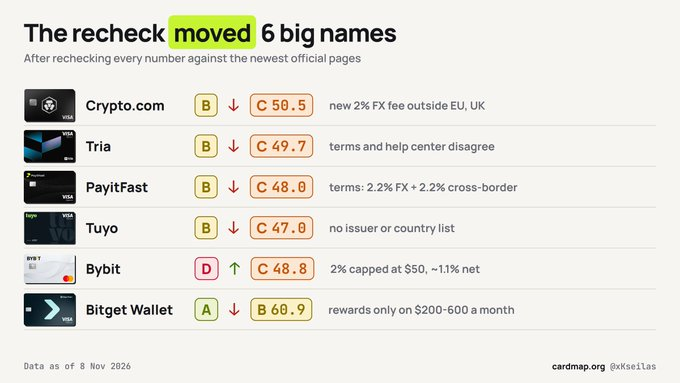
Among Grade C cards, there are several with no cashback in the free tier, or substantial cashback restrictions. Cryptocom Visa (50.5, downgraded from B) has a free Basic card with no cashback, and starting October 1, 2026, charges a 2% foreign exchange fee for spending outside the EU and UK. RedotPay (49.1) offers cashback only in the paid Pro tier, and it is limited to Apple Pay and Google Pay.
Several cards have issues with terms or conflicting data. Tria (49.7, downgraded from B) has discrepancies between the 1.5% terms in the Lite tier and what the help center states; in August 2026, a vulnerability in Rain's contract took approximately $432,000 from 636 Tria balances. Tria promised a full refund, and third-party tracking claims users received back their principal plus 10%, but the author could not access Tria's confirmation statement. PayitFast (48.0, downgraded from B) states 1% foreign exchange fees on the website, but on the card terms dated October 29, 2026, it states 2.2% plus a 2.2% cross-border fee, scoring based on terms.
Cards with complex fee structures also scored lower. Bybit (48.8, upgraded from D) charges a 0.9% conversion fee on all crypto top-ups in Australia, Brazil, and Mexico; it also charges on stablecoins in Argentina at 0.5%; cashback is 2%, with a cap of $50 after $500 spent monthly, netting about 1.1%. Tuyo (47.0, downgraded from B) offers a maximum cashback of 2% on foreign currencies, but has no published exchange rates, issuer, or country list.
The remaining 38 Grade C cards and 31 Grade D cards are listed in the blog, with most failing due to lack of cashback in the free tier or too narrow coverage.
Currently, the following cards should be avoided:
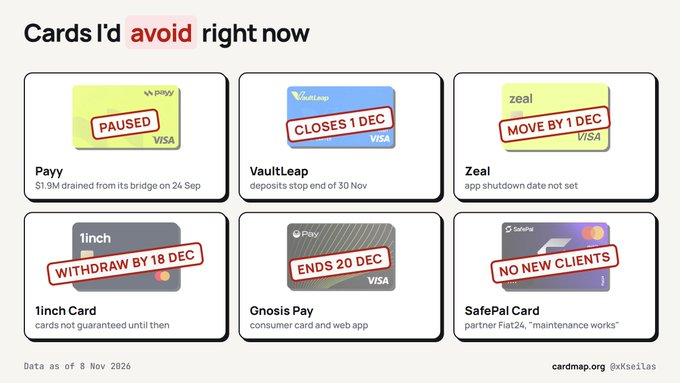
Payy: Approximately $1.9 million USDC was withdrawn from the Ethereum bridge on September 24, 2026. Deposit, withdrawal, transfer, and card payments are suspended. DiarioBitcoin reported on October 13 that Payy opened a 30-day claim period, eligible claims paid in USDC, and the wallet will close after the claim period ends. As of November 8, the author has not seen any relaunch notification.
VaultLeap: It is shutting down. Deposits will be stopped at the end of November 30, and cards, payments, and the App will close on December 1.
Zeal: Users are required to withdraw assets before December 1; the closing date for the App has not been determined.
1inch Card: It is in liquidation. Users are required to withdraw by December 18 and cannot guarantee card functionality by then.
Gnosis Pay: Consumer cards and the web App will stop on December 20. On November 6, it stated that unauthorized access to customer information occurred in the old card system, with no impact on funds. Prior to card suspension, all online payments required 3DS extra confirmation. Funds remain in the user's Safe wallet.
SafePal Card: The account and card partner Fiat24 stated that "due to maintenance," new customer applications are not being accepted (checked on November 8). TechFlow reported on July 30 that Fiat24 suspended crypto deposits since July 14. SafePal's own page has not notified.
Holyheld is now invite-only; fees and issuing entities for GMGN Card cannot be verified. Being unable to verify is not enough to include it on the blacklisting.
6. The wave of closures from 2025 to 2026
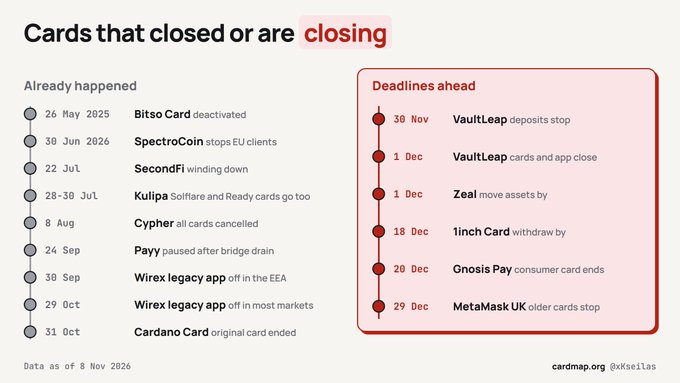
On May 26, 2025, Bitso Card was deactivated.
On June 30, 2026, SpectroCoin, without a MiCA license, ceased to open accounts, accept deposits, and exchanges for EU customers. France's AMF revoked Vancelian's PSAN registration.
On July 22, 2026, SecondFi stated that approximately 16.1 million ADA were stolen from 374 wallets before the liquidation was disclosed at the end of June.
From July 28 to 30, 2026, issuing party Kulipa ceased operations; they had issued over 120,000 cards, affecting Solflare and Ready cards.
On August 8, 2026, after Nium acquired Cypher, all Cypher cards were canceled, including Moonwell cards.
On September 30 and October 29, 2026, Wirex closed the old custodial App in the EEA before suspending most other markets.
On October 31, 2026, the original EMURGO and Wirex Cardano cards ended.
As of November 8, PlasBit's website is down, and the author could not find a closure notification.
7. The three models behind the 646 cards
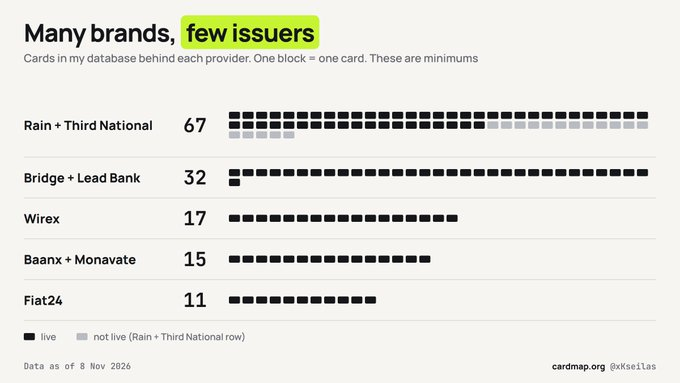
First, the issuers are highly concentrated. Visa reported in its Q4 fiscal year 2026 earnings call on October 27 that it has over 225 stablecoin-linked card programs, with around 5 million cards in more than 50 countries. In the author's database, Rain and Third National frequently appear together, backing 67 cards, 50 of which are active; Bridge and Lead Bank back 32, Wirex 17, Baanx and Monavate 15, and Fiat24 is mentioned for 11. This is still a lower estimate, as many issuers do not disclose data.
Second, when shared service providers encounter issues, multiple cards can collapse simultaneously. On August 28, 2026, a contract vulnerability on Solana affected Avici, Tria, and at least another project simultaneously, with Blockaid estimating a total of approximately $1.1 million.
Third, among high-risk cards, those without identity verification are the hardest hit. Out of 91 high-risk cards, 57 are KYC-exempt, sold through Telegram bots or advertised card platforms. Users reported a card withdrawal took six months, with warning sites stating that certain Telegram card bots request users' mnemonic phrases.
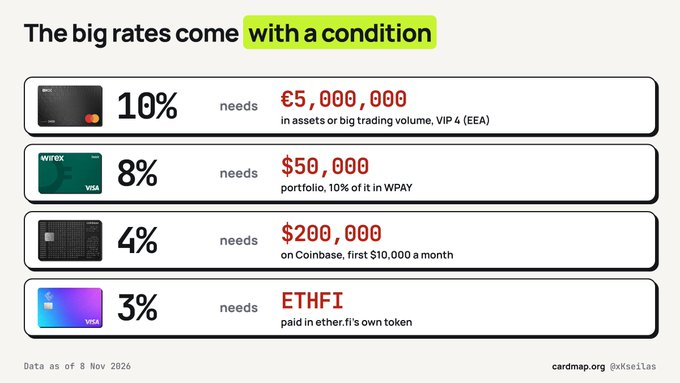
The high cashback promoted often comes with conditions. ether.fi pays in its own token; OKX requires VIP 4 for 10% in the EEA, which involves $5 million in assets or a matching trading volume over 30 days; Wirex One's 8% requires a $50,000 minimum and 10% in WPAY; Coinbase's 4% requires holding $200,000 in Coinbase, with rates dropping to 2% after the first $10,000 spent per month.
The author also found 28 reward cards, which are bank cards that earn fiat currency and return crypto assets or invest for you. 20 are active, with two making it into Grade A.
8. Selecting cards involves four considerations
In this ranking, the cost bore the highest weight because fees are charged per transaction. Cashback rules change rapidly: Bybit ceased offering cashback on fiat recharge spending on October 5, 2026, and KAST will stop awarding points on November 30.
When selecting cards, do not just look at promotional rates. First, consider the actual cost, then assess if the cashback can be redeemed, subsequently check the issuer and custody security, and lastly look at coverage and daily usage. High cashback that requires payment in the issuer's own tokens, locks, high asset tiers, or lacks transparency from the issuer should be regarded with caution.
免责声明:本文章仅代表作者个人观点,不代表本平台的立场和观点。本文章仅供信息分享,不构成对任何人的任何投资建议。用户与作者之间的任何争议,与本平台无关。如网页中刊载的文章或图片涉及侵权,请提供相关的权利证明和身份证明发送邮件到[email protected],本平台相关工作人员将会进行核查。