
Author: Biteye
Recently, the contract trading in the Crypto sphere has started to heat up again.
From Kraken's layout of trader "exam accounts" to OKX's recent launch of "contract platters," major trading platforms are exploring new contract trading methods.
Among them, the "exam account" has attracted the attention of many traders: by spending a few dozen dollars, there is an opportunity to obtain trading limits of several thousand or even tens of thousands of dollars, earn qualifying profits, and also receive a proportional share.
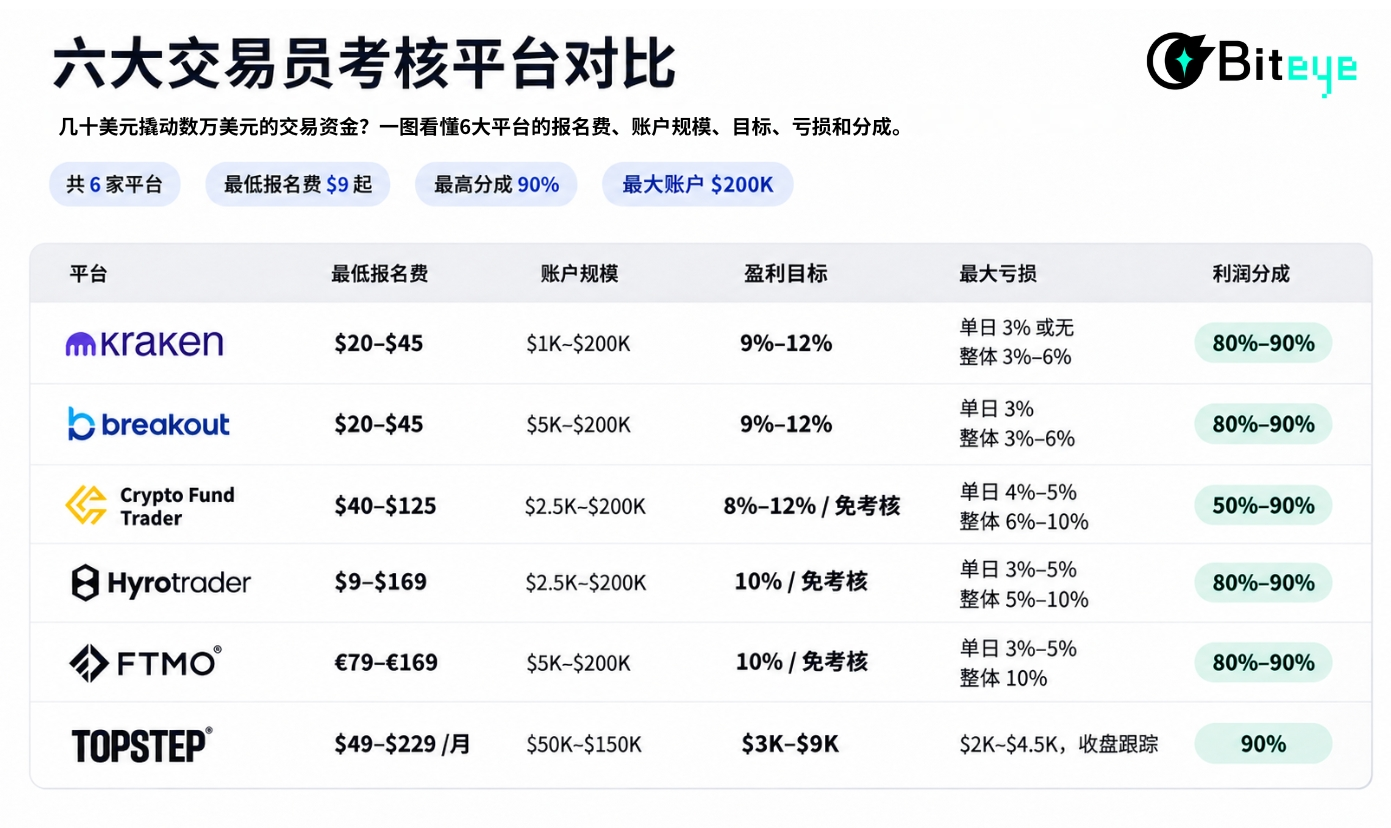
So, which mainstream platforms are currently available? What size of account limits can you really obtain for a few dozen dollars? How should users with different trading habits choose? This article organizes the rules and fees of six trader assessment platforms
How do exam accounts work?
In simple terms, an exam account is purchasing a simulated trading account to complete an assessment based on trading performance.
For example, buying a 5K account with a profit target of 10% and a maximum loss of 6%. You need to grow the account from $5,000 to $5,500, while not dropping below $4,700.
Passing the assessment does not mean you can withdraw directly. The platform will provide a new withdrawal account, and users need to continue trading. After meeting the withdrawal conditions, they can receive real rewards based on the agreed ratio. For instance, in an 80-20 split, generating a qualified profit of $1,000 from the new account would yield $800.
It is important to note that all trading is simulated, and rewards are paid by the platform. The platform mainly earns income through enrollment fees, reset fees, etc. Some platforms may also utilize the traders' data for real trading.
Among the six mainstream exam account platforms, which one is worth paying attention to?
1. Kraken: Official exchange exam account, starting from $20
Kraken currently has two exam account types: Kraken Funded and Kraken Prop, both supporting trading of crypto assets like BTC and ETH.
Kraken Funded is mainly aimed at beginners, operated directly within the Kraken App, starting from $20 with no leverage support. Users must achieve specified profit targets through simulated trading while adhering to loss limits. After passing the assessment, eligible profits from continued trading can be split at 80%.
Kraken Prop is designed for users with certain trading experience, using the Kraken Pro interface, supporting over 60 crypto trading pairs, with a maximum leverage of 5 times for BTC and ETH. There are no time limits, minimum trading days, or consistency requirements for the assessment. Upon passing, a simulated withdrawal account is provided, and eligible profits can be split at up to 90%.
2. Breakout: Acquired by Kraken, focused on Crypto trading
Breakout is a prop firm specifically for crypto traders, acquired by Kraken in September 2025. It supports over 60 crypto trading pairs including BTC and ETH, as well as some traditional financial instruments like stock indices and commodities.
The platform offers Classic, Pro, Turbo, and other assessment routes, primarily differing in profit targets, maximum loss amounts, and enrollment fees. It uses a fixed maximum loss line that does not increase with profits, and there are no assessment deadlines, minimum trading days, or consistency requirements.
Upon passing, default profit sharing is at 80%, which can be upgraded to 90% for a fee, supporting withdrawals in USDC. The minimum withdrawal amount is $50 after profit sharing, and users can apply once they meet the requirements.
3. Crypto Fund Trader: Supports Bybit, covers a large number of altcoins
Crypto Fund Trader is a crypto-native assessment platform that supports trading through Bybit, Match-Trader, MT5, etc., covering BTC, ETH, SOL, and a large number of altcoin trading pairs.
The platform offers One Phase, Two Phases, and Instant no-exam options, with account sizes up to 200K, and some products with leverage up to 100 times.
For example, in a single-phase assessment, some packages have a profit target of 10%, a daily maximum loss of 4%, an overall maximum loss of 6%, and there are no assessment deadlines. Weekend trading and overnight positions are allowed, but there are restrictions on high-frequency arbitrage and abnormal trading behaviors.
4. HyroTrader: Supports Bybit, BloFin, offering various assessment modes
HyroTrader is a prop firm focused on crypto perpetual contracts, supporting assessments via simulated accounts on exchanges like Bybit and BloFin, primarily trading USDT perpetual contracts.
The platform offers routes including Hyro Core, One-Step, Two-Step, and Instant, starting from $9. For One-Step, the profit target is 10%, with a daily maximum loss of 4%, an overall maximum loss of 8%, and it has minimum trading days and consistency requirements.
After passing the assessment, profit sharing starts at 80%, with qualifying users able to reach up to 90%, supporting withdrawals in USDT and USDC. The platform also has certain restrictions on cross-account hedging and martingale strategies.
5. FTMO: Established prop firm, supports crypto, gold, and forex
FTMO was established in 2015 and is a well-known comprehensive prop firm. It supports crypto asset CFDs such as BTC and ETH, along with traditional financial instruments like forex, gold, oil, and the Nasdaq.
The platform offers single-phase and double-phase assessments, with account sizes, profit targets, and loss limits depending on the package. The typical profit targets for conventional double-phase assessments are 10% and 5%, with daily and overall maximum loss limits set.
Upon passing, single-phase account profit sharing is usually 90%, while double-phase accounts start at 80% but can increase to 90% if growth plan conditions are met. It supports bank transfers and withdrawals in some cryptocurrencies.
6. Topstep: A well-known traditional futures platform, suitable for Nasdaq and gold trading
Topstep is a prop firm focused on CME futures, mainly covering traditional futures such as Nasdaq, S&P, gold, and oil, using its own TopstepX trading platform.
The platform offers three account sizes: 50K, 100K, and 150K. For example, the 50K account has a Standard monthly fee of $49, with an additional activation fee of $149 after passing the assessment; the fee-free version has a monthly fee of $95.
After passing the assessment, users must meet specified profitable days or consistency withdrawal conditions, with profit sharing typically at 90%. Unlike crypto perpetual contracts, Topstep trades standardized futures on CME, suitable for users looking to engage with the traditional futures market.
How to choose for the first time buying an exam account?
For users experiencing exam accounts for the first time, it is recommended to consider enrollment fees, account sizes, and trading instruments comprehensively, rather than solely pursuing higher capital multiples.
1. Overall cost-effectiveness: Kraken Prop Starter
While Kraken Prop Advanced only requires $20, the initial loss space is limited to $150. In contrast, the Starter enrollment fee is $45, raising the loss space to $300. For users primarily trading BTC and ETH, Starter offers a relatively balanced option between cost and risk tolerance.
2. Low-cost experience: HyroTrader Core
For users who have not yet engaged in trading assessments, starting with a low-cost package is advisable. HyroTrader Core starts at $9, corresponding to a 2.5K account, with a nominal account limit approximately 278 times the enrollment fee. Even if the assessment fails, the initial investment is relatively limited.
3. Multi-coin trading: Crypto Fund Trader 1 Phase
For users accustomed to trading altcoins, the coverage of trading varieties is extensive. CFT's lowest package at $40 corresponds to a 5K account, supporting trading through Bybit, covering numerous crypto perpetual contracts, suitable for those wishing to continue their existing trading strategies and habits.
In conclusion
The popularity of exam accounts also reflects a shift in trading demand in the crypto market: rather than directly putting out thousands or tens of thousands of dollars as capital, many traders are more willing to spend a few dozen dollars to seek larger-scale trading opportunities.
For platforms, this has also become a new revenue channel. In addition to traditional trading fees, they can earn income from enrollment fees, account reset fees, subscription fees, and more.
However, low enrollment fees can easily lead to overlooking accumulated costs. Spending a few dozen dollars may seem inexpensive, but if you keep buying after failures, you might end up spending hundreds or even thousands of dollars.
免责声明:本文章仅代表作者个人观点,不代表本平台的立场和观点。本文章仅供信息分享,不构成对任何人的任何投资建议。用户与作者之间的任何争议,与本平台无关。如网页中刊载的文章或图片涉及侵权,请提供相关的权利证明和身份证明发送邮件到[email protected],本平台相关工作人员将会进行核查。


