Binance announces that it has fully compensated $6.3 billion in stolen crypto assets.
Written by: Bao Yilong
Binance announces that it has fully compensated $6.3 billion in stolen crypto assets, marking the end of the largest cryptocurrency network theft in history.
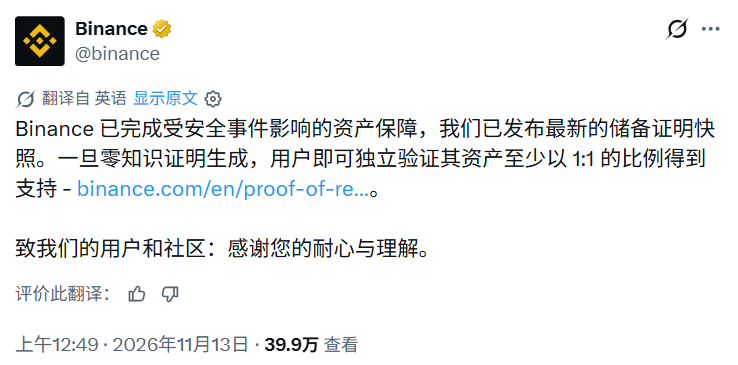
On November 12, Thursday, Binance confirmed in a post on its X platform account that all stolen assets have been fully compensated. Binance wrote in the post:
Thank you to users and the community for your patience and understanding.
Reportedly, the U.S. Department of Justice stated it would seize the $1.2 billion worth of cryptocurrency assets stolen from Binance by the hackers. U.S. government agencies and the private sector have frozen over $2.7 billion in stolen funds.
The world's largest cryptocurrency exchange recovered most of the stolen tokens within days using its own profits and emergency reserve funds after suffering a hacking incident on October 29.
This case not only affected mainstream cryptocurrencies like Bitcoin but also involved a large number of obscure tokens, creating additional challenges for Binance in its recovery and compensation efforts. The incident once again raised doubts about the cybersecurity level of the entire digital asset industry, especially as the crypto market is accelerating its integration into the mainstream financial system.
The compensation process went through multiple phases
After the incident, Binance acted quickly, using company profits and emergency reserve funds to compensate the vast majority of stolen tokens within a few days. However, according to the company, the remaining approximately 10% of the assets, involving low liquidity obscure tokens, would require more time to source and purchase in the market.
Throughout the compensation process, Binance consistently promised to fully cover user losses. With the completion of compensation work announced on Thursday, this promise was finally fulfilled.
According to Bloomberg, data from blockchain analysis firm Elliptic shows that the hackers used highly automated methods to transfer and launder stolen assets. Within less than a week after the incident, related money laundering operations involved over 20,000 digital wallets and executed at least 65,000 transactions, equivalent to launching a new wallet every 30 seconds and completing a transaction every 10 seconds.
Reportedly, the hackers' money laundering path was intricate, transferring stolen tokens through thousands of digital wallets and spanning multiple blockchains to obscure the source of funds. Among these, the hackers also used meme coins to complete approximately $430,000 in fund laundering.
A fake recruitment email buried the loophole
Reportedly, the core vulnerability of this incident was that an engineer fell victim to a phishing attack—the attackers lured with a forged job invitation to carry out the intrusion. This detail highlights the fragility of human factors in security protection within the cryptocurrency industry, even the largest exchange in the world is not immune.
This theft incident is not an isolated case. It is reported that cryptocurrency exchanges Bitget and Bybit, as well as hardware wallet-focused Coinkite and Ledger, have all recently experienced significant security incidents.
As the cryptocurrency industry boldly strides towards mainstream finance, the aforementioned events collectively reveal systemic cybersecurity risks within the industry.
免责声明:本文章仅代表作者个人观点,不代表本平台的立场和观点。本文章仅供信息分享,不构成对任何人的任何投资建议。用户与作者之间的任何争议,与本平台无关。如网页中刊载的文章或图片涉及侵权,请提供相关的权利证明和身份证明发送邮件到[email protected],本平台相关工作人员将会进行核查。


