Author: David, Deep Tide TechFlow
Deep Tide Introduction:
While the outside world is still guessing whether Jensen Huang will resign due to a double extramarital affair, Musk publicly took the opportunity with the phrase "It is my honor." This is not merely a polite gesture between tech giants at the center of controversy; behind it is the deep commercial and political binding of the two companies. SpaceX has just finalized a GPU financing lease worth about $40 billion, betting its future computing power entirely on Nvidia, which holds over $21 billion worth of SpaceX shares. In the complex game involving Trump, Congress, and chip exports, Musk's protection of Huang is essentially safeguarding his own lifeline of computing power.
Just days ago, 63-year-old Jensen Huang sent a letter to all employees admitting to extramarital affairs, after which Nvidia's board announced the initiation of an independent investigation. Before the storm could calm down, media outlets reported subsequent revelation of a second inappropriate relationship with a subordinate vice president, as well as queries from U.S. Congress members regarding chip exports and national security risks. Wall Street even started to circulate news of board meetings discussing his future.
Old Huang's crisis is rapidly evolving from personal moral issues into a political storm involving corporate governance and White House oversight.
Musk's statement at this moment is certainly not merely about loyalty. Beneath this jest lies a colossal computing power account that neither side can afford to lose, as well as a web of interests that is already intricately woven together.
$40 billion in computing power and $21 billion in equity, the two companies have long been mutually locked in
The reason Musk is more nervous about Huang’s position than anyone else is that his AI business empire has already bet all its fortunes on Nvidia's roadmap.
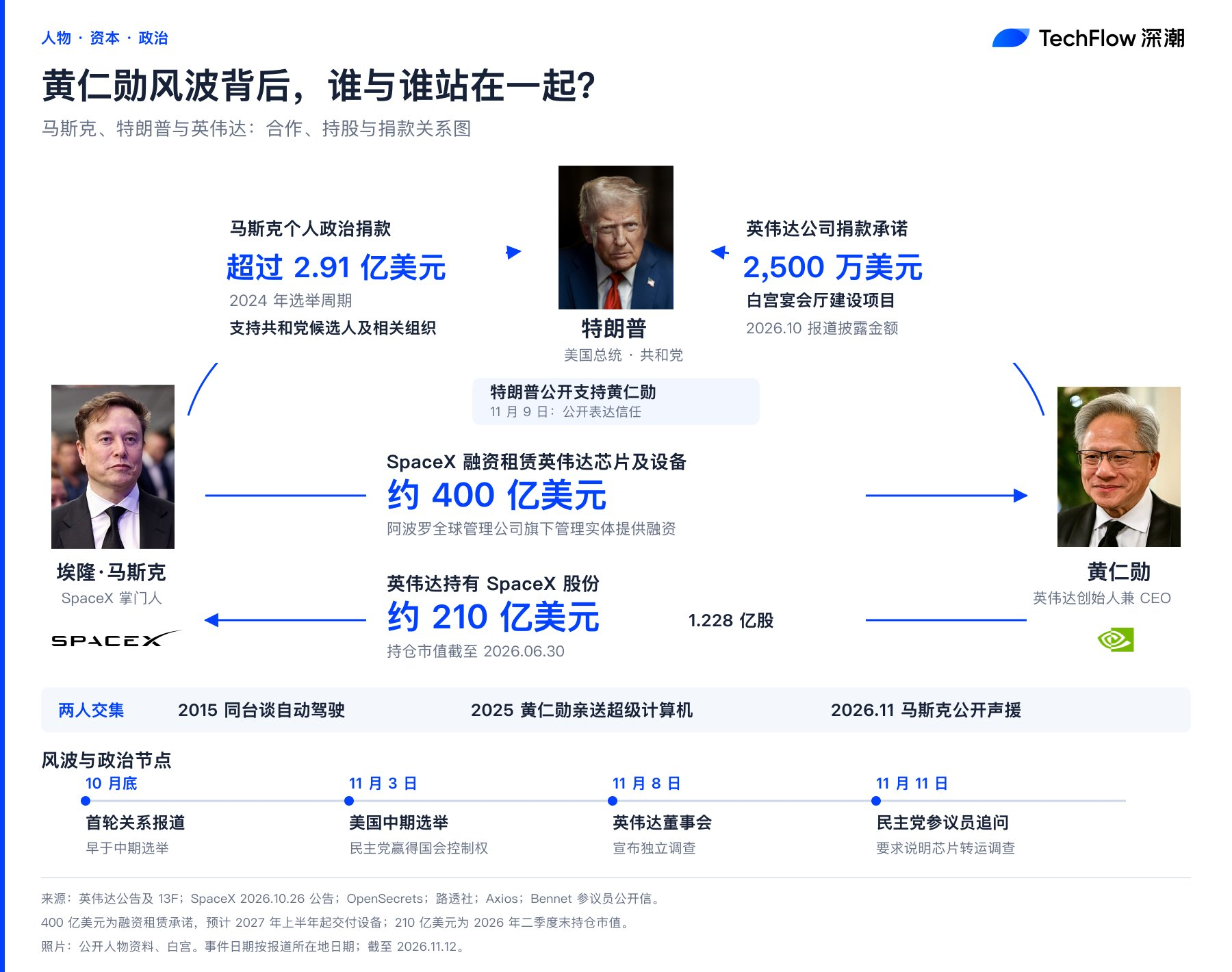
This year, SpaceX and the integrated xAI cluster have clearly announced that their data centers will exclusively adopt Nvidia architecture, particularly the next-generation Vera Rubin chip. To support the massive model training and integrated computing between air and space, Musk recently finalized a GPU financing lease agreement worth about $40 billion. This colossal transaction is led by Wall Street asset management giants like Apollo Global Management, with equipment scheduled for phased delivery starting in the first half of 2027.
This is not an ordinary procurement contract, but a long-term capacity bet. During a period of extreme shortage of advanced computing power, who can secure the first-row chip quotas and whose data centers can get powered first often depends on a single word from the steering figures.
On the Nvidia side, it is already no longer a simple hardware seller.
Through early strategic investment in xAI, Nvidia holds approximately 122.8 million shares of SpaceX on its balance sheet. As of the end of the second quarter this year, this equity's book valuation exceeds $21 billion, making it a significant ballast in Nvidia's external investment portfolio.
Money and goods have formed a rare two-way closed loop between these two giants. Musk uses the funds raised from Wall Street to massively lock in Huang's capacity, while Nvidia reversely deposits its earned profits and capital as equity in Musk's rocket company.
In such a highly intertwined structure, Huang is not just a CEO; he is the trust center in the entire performance chain. If Nvidia is forced to change leadership or falls into a long internal governance tug-of-war, any prioritization adjustments or delays in delivering the next-generation architecture will put Musk in a tight spot first.
Allies at the White House card table, no one can withstand a supply chain reshuffle
Beyond business accounts, the two also stand in the same camp on the political coordinates in Washington.
In the recently passed U.S. election cycle, Musk poured over $291 million into political action committees and organizations supporting Trump, becoming a core financier for the Republican Party's return to the White House.
Nvidia is equally well-versed in the survival philosophy of Washington. At a sensitive moment when there were subtle games regarding U.S. chip export controls to China, Nvidia committed $25 million to a White House banquet hall construction project, ranking alongside Apple at the highest level.
Thus, when Huang's troubles first emerged, even being labeled with espionage and export loophole allegations, Trump immediately spoke up, asserting that Huang is a "good person" and clearly indicating that he does not believe Huang would be aware of any supposed intelligence activities.
This statement is not accidental. Washington's control over advanced chips is forming a new divide, and as congressional seats are shifting, some lawmakers are calling for special investigations into chip transshipments and Southeast Asian data center issues, placing Huang at the target of bipartisan games.
For Musk, Trump’s trust serves as a protective moat for his policy influence, while a head of Nvidia who can directly communicate in the White House and withstand extreme Congressional pressure becomes the cornerstone for maintaining stability in the domestic AI supply chain.
As the battle for computing power reaches this point, the ability to control chip capacity and explain industry logic in the Oval Office is far more practically valuable than an entrepreneur's moral standing.
Machines cannot stop, morality can only be postponed
Looking back at Musk's statement "It is my honor," rather than throwing an olive branch to Huang, it can be seen as him publicly standing for their alliance.
The details of the extramarital affair may be magnified by the media, and violations in the上下级关系 (superior-subordinate relationship) will also be checked by external lawyers, but in the face of the hundreds of billions of dollars in computing arms race, these are ultimately just interludes.
Musk knows very well that for every day the world's most advanced AI cluster lies idle, depreciation and electricity costs are astronomical; without Nvidia controlled by Huang, the entire scheduling of chips in Silicon Valley would have to be rewritten.
Politicians in Washington care about hearings and geopolitical accusations, independent directors on boards focus on compliance processes and reputational risks, while the tech oligarchs sitting at the computing power table only care about whether they can get powered on schedule next week.
Musk made his position very clear with a joke. In this game of computing power and power, as long as the machines keep running, Old Huang's position is certainly not just his alone.
免责声明:本文章仅代表作者个人观点,不代表本平台的立场和观点。本文章仅供信息分享,不构成对任何人的任何投资建议。用户与作者之间的任何争议,与本平台无关。如网页中刊载的文章或图片涉及侵权,请提供相关的权利证明和身份证明发送邮件到[email protected],本平台相关工作人员将会进行核查。


