
Author: 0xBilly
Anthropic pre-market contract arbitrage is a rare opportunity in the market where both capacity and profitability are quite substantial. If you missed the bus this time, or did not invest heavily enough, I think it is necessary for you to review the entire arbitrage process with me and understand why such a huge opportunity still did not attract significant investment after we made it public.
The complete logic of this arbitrage can be found in my previous post. Today, I will only review two things:
- Timeline: Which events over the two weeks drove the spread to converge, which events caused it to widen, which events affected the win rate, and which events influenced the odds;
- Micro-operations: Under the premise that the big logic remains unchanged, how I managed my positions in real-time based on the aforementioned external events.
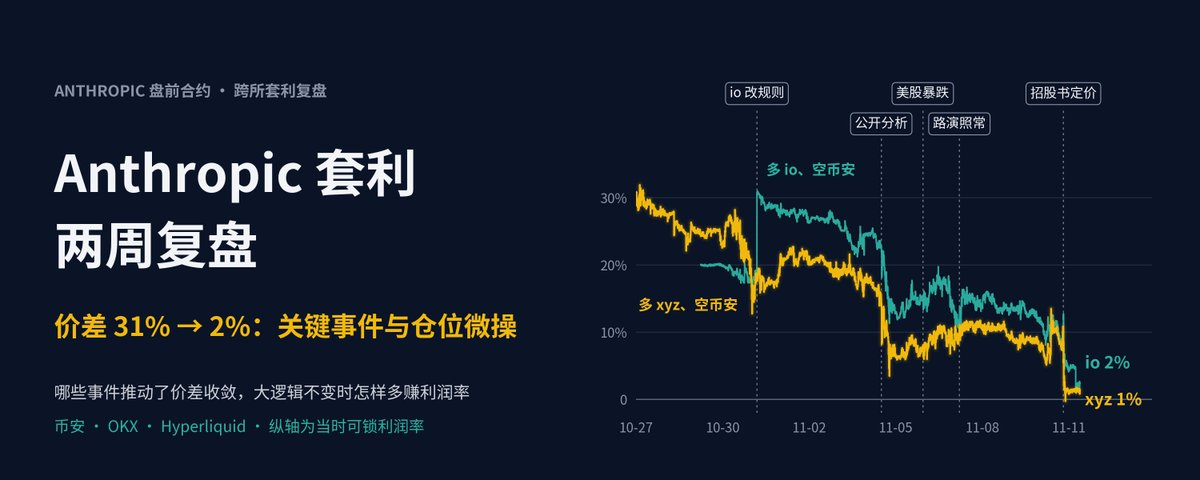
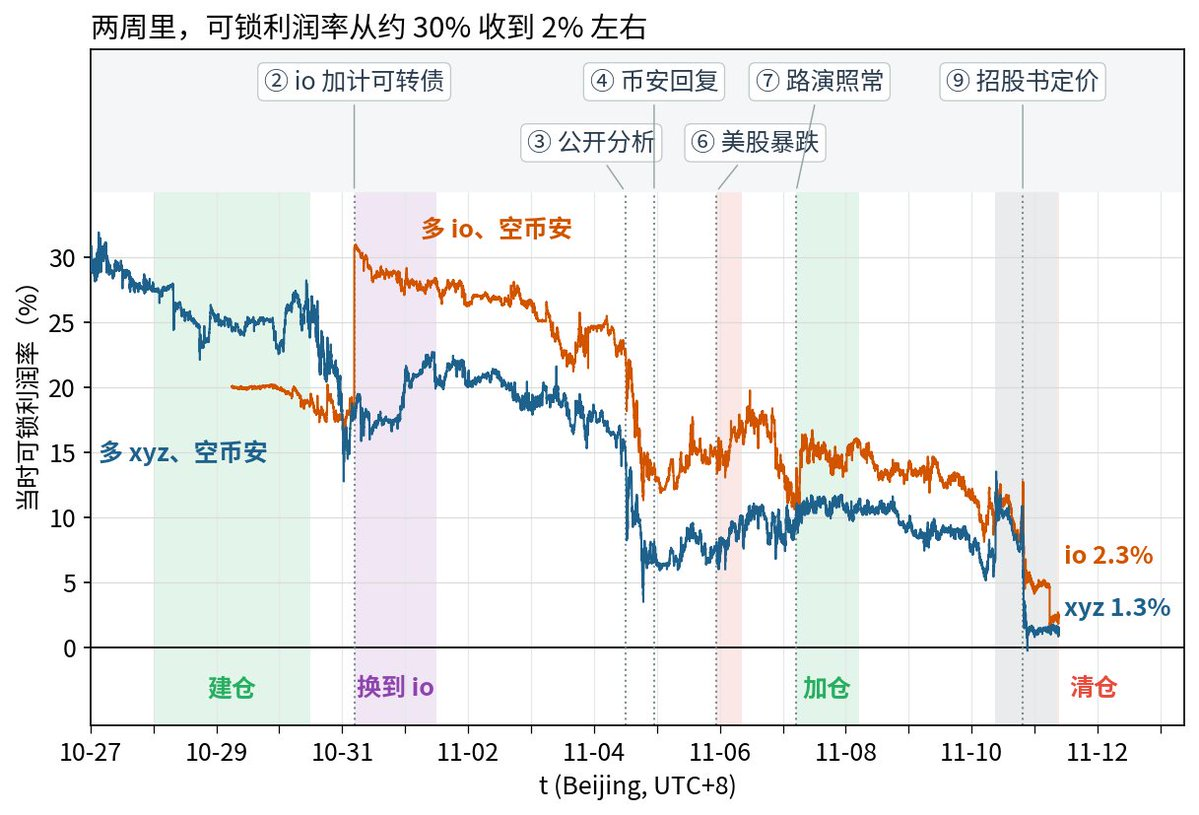
Let’s start with the conclusion: The spread converged from about 30% to around 2% over the two weeks, and I have completely closed all positions to secure profits. Before we publicly analyzed it, we had hardly monitored any competitors; after making it public, there were actually two good entry points: one was in the first few hours after our tweet was released, and the other was on 11-07 when the roadshow was confirmed to go ahead as usual: all rules were substantiated, yet there was still about 15% remaining in profitability, with a sufficiently long window for opening positions.
1. What was earned from this trade
Anthropic has not yet gone public, and several exchanges launched “pre-market contracts” that will be converted to stock prices after the IPO. The key is how many shares each contract converts to when listed:
- Binance quotes based on “valuation ÷ 1 billion,” with the market reporting 13 trillion, so Binance quotes about 1,300. However, when it listed, it only converted based on the total share capital after issuance, converting about 13.1 shares per contract.
- The market's valuation is based on fully diluted standards (total shares plus options, RSUs, convertible bonds, etc. that might become stock in the future, about 17.5 billion shares). 13 trillion corresponds to about $74 per share, and 13.1 shares are worth about $970, but Binance is selling at 1,300. With about a quarter fewer shares, the price is roughly a third more expensive.
- Hyperliquid has two contracts priced in stocks: xyz:ANT (trade.xyz) quotes directly per share; io:ANTH (Entropy) converts according to fully diluted shares, converting to about 17.5 shares after listing. Neither of these has this pricing error.
Therefore, the approach is long HL, short Binance, balancing based on the number of shares each is set to convert to at listing. Regardless of whether Anthropic rises or falls after the IPO, at the moment of conversion, the share difference is locked in. The meanings of several terms below:
- Route: Long xyz, short Binance is called the “xyz route”, long io, short Binance is called the “io route”.
- Lockable profitability: If we establish a position now and hold it until the listing conversion, we can lock in the profits (calculated based on the amount invested in HL). At the opening, the xyz route was about 30%.
2. Before making it public: No competitors
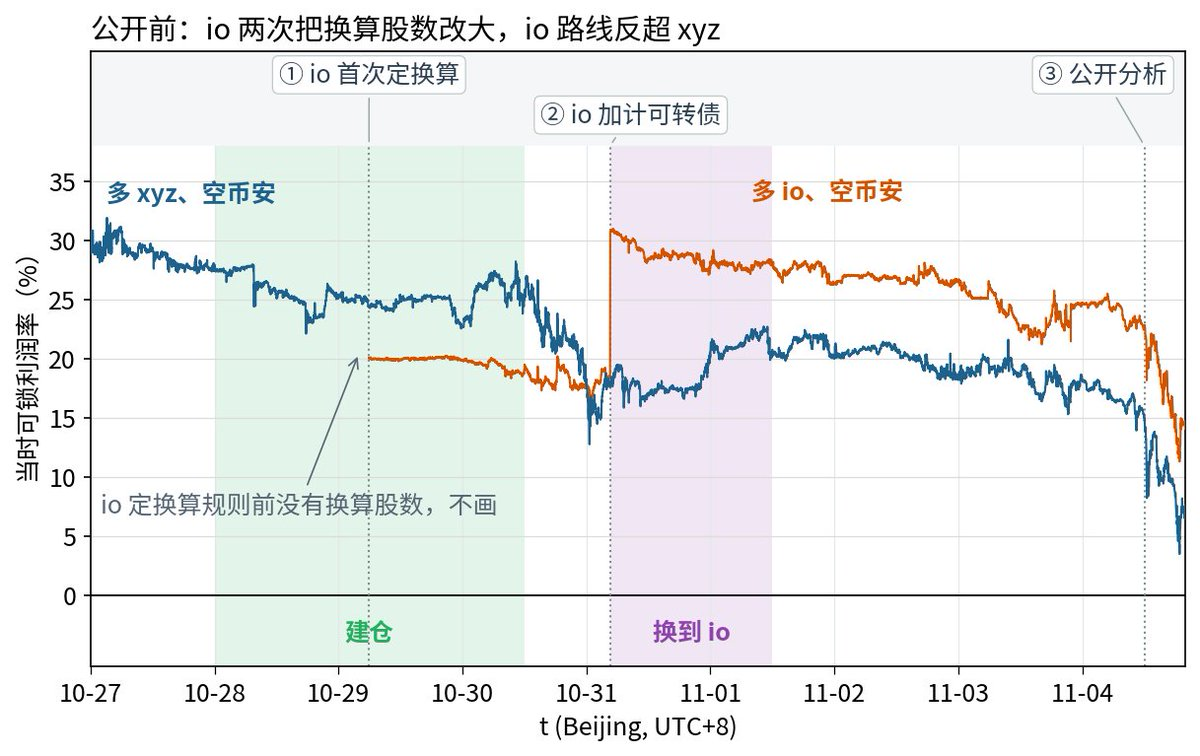
To enter this period, one must thoroughly study the prospectus and the rules of the four exchanges, confirming that Binance would convert based on total shares, which has a high barrier to entry. From our monitoring at the time, it was clear that during this stage, basically only my collaborators and I were engaging in this arbitrage.
During this time, we built positions with the xyz route initially. Later, the io conversion rules changed twice:
- ① On 10-29, io first outlined the conversion rules: After going public, it would convert based on “total shares + options + RSUs”, approximating about 15.3 billion shares. The io route was about 20%, not as good as xyz route's approximately 24%, so we continued with xyz.
- ② On 10-31, io added convertible bonds: included Amazon's convertible bonds fully, totaling about 16.9 billion shares; this was the complete fully diluted standard. The number of shares per io contract jumped to about 31%, exceeding the xyz route by more than 10 percentage points.
Micro-operation 1: Switching routes. The profitability of the io route changes with the io rules and both sides' prices; we switch to the higher route. On that day, we transferred our long positions from xyz to io. The transferred portion earned about 11% more compared to continuing with xyz.
3. The day of making it public: Closing half within hours
③ On 11-04 noon, my collaborator Long Wang, Ray, and others each posted analyses of the arbitrage logic from their perspectives.
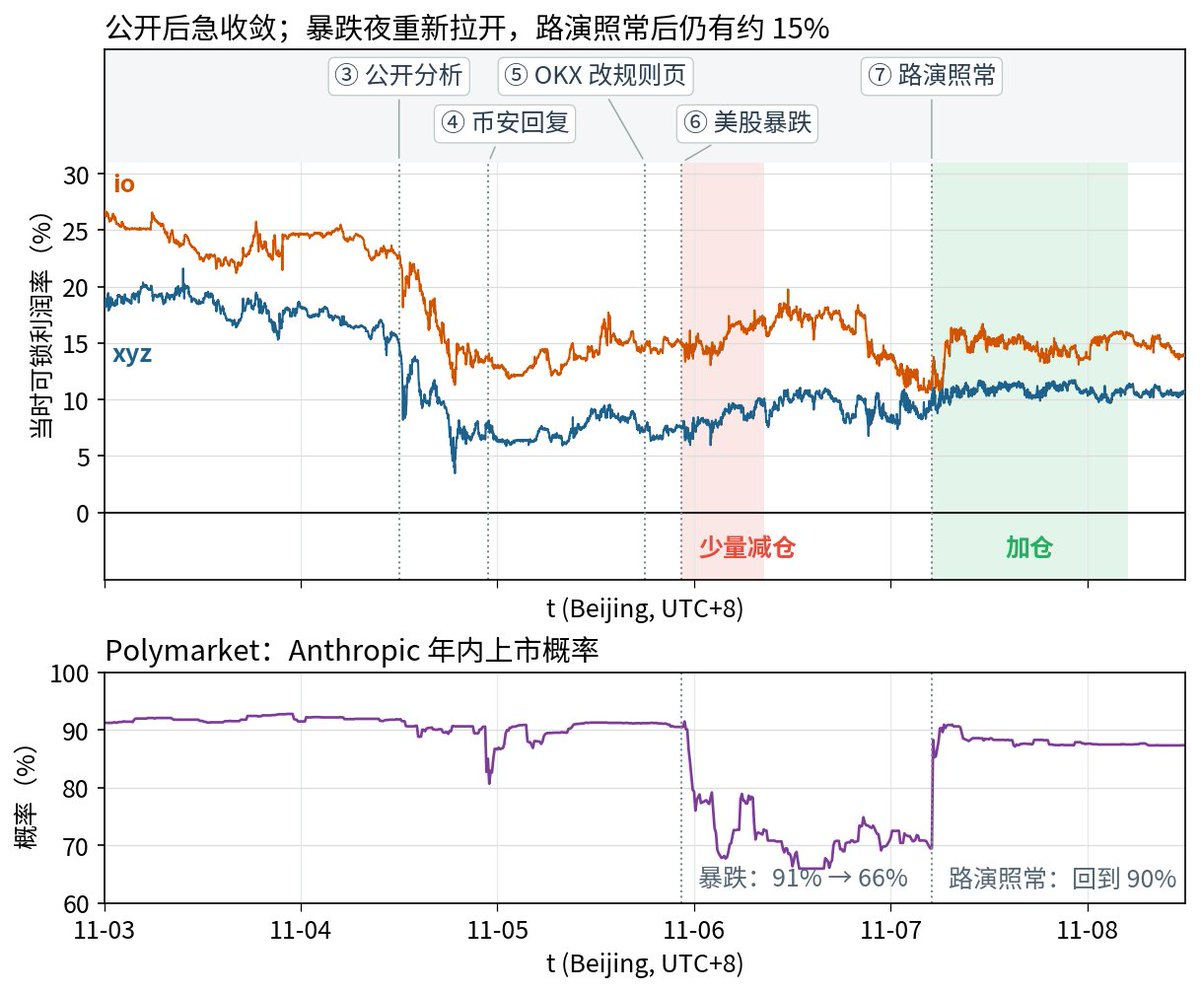
- Within 40 minutes, the xyz route dropped from 15.3% to 10.5%, while the io route fell from 22.7% to 19.6%. By the hour, the xyz route reached a low of about 6%, while the io route hit about 12%.
- Such quick closures were partly due to new arbitrage positions placing orders on both sides simultaneously, and partly because those who were previously doing the opposite (long Binance, short HL) were closing out their positions.
- If you acted quickly upon seeing the tweet, you could make considerable profits. Not catching the fastest wave is okay; later, some people took profits early, causing the spread to return somewhat, and the following day, the xyz route still had 7–8%, while the io route had 13–15%.
4. Three exchanges’ statements: Rules confirmed
Within a day of going public, all three exchanges confirmed their positions:
④ Binance: Binance staff clarified the conversion based on total shares below Long Wang's tweet, stating that the contracts track the price of 1 share of Anthropic common stock. Only issued and circulating common shares are counted. Unexercised options, unsettled RSUs, unconverted convertible bonds, overallotment by underwriters, and shares reserved in incentive plans are still not common shares and do not count;
- This standard was not a last-minute decision; it was specified in Article 8 of the Contract Details when the contract went live on June 2;
- ⑤ OKX: The Anthropic contract on OKX and Binance is of the same type (quoted based on valuation), and it directly modified the rules page, stating in black and white, “Total number of common shares immediately outstanding after the IPO”, clearly noting that it does not use fully diluted shares.
- io (Entropy): The rules page clearly copied the prospectus stating the “fully diluted total,” and the CEO of io publicly confirmed the conversion based on fully diluted shares.
At this point, “which number of shares each exchange uses” is no longer an assumption but an official confirmation. The only remaining major risk is: Will the IPO be delayed?
5. Night of the plunge: Remaining risk is only "delay"
⑥ On 11-05, U.S. stocks plunged: Nasdaq 100 fell about 6.4%, the chip index dropped about 12%, and VIX rose about 70% in one day.
- The market began to speculate whether Anthropic would delay or even cancel its public offering, with Polymarket “IPO this year” dropping from about 91% to a low of about 66% (bottom of Figure 3).
- Some individuals panicked and closed their positions, causing the spread to widen: the io route returned from about 15% to around 18%, reaching nearly 20% intraday.
- Our judgment: It is likely that the IPO would proceed as planned. Our friends in investment banks had not heard any news of canceled roadshows; moreover, a mere delay would not materially affect the fundamental strategy, at most causing a slight dispersion of a few points due to early profit-taking by peers.
Micro-operation 2: As news broke, reduce positions slightly for insurance, but keep the main positions intact. The risk shifted from “rules” to “time.” That night of the plunge, we exited a small portion, but the majority of positions remained unchanged.
6. Roadshow proceeds as planned: Highest certainty, profit margin still at 15%. Best betting opportunity after making it public
The night before the roadshow news (11-06 21:12), Bloomberg reported that some potential investors were only willing to give $1.2–1.3 trillion (previously $1.4–1.5 trillion). That night, Binance dropped about 11%, while io only fell about 7%, with the io route temporarily receiving about 11%.
⑦ On the early morning of 11-07, FT and CNBC reported in succession that Anthropic would proceed as planned and start the roadshow next week.
- Polymarket’s “IPO this year” rebounded from about 69% to 90% within an hour.
- The spread widened again: After the news came out, io was sold low, while Binance hardly budged, causing the io route to shift from around 11% back to approximately 15%, later maintaining around 15% for more than a day.
Micro-operation 3: Increase position as soon as the news is released. All three exchanges had substantiated the rules, concerns about delays were alleviated, certainty was the highest in the two weeks, yet profitability remained around 15%. This was the most worthwhile moment to enter during the entire process; we replenished our positions upon seeing the report and further utilized floating profits to increase our positions.
This window lasted for two to three days, with the spread gradually converging and profitability slowly declining, reaching about 9% for the io route and about 6% for the xyz route on 11-10 morning.
7. Leaks, prospectus, and liquidation
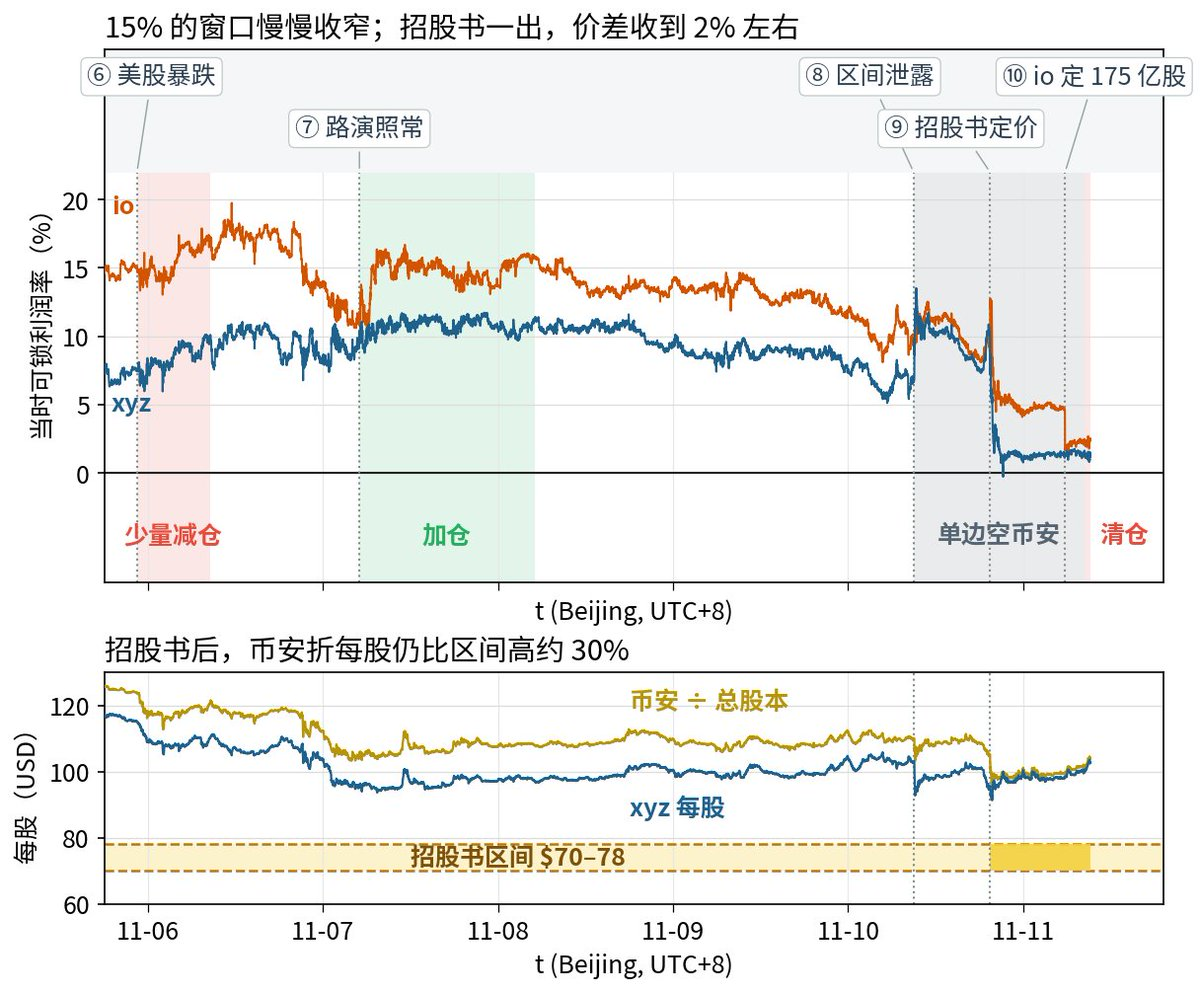
⑧ On the morning of 11-10, the issuance range was leaked: Reuters reported a price per share of $70–80, followed by reports of terms being retracted. We judged the range was likely genuine: at $75 multiplied by the fully diluted shares, exactly matching the previous rumor of $1.2–1.3 trillion. Since the terms were leaked, it was highly likely that the official pricing prospectus would be out that night. At the moment the news broke, xyz fell from about $104 to about $95, dropping even more than Binance, with the xyz route temporarily pulling to around 11%. The reason is that xyz is priced per share, allowing everyone to directly compare it to $70–80.
- From this point, we began to add a unilateral short position in Binance; the logic can be found in Section 8.
- ⑨ On the evening of 11-10, the pricing prospectus was released: priced at $70–78, with about 13.09 billion shares after issuance. The spread immediately contracted: xyz route decreased from about 10% to over 2%. Binance dropped about 4% within an hour.
- ⑩ Early morning of 11-11, io confirmed 17.5 billion shares: Entropy specified the estimated conversion for the listing at about 17.5 billion shares, a bit less than the approximately 18 billion estimated under the prior standard. The io route decreased from about 5% to about 2%.
- On 11-11 morning, we closed all positions. Now the xyz route is about 1%, the io route is about 2%, and this arbitrage is over.
8. Unilateral short in Binance: Why it was held and why it was added during the leak
Aside from the arbitrage positions, we continuously held a portion of Binance short (unilateral, with no corresponding long). The reason needs to start from “who is moving.”
The mistake was Binance's, but it was HL that was driven back. The pricing error in share count only belongs to Binance; logically, the convergence of the spread should mainly rely on a drop from Binance. The actual situation is:
- Before making it public, it was indeed mainly Binance that was falling: Binance -12.6%, while xyz only dropped 1.9%.
- After making it public, arbitrage positions placed orders on both sides. However, Binance had the best liquidity; the same capital put into it moved the least. Conversely, the shares on HL, xyz, and io were bought more: from the tweet to the plunge, Binance -3.6%, xyz +3.4%; after the roadshow proceeded as planned, Binance +3.6%, xyz +6.8%.
- Only on the night of the prospectus did Binance make up a drop of 5.0%, while xyz remained almost unchanged.
Binance's premium has two layers. Calculating with the rumored valuation: $1.2–1.3 trillion (fully diluted) translates to about $71 per share; on 11-07, Binance estimated around $105 per share based on total shares, which is about 50% higher. Of this 50%:
- About 10 points are share count mispricing, which only belongs to Binance, meaning the arbitrage spread itself will gradually disappear;
- The remaining approximately 40 points reflect the market's optimism about valuation, which applies to xyz as well (about $97 per share).
The unilateral short in Binance simultaneously bet on these two layers: the first layer is likely to disappear, while the second layer must wait for the market to correct its mistakes.
Why add during the leak. Once the issuance range was leaked, we added the unilateral short position for two reasons:
- The range is likely authentic (at $75 multiplied by fully diluted shares, it coincides with the $1.2–1.3 trillion rumor);
- With the range known, the second layer of premium now has a direct comparison benchmark. xyz priced per share directly correlates with the issuance price; any share at $100 compared to a range of $70–80 is clearly overvalued. xyz will narrow to the range, and since Binance is tied to the arbitrage spread against xyz, Binance will also be pulled down.
9. Final mistake: Continuing to short after the prospectus
After the prospectus was released, we continued to short Binance. The thought process at the time was:
- Binance's share price based on total share capital was still around $98, approximately 30% higher than the range stated in the prospectus of $70–78 (shown in the bottom section of Figure 4, the distance between the yellow band and the Binance line);
- Waiting for the media to write “market cap around $1 trillion” based on the prospectus would lead people to realize there are price issues, and the premium should begin to converge.
The next morning we found out:
- The premium did not converge; rather, Binance actually rose a bit, taking xyz with it;
- Coincidentally, there was news (FT) stating that underwriters were preparing to raise the valuation to over $1.5 trillion.
At this point, it became clear the judgment was wrong; the bulls did not capitulate just because the media wrote “market cap around $1 trillion.” We immediately cut losses and closed all positions. This short position had once shown significant floating profits the night of the prospectus's release but ultimately resulted in a loss.
免责声明:本文章仅代表作者个人观点,不代表本平台的立场和观点。本文章仅供信息分享,不构成对任何人的任何投资建议。用户与作者之间的任何争议,与本平台无关。如网页中刊载的文章或图片涉及侵权,请提供相关的权利证明和身份证明发送邮件到[email protected],本平台相关工作人员将会进行核查。


