Author: Curie, Deep Tide TechFlow
Deep Tide Introduction:
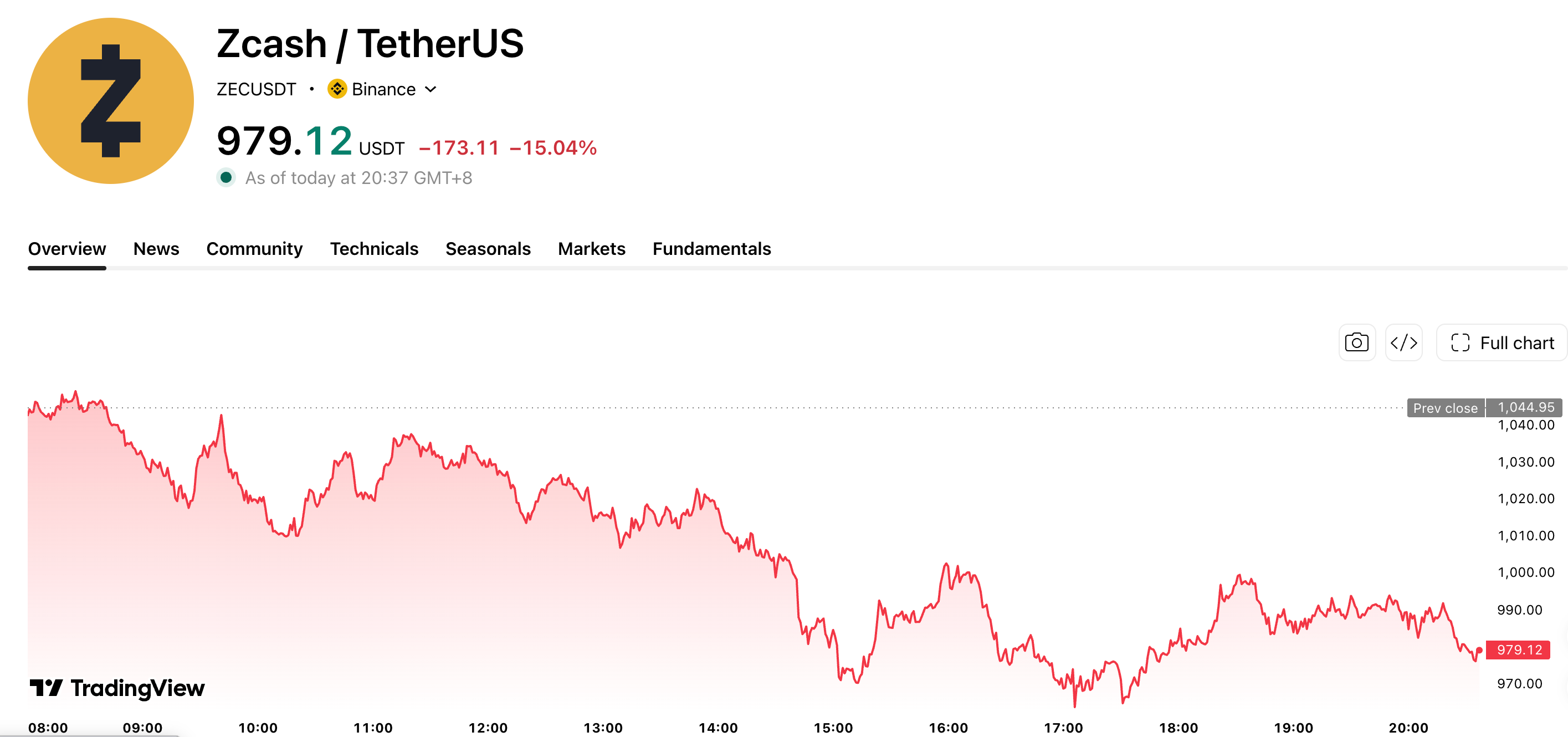
On November 10, Grayscale announced the establishment of a $1 million ecological sponsorship program, pledging to return all management fees collected from its Zcash ETF (ZCSH) in the first year to network development and marketing, distributing $100,000 each to four nonprofit organizations in the first batch. However, on the very day the good news was announced, the price of ZEC plummeted by 11.3% to around $1,043, and the decline over 30 days widened to nearly 20%. ZEC, which was highly promoted by overseas KOLs and institutions as the 'second spring of old coins' just two months ago, quickly entered a prolonged decline under the pressure of $2.3 billion in unliquidated contracts. This means that the narrative halo of Wall Street and Grayscale's PR subsidies have been exhausted; without fundamental support, ZEC has once again become a cash cow for high-leverage speculative funds to cash out on favorable news.
If you frequently scrolled social media a month or two ago, ZEC was probably the most eye-catching topic in various influential accounts and crypto research reports.
The script back then was highly enticing: the successful listing of the spot ETF on the New York Stock Exchange Arca in August, the mainstream financial community on Wall Street 'breaking the ice' with the privacy narrative, and the long-silent old mainstream welcoming value reassessment... Various bullish slogans were flying, as if this ancient privacy coin was about to take the stage again.
But reality quickly delivered a resounding slap in the face.
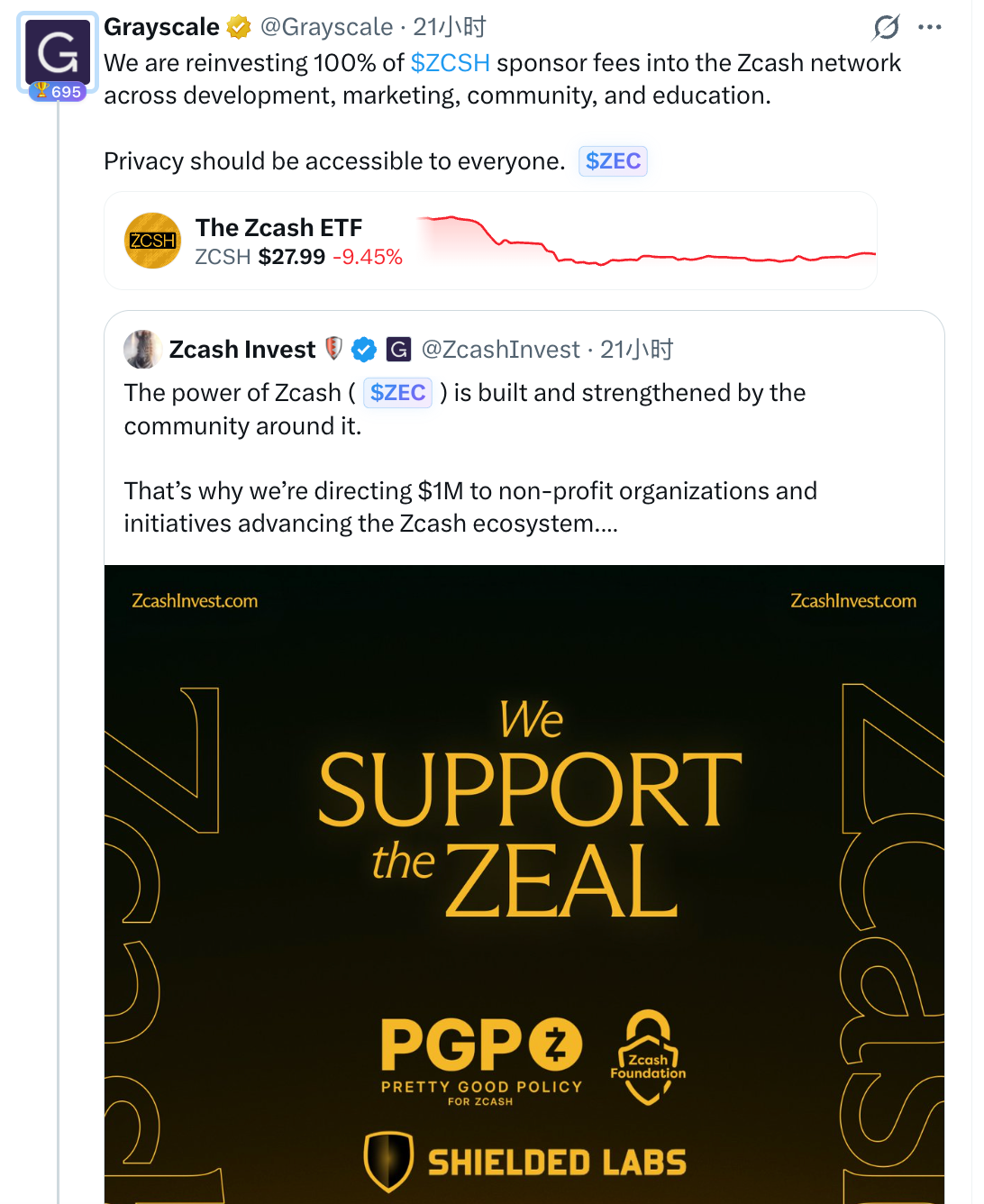
On November 10, Grayscale announced a sincere supporting action: committing $1 million from Zcash ETF (code ZCSH) management fees to fully support the Zcash ecosystem.
The first payment has been disbursed, with the Zcash Foundation and three other nonprofit organizations each receiving $100,000. Grayscale even launched nationwide advertisements and an investment education website simultaneously.
Institutional real cash is injected into the ecosystem, but the market responds with a heavy blow.
On the day the news was announced, ZEC slid throughout the day, crashing by 11.3% to around $1,043. Over the past month, it has already retreated by nearly 19%. The bustling calls were still echoing in their ears, but retail investors chasing highs found themselves firmly standing on the summit.
$1 million in voluntary subsidies can't buy real ecological prosperity
On the surface, Grayscale's approach of 'returning all ETF fees to the public chain ecosystem' can be hailed as a model in the industry, which is extremely rare in the traditional asset management circle.
But a closer look at the terms reveals that beneath this warm veneer lies plenty of calculation.
Grayscale clearly states in the official announcement: this $1 million commitment is 'voluntary in nature,' and Grayscale reserves the right to modify or terminate the sponsorship at any time. In plain terms, the first disbursement is merely $400,000 for the four organizations, while the remaining $600,000 feels more like a carrot hung in front. Rather than an ecological donation, it is more of a brand marketing effort by Grayscale to promote its own ZCSH fund.
What’s even more awkward is the disparity in scale.
Compared to Zcash’s massive market capitalization, the $1 million for development and marketing sponsorship doesn’t even seem like a drop in the bucket. Since Zcash ETF was listed on the New York Stock Exchange Arca in August, it has not stirred up a buying frenzy among traditional capital like previous Bitcoin or Ethereum ETFs.
Wall Street put the code on the display, but the number of funds truly committing real capital for long-term allocation is quite limited.
Without sustained off-exchange liquidity injection, solely relying on institutional self-funded promotion can hardly support the severely inflated narrative bubble from the past two months.
$2.3 billion in contracts pressing down, speculative hot money is accelerating the harvest
The market is falling so sharply, and the core issue lies in the chip structure.
Data shows that the current open interest (OI) of ZEC perpetual contracts across the network is around $2.3 billion. What’s currently circling around ZEC seems more like a group of highly volatile leveraged gamblers.
Looking back, the ZEC promotions on overseas social media over the past two months resemble a precise harvesting of liquidity in the derivatives market.
The dealers used the favorable narrative of 'the first privacy ETF listing' to rapidly ramp up interest and attract retail investors to follow suit and increase their leverage to go long. But when the contract position was pushed to the ceiling and Grayscale's supportive benefits finally materialized, it became the optimal liquidity exit window for major accounts to reverse and cash out or even short the market.
Moreover, Zcash’s own trust scars have not truly healed.
About three months before the ETF listing, a critical vulnerability in Zcash's privacy pool was exposed, leading to a dramatic 50% price drop in a short time. Although the technical team completed the fix in July, in an era where mainstream compliance regulation is highly wary of privacy technology, this technical scare has completely shattered the confidence baseline of many conservative funds.
On one side is a technology network lacking genuine user retention, while on the other side is a staggering $2.3 billion of high leverage. When encountering a major market adjustment or the realization of favorable news, a stomp from the bulls is almost an inevitable outcome.
The familiar taste of a cash cow
In the crypto market, 'old coins new speculation' has always been a dangerous business.
From early fork coins to today's privacy coins, the script often follows a highly consistent trajectory: find a reason that traditional old money recognizes, package it with a grand narrative of 'value reassessment,' and then attract chase high buyers through concentrated momentum created by overseas KOLs, ultimately distributing chips at the moment of highest liquidity excitement.
Most of those who hyped ZEC into a darling over the past two months have already cashed out and exited; now what remains on the market is nothing but the wreckage below the thousand-dollar threshold and the $2.3 billion liquidity disaster still to be settled.
For investors who were clouded by the hype, the expectations overshot in the past two months have all been fully returned; for Zcash, Grayscale's billboard cannot save it. If old coins want to experience a second spring, solely relying on the sponsorship fees bestowed by Wall Street is clearly far from enough.
免责声明:本文章仅代表作者个人观点,不代表本平台的立场和观点。本文章仅供信息分享,不构成对任何人的任何投资建议。用户与作者之间的任何争议,与本平台无关。如网页中刊载的文章或图片涉及侵权,请提供相关的权利证明和身份证明发送邮件到[email protected],本平台相关工作人员将会进行核查。


