

Every Monday, Wednesday, and Friday, focusing on the cryptocurrency market, Japan, South Korea, A-shares, and Hong Kong stocks, using data to review the market and trends to seize opportunities, produced by PANews.
BTC's Major Test Under Macroeconomic Tightening and Decreased Inflow, Waiting for MSCI Global Index Adjustment Results
Bitcoin briefly fell below $73,000 under the dual pressures of CPI exceeding expectations and a hawkish stance from the Federal Reserve. Bloomberg data shows that Bitcoin's status as a risk asset is fading, with a cumulative decline of about 16% this year, underperforming the S&P 500 index by about 26 percentage points. Market liquidity is urgent, with BTC spot ETFs experiencing four consecutive days of net outflows, including $95 million yesterday; USDT's market value has dramatically shrunk by $6.6 billion in the past 60 days, marking a liquidity withdrawal record more severe than after the FTX collapse in 2022.
On-chain indicators are lighting up in red, the CryptoQuant bull market score index has plummeted from 90 to 20, indicating an "extremely bearish" level. In the past 30 days, apparent demand has dropped by 284,000 BTC, and the unrealized loss rate for traders has fallen to -6%, approaching the historical bull market adjustment bottom threshold of -12%. Meanwhile, Glassnode warns that due to issues like address reuse, currently, 35.4% (approximately 7.12 million) of BTC public keys are exposed on-chain, with potential quantum computing threats and the aftermath of the recent Binance hacking incident intensifying the defensive mentality of long-term funds.
As Bitcoin broke below the 365-day moving average of $76,400 and key support, both bulls and bears are fighting over the 200-day moving average (between $73,200 and $73,500). Trader Sykodelic and CryptoQuant see this as the "strongest bull defense line" to differentiate between shallow pullbacks and deep bears; historically, if bulls break below this moving average after a monthly close, the downside may extend toward $67,000 to $69,000. Minga and Alex Marzell warn that if the lower edge of the weekly ascending wedge and the mid-range of $72,600 collapses, the market may replay a bearish pennant and head straight for $57,600.
The core focus of the market is locked on the MSCIGlobal Index adjustment results on the morning of November 12. Recently, Strategy, which holds over 850,000 BTC, raised $283.8 million in common stock, but 66.3% of this is used to buy back priority shares of STRC at a par value of $100, with only $81.9 million allocated for purchasing coins, highlighting the issue of fund diversion; if MSCI confirms tomorrow that it will include it as a "non-operating company" and remove it from the index, JPMorgan expects to trigger $1.57 billion to $2.8 billion in passive fund mechanical sell-offs before November 30. This traditional financial system constraint may directly breach its stock high premium, severing the channel through which listed companies rely on US equity leverage for ongoing Bitcoin funding.
Replaying the $2,000 Script? The Head and Shoulders Bottom Structure Waits for Validation
The market's continuous decline has pierced through investors' psychological defenses, with Ethereum spot ETFs experiencing four consecutive days of net outflows. BitMine, holding 5.9 million ETH, reported a massive net loss of $6.313 billion in the fiscal year 2026. This persistent weekly decline and breach of the initiation line has led renowned traders like Rune to express pessimism about the short-term trend, declaring "no long-term value, completely broken." However, BitMine's chairman Tom Lee disagreed, claiming that the price slump merely reflects the market's lack of patience; supported by the tokenization supercycle and Vitalik's reaffirmation of the "store of value" narrative, the bull market for the next 24 to 36 months has just begun.
Technicians and on-chain whales are evidently more aligned with Tom Lee's optimism, as analysts begin to bet on the replay of the "head and shoulders" and cycle script. Daan Crypto Trades points out that ETH has currently retraced to the 0.786 Fibonacci support level of the gains since August, perfectly replicating the 2025 scenario of "after being blocked at $2,800, falling back to $2,100 before taking off again." Bulls urgently need to hold the $2,100 level and aim to recover resistance at the daily 200 MA.
The rapidly executed spike below $2,000 is seen by Void, Ted, and Crypto Bond as the final liquidity sweep completing the bullish "head and shoulders" right shoulder structure. Void has established long positions between $1,950 and $2,015, setting a stop loss at $1,850, targeting a goal of $2,800 to $3,000. Analyst Merlijn emphasizes that $2,000 is the "maximum pain point" of this cycle (the last time it hit the maximum pain point, ETH surged to $4,900), and that OG whales from the 2015 ICO era have recently bottomed out 1,451 ETH at a price of $2,064 (accumulating an additional 3,672 ETH in the past week), indicating that smart money is accumulating amidst panic.
Today's Highlights:
Aptos (APT) unlocks about 4.54 million tokens, valued at approximately $2.7 million
Allora (ALLO) unlocks about 160 million tokens, valued at approximately $23.7 million
Upbit 24-hour trading volume rankings: XRP, BTC, ETH, PIERVERSE, SOL
Bitcoin spot ETF had a total net outflow of $95.012 million yesterday, with four consecutive days of net outflows
Ethereum spot ETF had a total net outflow of $1.3168 million yesterday, with four consecutive days of net outflows
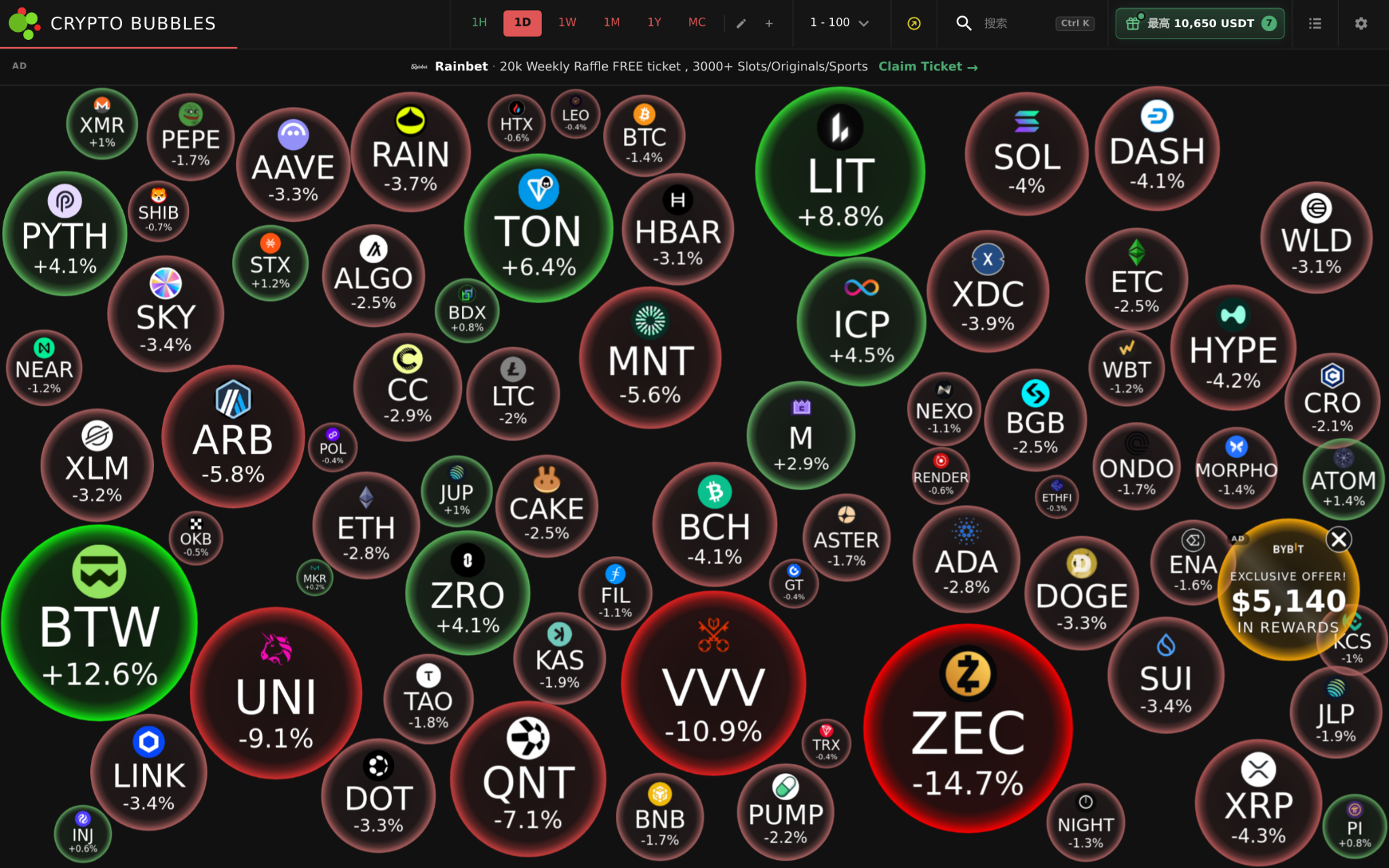
Today's top gains among the top 100 cryptocurrencies by market value: BTW up 12.6%, LIT up 8.8%, TON up 6.4%, ICP up 4.5%, ZRO up 4.1%.
Price Increases in Storage and Easing of Optical Module Bans Ignite Asia-Pacific Tech Stocks
Driven by Morgan Stanley's semiconductor research report and a surge in storage chip prices, Asian stock markets performed strongly today. The Korean Composite Stock Price Index rose by 2.60%, while the KOSDAQ index soared by 5.62%. Analyst Joseph Moore from Morgan Stanley noted that AI infrastructure orders are accelerating, resulting in "structural capacity shortages" in the storage market. The three major manufacturers are diverting nearly a quarter of their wafer production capacity to high-margin HBM, leading to severe shortages in general DRAM and enterprise-grade SSDs. The October contract price for DDR 8Gb has reached a nearly ten-year high, with North American manufacturers pushing for a 15% to 20% increase in enterprise-grade SSD prices in the fourth quarter. SK Hynix surged by 5.36%, Samsung Electronics rose by 3.57%, and equipment stocks such as TSE and Techwing all rose by over 17%. In contrast, gaming stocks such as SHIFT UP, Krafton, and Samsung Biologics performed poorly.
The Japanese stock market also opened high and rose, with the Nikkei 225 index closing up by 1.31%, and the Topix index closing up by 0.92%. The chip equipment and materials sector formed the absolute leading force, with International Electric and SUMCO soaring by 10.17% and 9.31% respectively, while Advantest and Tokyo Electron had significant gains. Meanwhile, market optimism regarding Anthropic's proposal to raise up to $3.5 billion from Japanese investors during its IPO sparked foreign investors' enthusiasm for reassessing the local computing ecosystem in Japan. SoftBank Group staged a dramatic "V-shaped" reversal, tumbling 11% in the morning due to a 1.12 trillion yen loss dragged down by impairment in the second fiscal quarter related to US data centers, but in the afternoon it erased nearly all losses after CoreWeave's results exceeded expectations, ultimately closing down only 0.44%.
Microsoft's lobbying for the Trump administration to lift the ban on Chinese optical modules has become the strongest catalyst, igniting a fuse across Hong Kong and A-shares today. Although the Hong Kong stock market was dragged down by concerns over high external interest rates, with the Hang Seng Index dropping by 0.98% and the Hang Seng Technology Index falling by 1.41%, sectors related to optical communication and storage thrived against the trend, with Cambridge Technology soaring by 23.08%, Chipone Semiconductor rising by 20.18%, and Zhongji Xuchuang and Yangtze Optical Fibers rising by over 13%.
The A-share market opened higher and sustained growth throughout the day, with the Shanghai Composite Index rising by 0.46%, and the ChiNext Index violently surging by 3.11%. The two markets saw a trading volume increase to 1.719 trillion yuan and a total of over 3,500 stocks rising. Over 11.6 billion yuan of main capital flowed into the CPO and PCB sectors, with Yuanjie Technology hitting the 20% limit-up, and many stocks including Dongshan Precision, Huadian Technology, and Jiangsu Hantang hitting the limit-up as well; Xinyi Ling, Zhongji Xuchuang, and Tianfu Communication all surged by over 13%. Additionally, the MiniMax open-source H3-Image model drove a limit-up trend in AI and robotics concepts in Shanghai's film and cultural investment holdings.
Open-source Securities and CITIC Construction Investment pointed out that with the large-scale release of 800G/1.6T optical modules and the CPO architecture by 2027, the domestic AI computing power chain is entering a golden period of explosion. UBS China's equity strategy chief Wang Zonghao stated that foreign capital actively increased its holdings in the technology sector in the third quarter and suggested adopting a "AI technology hardware + bank" barbell strategy to capture excess returns across the New Year.
免责声明:本文章仅代表作者个人观点,不代表本平台的立场和观点。本文章仅供信息分享,不构成对任何人的任何投资建议。用户与作者之间的任何争议,与本平台无关。如网页中刊载的文章或图片涉及侵权,请提供相关的权利证明和身份证明发送邮件到[email protected],本平台相关工作人员将会进行核查。


