From bonus opportunities to traffic harvesting, a common turning point in niche circles.
Written by: sashed
Translated by: Saoirse, Foresight News
Editor's Note: From the sneaker community, to finance circles, and now to the crypto community, niche trading communities seem unable to escape a similar fate. The author of this article reviews the complete evolutionary cycle of Crypto Twitter: from initial communication opportunities and discovering arbitrage spaces, to slowly spiraling into mutual depletion, and ultimately shifting to selling dreams of getting rich. The 10.10 incident has left a lasting psychological shadow. The crypto industry itself is still moving forward, but the Crypto Twitter that was once used to find Alpha has quietly uncoupled from the main track of the industry. Here is the content:
I have noticed on X (the former Twitter) that various niche circles such as sneakers, crypto, and finance all have a highly similar turning point: when the group's attention shifts from initially attracting everyone with bonus opportunities to grooming personas and monetizing fans, the circle begins to decline. Unfortunately, Crypto Twitter (CT) is now at this stage.
(Note: X refers to the former Twitter, commonly called Twitter in China; CT is the abbreviation for Crypto Twitter, and the subsequent text will continue to use the Chinese term.)
Let me share my experience: I first spent time in sneaker Twitter, then transitioned to finance Twitter and sports betting Twitter, eventually landing in crypto Twitter. In the finance and sports betting circles, I primarily observed, but in sneaker Twitter and crypto Twitter, I have been deeply involved for several years.
The commonalities at the grassroots levels of these communities are far more extensive than many are willing to admit. The crypto sector is the most ambitious of them all, which is why I choose to remain as a community member, but that is not the focus. Their operational logic is highly similar. Watching the changes in Crypto Twitter over the past year, I can only feel a sense of déjà vu.
After observing the rise and fall of various communities for so many years, I want to compile my observations and thoughts comprehensively.
Opportunity Period
Initially, a small group of anonymous players discovered something new and began sharing their ideas on X. The driving force behind community growth was pure curiosity. Gradually, people began to stumble into this space — mostly through algorithmic suggestions or recommendations from friends. The core value of the community in its early days was to provide early participants with a place to exchange ideas and capture market inefficiencies for arbitrage opportunities. No one thought about promotion or bringing in large numbers of newcomers; sometimes, it was even quite the opposite: within the community, there would spontaneously be implicit barriers to protect this hard-to-discover opportunity. The fewer the entrants, the higher the returns for the pioneers who found this new gold mine ahead of others.
As time passed, this mode of play was thoroughly explored and gradually standardized. Some formed specialized service teams to meet related needs, the influx of new players continued to accelerate, market arbitrage opportunities were constantly eliminated, and the gold mine was slowly depleted. In a sense, this evolved into a race to the bottom. Greed dominated the behavior of many, and everyone began to break unspoken internal rules, leading to increasing internal competition: for example, the holding ratio of a single currency exceeding 3% of the total supply, leaking internal news ahead of time, and so on. The core competitive advantage thus shifted from being “insightful” to “quicker to act.” Everyone sees the same opportunity and understands the same set of strategies, and what remains is a competition of execution speed.
That’s how the late sneaker Twitter was. At that time, there were even people in the circle who paid to access gray channels, having someone scan shipping labels ahead of time to begin pre-sales before the shoes officially launched.
Sneaker releases typically happen on Saturdays, and orders often have to wait until the latter half of the following week to arrive. By the time you actually receive the shoes, the market price has usually dropped significantly from the high point on the release day. Therefore, everyone rushes to get their orders in, aiming to act ahead of others.
Players diverged into two operating modes: one part of them would simply accept the highest bid on platforms like StockX and then find a source for the corresponding size; the other part would place an order and immediately list it for resale, without even knowing when the package would be shipped.
However, StockX requires sellers to ship within 2-3 business days, making it difficult to close the loop on this operation. Subsequently, countermeasures emerged: paying to find those who could access UPS scanning devices to pre-scan the labels and mark the packages as "delivered" in advance. This way, orders wouldn't be canceled; the shoes could simply be sent out once they are received later.
For certain sneaker categories, buyer demand had severely shrunk, and to make a profit, many had to rely on these pre-sale variants to squeeze out thin margins. (This pre-scanning operation itself posed legal risks, but at the time everyone was focused solely on selling quickly, with few considering the consequences. I recall that many players got into trouble because of this and even bore corresponding legal responsibilities; I can't remember the specific details now.)
Today's crypto market has essentially reached the same stage. It is always competing to see who is the first to escape: sniping new coins, trading against pre-set pairs, multi-wallet ambushes… all of this is endless internal competition. Participants' methods have become increasingly aggressive, and it is hard to self-regulate for a recovery unless a disruptive new opportunity emerges. The market is not devoid of opportunities; it’s just that this game is no longer as enticing as it used to be.
Shifting to Traffic Games
As people in the circle eat away at each other and internal competition grows unceasingly, another group of people switches tracks and begins a completely different game: the traffic business. The attractiveness of the arbitrage opportunities that initially drew everyone in is steadily declining, and selling dreams of getting rich turns out to be more profitable than participating in trading. Social interactions for traffic were once just a byproduct of exploiting opportunities; now it has become the core business itself. Previously, profits relied on trading while gradually accumulating followers; now, the focus is on building a fanbase first, then monetizing it directly. Coupled with mechanisms where members within the circle point to each other for traffic and share rewards, many bloggers simply regard newcomers as "sheep," guiding them in to take over.
Bloggers selling courses in finance Twitter serve as a good reference. Finance Twitter and sneaker Twitter are not entirely the same: there are indeed people in the circle doing serious business and creating real value (these cases are not many, but they exist objectively); whereas, sneaker resale is essentially a zero-sum game of buying low and selling high. From this perspective, the similarity between Crypto Twitter and Finance Twitter is far greater than that of sneaker Twitter. The crypto field still has real innovations, such as the parent company of the New York Stock Exchange, Intercontinental Exchange (ICE), collaborating with Trade.xyz to introduce Hyperliquid-based perpetual contracts to the US market.
However, as native arbitrage opportunities have decreased, the builders who work diligently have to share exposure with harvesters. The latter continually undermine the community atmosphere, burdening the entire track with stigma. Such bloggers are everywhere in finance Twitter: focused on building personal IP and ultimately aiming to sell low-value paid materials, courses, or push advertisements to their fans.
As the online commercial track becomes more competitive and low-barrier easy opportunities disappear, many have found that selling the fantasy of "doing big business" to others is far easier than actually establishing a genuine business, with returns that are also higher.
Many people simply judge that as long as one sells courses and sets up paywalls, it equates to chopping leeks. I do not agree with this viewpoint. There are indeed valuable paid contents with high information density on the market. The key point I want to discuss is not the act of paid information itself, but that once the profit from "selling opportunity narratives" exceeds the returns from "personally capturing opportunities," the entire community ecosystem undergoes a qualitative change.
Previously mentioned sneaker Twitter eventually devolved into a race of preemptive selling. And today's Crypto Twitter, while suffering the same race to the bottom, has replicated the predicament of Finance Twitter's "course-peddling" — the promoters of Meme coin wealth narratives are the new generation of traffic sellers.
Many now say that the Meme coin track is dead, but this is an overstatement. This topic has been discussed repeatedly, and I do not intend to elaborate, but one thing is certain: the era of rapidly becoming a millionaire through Meme coins has basically come to a close. Newcomers find it very difficult to make a name for themselves on this track. There is a typical K-shaped divergence now, where traffic dominates the landscape: top players continue to amplify their advantages.
Sneaker resale has never completely disappeared; there are still people making money from it today, but the bonus period has long passed. Meme coins are replicating the exact same path. Just because a market is still operating does not mean it is worth your involvement.
Of course, new coins with a market cap of nine digits or even a billion-level might still appear in the future, but trying to catch such targets will be exceedingly challenging. It is not worth focusing here, like panning for gold in a minefield: the upside is very high, but the probability of success is disproportionately low.
Many are unwilling to admit or accept that this asymmetrical bonus era has ended, still hesitating to exit. They repeatedly peddle this fading story of getting rich to others, essentially creating new liquidity for themselves.
The Kimchi incident is a perfect example. His emergence beyond the circle was due to the widely circulated narrative: trading TRUMP-related coins earned him $40 million. But this story was initially a joke made up by a friend, which became increasingly distorted over time.
Afterward, he collaborated with the Pump.fun platform, which marketed with the core message: trade Meme coins, and you too can become the next Kimchi. In simple terms, it's "packaging through storytelling, creating a success template." The template they used to attract users was inherently false.
This incentive mechanism continually fosters such an atmosphere. The new generation of players prioritizes becoming traffic bloggers rather than traders — even the activities they engage in might be questionable as to whether they can be termed trading. The platform needs transaction volumes, and bloggers need to monetize their followers; both sides don't actually need their fans to make real profits.
Interestingly, the community's tolerance for such behavior continues to rise. In the early days, players with a bad reputation would be collectively excluded because everyone wanted to protect hard-won bonuses. But now, similar bloggers can secure significant collaborations and take the stage on larger platforms.
I find that simply resisting is futile. You cannot expect others to voluntarily abandon high-yield businesses just because they harm the community atmosphere. A more pragmatic approach is to let them continue playing their traffic games while we actively distance ourselves from the information streams they gather.
Collective Fade from Public View
What is happening now is exactly this. The core participants who once supported the value of Crypto Twitter are quietly withdrawing from public information streams. Some have turned to stock trading, some have left directly after profiting; others still trade crypto assets but have shifted to private communication, unwilling to interact with the remaining group in Crypto Twitter today.
I believe their choice is correct, and I have been struggling with whether to follow suit. To be frank, I have long acknowledged that I am a member of the crypto community because I believe Bitcoin and blockchain are long-term trends. However, at the same time, Crypto Twitter is moving in the completely opposite direction, and I have little reason to continue participating in public information streams to discuss or share content.
The original meaning of Crypto Twitter was to exchange ideas and explore opportunities with a group of pioneers. Now, high-quality exchanges and valuable early-stage information have mostly shifted to Telegram, private groups, and other channels. As long as one connects with reliable small circles, even completely ignoring the public Crypto Twitter information stream, trading won't be affected. The unique early opportunities that could be found in Crypto Twitter's public information stream are becoming increasingly scarce.
What I contribute occasionally today is mostly casual market chatter and commentary. However, there are still quite a few creators better than me who continue to output substantive material in the public information stream without chopping or promoting scams. These individuals are severely underestimated.
On a positive note, while writing this content, I have already seen many trend-following tourists choose to exit, which is a good thing. I won’t name names, but a blogger who often live-streams buying coins and actively brings followers into Crypto Twitter recently announced that he would keep his distance from it. His reasoning is that people will inevitably ruin the next good opportunity, and it seems he considers himself to be that "good opportunity" itself.
Decoupling
Following the narrative logic of Crypto Twitter, I propose a decoupling: this time, it is the decoupling of the crypto industry from Crypto Twitter.
I am not predicting that Crypto Twitter is about to peak. In my view, Crypto Twitter peaked long ago, and this decoupling has been ongoing for quite a while. One side note: over the past year, ordinary Crypto Twitter users have been consistently complaining about Launchpad, while keen players have already made seven to eight-figure profits through perpetual contracts or seized on-chain opportunities early, such as targets like VVV and CARDS.
Ironically, the 10.10 incident left participants in Crypto Twitter with an indelible psychological scar. A persistent wave of panic has since taken shape: all earnings can vanish in an instant. This almost subconscious fear has further given rise to participants eager to seize short-term benefits. The attitude of the current U.S. President and his family towards crypto assets has also exacerbated the deterioration of the situation.
People's tolerance for these predatory behaviors has increased; they no longer band together to exclude such players as they did a few years ago.
Writing all this is not to urge everyone to blindly bullish on crypto. I believe the crypto track will exist long-term, but its development path is certainly not the way that people imagine within the public information streams of Crypto Twitter. From a long-term perspective, Crypto Twitter is gradually drifting away from the real development direction of the crypto industry. Crypto is slowly becoming a relatively mundane supplementary option within the traditional financial system. Of course, betting on which projects can run this narrative still possesses gamified enjoyment; but overall, it is far less stimulating than the stories of overnight wealth from air projects of the past.
When Bitcoin rises and the market's risk appetite increases, there will still be a window where people discard rationality and engage in high-stakes speculative plays. However, these market windows are extremely fragile, and the escape routes available to participants will only grow narrower.
The sentiment on Crypto Twitter is highly sensitive to Bitcoin's performance, but the crucial point is: upward trends simply temporarily mask underlying contradictions and do not resolve them. When Bitcoin continues to rise, everyone might temporarily forget these issues, but human behavior patterns and underlying mindsets will not change. The market caps of coins can be pushed higher, but issues of running away, scams, and predatory behaviors will also increase, possibly at an even faster rate. In the end, the negative impacts will likely outweigh the gains.
The on-chain bull market that lasted for a month from late August to September is a vivid example: many coins skyrocketed, but the chaos of cashing out and harvesting happening concurrently was equally alarming.
Conclusion
I am not proclaiming that Crypto Twitter has peaked; I believe it reached its peak 12 to 18 months ago. This content represents my series of observations, confirming that the peak of bonuses is a thing of the past, while also discussing possible future directions for Crypto Twitter. Some may find this pessimistic, while others may not see it this way.
Overall, this matter is not that important. It is laughable to expect the dramas of Launchpad players and on-chain speculators to alter the long-term logic of Bitcoin.
Crypto Twitter has an addictive nature, so it won't immediately turn into a ghost town. A more likely trajectory is: player stratification, turning towards private domains, with increasingly stringent filters on their communication targets. Keyword blocking, blacklisting accounts, and meticulously managing follow lists are now commonplace and will become even more prevalent in the future.
Returning to the cases of Finance Twitter and sneaker Twitter. The two cases can aptly illustrate the logic I want to express. The thread related to Nike almost completely encapsulates the full cycle of sneaker Twitter from its rise to its decline.
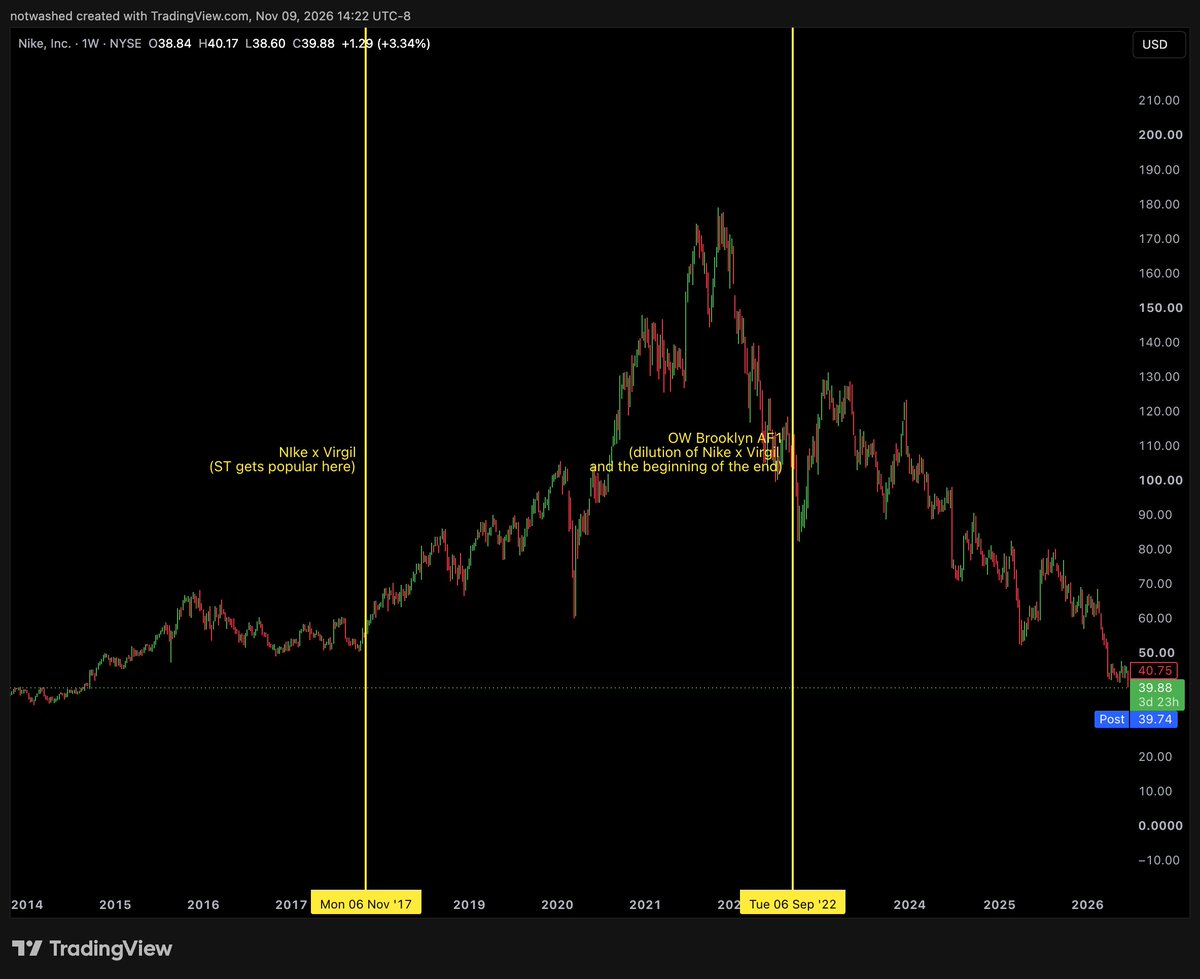
The rise and fall of sneaker Twitter
By 2023, most of the core players have left, turning towards card trading, ticket scalping, entrepreneurship, and other directions. The second thread is less precise than the sneaker case but represents my understanding of the relationship between Crypto Twitter and the crypto industry.
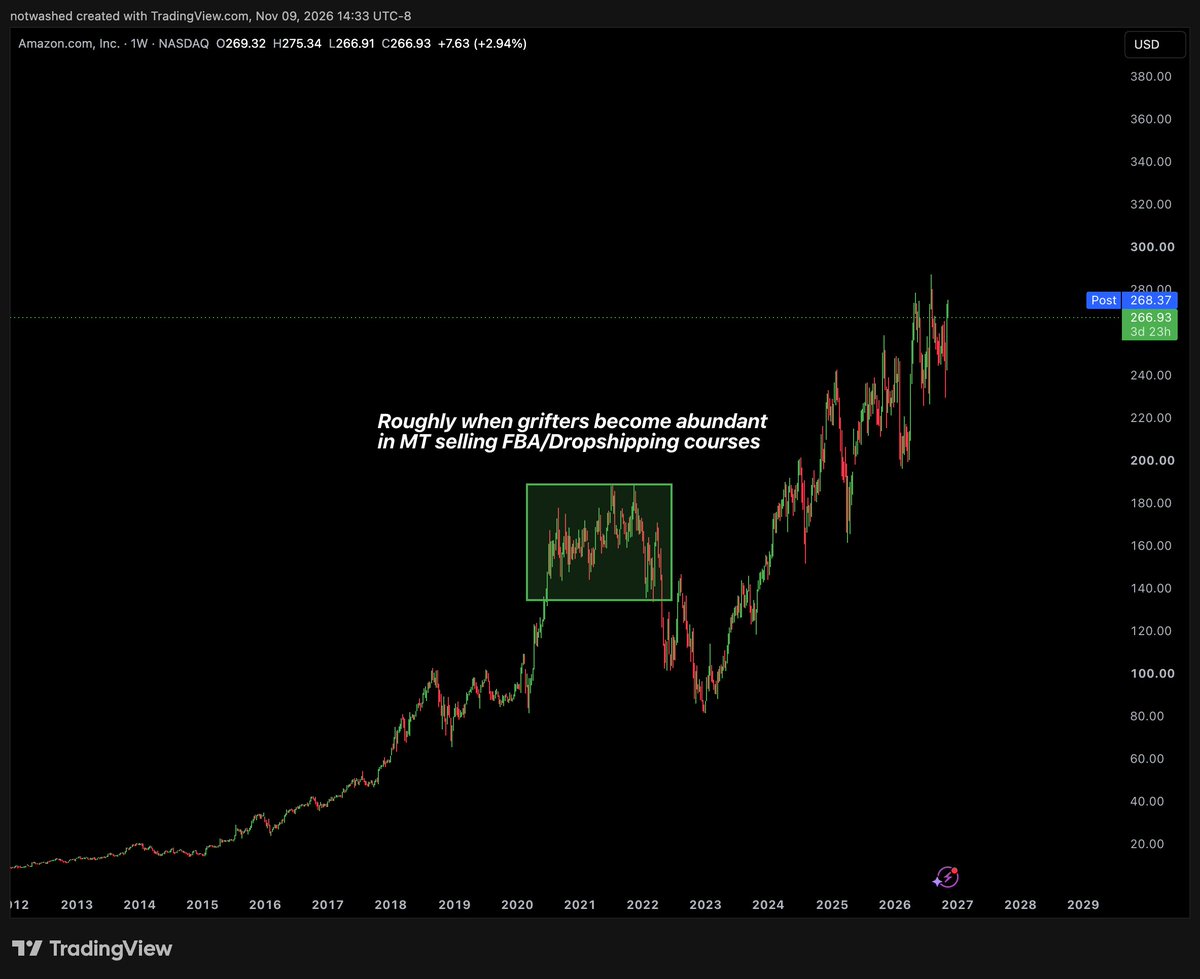
This is just a rough illustration; no need to nitpick details.
The e-commerce industry as a whole is on a long-term upward trajectory, but the niche communities, discussion atmospheres, and arbitrage bonuses surrounding e-commerce have essentially peaked around 2021-2022.
Amazon is certainly more than just e-commerce; it is a massive behemoth. But the core principle is the same: a continually prosperous industry does not mean that those who were first to reap the emerging bonuses can continuously grasp the opportunities.
To add: Finance Twitter covers a wide range of topics, nearly encompassing all online businesses. When I was lurking, mainstream discussions focused heavily on building personal brands (mainly through dropshipping), paid information products, agency services, and affiliate marketing.
The story of sneaker Twitter demonstrates how players mutually consume one another in ongoing upgrading internal competition, ultimately destroying the bonuses that once drew everyone to participate. The story of Finance Twitter shows how, when native opportunities no longer allure, participants shift from doing business for profit to relying on personal traffic influence for monetization.
From this perspective, today's Crypto Twitter is closer to Finance Twitter than sneaker Twitter. The crypto industry will not completely end like the sneaker resale bonuses; neither will Crypto Twitter be left in disarray.
Even if the crypto industry continues to develop, the public information flow of Crypto Twitter will slowly become irrelevant. The unique early-stage information that once circulated in Crypto Twitter's public streams is increasingly settling in on-chain signals, Discord, and private groups on Telegram. Social interactions built on traffic are not inherently sinful; there are still bloggers who diligently grow their followers while actively maintaining community environments. The wise approach is to focus on these quality accounts and filter out the massive noise.
Once a niche territory capable of uncovering opportunities, exchanging ideas, and connecting with skilled peers, the golden age of Crypto Twitter has essentially come to an end. However, it is not significant.
免责声明:本文章仅代表作者个人观点,不代表本平台的立场和观点。本文章仅供信息分享,不构成对任何人的任何投资建议。用户与作者之间的任何争议,与本平台无关。如网页中刊载的文章或图片涉及侵权,请提供相关的权利证明和身份证明发送邮件到[email protected],本平台相关工作人员将会进行核查。


