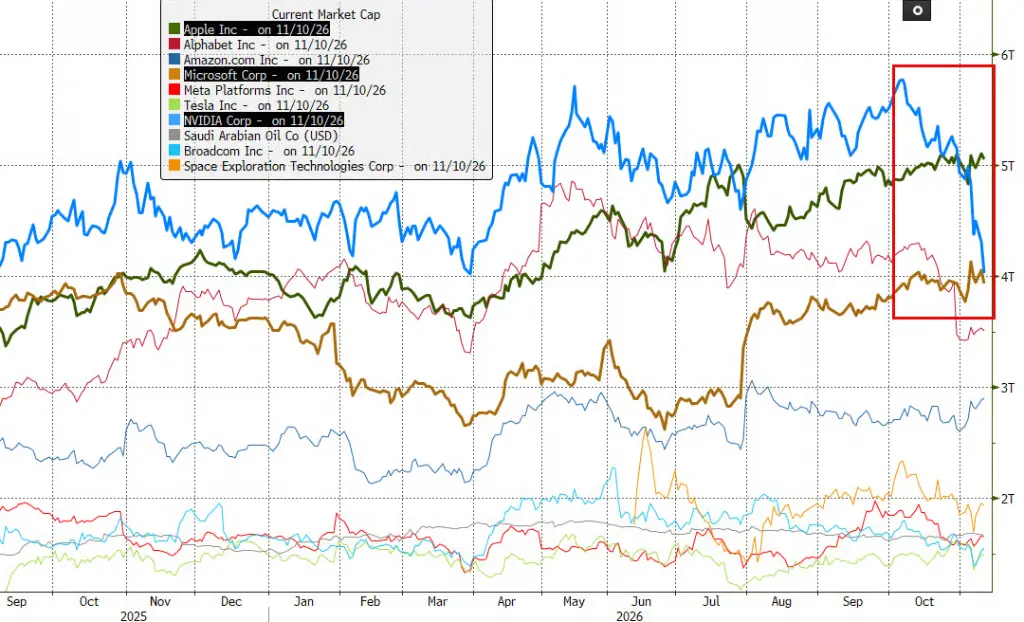
Nvidia's stock price fell for the second consecutive trading day, dropping more than 6% at one point on Tuesday, with a market value loss close to $430 billion over two days.
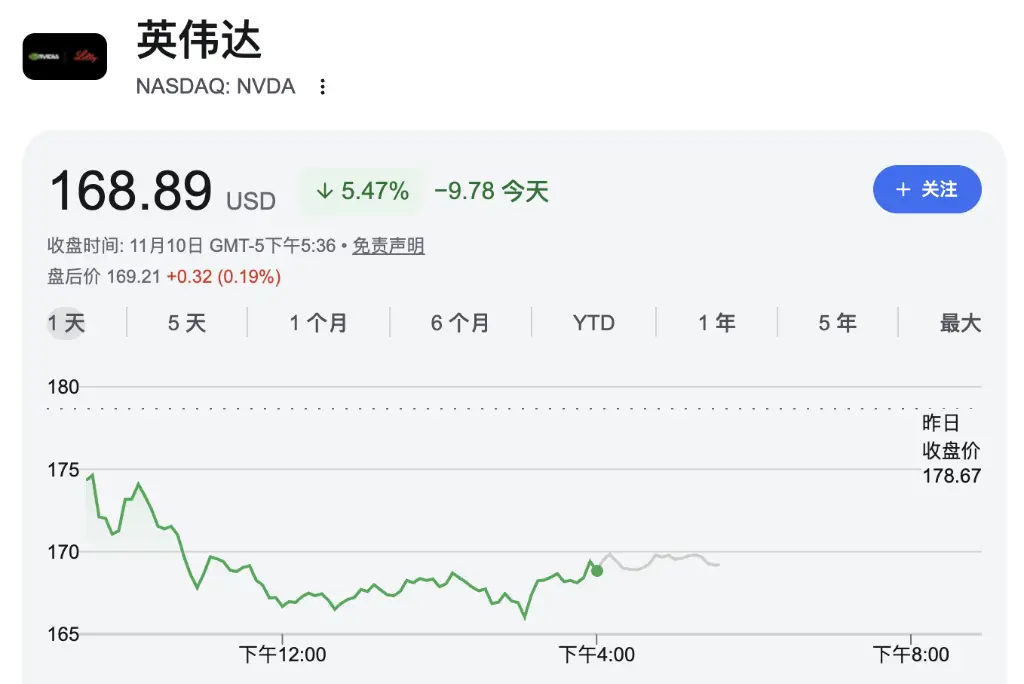
Data shows that nearly $2 trillion has evaporated from its market value since its historical high, with a total market value loss of up to $1.2 trillion in just the last 10 trading days.
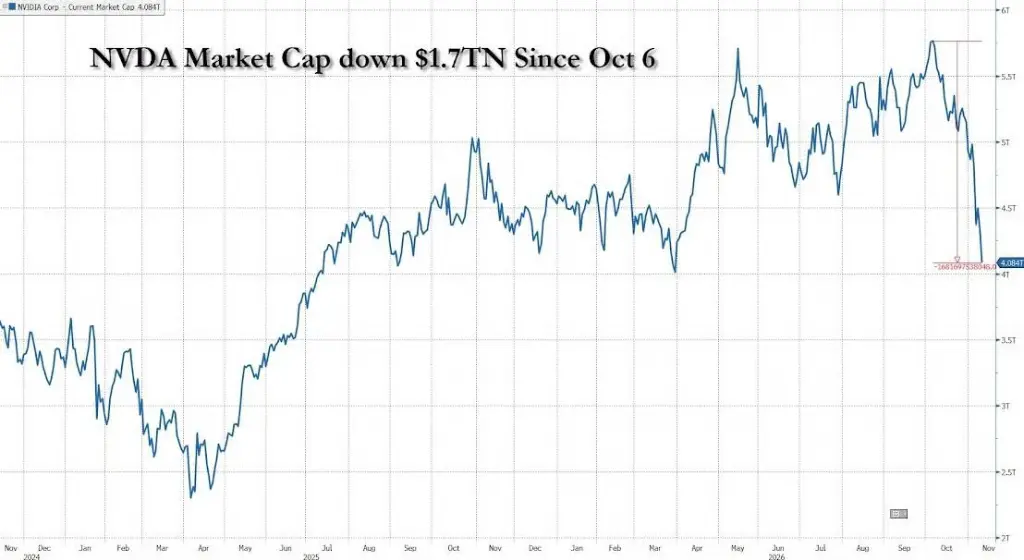
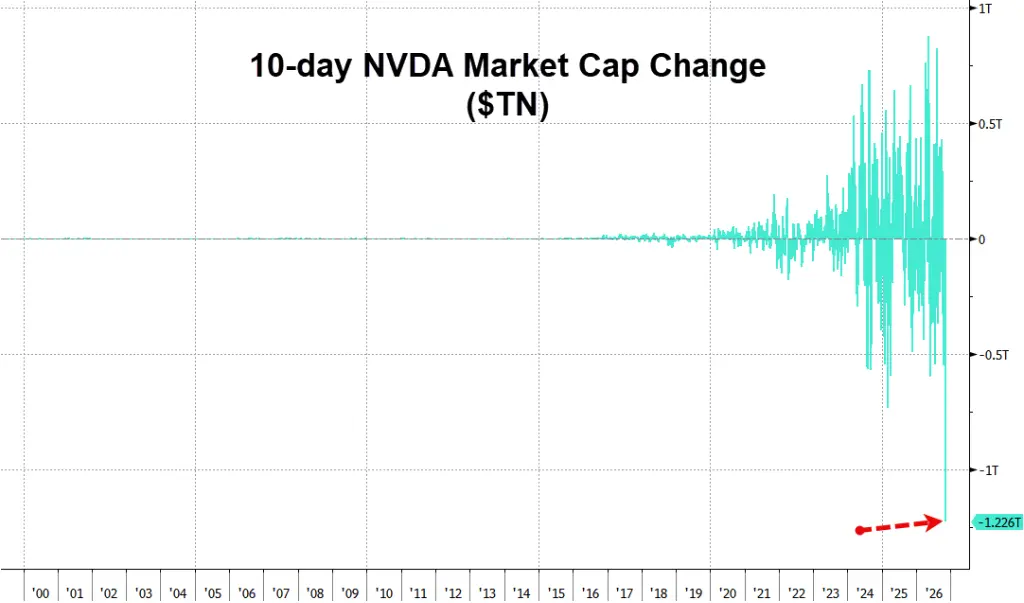
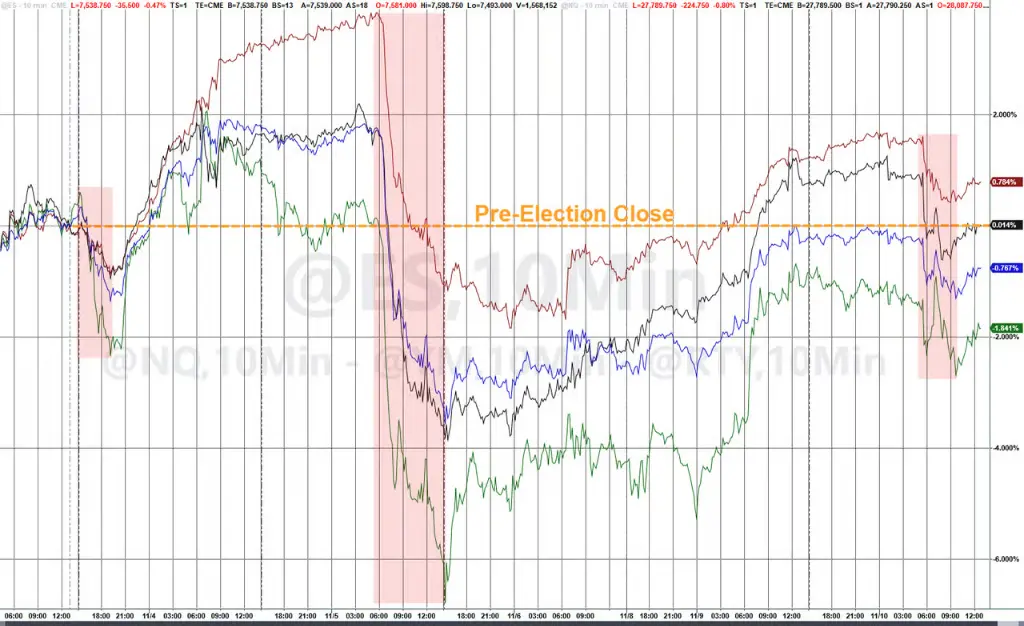
On Tuesday, Nvidia's decline was significantly greater than that of other large tech stocks, becoming an important factor dragging down the performance of tech stocks. Meanwhile, the stronger-than-expected CPI data, combined with the hawkish statements from Federal Reserve officials, drove U.S. Treasury yields significantly higher, further suppressing risk asset sentiment and exacerbating the pressure on tech stocks.
Microsoft fell 2.2%, Alphabet dropped about 0.4%, Meta closed flat, Apple fell about 0.6%, Tesla rose 0.5%, and Amazon increased by about 1.5%. The S&P 500 index dropped about 0.4%, while the Nasdaq 100 index fell 0.6%. Notably, the Nasdaq 100 index has cumulatively fallen about 2% since the election, showing a clear pressure on tech stocks overall.
During the trading session, Microsoft's market value briefly surpassed Nvidia's, making it the second-largest publicly traded company in the world by market value. However, after Anthropic released its office suite, Microsoft's decline expanded, falling behind Nvidia again. Nvidia's market value has now fallen back to a level comparable to that of Apple and Microsoft, significantly narrowing its previously leading advantage.
Shareholders file class-action lawsuit, corporate governance risk further escalates
As the stock price is under pressure, Nvidia also faces new legal and corporate governance pressures. A shareholder filed a lawsuit in California on Monday, accusing Nvidia and CEO Jensen Huang of misleading investors in their disclosures and responses regarding related events, seeking compensation for investors who purchased Nvidia stocks within a specific period.
The lawsuit claims that the company and Huang did not sufficiently disclose related relationships and the potential risks they might bring, leading investors to buy stocks without fully understanding the circumstances.
The plaintiff also alleges that the related events could pose significant risks to Nvidia's reputation and business prospects. The lawsuit is currently at an early stage, and the related accusations have yet to be verified by the court, with Nvidia not having made a formal response to the lawsuit.
On Tuesday, negative news surrounding Huang continued to emerge: Nvidia's board announced it had hired an independent law firm to conduct an internal investigation; House Republicans are reportedly considering issuing a subpoena to the Nvidia CEO for a closed-door briefing; and media reports indicate that Secretary of State Rubio previously informed Trump regarding Huang's contacts with related persons; meanwhile, there are reports that the Federal Bureau of Investigation (FBI) is investigating Huang's relationships with relevant individuals.
Previously, Nvidia's board announced the establishment of a committee composed of independent directors and hired external independent legal counsel to investigate the reports involving Huang.
The board stated that there is currently no reason to believe that Nvidia's national security interests or corporate secrets have been compromised, but the investigation will review all available information. Huang has expressed support for the investigation and committed to full cooperation.
Uncertainty in AI investment prospects compounded by executive risk, Nvidia faces dual pressure
In addition to governance concerns arising from the executive incident, whether AI infrastructure investments can continue to deliver sufficient returns remains a core issue of market interest. As a core supplier in the AI computing power supply chain, Nvidia's stock performance is influenced not only by the company’s operational expectations but also to a certain extent reflects investors' judgments about the entire AI capital expenditure cycle.
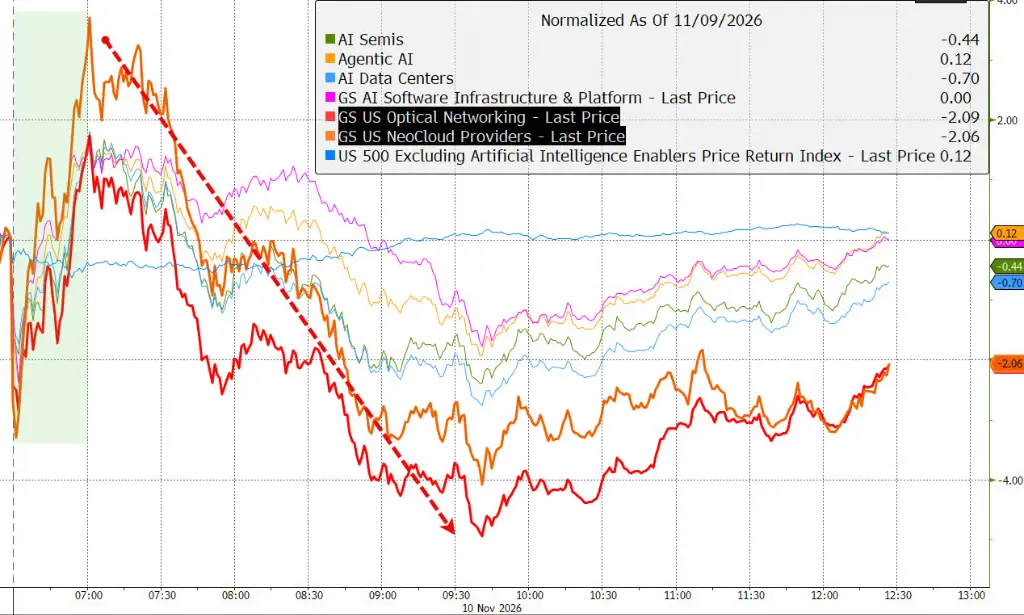
Data shows that on Tuesday, AI-related stocks underperformed the market overall, with emerging cloud computing (NeoClouds) and optical networking sectors among the biggest losers, while the portion of the S&P 500 index excluding AI-related components barely finished flat, indicating that market sell-off pressure is highly concentrated in the AI industry chain.
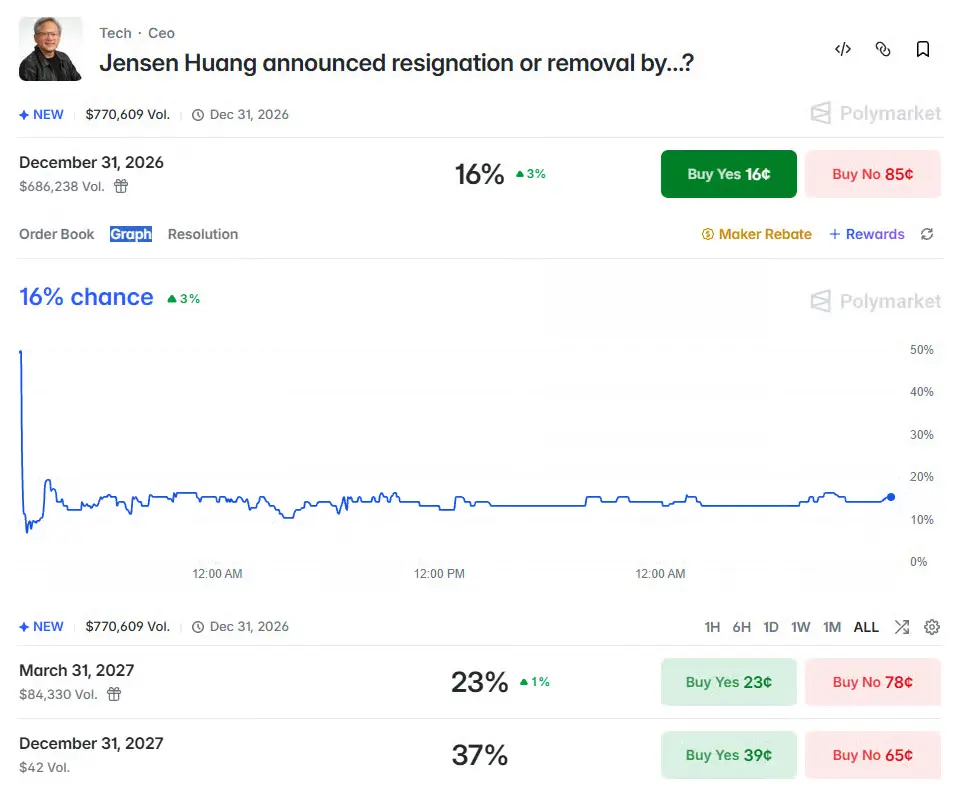
The Associated Press pointed out that Huang has led Nvidia for 33 years, and his personal image is highly tied to the company’s strategy, operational decisions, and market perception. Therefore, related investigations have also led investors to begin focusing on management stability and potential succession issues. Prediction market Polymarket data shows that traders currently assign only a 16% probability that Huang will step down by the end of the year, with some analysts believing this pricing is too low.
From market performance, Nvidia has underperformed other large tech stocks for two consecutive trading days, indicating that investors are reassessing the risks facing the company. A Goldman Sachs trader report shows that the sell-off on Tuesday was primarily driven by genuine fundamental factors, with hedge funds and long-term institutional investors both being net sellers, focusing their sales on tech and industrial sectors.
In the short term, the progress of the board's investigation, ongoing lawsuits, and management stability will be important variables affecting the stock price; meanwhile, the return prospects of AI infrastructure investment will continue to determine the market's long-term valuation judgments of Nvidia.
Additionally, a previous article from Wall Street observed that Goldman Sachs estimates that programmatic trading strategies (CTA) will sell about $31 billion in S&P 500 futures over the next week without considering market direction, which will bring additional technical downward pressure on tech stocks.
Risk warning and disclaimer
Markets carry risks; investment requires caution. This article does not constitute personal investment advice and does not take into account the individual user's specific investment objectives, financial situation, or needs. Users should consider whether any opinions, views, or conclusions in this article align with their specific circumstances. Investing based on this is at the user's own risk.
免责声明:本文章仅代表作者个人观点,不代表本平台的立场和观点。本文章仅供信息分享,不构成对任何人的任何投资建议。用户与作者之间的任何争议,与本平台无关。如网页中刊载的文章或图片涉及侵权,请提供相关的权利证明和身份证明发送邮件到[email protected],本平台相关工作人员将会进行核查。


