Author: Mia Silverio, Prof G Media
Translation by: Deep Tide TechFlow
Deep Tide Insight: The "blue wave" swept both the House and Senate in the U.S. midterm elections, winning five gubernatorial seats, with high inflation and living costs becoming the core measure for electoral accountability. Amid the shift in public opinion and the resonance with calls for AI protection, 40 out of 41 local ballot measures for data centers across the U.S. were rejected, and over 40% of states with planned computing power capacity have elected governors who advocate for a pause in construction.
The shocks from the elections quickly transmitted to the capital markets, with the Nasdaq 100 index losing $2.3 trillion in a single day, while the Philadelphia semiconductor index fell 12%, putting downward pressure on the expected valuation for Anthropic's listing. The article further reviews the state of the Middle East conflict, the congressional deadlock, and the historical returns of U.S. stocks, particularly the political reshuffle driven by the younger generation.
What does the midterm election mean for the market as a vote against living costs?
Last week, a "blue wave" swept through both houses of Congress during the historic U.S. midterm elections. It was a decisive victory: the Democratic Party captured the House of Representatives with the largest popular vote margin since Watergate and flipped five gubernatorial seats in states that Trump previously won in 2024.
Voters expressed their anger over rising living costs, pointing the finger directly at two prominent "scapegoats": on one hand, the Iran war stirred by the Trump administration (driving up gas prices and overall inflation), and on the other, the AI data centers blamed by voters for soaring electricity bills.
At the same time, American voters are calling for the emergence of younger political leaders, with the 120th Congress welcoming a record 97 Generation Z and Millennial lawmakers.
After the election results were announced, U.S. stocks rebounded briefly as Trump expressed acceptance of the results and a willingness to cooperate with Democrats. The Dow Jones Industrial Average rose 3% that day, marking the best single-day performance in over a year, while the S&P 500 index also rose over 1.5%.
However, this gain was fully reversed by Thursday. The Nasdaq 100 index plummeted 6.4%, with a market value loss of as much as $2.3 trillion in a single day, setting the record for the largest single-day market value loss for the index; chip stocks faced severe selling pressure, with the Philadelphia semiconductor index plunging 12%. For these two indices, this represents the largest single-day decline since March 2020.
The market's sharp reversal stemmed from growing investor concerns: a Democrat-led Congress may enact tougher regulatory measures, while newly elected Democratic governors could slow down data center construction in their respective states. In either case, it would slow the current cycle of AI infrastructure development that has supported the strength of U.S. stocks and the macro economy.
Voters reject data center construction; AI trading pays the price
This midterm election acted like a mirror, reflecting the American public's real attitude toward AI, and the result is not optimistic. Over 80% of Republican and Democratic voters support candidates advocating for safety regulations on AI, with voters decisively rejecting data center projects in local elections.
Of the 41 local voting measures related to data centers across the U.S., as many as 40 were rejected. Additionally, the three key states (Ohio, Georgia, and Texas) that account for over 40% of the planned computing power capacity elected Democratic governors who promised to halt or slow down data center development during their campaigns.
While it is unlikely to completely halt the overall construction pace of data centers, it will almost certainly lead to delays in project timelines and increased construction costs.
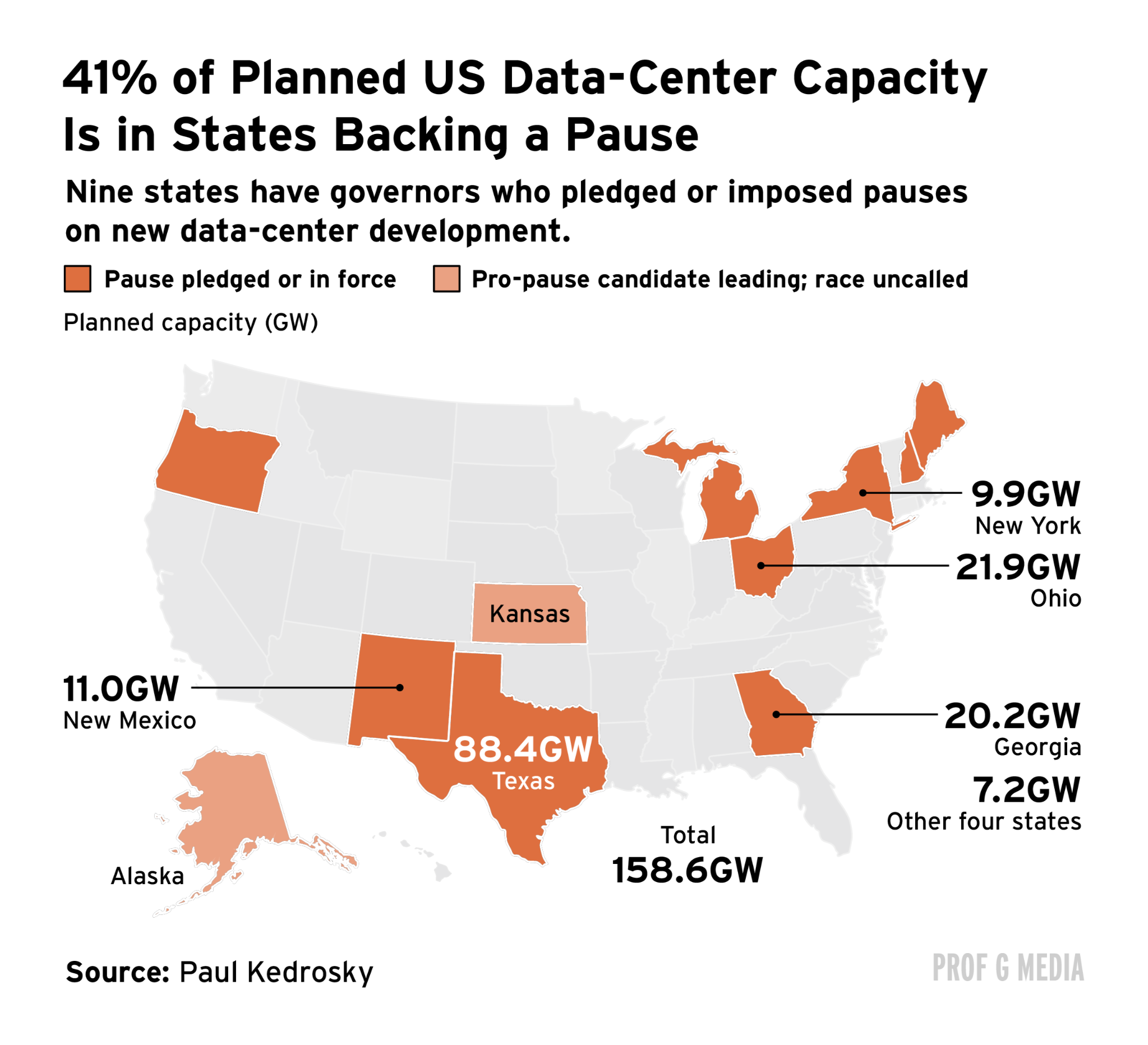
Image: Distribution of planned computing power capacity in states supporting a pause in data center construction (Texas 88.4 GW, Ohio 21.9 GW, Georgia 20.2 GW, etc. Nine states account for 41% of the total planned amount in the U.S., totaling 158.6 GW; Source: Paul Kedrosky / Prof G Media)
In the subsequent sell-off on Thursday, chip stocks and AI infrastructure stocks, which were most directly impacted by the delay of these projects, suffered the most severe declines. Chipmakers Western Digital and SanDisk fell 17% and 22%, respectively, while Micron and AMD also saw declines over 17%.
At the same time, emerging cloud computing companies (Neoclouds) continued to be mired in a downward spiral, with the market values of CoreWeave, Nebius, and IREN halving nearly 50% over the past month.
The election results were not the only factor triggering this wave of declines. On Thursday, Bloomberg reported that Microsoft, one of the first tech giants to lease computing power from emerging cloud providers, is withdrawing from some data center collaboration projects with Nebius, IREN, and Nscale and is evaluating whether to sign new computing power contracts.
This wave of sell-off also affected the IPO pipeline in the AI sector. The probability on prediction platform Kalshi for "Anthropic will go public by December 1" plummeted from nearly 90% earlier this week to 59%. Bloomberg also disclosed that potential IPO investors are currently valuing Anthropic in the range of $1.1 trillion to $1.3 trillion, significantly lower than the $2 trillion target discussed in early October.
Large tech stocks also saw a decline last week, but Amazon, Microsoft, and Alphabet still ended the week with gains. Although tighter AI regulation will bring some resistance, the slowdown in approvals for new data centers may actually favor the largest cloud giants: they currently control 48% of the world's data center capacity, and the hindrance in new capacity expansion means the existing capacity they hold will become scarcer and more valuable.
Scott Galloway's opinion: Data centers are arguably the worst brand management issue in the U.S. They have now become a hollow vessel for public resentment over income inequality. The public has long harbored grievances against tech billionaires, and the only way they can vote to protest against these wealthy individuals is to vote against the construction of data centers.
OpenAI is currently attempting to repackage data centers as "compute campuses" to reshape its brand image, but this strategy is fundamentally ineffective; it’s akin to renaming a landfill as a "historical materials park"—a self-deception.
Voters blame rising prices on the Iran war
The Washington Post reports that before the election day, Trump called on voters 63 times in total to "pretend he is on the ballot" in the midterm election, with over 50 of those calls made between October and early November. Many voters followed this advice, but the results were not as he wished.
As the vote counts from various states were released, Trump quickly changed his rhetoric.

Image: A screenshot of a post by Trump on Truth Social on November 3, 2026, stating that he was not on the ballot, otherwise he would have won overwhelmingly
His decision to go to war with Iran may have directly led to the Republican Party's loss in this midterm election. Nearly three-quarters of American voters surveyed stated that the Iran war was a key or significant factor influencing their voting decisions, and these voters cast 62% of their votes for Democrats, with only 35% supporting Republicans.
Even U.S. Vice President JD Vance publicly attributed the Republican losses to the Iran war the day after the election.
The market interprets this political trend as a signal that the Middle East conflict may end sooner. Last week, international crude oil prices fell 13%, and the aerospace and defense ETF also dropped 1%.
However, the Democrats cannot unilaterally stop the war. Senate Democratic leader Chuck Schumer proposed using Congress's control over fiscal appropriations to force a ceasefire, but the Democrats do not possess an absolute majority in either house to overturn a presidential veto.
The more likely scenario remains a deadlock between the executive and legislative branches, and historical data shows that this is typically not good news for U.S. stocks. According to data from the Royal Bank of Canada (RBC), since 1953, in all combinations of party power where a Republican president is aligned with a Democratic Congress, the S&P 500 index has recorded the lowest average annual return.
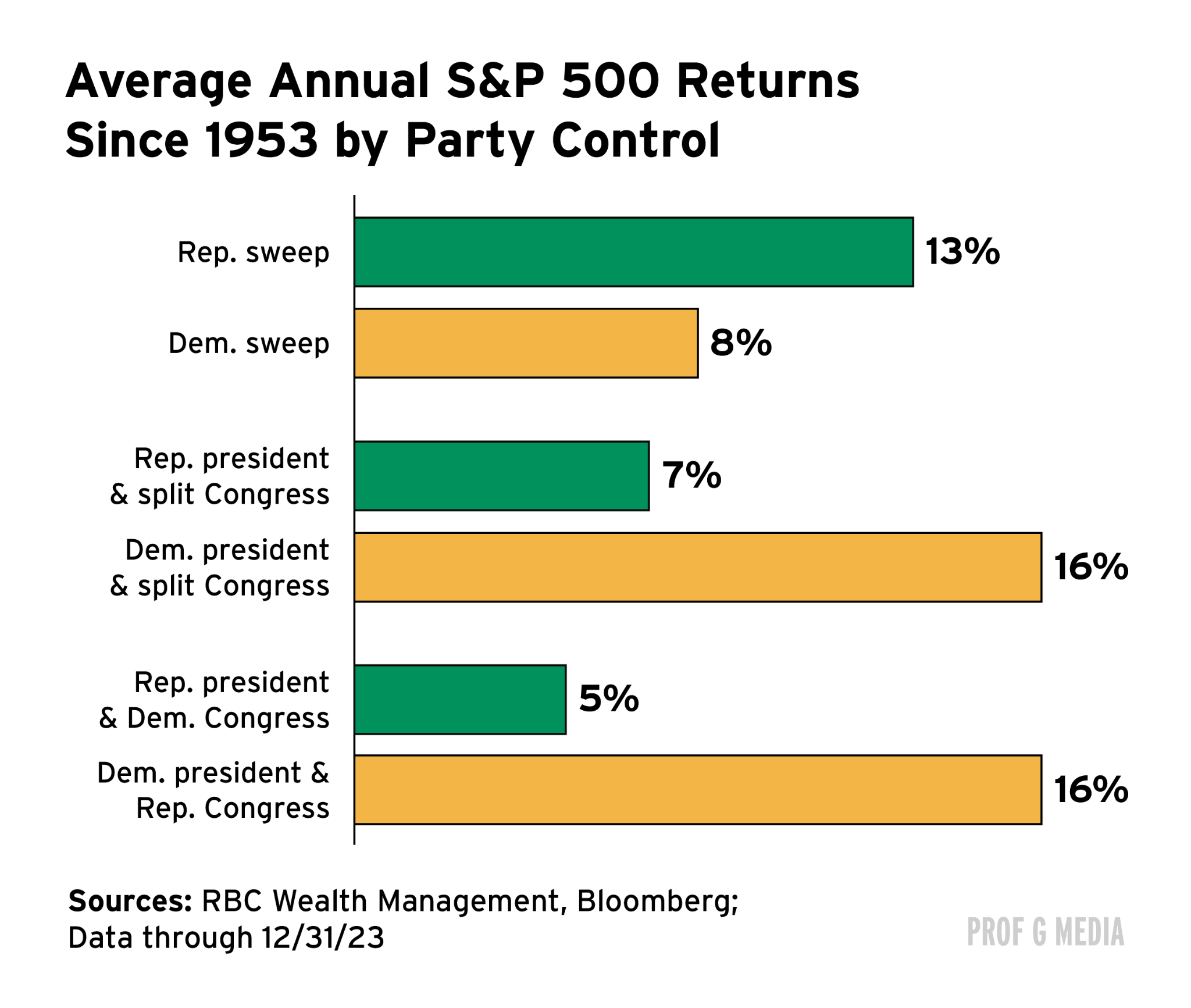
Image: Comparison of the average annual return of the S&P 500 index under different party power combinations in the U.S. since 1953 (Republican president with Democratic Congress at 5%, the lowest; Democratic president with either split Congress or Republican Congress both at 16%; Source: RBC Wealth Management, Bloomberg)
Younger voters elect a new generation of leaders
Two years ago, younger voters helped Trump return to the White House, but in this midterm election, they overwhelmingly leaned towards Democrats. Support for the Democratic Party among male voters under 30 rose from 51% in 2024 to 59% in 2026; for female voters in the same age group, support increased from 61% to 70%.
The issue of living costs has always been the top priority for Generation Z voters. In a youth opinion poll released by Harvard University this fall, as many as 91% of young voters stated that living costs were the core consideration influencing their voting decisions, ranking highest among all issues.
The reason "affordability" became the decisive issue throughout the campaign lies in the high-profile promises made by Trump and the Republican Party to address this problem, which went unfulfilled. At a campaign rally in August 2024, Trump declared: "From day one of taking office, we will end inflation and make America affordable again."
However, the reality is quite the opposite: the inflation rate rose from 3.0% when he took office to 3.7% in September of this year, swallowing all real wage growth for American workers; at the same time, workers currently only receive 52.8% of the total economic output in the U.S., marking the lowest share since the government began tracking this data in 1947.
Trump's commonly used narrative for economic success has had little effect on young people. He frequently cites the stock market's record highs as evidence of a well-functioning economy, but young people hold a minuscule share in the stock market: Millennials and Generation Z own only 9.3% of U.S. stocks and mutual funds, while the Baby Boomer generation holds a substantial 54.5%.
Younger voters are eager to see a new generation of leadership. In Harvard's spring youth opinion poll, respondents indicated that the ideal age for Congress members should be 39. In contrast, the average age of lawmakers in the 119th Congress was nearly 59; a CNN poll this summer also showed that nearly 60% of Americans consider “a quarter of Congress members being over seventy” a significant issue.
This sense of frustration is directly reflected in this year's ballot composition: over one-third of congressional candidates this year were under the age of 45, and Millennials became the largest cohort among Senate candidates for the first time in history.
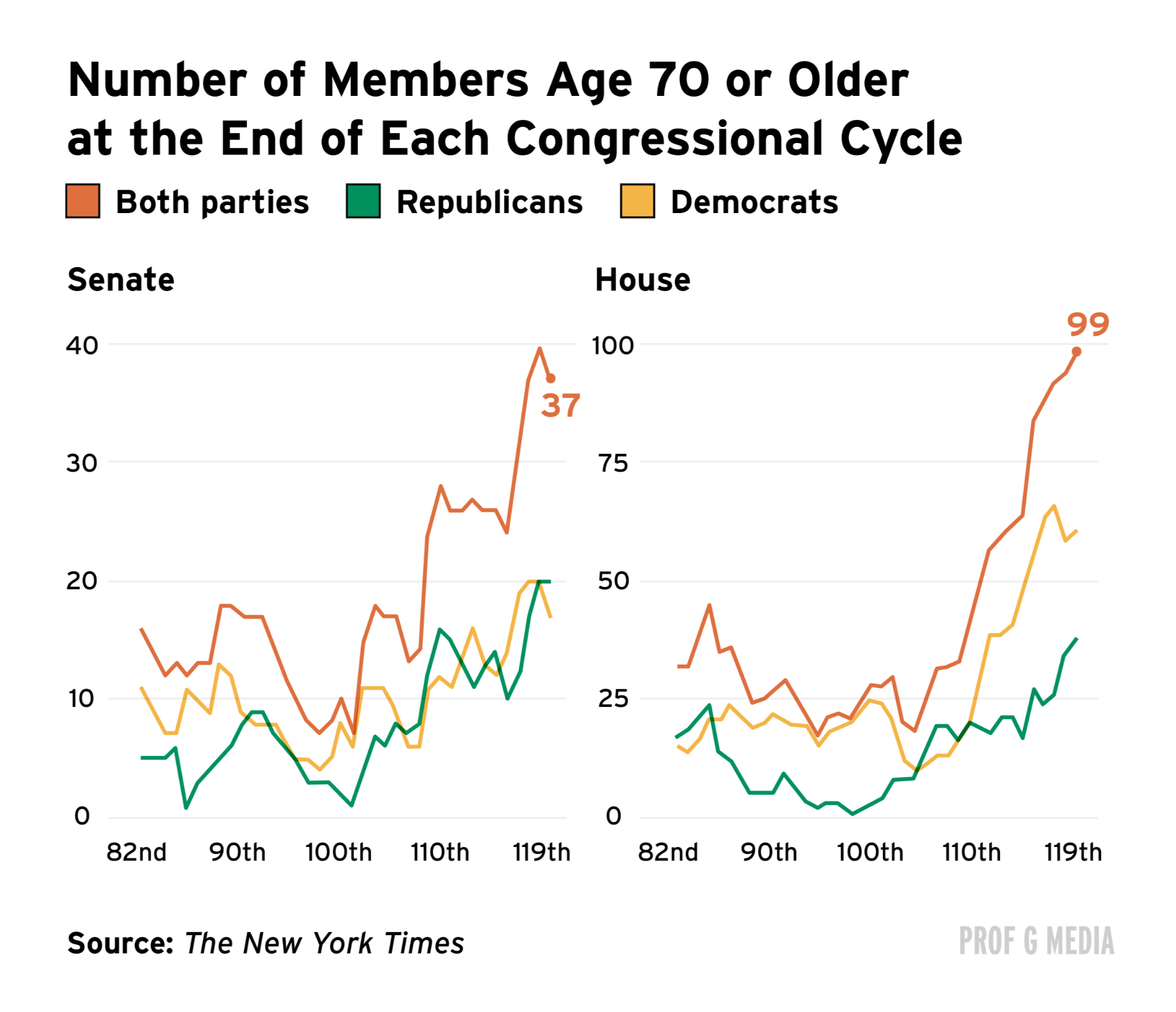
Image: Changes in the number of senators aged 70 and above at the end of each U.S. Congress (at the end of the 119th Congress, there were 37 in the Senate and 99 in the House, at a historical high; Source: The New York Times / Prof G Media)
Ed Elson's opinion: The change we have been calling for has finally come true: young people stepped up to vote, young candidates stood up to run, and many of them were successfully elected.
Younger males originally liked Trump largely because he presented himself as a "bro." He frequently appeared on podcasts and was indeed entertaining at one point, but this persona's half-life was only a few months before they realized they had been fooled.
Now, I hope to see the Democrats seriously confront the issue of intergenerational inequality and come up with feasible policies to try to turn the tide. This may mean leveling the income tax rates between labor income and capital gains or implementing income threshold checks for Social Security benefits.
These are extremely tough political issues. But if the Democrats merely say they care about young people without taking action, young voters will just as mercilessly abandon them.
Ed Elson predicts: We are about to enter an era of cautious advancement in AI regulation.
免责声明:本文章仅代表作者个人观点,不代表本平台的立场和观点。本文章仅供信息分享,不构成对任何人的任何投资建议。用户与作者之间的任何争议,与本平台无关。如网页中刊载的文章或图片涉及侵权,请提供相关的权利证明和身份证明发送邮件到[email protected],本平台相关工作人员将会进行核查。


