The ecological lineup is not small, but the real test has just begun.
Written by: KarenZ, Foresight News
On November 9, the Hyperliquid ecological Layer 2 network Elysium built by Kinetiq went live on the mainnet as planned.
With Hyperliquid already having HyperCore and HyperEVM, why is there a need for another Layer 2? This question may be more worthy of attention than Elysium's claimed 100 milliseconds block time.
According to Hyperliquid's design, HyperCore is responsible for core financial functions such as spot and perpetual contract order books, while HyperEVM provides a smart contract environment compatible with the Ethereum Virtual Machine for developers. Both share HyperBFT consensus and can interact directly.
However, the speed of the trading engine does not imply that the smart contract execution environment can meet all needs. HyperEVM adopts a gradual scaling strategy, and the current throughput has certain limitations for applications that require continuous price updates and frequent transaction execution. Especially for professional market makers, if they need to adjust quotes multiple times per second, execution speed and transaction costs become important considerations.
Elysium targets this expansion need: to add a layer of high-performance execution environment and further connect HyperCore's market data and order book. Its goal is not only to make smart contracts run faster but also to support token issuance, improve liquidity in the spot market, and attract more trading demands into Hyperliquid.
From Liquid Staking to Hyperliquid L2
Kinetiq, the driving force behind Elysium, is not a suddenly emerged infrastructure startup.
Kinetiq initially entered the Hyperliquid ecosystem through the HYPE liquid staking protocol. Users can stake HYPE through Kinetiq to receive kHYPE, which represents the staked position, allowing them to earn staking rewards while using kHYPE for other DeFi applications to improve asset utilization efficiency.
This business has already secured an important position for Kinetiq in the Hyperliquid ecosystem.
According to DefiLlama data, as of November 9, Kinetiq ranked first in the Hyperliquid L1 liquid staking protocol, with a TVL close to $800 million, significantly ahead of the second-ranked stHYPE (approximately $170 million), accounting for about 82% of the total TVL in this category. Its kHYPE historical data shows that the TVL peaked at about $2.3 billion in September 2025.
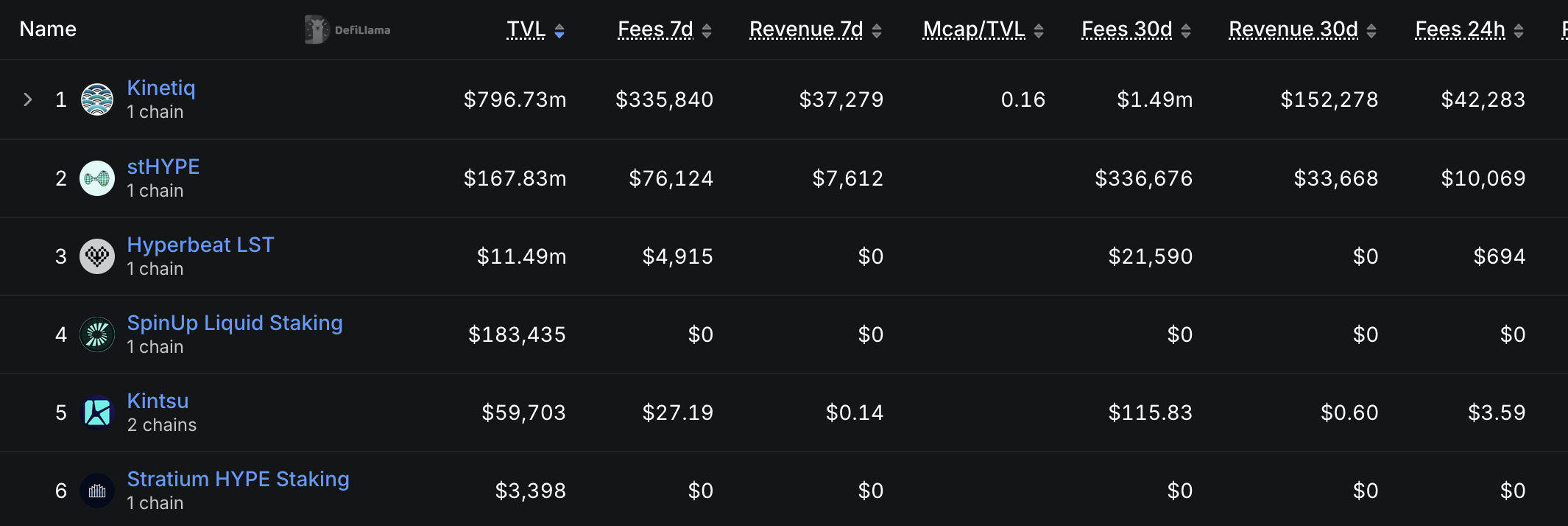
Liquid staking leaderboard on Hyperliquid L1: Source: DefiLlama
The team subsequently launched Markets.xyz, extending its business into the trading market. Markets.xyz is an on-chain trading platform based on Hyperliquid, supporting spot and perpetual contract trading across cryptocurrency, stocks, indexes, forex, and commodities. Its related perpetual contract markets are built using Hyperliquid's HIP-3 mechanism, aiming to allow more traditional financial asset price exposure to enter an around-the-clock on-chain trading market.
Accompanying Markets.xyz is kmHYPE. Users can obtain kmHYPE by staking HYPE, participating in the operation and profit distribution of the related HIP-3 trading markets. According to DefiLlama data, as of November 8, kmHYPE's TVL was approximately $38 million.
Meanwhile, Kinetiq also launched Launch, leveraging the liquid staking mechanism and funding model to assist third-party teams in raising the HYPE staked assets needed for HIP-3 market deployments. It alleviates the pressure on the deploying party to raise staking assets independently.
From kHYPE to Markets.xyz, then to Launch, Kinetiq's business has gradually extended from staking services to trading and market infrastructure. The introduction of Elysium further enters the domain of underlying smart contract execution.
This expansion path shows clear business connections: liquid staking helps Kinetiq consolidate HYPE assets, Markets.xyz and Launch link part of those assets with the trading market, while Elysium attempts to provide a larger execution space for token issuance, professional market making, and other high-frequency applications.
If Elysium can attract enough developers and trading activity, Kinetiq has the opportunity to create synergies that cover staking, trading, and infrastructure.
Kinetiq's core members include co-founder Omnia (operating under a pseudonym) (@0xOmnia), co-founder and CTO Justin Greenberg, and co-founder and co-CEO Magnus Lai.
In terms of financing, Kinetiq announced the completion of approximately $1.75 million in seed round financing in October 2025, with investors including Maven 11, Susquehanna, IMC Trading, Flowdesk, Chorus One, and other institutions. Compared to many infrastructure projects that raise tens of millions of dollars, its public financing scale is relatively limited.
How does Elysium operate? What problems does it solve?
Elysium chooses to add execution space above HyperEVM. It utilizes the Arbitrum Orbit tech stack, with Conduit providing the related infrastructure, supporting settlement submissions to HyperEVM; transaction fees use HYPE, which is cross-chain from HyperEVM at a 1:1 ratio as native Gas.
Elysium's announced parameters include 100 milliseconds block time, approximately 300 milliseconds user-perceived transaction receipt, and an execution throughput target of 300 Mgas/s.
In comparison, HyperEVM's small block is generated approximately once per second, with each block accommodating around 3 million Gas. Large blocks are generated approximately once every 60 seconds, with each block handling about 30 million Gas. Based on the execution rate of small blocks, Elysium's target throughput is about two orders of magnitude higher.
The significance of speed still needs to be contextualized for specific use cases.
Elysium officially highlights PropAMM, an automated market-making mechanism operated by professional market makers. Unlike traditional AMMs that rely on fixed pricing formulas, PropAMM relies more on professional market-making strategies to continuously adjust quotes to adapt to external market changes.
According to Kinetiq's vision, Elysium hopes to allow market makers to update quotes five to ten times per second at lower costs. If this capability proves effective under actual load, market makers will have a chance to adjust prices and inventory risk more timely, improving liquidity in asset trading.
This also connects Elysium with Hyperliquid's spot market.
HyperCore already has a native spot order book, but establishing a continuous, sufficiently deep buy and sell market for a new token is not easy. Kinetiq noted in its August announcement that compared to the perpetual contract market, Hyperliquid's spot trading still has considerable room for growth.
Therefore, Elysium has designed a more comprehensive path for token development: new tokens will first launch on Elysium, build initial liquidity through AMMs, then introduce PropAMM to enhance market-making capabilities, and subsequently have the option to enter HyperCore's spot order book and further expand to perpetual contract trading through HIP-3.
It should be noted that this is a technical and product-level optional path, and does not mean that all tokens can automatically enter the HyperCore spot market or obtain perpetual contract listing qualifications.
Additionally, Elysium also plans to connect to HyperCore. According to the roadmap, about four weeks after the mainnet launch, the network will upgrade via ArbOS to include HyperCore's native market data reading interface, and a rapid write path for submitting transaction instructions via keeper.
This means that smart contracts on Elysium will potentially access the depth of HyperCore's order book, prices, balances, and positions directly in the future, without fully relying on third-party oracles to transmit this data.
At the same time, related applications can also interact with HyperCore through dedicated transaction execution paths. This is especially important for automated trading, market making, and strategies that need to simultaneously utilize both spot and perpetual contract markets.
Elysium Economic Design: No New Token, How to Benefit KNTQ?
The most noteworthy aspect of Elysium's economic design is that it does not plan to issue a separate Gas token, but will continue using HYPE and link part of its generated revenue with KNTQ.
Additionally, according to Kinetiq's official website, Elysium plans to allocate 25% of the sequencer fees to application developers, 50% for repurchase and destruction of KNTQ, and the remaining 25% will go into the Kinetiq treasury.
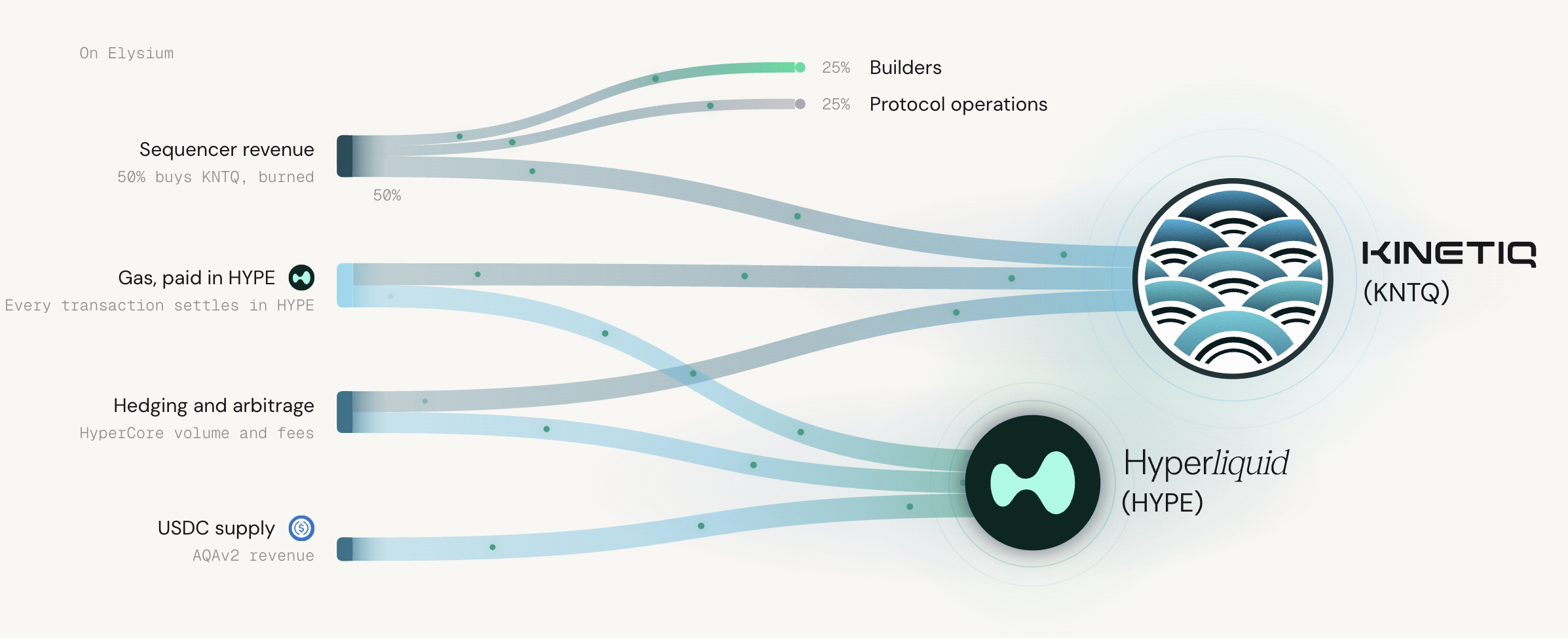
This design attempts to address three issues simultaneously: how to attract developers, how to maintain infrastructure operation, and how to link KNTQ with new business economically.
Among these, the developer share is particularly notable. Elysium leaves part of the sequencer revenue for these applications, allowing them to use it for user incentives, fee rebates, and other activities, with the aim of motivating applications to continuously attract trading demands.
The ecological lineup is not small, but the real test has just begun
Before the mainnet launch, Elysium has already announced several ecological collaborations and integration plans.
According to Elysium's official ecological page, it has included over 120 projects and infrastructure service providers, covering various fields including DeFi, Launchpad, NFT, gaming, cross-chain bridges, and infrastructure. This includes both mature projects like Uniswap, Pump.fun, 0x, and OpenSea, as well as trading tools, wallets, and infrastructure service providers like GMGN, Bitget Wallet, OKX Wallet, Wormhole, and QuickNode. However, this does not mean that all projects are already officially operating on the Elysium mainnet.
Like other mainnet launch projects, Elysium has attracted a number of token issuance platforms. Its ecological page lists 29 Launchpad platforms, including Ascend, Montra, AkaFun, and Boxa. Some projects have begun token issuance and trading activities before the mainnet launch.
From recent market data, the market cap of e/cc issued through the Ascend platform is approximately $5.93 million, with another 4 tokens issued through this platform having market caps between $100,000 and $1 million; the market cap of the platform token from Montra is approximately $5 million, with 8 issued tokens also in the $100,000 to $1 million range; Boxa's platform token has a market cap of approximately $1.5 million, with another 3 issued tokens in this range. The AkaFun ecosystem is relatively quiet, with only 1 issued token having a market cap exceeding $100,000.
These platforms could become one of the earliest scenes generating significant trading for Elysium, but they also present a problem. New token issuance can create activity in a short time, but often comes with low liquidity, bot trading, and short-term speculation. If a project lacks sustained market demand after issuance, trading volume may quickly decline.
The technical boundaries also need to be clear.
Initially, Elysium's network will employ a single sequencer and permissioned validation, with plans to gradually introduce a permissionless fraud-proof mechanism in the future.
In terms of data availability, Elysium uses the AnyTrust model, but initially operates a single data availability server provided by Conduit, rather than forming a multi-member data availability committee. The official statement indicates that if the data availability server is unavailable, the system can revert to publishing complete transaction data to HyperEVM.
Moreover, Elysium's standard Optimistic withdrawal requires about a 5.5-day challenge period, which should not be confused with the transaction receipt time of a few hundred milliseconds.
More importantly, Elysium is not the official Layer 2 of Hyperliquid Labs or Hyper Foundation. Kinetiq has clearly stated in its initial announcement that it is an independent team participating in the construction of the Hyperliquid ecosystem without obtaining official special support.
This identity also determines that Elysium must prove its value through its own product capabilities, developer relationships, and actual usage demand, rather than relying solely on its existing influence within Hyperliquid to achieve success.
The mainnet launch is just the beginning. The more convincing factors will be the applications, funds, and transaction volume that remain on this chain in the long term. For a Layer 2 focused on high-performance trading, sustained liquidity and genuine trading demand may be more important than prettier performance parameters.
免责声明:本文章仅代表作者个人观点,不代表本平台的立场和观点。本文章仅供信息分享,不构成对任何人的任何投资建议。用户与作者之间的任何争议,与本平台无关。如网页中刊载的文章或图片涉及侵权,请提供相关的权利证明和身份证明发送邮件到[email protected],本平台相关工作人员将会进行核查。


