

Every Monday, Wednesday, and Friday, focusing on the crypto market, Japan, South Korea, A-shares, and Hong Kong stocks, using data to review the market and trends to seize opportunities, produced by PANews.
The breach of the 50-week moving average triggers a bloody battle, BTC retreats to the 200-day moving average awaiting the ultimate CPI judgment
Non-farm payrolls posted record numbers locking in the Federal Reserve's interest rate hike expectations for December, combined with the weekend scandal involving Nvidia CEO and the stalemate in US-Iran negotiations, caused the crypto market, which is open all day, to first fall victim to macro risk aversion sentiment. Bitcoin broke out of its range-bound trend over the weekend, retreating nearly 16% from its earlier high of $87,000, dipping below $75,000 and briefly plunging to around $73,510, before fluctuating around $74,500. This weekly decline of 4.47% not only recorded a rare five consecutive red candles but also closed below the 50-week moving average (approximately $75,500) for the first time since mid-September, pushing the market into a high-volatility watershed.
Faced with the breach crisis, both bulls and bears are engaging in fierce competition around the key support level of $72,500 to $73,500. Several well-known analysts and traders pointed out that the 200-day moving average (around $73,200) and the Fibonacci retracement level of 0.5 for the uptrend from $57,000 to $87,000 (at $72,581) constitute the most critical defense line at the moment. Additionally, CoinAnk data shows that the range from $72,850 to $74,700 is saturated with an extreme bullish liquidation cluster with a peak of $289 million.
However, the loss or gain of the 50-week moving average still sends chills down the spines of technical analysts. Doctor Profit warned that the 50-week moving average is the last line of defense for a bull market, and if it cannot be effectively reclaimed, the previously gained price from $57,000 to $87,000 may become a bear trap, with prices likely heading straight for the Fibonacci golden pocket at $68,000 to $69,000. Ash Crypto, Ardi, and Material Indicators co-founder Keith Alan also noted that if this week fails to confirm the breakdown as a "false breakdown," Bitcoin may further test the $66,000 to $70,000 range (200-week moving average) or even drop to the $60,000 level to seek buyer liquidity.
However, Galaxy Digital's research head Alex Thorn soothed the market by citing historical data from 2011 and 2019, indicating that after a bear market bottom, the first break below the 50-week moving average has never set a new weekly low. Furthermore, analysts Saif Trades and Killa firmly believe that the current approximate 16% pullback is merely a "higher low" within the bull market, and they remain bullish in the long term, predicting a rise to $90,000 or even $180,000.
In the derivatives market, the persistent negative premium on Coinbase indicates the absence of US spot buying, while 75% of Binance accounts are blindly going long. Meanwhile, CoinGlass's "net short" indicator and the spot buy wall have both retreated to the $60,000 level. Trader Stoic pointed out that $76,000 is the current "gamma flip point," and only if volume stabilizes at this level can market makers shift from "selling on rallies" to "chasing prices in trends," thereby opening the door to an advance towards $80,000. If it fails to break through the concentrated open interest zone from $76,000 to $77,600, Bitcoin will find it hard to escape the pull of decline.
Looking ahead, Bitcoin's ability to launch a counterattack will depend on the performance of the US stock market at Monday's opening and the US October CPI inflation data released on Tuesday. If the inflation data exceeds expectations, it will completely lock the Federal Reserve’s interest rate hike door, forcing Bitcoin to test the $72,000 buy wall; conversely, if inflation cools moderately alongside a rebound in US stocks, the market can expect a strong rally. Additionally, the breakeven point for miners, where mining revenues cover electricity costs (around $70,000), serves as an invisible support for the market.
Ethereum ETFs face continuous net outflows, ETH falls below $2,100 triggering liquidity crunch in altcoins
Ethereum has recently faced dual blows from both fundamentals and technical aspects, with prices briefly losing the critical support of $2,100, reaching a low of $2,060. In terms of capital flow, SoSoValue data shows that Ethereum spot ETFs have seen net outflows for six consecutive weeks, with last week's outflow reaching $365 million (of which $346 million was from BlackRock’s ETHA). Furthermore, Ethereum co-founder Vitalik Buterin suggested a narrative transformation, proposing to shift ETH from a "fee-burning token" to a "store of value" asset to tackle challenges in the AI era, sparking market discussions on this narrative shift.
Technically, traders generally view $2,100 as the divide between bulls and bears. Analysts indicate that ETH needs to quickly reclaim $2,210 and even $2,300 in the short term; otherwise, it risks easily probing the $2,000 milestone. Despite market pressures, smart money on-chain has begun to position against the trend, with Lookonchain monitoring showing that large whales withdrew 34,600 ETH (approximately $73.75 million) from Binance within three hours, while several large holders aggressively bought over 23,000 ETH in the $2,149 to $2,155 range.
The altcoin market also experienced a brutal shakeout, with USDT market share soaring to 7.25%. The Threshold Network (tBTC) cross-chain bridge affected by the Linux vulnerability has recovered, but a reserve pool of about $120 million on Aave remains frozen. Additionally, the meme trading platform XXYY announced it would shut down at the end of November, and the Web3 task platform Galxe will integrate into Gravity L1 and cease its old services; Animoca Brands announced a shift towards AI agents and Web3 digital ownership infrastructure.
On the political and protocol upgrade front, despite the crypto super PAC Fairshake having a 92% win rate in the midterm elections, regulatory clouds continue to loom. The market will closely monitor the progress regarding "versioned opcode gas repricing" in the Ethereum EIP draft. If ETH fails to hold the life-and-death defense line of $2,000 to $2,100 this week, the altcoin market may face a new round of deep deleveraging liquidation.
Today's highlights:
- This Week Preview | US October CPI released; Hyperliquid ecosystem L2 network Elysium launches mainnet
- Data: Tokens like ALLO, AZTEC will see over ten million dollars in large unlocks this week
- Hyperliquid ecosystem L2 network Elysium launches mainnet
- Coinbase will suspend trading of BAL and TNSR
- Kamino (KMNO) unlocked about 229 million tokens, valued at approximately $9.1 million
- Collector Crypt (CARDS) unlocked about 59.26 million tokens, valued at approximately $18.4 million
- Upbit 24-hour trading volume ranking: XRP, BTC, ETH, SOL, DOGE
- Bitcoin spot ETF had a net outflow of $1.282 billion last week, with BlackRock IBIT leading the way with a net outflow of $1.209 billion
- Ethereum spot ETF had a net outflow of $365 million last week, marking six consecutive weeks of net outflows
- HYPE spot ETF had a net outflow of $15.6168 million last week, a historical third high
- XRP spot ETF had a net outflow of $529,500 last week
- SOL spot ETF had a net outflow of $26.2521 million last week
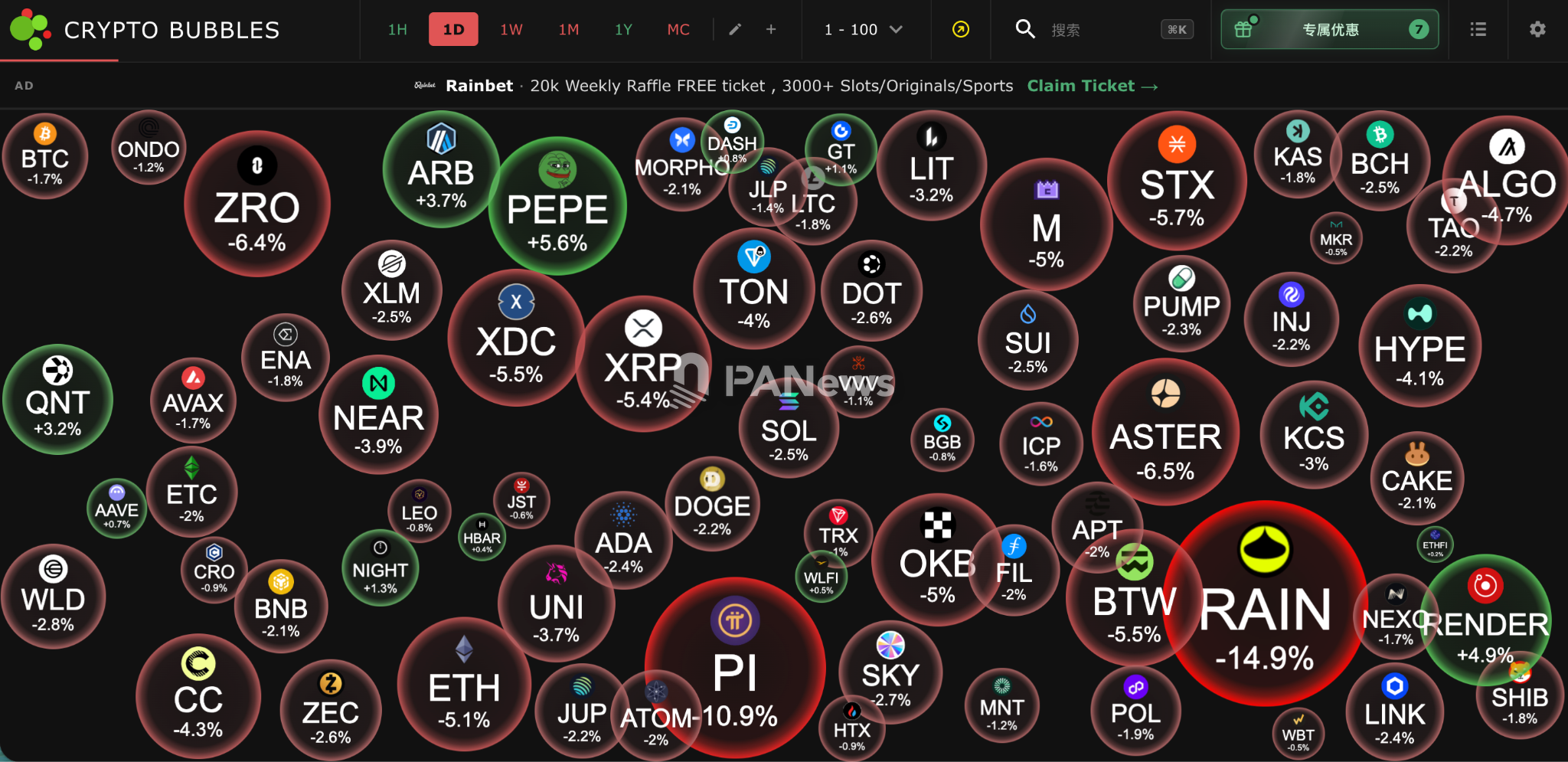
Today's top gainers among the top 100 cryptocurrencies: PEPE up 5.6%, RENDR up 4.9%, ARB up 3.7%, QNT up 3.2%, NIGHT up 1.3%.
The era of discounted tech stocks coupled with Huang Renxun's scandal creates a split market in Asia-Pacific
Influenced by the "political and ethical storm" in Silicon Valley, the South Korean stock market experienced extreme fluctuations. The KOSPI index briefly surged but ultimately fell 0.79% due to Nvidia's overnight plunge. South Korea's market heavily relies on the semiconductor supply chain; Nvidia CEO Huang Renxun's personal storm and the rumors of an external independent review directly harmed supply chain sentiment, leading to a significant reduction in Samsung Electronics' intraday gains; SK Hynix also weakened and faced bloodletting pressure from two leveraged ETFs linked to it that are set for liquidation around this Thursday. Nomura Securities' team warned that the US "blue wave" will halt the approvals for data centers, effectively ending the cloud giants' chip accumulation frenzy, directly puncturing the 200% to 300% premium bubble of GPUs and HBM in Asia's gray market, undoubtedly casting a heavy shadow on the upcoming "new regulations for cornerstone investors" taking effect this Friday in South Korean tech stocks.
In contrast, the Japanese stock market followed an independent trend under the depreciation of the currency and the local recovery logic, with the Nikkei 225 index rising by 2.33%, and the Topix index soaring by 3%. The yen's exchange rate against the dollar fell to around 158.49, significantly boosting earnings expectations for Japanese export-oriented manufacturing companies and automotive leaders. Despite Nvidia's scandal perturbing some semiconductor equipment sectors, strong capital attraction from traditional industrial giants like Toyota and Mitsubishi Heavy Industries, as well as undervalued financial stocks, helped Japanese stocks overturn last week's lethargy following US stock adjustments. Nomura Securities' research report believes that the current strong momentum of Japanese stocks mainly comes from revisions of EPS expectations driven by yen depreciation and the regional rebalancing of global capital under the turbulence of US AI stocks.
The Hong Kong stock market remained under pressure throughout the day, with the Hang Seng Index falling 0.13% and the Hang Seng Tech Index down 0.92%. Affected by overseas selling sentiment in the computing hardware sector, Hong Kong's semiconductor and tech network stocks fell broadly, with Meituan down 6.53%, Kwanon's layered board down 9.21%, and Xiaomi and Alibaba under slight pressure. However, news that Alphabet is considering issuing Hong Kong dollar bonds worth $1 to $1.5 billion helped boost some liquidity confidence.
The A-share market saw a rebound driven by domestic demand and new concepts, with the Shanghai Composite Index rising 0.32% on lower volume, while the Shenzhen Component Index and the ChiNext Index dipped slightly by 0.27%, with a total market turnover of 1.49 trillion yuan. The market exhibited a clear dichotomy between risk aversion and thematic investment: boosted by the 36.6% soar in PPI for the coal mining industry and a 35% rise in the oil and gas mining sector in October, coal and gas sectors led significant gains, with Zhengzhou Coal and Electricity and Shengtong Energy hitting their price limits; on the tech growth side, Apple’s open-source humanoid robot control system HALO utilizing Alibaba's Qianwen model achieved a 91% task success rate on the Yuzhu G1, igniting a surge in humanoid robot stocks, with Upwell New Materials and Xiangming Intelligent both hitting their price limits, while previously high-flying sectors like photovoltaics and lithium metals faced large sell-offs as funds took profits. Founder Strategy pointed out that amidst external expectations of Federal Reserve interest rate hikes and overseas tech black swans wreaking havoc, domestic policy deployments to stabilize the market are pushing funds towards defensive cyclicals and undervalued, controllable sectors.
免责声明:本文章仅代表作者个人观点,不代表本平台的立场和观点。本文章仅供信息分享,不构成对任何人的任何投资建议。用户与作者之间的任何争议,与本平台无关。如网页中刊载的文章或图片涉及侵权,请提供相关的权利证明和身份证明发送邮件到[email protected],本平台相关工作人员将会进行核查。


