Author: 2xnmore
Translation: Deep Tide TechFlow
Deep Tide Overview: In the social media frenzy surrounding whales accumulating on-chain, the vast majority of analyses are unable to differentiate between genuine spot buy orders and the routine movement of assets between internal addresses.
The market-driving forces behind different on-chain actions vary greatly: directly using stablecoins to buy is an irreversible genuine purchase, while exchange withdrawals may just be multi-signature custody maintenance, and staking transfers are merely passive rebalancing of existing positions.
The author, in conjunction with the tens of millions of dollars of movements in Ethereum, Solana, and seven major tokens this week, has established a four-tiered signal strength determination framework to help traders penetrate on-chain smoke screens.
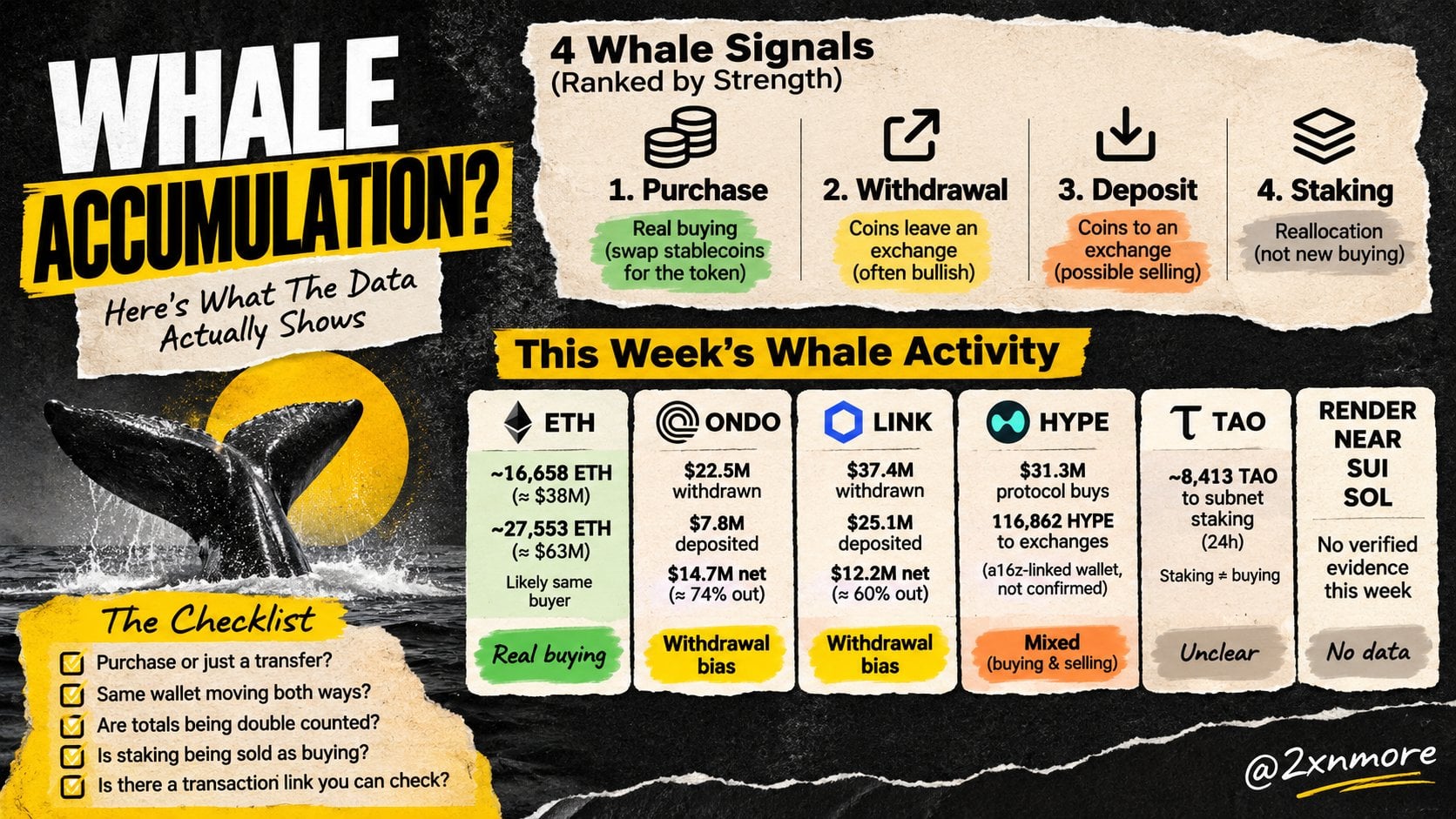
Four Types of On-Chain Fund Flows that Mislead
You've likely seen posts on social platforms stating "a mysterious whale on-chain has been madly sweeping up hundreds of thousands of tokens." However, among these seemingly exciting updates, over 90% of bloggers cannot even distinguish between a genuine spot buy and the internal relocation of assets by institutions between different hot and cold wallets.
Labeling any large on-chain fund movement as “whales accumulating” is the most common yet deadly misconception in the crypto world. Before deeply tracking genuine on-chain movements, a strict four-level signal filtering system must be established, arranged by confidence from strong to weak:
Level One (Highest Certainty): Genuine cash spot conversion. An independent on-chain address actively uses USDC or USDT and directly exchanges target tokens in a decentralized liquidity pool. This action will immediately push up on-chain prices, representing pure and irreversible active buying.
Level Two (Moderate Strength): Large withdrawals from centralized exchanges. Tokens withdrawn from centralized exchanges like Binance and Coinbase are transferred to unmarked personal on-chain addresses. This is generally seen as a long-term holding move but cannot rule out neutral administrative movements such as market makers aggregating or internal address reallocations by custodians or multi-signature migrations.
Level Three (Weak Signal but Needs Caution): Large deposits to centralized exchanges. Tokens flow from personal addresses to exchange deposit addresses. This often signifies potential selling pressure from a dump, but it can also simply be market-making operations for hedging through collateral or serving as contract margin and does not necessarily imply spot selling.
Level Four (Lowest Correlation): Liquidity staking and internal protocol flow. Existing tokens are moved from regular wallets into staking smart contracts or borrowed out. This is merely a reorganization of existing position returns and has no relation to marginal new buying in the market.
Signal Strength First Layer: Real Stablecoin Accumulation
From the analysis of the most critical movements of nine major tokens across the net this week, the true reflection of first-layer genuine cash buying intentions comes from a few precise large holders on Ethereum and Solana.
In the Ethereum ecosystem, an extremely active whale address was observed to have used around $38 million of stablecoins USDC to directly acquire 16,658 ETH while the price of Ethereum was around $2,280. Tracing the historical cumulative flow of this address reveals that the single buyer has accumulated a total of 27,553 ETH within the same price range, using cash capital exceeding $63 million. This continuous and proactive consumption of cash positions constitutes the most solid evidence of bottom support in the market.
On the Solana chain, an anonymous large holder made a single cash purchase of SOL worth $10 million. At a time of market turmoil and panic selling, daring to exchange cash for volatile assets offers the most practical reference for strong on-chain buying signals.
Signal Strength Second Layer: Exchange Withdrawals and Cold Wallet Aggregation
This week, withdrawals from exchanges accounted for the largest proportion of movements, and these operations require extreme caution in filtering out noise:
On Ethereum, two very noticeable large outflows from centralized exchanges were monitored: one was up to 10,793 ETH (approximately $24.6 million), and the other was 6,000 ETH (approximately $13.7 million). Although the tokens post-withdrawal settled in newly created empty addresses, and no short-term selling actions were observed, both operations were not accompanied by immediate on-chain stablecoin conversion records, indicating a high probability of after-hours large transactions (OTC) for the spot delivery of withdrawn coins, or regular risk isolation from institutional multi-signature custody at the end of the quarter.
On the Avalanche (AVAX) network, tokens valued at $8.4 million were also detected being withdrawn in bulk from exchanges. While this reduces the available supply of on-hand tokens for sale within the exchange, as long as there has not been follow-up liquidity or participation in ecological lending, it simply represents a change in the state of fund storage and should not be blindly equated with a surge in spot prices.
Signal Strength Third Layer: Exchange Deposits and Potential Selling Pressure
For substantial deposits at exchanges, the key is to monitor the depth of movements after the tokens arrive at the exchange.
This week, an ancient wallet that had been dormant for 18 months suddenly deposited 3,000 ETH (worth approximately $6.8 million) into Coinbase. Subsequent on-chain monitoring showed that this asset was quickly distributed into liquidity pools of hot wallets, and during the corresponding time period, there was a continuous offer of large orders on centralized exchanges pressing down. Such precise corresponding fund deposits represent the real warning for traders to prepare for defensive exits.
In contrast, certain market maker addresses deposited equivalent tokens to Binance and then withdrew stablecoins of equal value within just two hours, which clearly belongs to standard cross-market arbitrage and market maker inventory rebalancing, leading to excessive market panic due to false signals.
Signal Strength Fourth Layer: Staking Circulation and Existing Position Rebalancing
This week, in BNB and certain altcoins, there were bragging announcements of "tens of millions of dollars in inflows." However, after carefully detangling the on-chain transaction context, it becomes evident that this was merely a decentralized staking protocol performing upgrades to the underlying smart contracts and relocating nodes, with tokens extracted from the old staking pool being programmatically transferred in bulk to the newly deployed V2 contracts.
Such purely technical maintenance transfers, often amounting to hundreds of millions, frequently trigger high-level alerts in on-chain bots and low-level crawlers, but regarding the fundamental supply and demand in the secondary market, their actual net impact is completely zero.
Practical Rules to Identify Whale Movements and Prevent Deception
Do not let flashy amounts blind your eyes. When faced with any large on-chain transaction, ensure to rigorously execute a three-step penetration in your analytical mind map:
Step One: Verify the counterparty's asset. Is it a reduction of fiat liquidity using USDC/USDT, or simply a transfer from address A to address B? Transfers without cash expenditure are all downgraded to ordinary neutral reallocations.
Step Two: Check the historical wallet associations. Use Arkham or DeBank to search whether the sender and receiver belong to the same institution's derived sub-addresses or cold wallet custody systems. Institutions' compliance aggregations through left-hand to right-hand transfers are the most common parent of on-chain false prosperity.
Step Three: Link trading depth verification. Genuine whale spot accumulation must leave significant price slippage and basis premiums in the liquidity pools or the depth of centralized exchange order books. In the absence of depth disturbances, most are simply meaningless self-entertainment.
Learning to understand the true language on-chain is essential to protect your capital in this asymmetric information game.
免责声明:本文章仅代表作者个人观点,不代表本平台的立场和观点。本文章仅供信息分享,不构成对任何人的任何投资建议。用户与作者之间的任何争议,与本平台无关。如网页中刊载的文章或图片涉及侵权,请提供相关的权利证明和身份证明发送邮件到[email protected],本平台相关工作人员将会进行核查。


