Author: The Token Dispatch
Translation: Deep Tide TechFlow
Deep Tide Introduction: The SEC's Release 34-106402 innovative exemption order originally opened a five-year on-chain testing door for tokenized securities trading venues (TSV) that do not belong to exchanges. The core controversy lies in the "default consent mechanism," whereby a third-party platform can directly tokenize and push a company’s shares to the AMM liquidity pool if the issuer does not raise any objections within 30 days of receiving written notification. However, 52 core giants represented by NVIDIA, Apple, Tesla, and JPMorgan (accounting for 84%) have intensively sent letters to counter during the window period. This resistance does not stem from the business community's rejection of blockchain technology itself but is rooted in a defense of underlying governance: dark pool pricing, the legal disconnection between on-chain and DTC shareholder registries, and the deep-seated power plays of traditional financial giants (like Nasdaq, Intercontinental Exchange, SIFMA) over the narrative of regulation.
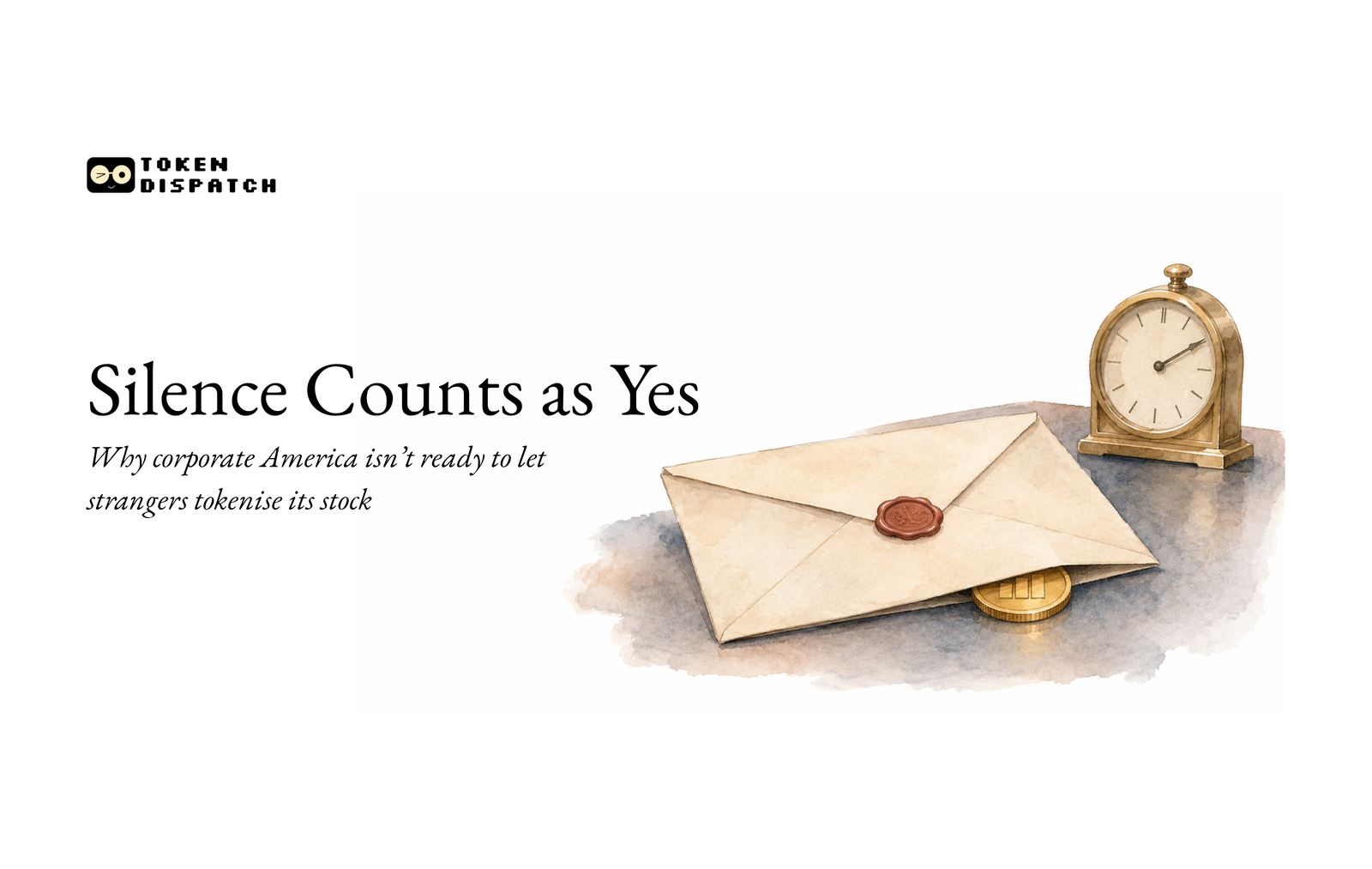
Imagine a software engineer in Pune, India, who makes small monthly purchases of U.S. stocks through a mobile app. However, the opening hours of U.S. markets coincide with his dinner time, and the market closes after midnight. If there were a token that represents equal stocks and trades around the clock, it would seem tailor-made for him.
This is exactly the promise that tokenization makes: No matter where you are or what time zone you are in, it will no longer be an obstacle to owning assets. However, now publicly listed companies have a voice. In the past few weeks, dozens of listed companies have explicitly refused to allow their stocks to be traded as tokens in this new venue.
The gatekeepers of the past were brokers and traditional exchanges, and now the gatekeepers have become the issuers themselves.
This is a thought-provoking institutional arrangement. Although shareholders are the owners of the company, it is ultimately the management that decides where the stocks are traded. The management insists that this is to protect investors, and perhaps their intentions are indeed genuine, but why has no one ever listened to the voices of investors?
Being cautious is certainly a good thing, but those who should benefit the most often have the weakest voice. In today's special column, Primal Capital partner Sebastien Davies dives deep into why so many publicly listed companies choose to refuse dialogue and what conditions are needed to change their stance.
When I first started writing this article, I was focused on another number. On October 23, the tokenized stock trading venue OKXICE, jointly established by the Intercontinental Exchange (ICE) and OKX, released a list of 22 companies that opposed tokenized trading of their stocks. Among them, 19 are from its initially listed 62 candidates.
What really caught my attention were the remaining 43 companies. Because under the SEC's latest exemption rule, a company that remains silent is treated as if it has expressly consented. I wanted to explore how this "default consent" mechanism would treat the silent ones.
However, what raised my blood pressure was that in the following 11 days, another 33 companies from the original list appeared on the dissent list. The latest announcement released on November 3 listed a total of 59 companies that raised objections.
Comparing with the initial roster announced on October 4, out of the original 62 companies, 52 (about 84%) have formally opposed, leaving only 10 that have not disclosed public objections. The five major giants I have been closely following all made it to the opposition list: JPMorgan and NVIDIA appeared at the end of October, Amazon and Tesla joined on November 2, and Apple completed its submission on November 3.
Thus, the essence of the question has changed. I initially intended to explore what silence could bring, but the market's strong reaction forced me to ponder: Why are so many publicly listed companies willing to go to great lengths to submit formal objections? What exactly needs to change to prompt them to make a diametrically different decision?
SEC's Institutional Framework: Innovative Exemption and 30-Day Countdown
On September 17, the SEC issued Release 34-106402 innovative exemption order, allowing tokenized securities venues (Tokenised Securities Venue, TSV) to conduct a five-year on-chain trading experiment for U.S. stocks without registering as traditional exchanges.
Tokens must correspond to real assets, held by licensed broker-dealers at a ratio of 1:1 to underlying shares, with token holders enjoying fully equivalent dividend rights, voting rights, and claims for bankruptcy liquidations. Moreover, the trading volume of tokenized trades for the top 75 companies by market capitalization is strictly limited to 0.25% of the average daily volume (ADV) of the previous month, meaning that out of every 400 shares traded, only one can be tokenized.
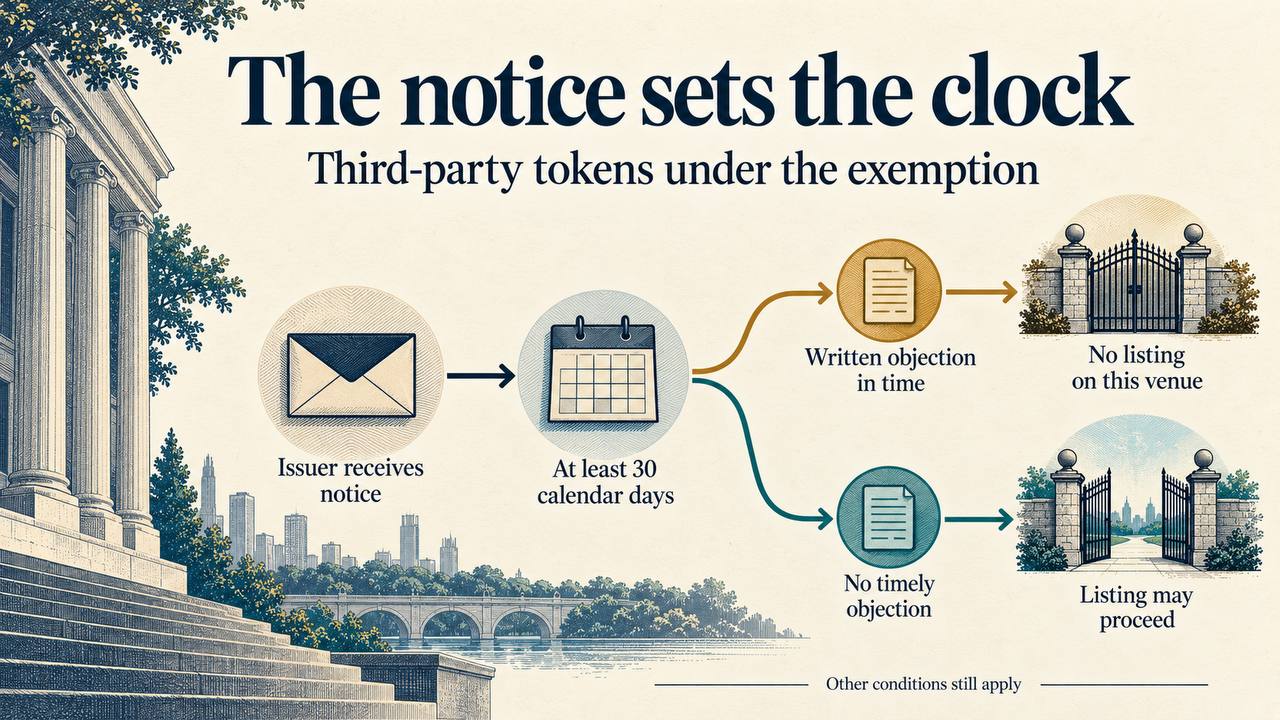
Figure: The 30-Day Dissent Notification Mechanism Process for Third-Party Stock Tokenization under SEC's Innovative Exemption
When a third-party institution mints tokens, the trading venue must deliver a written notice to the stock issuer and must wait at least 30 calendar days. As long as the issuer submits a written objection within that window, the corresponding tokens cannot be launched on that venue. If the issuer remains silent and does not raise objections, the trading venue can proceed directly with the launch as long as it meets the other prerequisites of the exemption order.
Erin Martin, a partner at Morgan Lewis law firm and former senior SEC attorney, pointedly remarked in an interview with Fortune: “There is no such thing as a proactive consent right here; essentially, what the issuer is granted is merely a passive objection right afterwards.”
This institutional logic has not changed to this day. Silence still represents that platforms can naturally proceed with the launch. What is truly thought-provoking is that very few companies in the United States are willing to choose to let it slide.
How the Dissent List Evolved: From 9 to 59
OKXICE plans to conduct 24-hour trading through the Uniswap liquidity pool on the XLayer chain under OKX, with trading pairs pegged to USDC or USDG. The initial notice it issued on October 4 included 63 stock codes from 62 publicly listed companies. According to the announcement disclosure date statistics, the evolution of the number of dissenting companies is as follows:
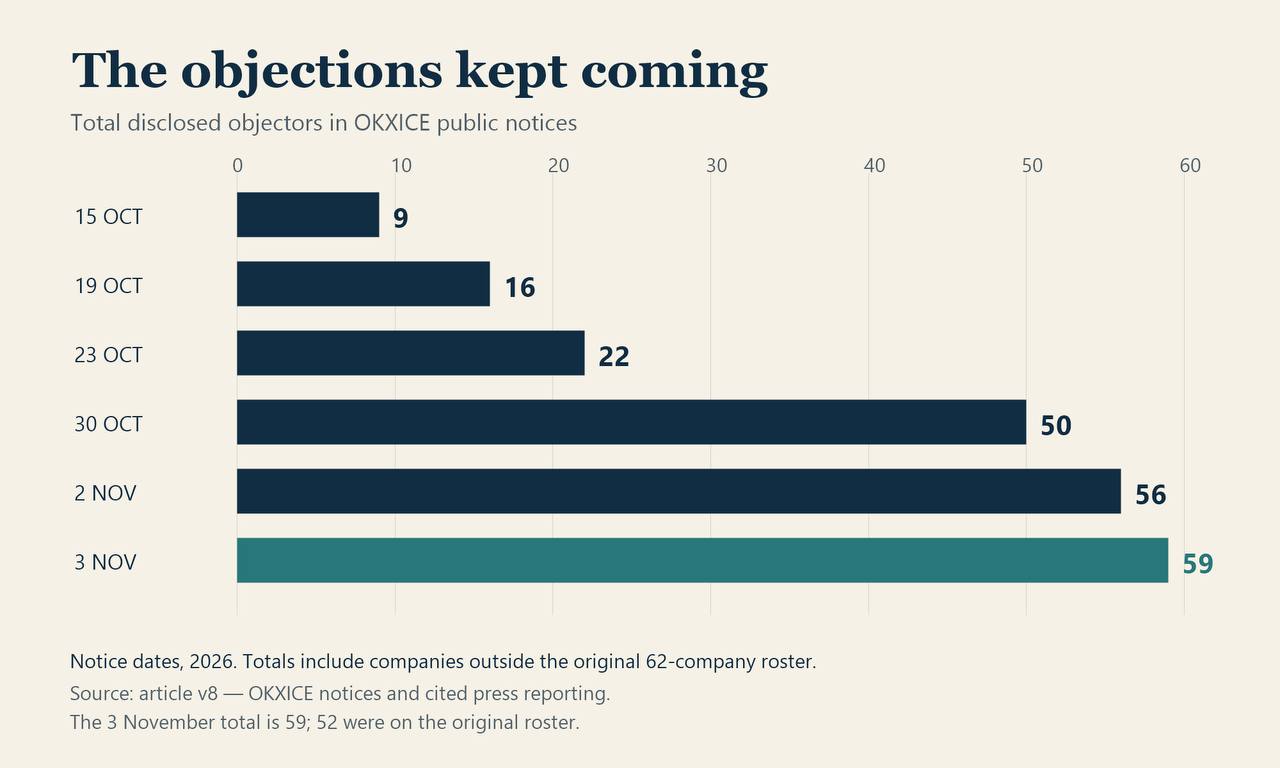
Figure: Trend of the Number of Dissenting Companies Disclosed in OKXICE's Public Announcements
As of now, only 10 companies have not publicly disclosed their objections: Strategy, Robinhood, Coinbase, Circle, Securitize, BitGo, Palantir, Super Micro Computer, ServiceNow, and Boeing. Among them, six have core businesses deeply rooted in cryptocurrency or asset tokenization, while Securitize and BitGo have previously publicly stated their opposition.
Not disclosing an objection does not equate to the company having given explicit approval or that the objection window has closed or that the platform has decided to formally launch. For issuers who received notifications on October 4, their objection window closed on November 3. However, the specific start and end times of each window depend on the dates the companies actually signed for the notices, which have not been made public.
Moreover, the trading venue has a maximum of five business days for a disclosure buffer after receiving an objection, so any dissent letter sent out before the deadline may still be published later.
Why Giants Are Countering: Dark Pool Pricing, Disconnected Registries, and Reputational Risks
Currently, only one company that has raised an objection has publicly explained the specific reasons. A spokesperson for Texas-based optical components manufacturer Applied Optoelectronics (AOI) stated on October 21 to Fortune that the company “has not seen this mechanism providing any clear benefits to AOI or our shareholders that would outweigh the accompanying uncertainties.”
AOI's response precisely points out the economic account behind it. Faced with an unfamiliar trading venue, the potential costs perceived by issuers are much clearer than the intangible benefits.
The actual benefits that tokenization can bring are merely extremely limited additional liquidity (strictly capped to a quarter) and allowing investors who prefer on-chain holdings to own stock on a platform beyond the company’s control. In contrast, its potential costs are self-evident.
The first major issue is the deficiency in price transparency. Nasdaq's guidelines for publicly listed companies state that these types of trading venues are not required to show the best quotes publicly, nor are they obliged to report trading data in real-time to the Consolidated Tape system across the U.S.; their trading data may be delayed by up to 10 minutes, creating "a shadow dark pool market for equity securities."
The SEC itself has also warned that prices in AMM liquidity pools "are very likely to depend only on the relative proportions of assets in that pool." The mismatch of trading hours exacerbates the issue: an on-chain liquidity pool operating overnight during the main market's off-hours (including after-hours earnings reports) continues to match autonomously, generating distorted prices that shareholders can see but the listed company cannot explain.
Secondly, there is a legal authenticity conflict in the shareholder registry. Joris Delanoue, head of the SEC-registered transfer agent Fairmint, points out: “For equity securities such as stocks, the blockchain is not the final source of truth; the statutory shareholder registry authorized by the issuer is the sole authority.”
The vast majority of U.S. stockholders hold their shares through brokers, and the nominal owner on the statutory registry is often shown as Cede & Co., the nominee for the DTC. Tokenizing stocks adds a new layer of records to this meticulous system, and every layer of ledger must ensure precise reconciliation.
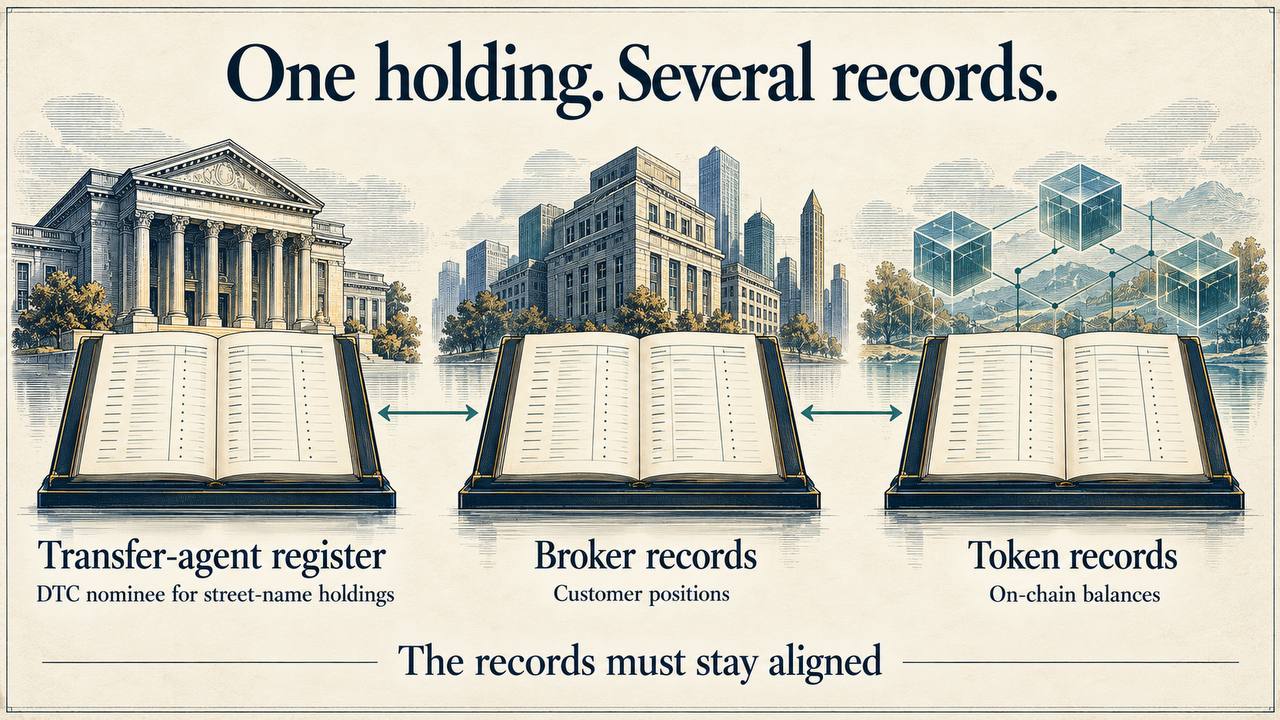
Figure: The Reconciliation Consistency Challenge Among Multiple Ledgers Behind Stock Tokenization
Finally, there is a cognitive confusion among investors. Nasdaq in its defense candidly stated that if investors suffered a loss or a poor experience in a trading venue that an issuer had implicitly allowed, “investors are likely to blame the listed company itself.” Weighing all the potential risks and compliance costs, the price of submitting an objection is just a written dissent letter.
Some companies may simply be waiting for a more mature and sound market. OKXICE co-chair Andrew Cuomo previously publicly stated that he expects many companies to choose to remain inactive, as no one wants to be a test subject for trial and would prefer to wait and see first. However, under the 30-day rule of individually auditing one venue, outsiders cannot distinguish whether a company is observing prudently or outright rejecting it.
Another part of the companies may simply harbor doubts about the specific venue or trading structure. OKX, being an offshore cryptocurrency trading platform with a complex regulatory history, has its token trading reliant on automated liquidity pools pegged to stablecoins. Many traditional giants’ boards are clearly unwilling to bind their brands to such a model.
The core contention most companies are fighting for is control. A company could be pleased to see its stocks tokenized, but only if it decides when, by whom, and under what structure to issue them, and what terms to follow. In fact, the SEC's exemption order clearly allows issuers to autonomously tokenize their stocks without going through the cumbersome process of third-party notice approval.
Traditional payment giants made similar choices in the face of stablecoins: Mastercard directly acquired BVNK, while Visa allowed issuing organizations to use USDC for prepaid funding. Traditional giants insist on dominating technological integration at their own pace and standards.
Simply having a statistical list cannot tell us which motivation is the main reason most issuers opposed. Of the 52 dissent letters, only one provided a public statement; the real considerations behind the majority of decisions remain locked away in the boardrooms.
The Power Struggle Behind the Rules: Wall Street and Exchanges
The participants in this fierce struggle over industry standards all harbor tremendous ambitions for tokenization. The Intercontinental Exchange (ICE) candidly warned in its 2025 10-K report: “If we do not actively innovate, we will face enormous risks of being replaced or disintermediated,” specifically naming tokenized securities.
OKXICE is precisely the answer provided by ICE, and the "silence means consent" default mechanism is clearly highly advantageous for its rapid expansion. On the other hand, although Nasdaq has declared it will resolutely withdraw from these venues, it quietly established a digital asset department in the third quarter and, in September, invested $100 million to purchase preferred shares of Kraken's parent company.
Nasdaq's concern for investor protection is certainly reasonable, but it cannot be denied that it has a significant business interest in where future tokenized stocks will be traded.
The Securities Industry and Financial Markets Association (SIFMA), representing the interests of licensed broker-dealers and asset management institutions in the U.S., formally requested SEC to overturn this default rule on October 19. SIFMA argues that third-party tokens “should only be allowed to trade on TSVs with the explicit affirmative consent of the issuer” and vehemently criticizes the current decree that “directly equates the issuer's silence to consent.” Notably, Goldman Sachs, which took the lead in raising objections since October, is a core member of SIFMA.
If the rule is amended to "opt-in,” the fate of issuers who never responded would be rewritten: the 10 companies that have not yet stated will automatically be excluded from the launch list. Yet this still does not fully explain why 52 companies would rather proactively take steps to submit written objections. On the OKXICE list, most issuers did not leave their fate to the default rule. How many of the remaining 10 companies will ultimately see true issuance remains an unknown.
Tokenization Boundaries: The Vetoed Structure and Under-the-Radar Currents
The veto power of publicly listed companies only covers a very specific structure: that is, tokenized products established within the U.S. regulatory jurisdiction, based on this exemption order, and supported by third-party entities with 1:1 custody. This power cannot reach offshore tokens or derivatives that only provide price exposure without actual ownership.
For example, in the third quarter, BNB Chain's approximately $25.6 billion in tokenized stock trading volume occurred almost entirely outside the SEC’s regulatory decree. Although this is merely the volume of transactions and does not indicate that every product's legal structure is legitimate, it is sufficient to reveal the enormous scale of the offshore market.
The strong resistance from publicly listed companies may even push the previously potential compliance demand towards non-compliant packaged products that companies find harder to control and more opaque in information. Regardless, under the current regulatory exemption framework, the vast majority of issuers on the OKXICE original list exercised their veto rights on time before the deadline.
Future Evolution Path: Official Tokenization and New Trading Venues
I am now focusing on a more specific question: Among the companies that said "no" to OKXICE, will any of them agree to release their stocks when they have the ability to independently choose the trading venue, technical structure, and commercial terms in the future?
In fact, the second path has already emerged. On October 29, Nasdaq small-cap company Canton Strategic Holdings announced an agreement with TSV LLC and hired Fairmint to tokenize its shares “in an issuer-official initiated model.”
This certainly does not prove whether the giants opposing OKXICE will follow suit, but it fundamentally changes the market's litmus test: the question is no longer whether companies are willing to go the “official initiated” route, but whether any among the 52 dissenting giants will take the lead in taking that step.
Another core test lies in the comparison of same-type venues. Since this exemption order is entirely built around licensed AMM liquidity pools, a truly fair comparison should be a competitive venue established under the same exemption order framework, but with more rigorous security mechanisms or higher reporting standards. If a traditional central order book is directly introduced, not only will the regulatory approval path change drastically, but the attributes of the trading venue will also undergo a qualitative change.
If the same group of publicly listed companies still collectively opposes the new venue, then the explanatory power of “purely targeting the OKXICE platform background” will be significantly weakened; conversely, if the feedback from companies diverges, it precisely confirms that the design of the trading mechanism and the ownership of control are far more crucial than mere resistance to tokenization itself.
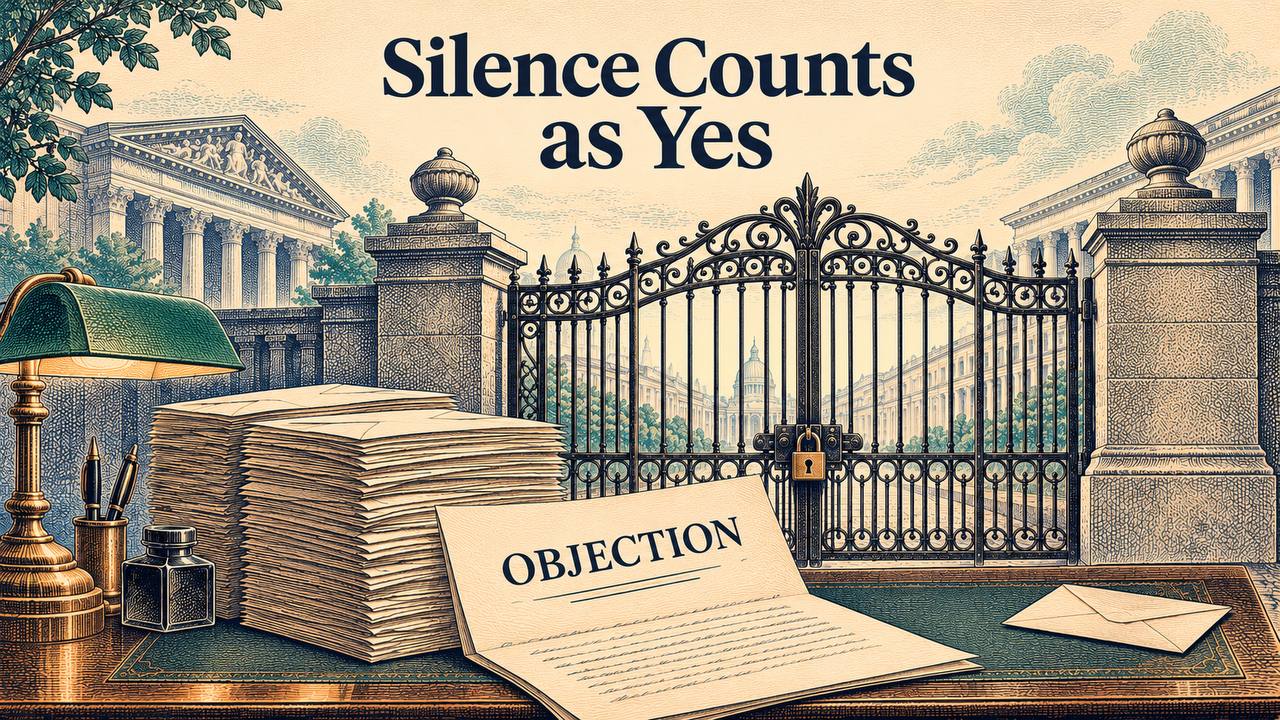
Figure: U.S. publicly listed companies blocking unauthorized tokenization with written dissent letters
Observational Points Going Forward: The Initial List, Unified Legislation, and Industry Differentiation
I eagerly look forward to seeing the final official launch list, which will reveal which targets OKXICE ultimately selects and successfully launches. Regrettably, we still do not know the specific reasons for the absence of certain names. Given the current pace of advancement, we cannot take it for granted that those 10 silent companies will smoothly initiate tokenized trading.
I am also continuously observing those 52 companies that have raised objections as a whole. The first company to choose to independently tokenize its shares will demonstrate to the market that after rejecting the imposed terms of OKXICE, giants can completely reshape tokenization in their own way.
Meanwhile, if a second trading venue sends third-party notices to this batch of companies based on the same exemption order, it will provide us with more valuable firsthand information to help us see how businesses across the United States weigh the future of asset tokenization.
SEC Chair Atkins and Commissioner Uyeda are expected to promote a formal legislative procedure of regular “notification and solicitation of comments” in the future, at which point it will be determined whether the “opt-in” mechanism advocated by SIFMA will be written into formal regulations. The final establishment of this institutional standard will determine the life and death trajectory of the entire stock tokenization industry for those companies that have never responded due to outdated information, as well as for smaller trading venues that have low visibility or may not even catch the attention of publicly listed company legal departments.
免责声明:本文章仅代表作者个人观点,不代表本平台的立场和观点。本文章仅供信息分享,不构成对任何人的任何投资建议。用户与作者之间的任何争议,与本平台无关。如网页中刊载的文章或图片涉及侵权,请提供相关的权利证明和身份证明发送邮件到[email protected],本平台相关工作人员将会进行核查。