Author: Zen, PANews
After exiting the cryptocurrency space, crypto VC veteran Paradigm is accelerating the weave of its hard tech network.
On November 5, American drone delivery company Zipline announced the completion of a $1.5 billion financing round, with a post-investment valuation of $21.5 billion. Paradigm, together with WCM Investment Management and Layer Global, co-led the investment. In January this year, its valuation was only $7.6 billion, nearly tripling in less than a year.
For the cryptocurrency sector, the standout in this financing round is undoubtedly the lead investor Paradigm. This VC, which rose to fame in the cryptocurrency industry, is best known for its successful investments in crypto projects like Coinbase and Uniswap.
However, a look at Paradigm's investment records over the past year reveals that this firm, once focused on studying token economies and smart contracts, is now more concerned with drone flight safety, factory production efficiency, nuclear reactor power generation, and even space defense.
After consecutively investing in several AI, robotics, and hard tech companies, Paradigm launched a new $1.2 billion fund in July this year to expand its layout in cutting-edge technology.
Why Paradigm Heavily Invested in Zipline
Founded in 2014, Zipline's initial business model was far removed from today's drone delivery.
In 2016, the company began operations in Rwanda, using drones to deliver blood, vaccines, and other medical supplies to remote hospitals. At that time, many local hospitals lacked a stable supply of medical materials, and road transport was limited by geographical conditions. Zipline's drones bypassed rugged roads, providing a faster supply method for these hospitals.
This seemingly altruistic business gradually evolved into a technology company valued at over $20 billion. After years of operation, Zipline expanded its business into several African countries and entered the U.S. market, with the range of delivery items extending from medical supplies to food, retail goods, and daily necessities.
What sets Zipline apart from typical drone manufacturers is that it not only produces drones but also develops flight control software, delivery systems, and takeoff and landing facilities, taking responsibility for operating the entire logistics network. In simple terms, it attempts to create an automated logistics service that can replace some ground delivery.
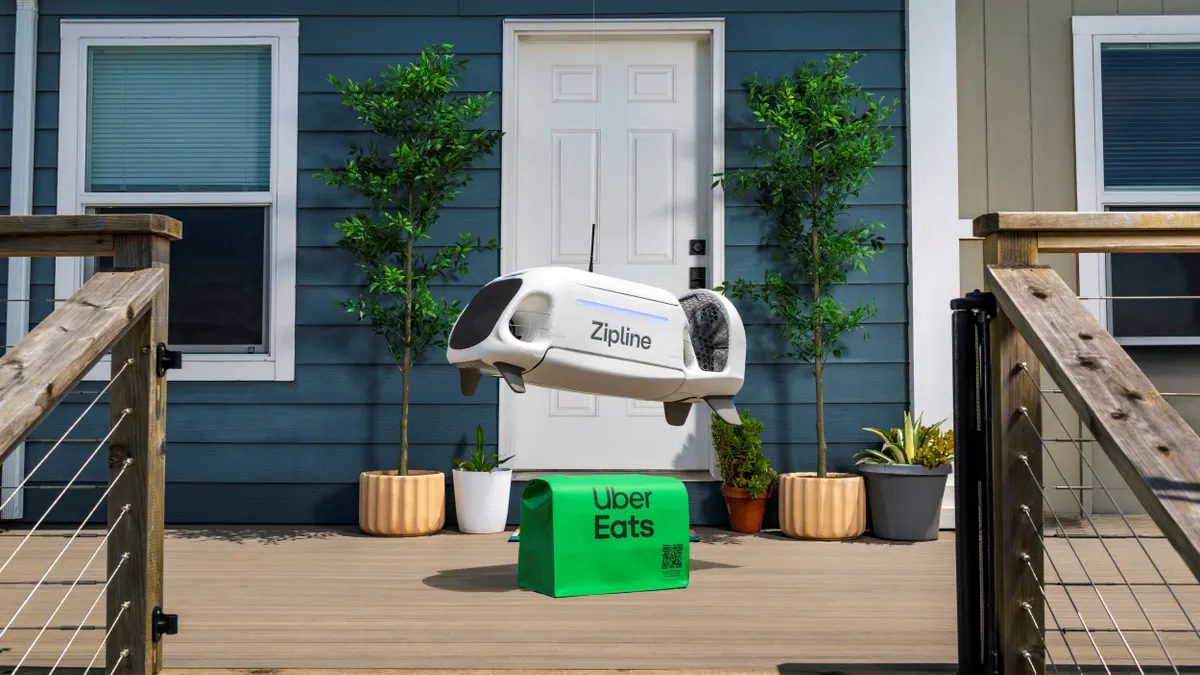
According to Zipline, this system has already accumulated considerable operational data: as of November this year, Zipline drones have completed 150 million miles of commercial autonomous flights. This year, delivery orders in the Dallas-Fort Worth metropolitan area exceeded 1 million, with an October median delivery time from order to arrival of 19 minutes, while traditional deliveries usually take over 30 minutes.
As the drone delivery business matures, Zipline's commercial footprint is rapidly expanding. This month, Walmart announced a new multi-year agreement with Zipline to add 300 new drone delivery sites in the U.S.; Uber hopes to increase the cooperative delivery business to 1 million orders per day by 2029.
These developments have enabled Zipline to gradually embody the characteristics of a scaled logistics company. What Paradigm is interested in is likely the gradually forming logistics network behind the drones.
Paradigm co-founder Matt Huang emphasized Zipline's scalable operational capability, safety record, and mature user experience in the financing announcement.
From AI to Nuclear Energy, Paradigm's Investment Landscape
In addition to Zipline, Paradigm's investment portfolio includes several names that may seem unfamiliar to those in the cryptocurrency space.
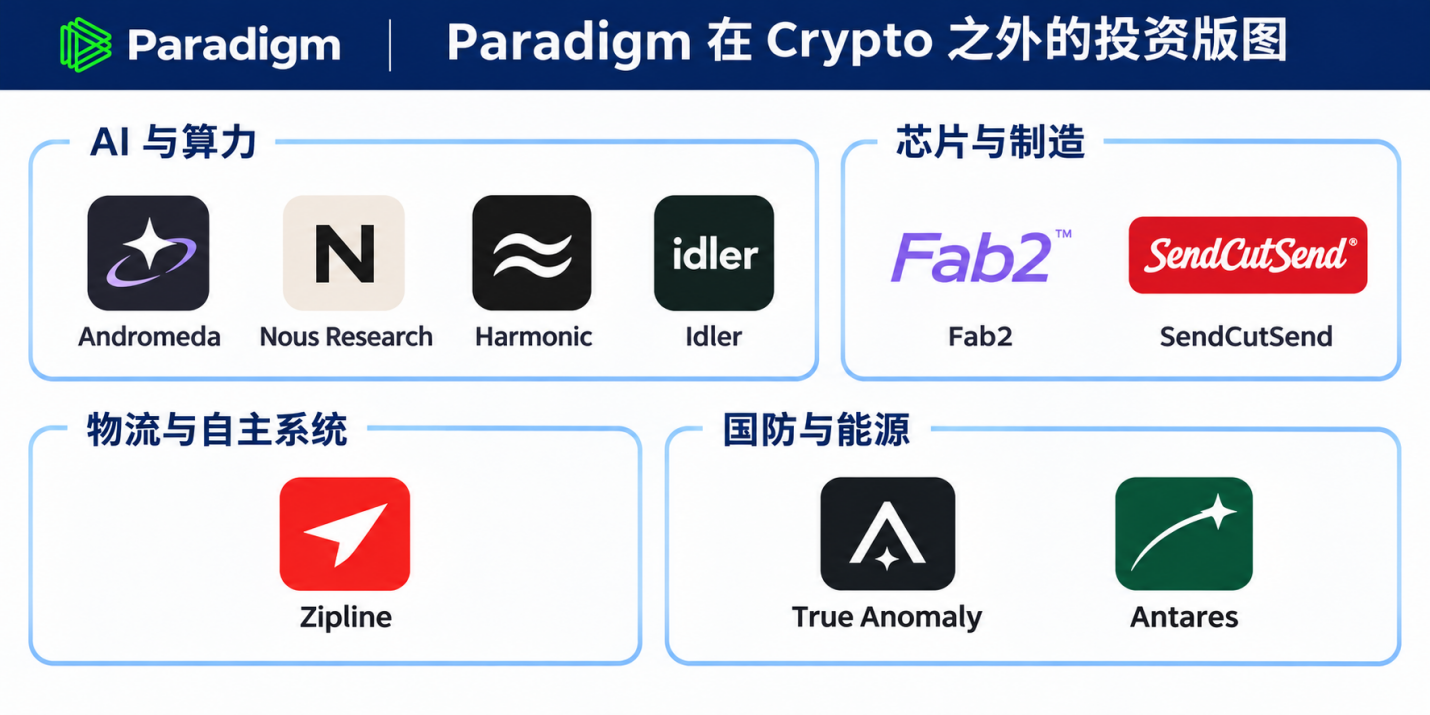
As early as April 2025, Paradigm led a $50 million financing round for open-source AI research organization Nous Research. This company developed the Hermes series models while exploring distributed AI training, attempting to involve more developers in the creation of advanced AI models.
In July 2025, Paradigm participated in a $100 million Series B financing for the math reasoning AI company Harmonic. The company, founded by Robinhood co-founder Vlad Tenev and Tudor Achim, mainly develops an AI system called Aristotle capable of formal verification of mathematical reasoning results, aiming to reduce errors produced by large models in areas like mathematics, code, and hardware design.
In August this year, Paradigm also led a $9 million seed round for AI data research company Idler. Idler primarily develops reinforcement learning training environments and model evaluation data to help AI agents learn complex tasks like software development and cybersecurity in simulated real work scenarios.
Interestingly, Idler's founder Ivan Chub previously participated in founding blockchain games like Dark Forest and the Ethereum application research organization 0xPARC. This time, tech talent from the crypto space is starting to pivot towards providing infrastructure for AI training.
Another project that reflects Paradigm's investment logic is the AI computing power platform Andromeda. Andromeda aims to integrate dispersed GPU resources, evaluate and standardize different clusters, and then achieve computing power procurement, matching, and deployment through a unified platform.
In March 2026, Andromeda completed a financing round, reaching a valuation of $1.5 billion. Paradigm's cumulative investment in it has already reached $60 million.
Beyond AI, Paradigm's investments have also extended to industrial manufacturing, semiconductors, space defense, and energy sectors.
Among these, the “least tech-oriented” investment is undoubtedly the American metal component manufacturer SendCutSend.
The company's founder Jim Belosic initially just wanted to solve the difficulties he encountered while modifying cars. In 2017, he tried to transform a vintage Ford car into a steam-powered vehicle but found it very difficult to customize some fine metal parts. Later, he came across laser cutting technology and discovered a business, founding SendCutSend in 2018.
The company's business model is also quite simple: customers upload design drawings, the system automatically quotes, and then the factory completes laser cutting, metal bending, and machining. Custom parts that previously required repeated communication with manufacturers can now be ordered just like online shopping. With the development of robotics, autonomous driving, and the aerospace industry, SendCutSend's clients have grown to include Waymo, Anduril, Relativity Space, and the aforementioned Zipline.
In May this year, SendCutSend completed a $110 million financing round, co-led by Paradigm along with Sequoia and Stripe co-founders. In October, the company completed another round of financing, achieving a valuation of $2.1 billion, almost doubling from five months earlier.
Interestingly, SendCutSend founder Belosic has a rather pragmatic understanding of venture capital. In an interview with Fortune magazine, he stated that he likes to convert VC money directly into employee salaries, enabling employees to buy homes and raise children.
In the semiconductor manufacturing field, Paradigm has also invested in Fab2, a startup attempting to change the way chips are produced.
One of Fab2’s founders, Sam Zeloof, became famous for making chips in his garage as a teenager, while the other founder, Jim Keller, is a well-known chip architect who has participated in processor designs for trusted companies like AMD and Apple.
Fab2 aims to build small, automated semiconductor factories through the in-house development of pumps, valves, sensors, and precision machining equipment, ultimately achieving mass production of these factories.
In September this year, Fab2 completed a $500 million Series A financing, reaching a valuation of $3.7 billion, led by Fundomo, with participation from Paradigm and other institutions.
Paradigm’s investments have also extended into space. In April this year, American space defense company True Anomaly announced the completion of a $650 million Series D financing, with Paradigm participating as a new investor. The company develops autonomous spacecraft Jackal and mission management software Mosaic, mainly focusing on the space security and military needs of the U.S. and its allies.
If investing in drones and space defense is already an impressive crossover, then Paradigm's investment in nuclear energy companies takes it a step further.
In July this year, nuclear energy startup Antares announced the completion of $470 million in funding, co-led by Paradigm and Caffeinated Capital, which includes $370 million in equity financing and $100 million in debt financing.
Antares is developing mini nuclear reactors intended for military bases, remote facilities, and special mission scenarios, with a designed power output between 100 kilowatts and 1 megawatt. In June this year, its Mark-0 demonstration reactor achieved critical status, and the company plans to continue advancing power generation systems and commercial deployment.
Thus far, Paradigm’s investment portfolio has covered AI models, automated logistics, industrial manufacturing, space defense, and advanced nuclear energy. Extending from digital assets to physical industries, it is participating in building a technology infrastructure entirely different from the past.
Betting on the Future is More Important than Holding onto Crypto
Paradigm's transformation actually reflects a deeper trend in the Silicon Valley venture capital market: a shift in the imagination of the future is occurring. At the end of October, a16z Crypto rebranded to a16z Frontier focusing on frontier technology.
When Matt Huang and Coinbase co-founder Fred Ehrsam established Paradigm in 2018, cryptocurrencies were viewed by many investors as a crucial part of the next generation of internet and financial infrastructure.
It was a time full of imagination—Bitcoin, Ethereum, and smart contracts spurred new financial and technological experiments, and many startups emerged in areas like decentralized trading, digital assets, and on-chain finance. Paradigm built its investment reputation during this period.
However, breakthroughs in generative AI have rapidly moved artificial intelligence from long-term technical research to commercial application. Large models have given birth to new software and services and spurred the demand for GPUs, data centers, energy, and automation equipment. Robotics and autonomous systems are beginning to enter logistics, manufacturing, and other physical industries.
These fields not only attracted a substantial amount of venture capital but also provided large-scale and relatively clear commercial demands.
In contrast, while cryptocurrencies have made some progress in areas like stablecoins, payments, and financial market infrastructure, many native crypto projects continue to revolve around token issuance, trading, and speculative activities. Market activity remains highly correlated with token prices and industry cycles, and the pathways for technology innovation to translate into sustained commercial revenue still need broadening.
For venture capital firms always on the hunt for high-growth opportunities, AI and the tangible tech industries that stem from it are clearly more attractive directions.
Paradigm managing partner Alana Palmedo offered a rather straightforward explanation: Crypto was Paradigm's earliest frontier technology, and it is still exciting, but many changes in other fields have now become difficult to ignore.
The work of investment institutions is to seek the future. As more potential significant technological breakthroughs occur in AI, robotics, manufacturing, and energy sectors, it's a fairly natural choice to expand the investment scope to these industries.
Moreover, the companies Paradigm is investing in share a noteworthy common characteristic: most of them focus on solving specific problems in real industries.
Zipline aims to reduce delivery costs and improve logistics efficiency; SendCutSend helps businesses to procure custom parts faster; Antares explores stable and reliable energy supplies; True Anomaly seeks to address the growing demand for space security.
The markets they face already exist, and the goal of technological innovation is to provide solutions that are more efficient, cost-effective, or capable. This contrasts sharply with many crypto projects which establish token economies first, attract users and liquidity, and then seek long-term business models.
Of course, tangible technologies also have their own challenges. Investors may need to wait several years to determine whether a technology truly possesses scalable profitability. For top VCs, the real risk lies not in missing a particular token or cycle, but in narrowing the future to a single narrative. Paradigm's new $1.2 billion fund is betting on a hard tech network that can embed itself into real industries and traverse cycles.
免责声明:本文章仅代表作者个人观点,不代表本平台的立场和观点。本文章仅供信息分享,不构成对任何人的任何投资建议。用户与作者之间的任何争议,与本平台无关。如网页中刊载的文章或图片涉及侵权,请提供相关的权利证明和身份证明发送邮件到[email protected],本平台相关工作人员将会进行核查。


