On November 6, local time, Google's parent company Alphabet revealed that, as of the end of the third quarter of 2026, the company holds approximately 2.977 million shares of chip giant Qualcomm, with a market value of about $548 million. However, Qualcomm was not mentioned in documents until the end of June.
After the news broke, Qualcomm's pre-market stock price rose more than 3% at one point. Given that Qualcomm is trying to reduce its dependence on the mobile chip business, this additional stake was immediately linked by the market to Qualcomm's data center business: Qualcomm is attempting to transition from mobile chips to AI infrastructure, while Google is expanding its computing power to meet the growing demand for AI.
In the latest fourth quarter earnings report, Qualcomm CEO Cristiano Amon reiterated that the company plans to achieve $5 billion in data center revenue by the fiscal year 2027; according to previously announced targets, this figure is expected to exceed $15 billion by the fiscal year 2029.
However, as more documents are uncovered, Alphabet's holdings in Qualcomm stocks have prompted another explanation.
According to The Information, this stock holding may be related to Qualcomm's acquisition of American AI software startup Modular. Alphabet's investment arm, GV, had previously invested in Modular, and when Qualcomm acquired this company this year, it primarily used its own stock as the transaction consideration. In the SEC prospectus submitted by Qualcomm, two funds under GV were listed as selling shareholders of Qualcomm stock, collectively holding approximately 3.196 million shares.
However, this number does not match the 2.977 million shares disclosed by Alphabet, and the holdings in both documents have not yet found a complete correspondence.
Qualcomm is Seeking Its Next Growth Point
For a long time, Qualcomm's business model has been closely tied to the smartphone market. As one of the world's major mobile chip suppliers, its Snapdragon processors are widely used in Android phones, and the baseband chip and communication patent licensing business have also provided the company with long-term revenue.
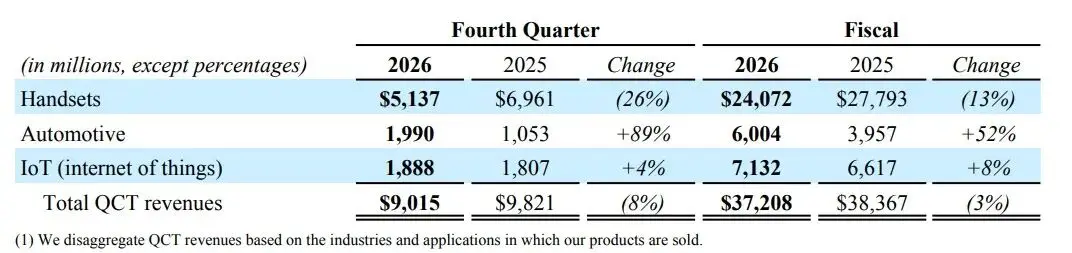
However, as the smartphone market gradually matures, this business structure has begun to face new pressures. On one hand, global smartphone shipments have slowed down, and phone manufacturers are increasingly emphasizing cost control; on the other hand, Apple's continuous push towards self-developed baseband chips poses a risk of long-term customer loss for Qualcomm. Qualcomm's latest disclosed fourth quarter performance for the fiscal year 2026 has already shown signs of this pressure: affected by the weakening mobile business and other factors, its mobile chip revenue for the quarter decreased by approximately 26% year-on-year, dropping to $5.14 billion.
(Source: Qualcomm)
In recent years, Qualcomm has successively increased its investment in automotive, IoT, personal computing, and industrial sectors, hoping to transfer the low-power computing, communication, and chip design capabilities accumulated in the mobile chip field to more scenarios.
However, with the development of generative AI, Qualcomm sees a larger market: data centers.
In the past, AI computing for data centers was mainly dominated by NVIDIA GPUs. However, as the scale of AI applications expands, computing demands are also changing. Especially as AI transitions from simple question-answering to intelligent agents, models need to continuously call tools, perform tasks, and handle more requests, which increases the inference computational load. For cloud service providers, in addition to chip performance, considerations also need to include computing costs, energy consumption, and the overall operational efficiency of the data center.
This presents Qualcomm with a cutting-in opportunity. Its long-accumulated low-power computing technology, as well as the collaborative design capabilities of different computing units such as CPU, GPU, and NPU, can theoretically play an advantage in some data center workloads. Especially in the AI inference market, as model deployment scales continue to expand, customers are increasingly concerned about the balance between performance, energy consumption, and costs.
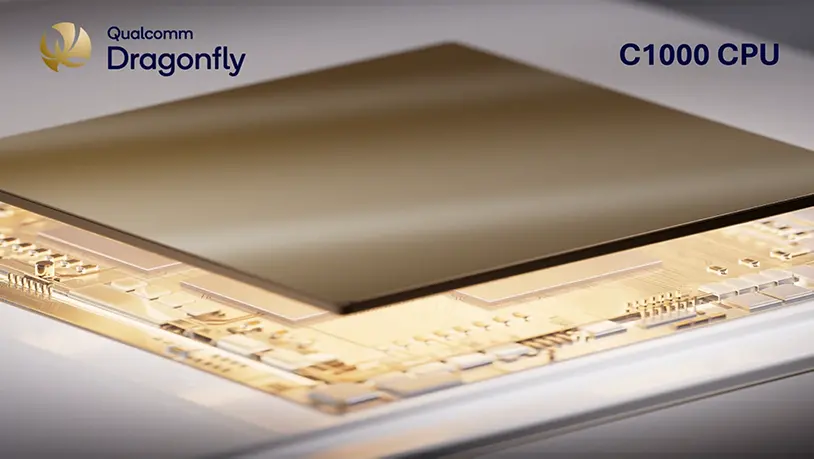
In June 2026, Qualcomm officially unveiled its data center business roadmap during Investor Day, launching the Dragonwing product portfolio for data centers, including C1000 CPU, AI300 inference accelerator, and high-bandwidth computing technology (HBC). Unlike traditional GPU routes, Qualcomm hopes to provide computing solutions that cover different aspects of data centers through a combination of CPU, AI accelerators, memory, and interconnection technologies. The company also proposed that by the fiscal year 2029, data center business revenue will exceed $15 billion, and non-mobile business revenue will reach $40 billion.
This means that Qualcomm is not satisfied with merely being a chip supplier, but hopes to extend the software-hardware collaborative capabilities formed in the mobile terminal space to cloud computing infrastructure.
The acquisition of Modular just fills in the software segment. This startup focuses on AI software infrastructure, with core products including the programming language Mojo and AI inference platform MAX, attempting to address the software adaptation challenges between different chip architectures, enabling developers to more easily deploy and optimize AI models across various hardware.
This is particularly important for Qualcomm. In the past, its advantages were more prevalent in mobile terminals, while the developer ecosystem and software toolchain were areas needing to be supplemented for entering the data center. After acquiring Modular, Qualcomm can integrate its software platform with its chips, lowering the barriers for developers to use Qualcomm hardware.
The Chip Competition in Data Centers
Qualcomm's entry into data centers is not an isolated business move. Over the past two years, the demand for AI computing power has continued to grow, and competition in data centers has gradually extended from merely purchasing GPUs to include multiple aspects such as chip design, memory, network interconnection, and software ecosystems. Large tech companies are increasingly participating in chip design, hoping to reduce costs and improve energy efficiency through customized solutions and decrease dependence on a single supplier.
NVIDIA still occupies the most important position. Its advantages lie not just in the GPUs themselves, but also in the CUDA software ecosystem, networking technology, and a complete solution from chip to entire system. However, high procurement costs and supply limitations have also prompted large cloud vendors to seek other solutions.
AMD is competing for the GPU market with its Instinct series accelerators; Broadcom focuses on designing customized AI chips (ASICs) for large tech companies. Compared to general GPUs, ASICs can be optimized for specific workloads, creating differentiation in terms of energy efficiency, cost, and performance. Companies like Marvell are also looking for opportunities in network interconnection and customized computing.
Meanwhile, cloud computing giants have begun to design their own chips. Google has TPU, Amazon has Trainium and Inferentia, Microsoft has introduced Maia, and Meta continues to push MTIA. For these cloud vendors, developing their own chips does not contradict external procurement; the key is to find more suitable hardware solutions for different computing tasks.
Qualcomm's entry occurs amidst this round of changes in industrial division of labor.
After unveiling the data center roadmap in June of this year, Qualcomm began accelerating efforts to collaborate with large tech companies. In September, the company announced a multi-generation customized chip partnership with Amazon Web Services (AWS), focusing on AI inference computing and data center optical interconnection. The collaboration demonstrates that Qualcomm has begun to engage with customers that have large-scale computing power demands. Additionally, Qualcomm is also advancing its data center chip business with companies like Microsoft and Meta.
(Source: Qualcomm)
It is worth noting that Qualcomm's partnership with Amazon is no longer just a traditional chip procurement relationship. According to Reuters, the agreement allows Amazon to purchase up to $60 billion worth of Qualcomm AI data center chips and related products in the future, while Qualcomm has granted Amazon stock purchase warrants for up to 25 million shares. This means that Amazon's equity arrangements are linked to actual procurement activities.
However, securing customer orders is just the first step into the data center market; the ability to deliver on time is also a practical test. Qualcomm CEO Amon noted in an interview that there are currently supply chain tensions affecting AI infrastructure construction, with capacity for key segments like advanced process chips still limited. For Qualcomm, which has just entered this market, ensuring that chip manufacturing and product delivery can keep pace with demand is equally crucial.
At the same time, Qualcomm also needs to face competitors such as NVIDIA, AMD, and Broadcom and Marvell, which have already deeply participated in the supply chains of large cloud vendors. It needs to prove not only chip performance but also software compatibility, system integration capabilities, and long-term supply capacity.
Google's Computing Power Landscape
If Qualcomm is looking for opportunities to enter data centers, Google represents another typical scenario: it is both a massive demand side for AI computing power and a chip designer and cloud computing service provider.
Google began developing its own AI chips quite early. In 2015, Google launched its first generation of Tensor Processing Units (TPUs), which were initially used to accelerate internal machine learning tasks. As the demand for large model training and inference grew, TPUs gradually became an important part of Google's AI infrastructure. Today, Google not only supports the training and operation of models like Gemini with TPUs but also provides TPU computing power to external customers through Google Cloud.
However, developing its own chips does not mean that Google can completely eliminate external suppliers. Chip design is just one part of data center construction, requiring involvement from various companies for processors, memory, network switching chips, high-speed interconnections, and servers. Especially customized AI chips often require cooperation among chip design companies, foundries, and cloud service providers.
Broadcom is one of the most important partners in Google's ecosystem. The two have collaborated for many years in the TPU field, with Broadcom participating in the design and supply of multiple generations of Google TPUs. In April of this year, Broadcom disclosed a long-term agreement with Google to continue providing design and supply support for Google's future generations of TPUs, as well as networking and other components for the next generation of AI server racks, with the partnership lasting until 2031.
Alphabet has previously held shares in chip design company Arm and established a partnership with Marvell regarding customized AI chips. In August 2026, Reuters reported that Marvell provided Google with a potential stock subscription arrangement worth up to approximately $12.2 billion, with relevant equity linked to the custom chip cooperation goals of both parties.
This means that Google, on one hand, develops its own TPUs, and on the other hand, establishes connections with various external chip companies. Broadcom participates in TPU design and supply, Marvell is involved in customized chip development, and NVIDIA GPUs continue to meet some of the computing needs. For Google, self-developed chips are not intended to completely replace external suppliers, but rather to reduce dependence on a single supplier by leveraging multiple technical routes and partnerships and achieving greater flexibility in computing power allocation.
So, does Qualcomm have the opportunity to enter Google's ecosystem?
From a technical perspective, there indeed exist some potential intersections between the two companies. Qualcomm's long-accumulated low-power computing, CPU design, and heterogeneous computing capabilities find some alignment with Google’s expanding AI infrastructure. Particularly as the demand for AI inference grows, data centers' focus on computing efficiency and cost per unit Token is increasing, providing Qualcomm with more application scenarios for the computational architecture it wishes to promote.
However, this does not mean that Google has become a potential customer for Qualcomm's data center chips. Currently, there is no evidence from publicly available information indicating that the two parties have reached agreements on data center chip procurement or custom computing. The globally recognized venture capital and technology ecosystem data platform Dealroom also reminded during its analysis of this deal that 13F filings only reflect what stocks institutions held at the end of the quarter and do not disclose the timing, cost, or investment purposes of purchases.
The existing cooperation foundation between Google and Qualcomm primarily arises from the mobile terminal and automotive sectors. Their collaboration has lasted for over ten years, ranging from Snapdragon chips and the Android phone ecosystem to the automotive and personal computing fields in recent years. In January 2026, the two announced an expansion of their cooperation in the automotive sector, integrating Qualcomm's Snapdragon digital chassis with Google's Android Automotive OS and cloud services; in September, Google launched Googlebook, with Qualcomm's Snapdragon X Elite becoming one of its first processor platforms. The scope of collaboration is also extending from mobile terminals to more computing scenarios.
It remains unclear how much of Alphabet's disclosed holdings are related to the Modular acquisition. However, this does not prevent us from observing the industrial layouts of both companies. Qualcomm is attempting to transition from mobile chips to data centers, while Google is continually expanding its computing power supply chain beyond self-developed chips.
Whether there are deeper industrial ties behind this equity remains to be concluded. However, it is certain that as AI computing power competition intensifies, the relationship between chip companies and tech giants is changing. Whether Qualcomm can become a new player in the data center market, and whether it can produce new collaborations in the computing power field with tech giants like Google, is worth continued attention.
References:
1. https://www.mobileworldlive.com/google/alphabet-reveals-548m-qualcomm-stake/
2. https://s204.q4cdn.com/645488518/files/content_files/FY2026-4th-Quarter-Earnings-Release.pdf
3. https://www.qualcomm.com/content/dam/qcomm-martech/dm-
assets/documents/Investor-Day-2026_TPialis_Data-Center.pdf
4. https://www.qualcomm.com/news/releases/2026/06/qualcomm-unveils-comprehensive-data-center-roadmap-for-the-agent
5. https://www.reuters.com/business/alphabet-discloses-548-million-worth-qualcomm-stake-2026-11-06/
Note: Cover/featured image generated with AI assistance.
免责声明:本文章仅代表作者个人观点,不代表本平台的立场和观点。本文章仅供信息分享,不构成对任何人的任何投资建议。用户与作者之间的任何争议,与本平台无关。如网页中刊载的文章或图片涉及侵权,请提供相关的权利证明和身份证明发送邮件到[email protected],本平台相关工作人员将会进行核查。


