Author: Thejaswini M A, The Token Dispatch
Translated by: Deep Tide TechFlow
Deep Tide Introduction: In Gogol's satirical novel "Dead Souls," published in 1842, he tells the story of purchasing lists of deceased serfs to serve as paper assets. Today, as artificial intelligence can cheaply and massively forge virtual identities, similar issues are resurfacing. The question of how much it costs to prove a real human exists behind a screen is transforming from a theoretical issue into a mechanism with market value. This article outlines the technological paths and economic logic of CAPTCHA, the black market for receiving codes, proof of work, and the World currency's iris and vein palm print recognition.
The Dead Souls Problem in the Digital World
A decently dressed stranger arrives in a small provincial town in Russia and begins investing in purchasing the lists of deceased serfs who have not yet been deregistered from the official census.
This is the plot of Gogol's 1842 novel "Dead Souls." The reason this practice made sense at the time was that Russian landlords needed to pay taxes based on the number of serfs they owned, while the census was updated only every few years. Landlords wanted to shed the tax burden of the deceased, while buyers could apply for loans from the national bank by holding the names on paper.
The logic provided by history is clear: any system that offers benefits based on headcount but cannot verify the authenticity of entities will ultimately be filled with fake accounts.
During the first few decades of the Internet, becoming a person online was completely free; pretending to be multiple people was also free.
Websites allowed multiple email registrations, social platforms allowed the use of pseudonyms, and the blockchain world allowed one person to generate tens of thousands of wallet addresses in an afternoon. Once the system assigned one vote to each account or issued equal airdrops to each wallet, those who could create accounts at the lowest cost could get the largest share.
Thus, human identification is not just an identity verification technology but also an economic technology. Since the Internet requires proof of human identity, the key question is: what is the price of this proof?
The Economic Cost of Black Market Code Reception and CAPTCHA
A research team from Cambridge University has long tracked the cost of purchasing SMS verification codes, which is currently one of the most common lines of anti-forgery certification.
These prices fluctuate with market demand. For example, on December 19, 2025, the cost to obtain a Telegram verification code was $0.34, Facebook was $0.21, and WhatsApp was $0.25. The mass production of fake accounts has already formed an independent supply and demand market.
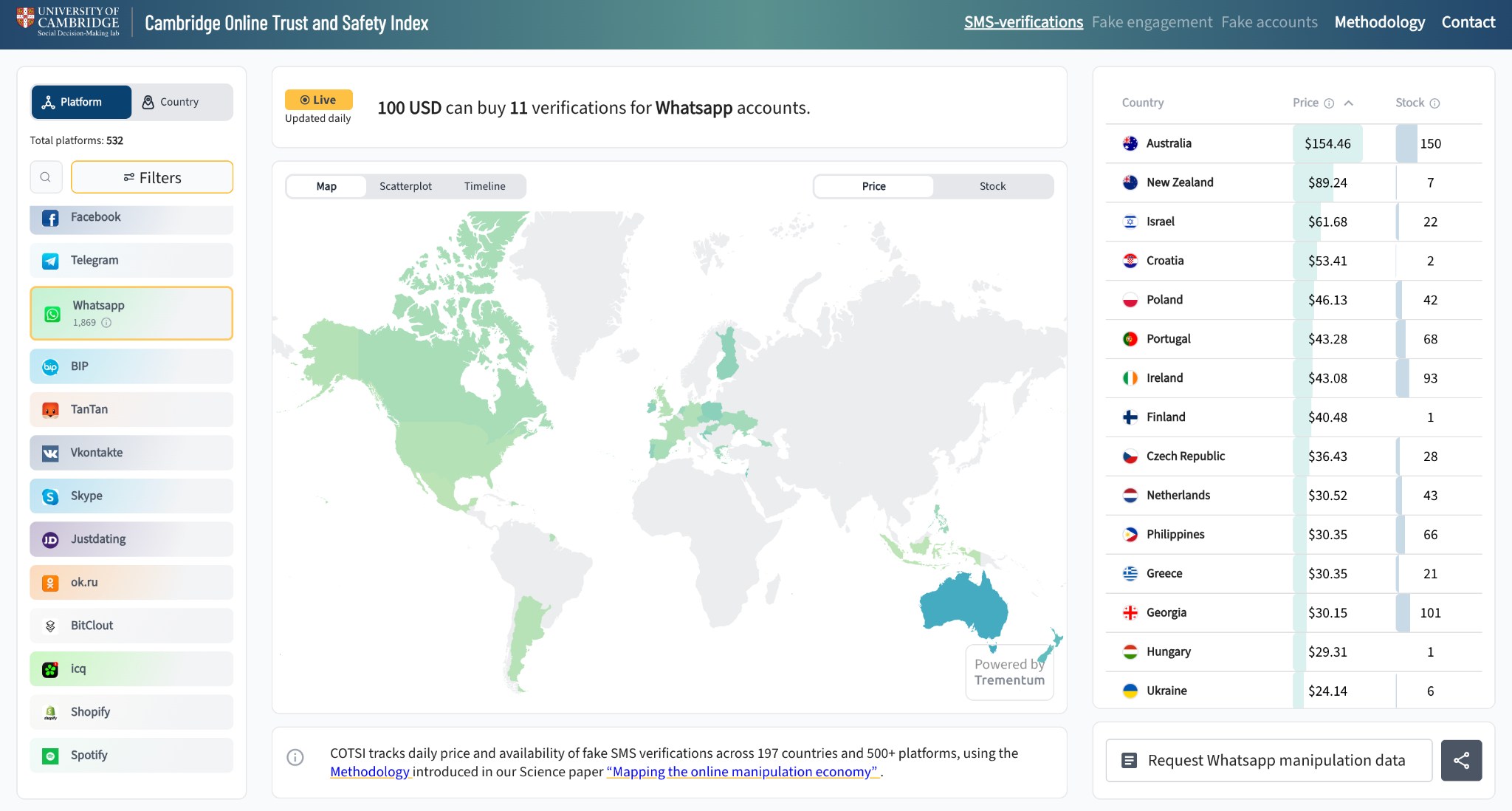
Image: Black market prices for SMS verification codes and fake account creation
A common method for creating fake accounts is using SIM cards. In September 2025, the U.S. Secret Service seized 300 SIM concentrators and 100,000 prepaid SIM cards, which were used by a group to mass register thousands of social and payment accounts.
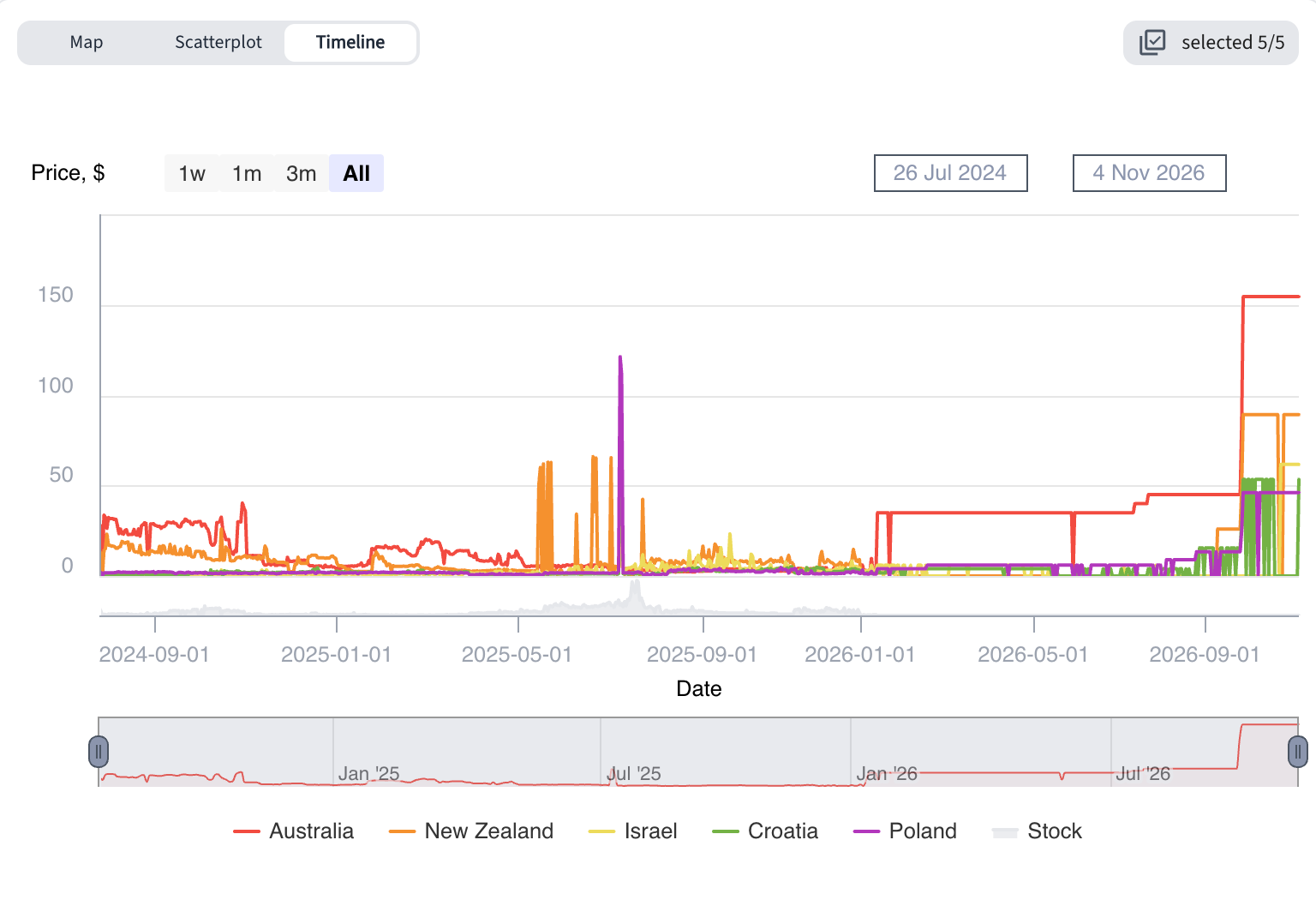
Image: Source cotsi
Another cost is the time invested by society as a whole. According to related research, global Internet users collectively spend about 500 person-years each day identifying distorted letters, selecting red-green lights, and other CAPTCHA verifications. At the U.S. minimum wage equivalent, the time value lost annually due to CAPTCHA recognition is approximately $1.3 billion.
Even so, automated scripts and bots are also learning to bypass these tests. In 2024, research teams achieved a 100% machine break rate for mainstream graphical CAPTCHAs using multimodal visual models.
Concept of the Encrypted Network: No More Headcount Statistics
The cryptocurrency industry refers to this type of fake account attack as a Sybil attack, a name derived from a seminal paper published by Microsoft researcher John Douceur in 2002.
When designing Bitcoin, Satoshi Nakamoto's solution was simply to stop counting heads.
He understood that voting based on IP addresses wouldn't work since one person could easily rent many proxy IPs. Bitcoin ties voting rights to computational power, as miners prove their participation by computing hash values and consuming power, known as proof of work (PoW). Later, proof of stake (PoS) further bound governance rights to staked capital.
Both computational power and capital are tangible scarce resources, unable to be infinitely replicated by simply registering accounts out of thin air. However, in scenarios where benefits need to be allocated based on real headcount, systems purely based on capital weight still cannot meet the demand for one person, one vote.
Worldcoin Orb Iris Scheme and Dedicated Hardware Bottlenecks
World (formerly Worldcoin) is attempting to return to directly recognizing human bodies through its custom hardware device, Orb.
Orb collects users' faces and irises using an infrared camera, confirms that the individual is a real person and not duplicately registered, and then generates a unique digital identity credential. Official data shows that over 18 million people have completed the verification process.
World's technical logic is that dedicated biometric hardware can provide extremely high uniqueness and anti-forgery capabilities for humans. If a regular smartphone camera could capture irises, hackers could use fake cameras to inject forged digital video streams; therefore, to prevent injection, World must manufacture Orb hardware in-house to strictly control the sensors, lenses, and lighting conditions.
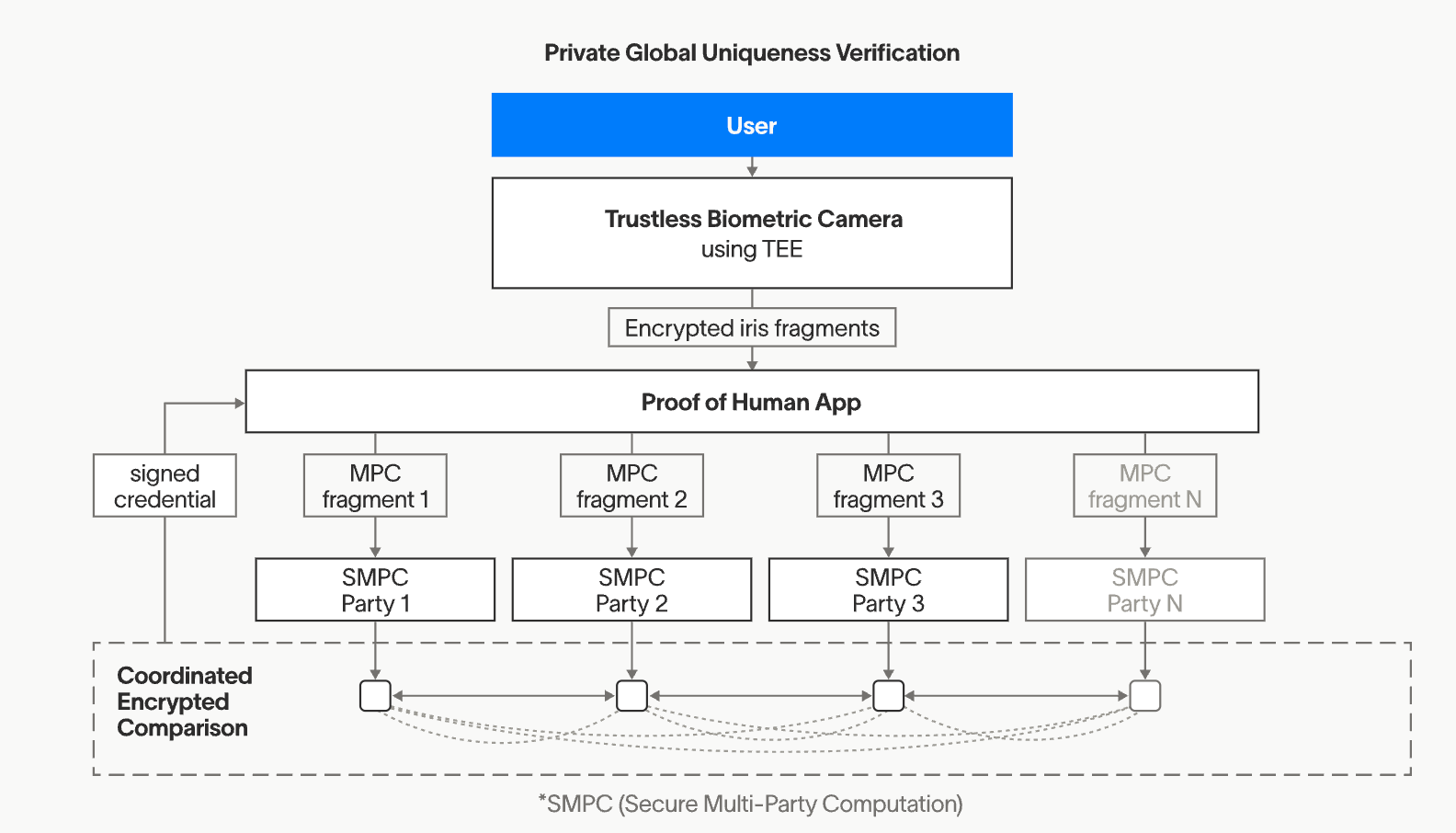
Image: Source world
However, dedicated hardware also brings structural challenges for deployment: the higher the precision of the devices, the more elevated the barriers to production, transportation, and coverage. In terms of data storage, World adopts a secure multiparty computation (SMPC) scheme, splitting users' iris codes into encrypted fragments that are stored in servers across different institutions, preventing a single centralized entity from controlling the entire biometric feature database.
But from the perspective of security, decentralized biometrics still face calculations of attack costs. Attacking Bitcoin requires purchasing immense electricity, attacking PoS chains requires acquiring expensive tokens, and in the biometric system, if airdropped tokens in a poor region are worth more than the living cost of local residents in a day, hackers can often organize intermediaries to lure real residents offline with small cash incentives to scan their eyes and then resell the credentials for profit.
Evolution of Palm Print and Vein Recognition Technology
In addition to iris recognition, palm-based biometric schemes are also accelerating commercial use. Amazon has launched Amazon One palm print payments for physical retail checkouts, and Tencent WeChat has also introduced WeChat palm scanning deployed in subway station turnstiles and convenience stores.
Palm recognition mainly combines two features: the epidermal palm print texture and the subcutaneous vein distribution structure under infrared light. Because subcutaneous veins have specific infrared absorption characteristics only when live blood is flowing, they are significantly more difficult to forge than ordinary flat facial photographs.
In terms of user experience, extending a palm is more psychologically comfortable and publicly hygienic than placing one's eyes close to a metal ball. Users do not need to remove sunglasses or bend down to align with the lens, making it more aligned with daily behavioral habits when passing turnstiles or cash registers.

Image: Discussion examples of the security of palm print authentication on social networks
However, the core trade-offs are similar to World: to achieve a high level of anti-forgery security, it is equally necessary to equip dedicated infrared vein sensors, and it cannot solely rely on the widespread use of inexpensive ordinary mobile phone front cameras.
Conclusion
From the paper serfs in "Dead Souls" to today's SMS black market and automated robots, as long as there is a mechanism in place that allocates benefits based on headcount, the industry of producing fake heads will persist.
In an era of synthetic content and the proliferation of intelligent agents, recognizing the boundaries of real humans is gradually retreating from software codes to biological entities. Whether it is iris or palm recognition, how to balance the security barriers of dedicated hardware with the convenience of global accessibility will remain a core question that decentralized identity systems must answer in the next stage.
免责声明:本文章仅代表作者个人观点,不代表本平台的立场和观点。本文章仅供信息分享,不构成对任何人的任何投资建议。用户与作者之间的任何争议,与本平台无关。如网页中刊载的文章或图片涉及侵权,请提供相关的权利证明和身份证明发送邮件到[email protected],本平台相关工作人员将会进行核查。


