Author: William M. Peaster, Bankless
Translated by: Deep Tides TechFlow
Deep Tides Overview: The retail trading giant Robinhood's entry into L2 is profoundly affecting the decentralized exchange ecosystem. On the Robinhood Chain, the Hook mechanism of Uniswap v4 has fully transitioned from theoretical design to practical gameplay. This article explores the technical architecture, economic allocation logic, and cutting-edge ecological projects of the Hook mechanism, providing a panoramic view for developers and traders exploring programmable liquidity.

Core Principles of the Hook Mechanism
If a token exchange is initiated on the Robinhood Chain, it is highly likely that a piece of Hook code is executing behind the scenes.
Simply put, Hook is a pluggable smart contract plugin mounted on the core pipeline of the Uniswap v4 singleton contract. It allows developers to inject custom execution logic at four key points in the lifecycle of a liquidity pool: before and after pool initialization, before and after modifying liquidity positions, before and after executing trade matching, and before and after settling donation fees.
Through this modular hook, liquidity pools are no longer static constant product formulas but have transformed into fully programmable dynamic financial engines. This allows developers to directly implement dynamic volatility fee rates, time-weighted average market making (TWAMM), limit order placements, collateral lending and borrowing, and dedicated liquidity dividend pipelines.
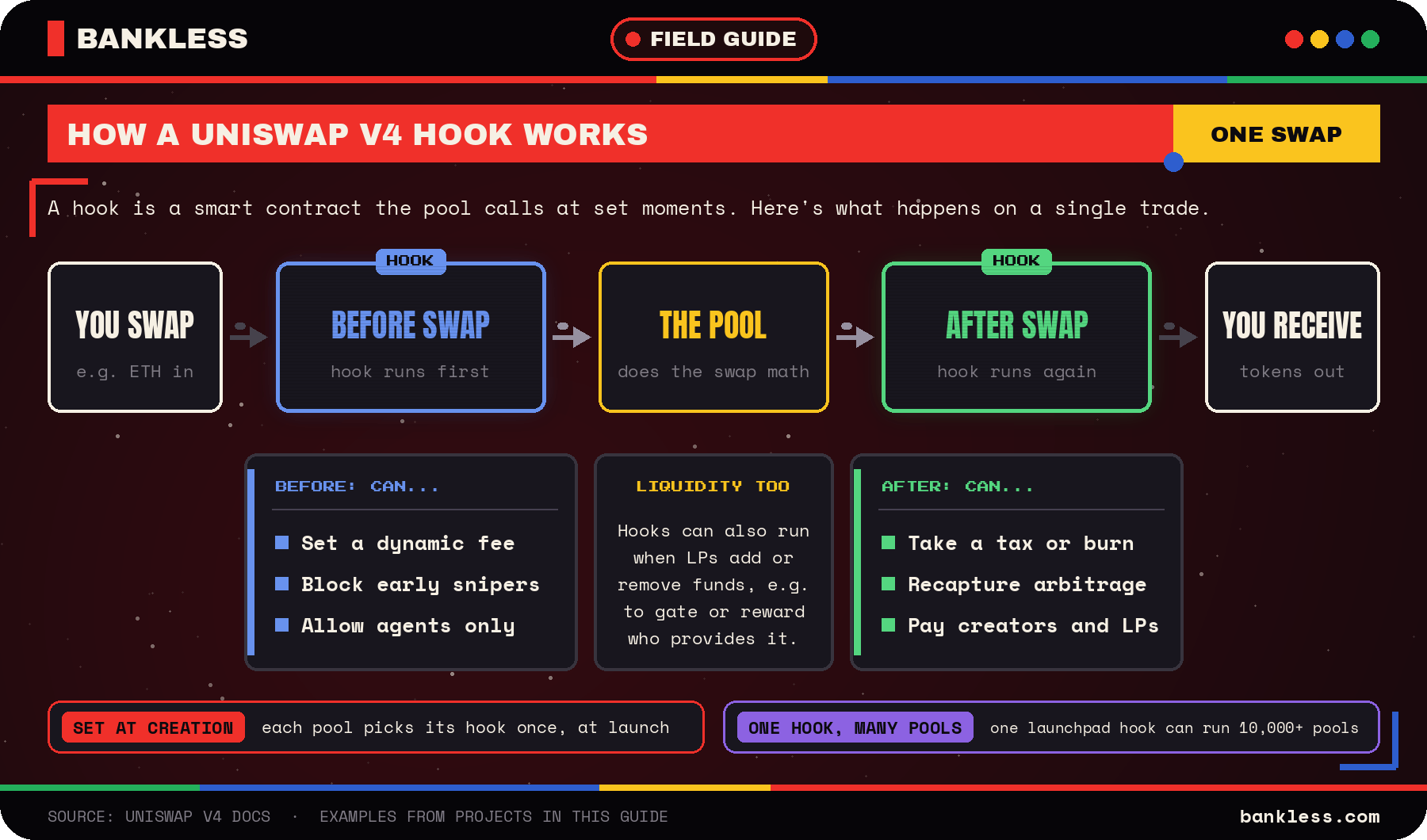
Figure: Lifecycle of Uniswap v4 core singleton contract and Hook plugin execution
The Retail Funds Flywheel Brought by Robinhood Chain
Why has Robinhood Chain become the first testing ground for Hook innovation? The core reason lies in the uniqueness of the fund attributes.
The traditional Ethereum mainnet and mainstream DeFi chains are flooded with highly sensitive MEV front-running arbitrage bots and giant multi-signature wallets, making it easy for small retail orders to fall victim to sandwich attacks. In contrast, Robinhood introduces a massive volume of uninformed trading flow due to its large retail user base.
For market makers and liquidity providers (LP), uninformed retail trading flow means significantly lower impermanent loss (IL) and higher actual fee earnings. Various Hook teams have developed dynamically subsidized fee pools tailored for retail funds, resulting in a unique capital attraction effect.
Panorama of Cutting-Edge Hook Protocols
In the current ecosystem of the Robinhood Chain, several representative native Hook protocols have emerged:
First, the Hookr protocol. This project focuses on automating liquidity position management, automatically calling Hook to adjust concentrated liquidity ranges when prices move away from key transaction intervals, preventing retail LPs from becoming one-sided buyers.
Second, Pearl DEX. It uses a customized dynamic hedging Hook to automatically increase trading slippage protection ratios during periods of extreme market volatility, allowing part of the protocol’s premium to flow back into the native staking pool.
Third, cross-protocol liquidity aggregation Hook. This connects on-chain order liquidity with centralized order books to achieve optimal path automation for order routing.
Development Outlook and Potential Systemic Risks
Programmable Hooks greatly expand the imaginative space of financial Lego bricks but also bring significant combinatorial risks:
The exposure to coding vulnerabilities multiplies. Hook contracts have the highest authority to intervene in trade execution. If the plugin itself has a reentrance vulnerability or logical flaw, it may jeopardize the asset security of the entire liquidity pool; additionally, excessive external calls will significantly increase the gas cost of individual transactions.
For liquidity providers participating in this ecosystem, thoroughly verifying the audit reports and whitelisting constraints of Hook contracts will become a required lesson in the second half of exploring programmable DeFi.
免责声明:本文章仅代表作者个人观点,不代表本平台的立场和观点。本文章仅供信息分享,不构成对任何人的任何投资建议。用户与作者之间的任何争议,与本平台无关。如网页中刊载的文章或图片涉及侵权,请提供相关的权利证明和身份证明发送邮件到[email protected],本平台相关工作人员将会进行核查。


