Author: Protos Staff
Translation: Deep Tide TechFlow
Deep Tide Introduction: This week, Nasdaq tech stocks experienced a significant drop in a single day, and external markets even triggered trading halts. However, regulatory documents disclosed by the U.S. Securities and Exchange Commission show that months before the crash began, the executive teams of core hardware and cloud computing giants in Silicon Valley had already launched an epic wave of share reductions. This article analyzes the real profit landscape of billions of dollars in capital swiftly exiting at high levels based on 282 genuine SEC Form 4 filings.

Precise Withdrawals Before the Crash
From May to October this year, core personnel from nine leading U.S. AI public companies cashed out a total of $7.4 billion as stock prices neared historic peaks.
Since November, the AI core index, which has attracted significant attention on Wall Street, has cumulatively fallen by 16%, with a single-day market value loss of over $3.2 trillion in the U.S. tech sector during Thursday's severe sell-off. International markets faced indiscriminate damage, with South Korea's composite stock price index plummeting by 8.5%, triggering circuit breakers.
However, before this round of liquidity crashes occurred, the masterminds and executives of the AI tech empire had already secured substantial profits.
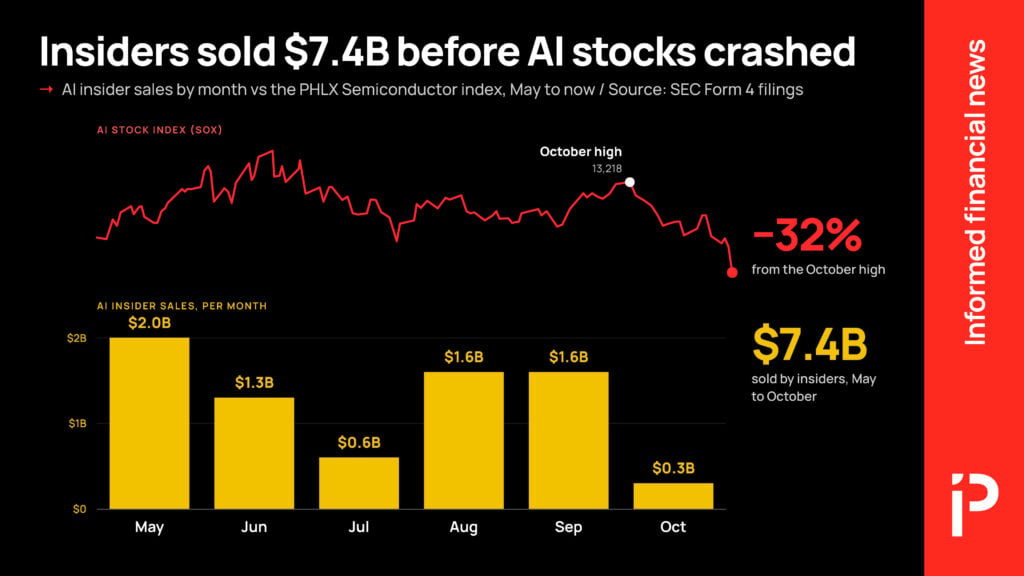
Figure: Cash-out amounts and distribution details of internal personnel from nine U.S. AI companies from May to October
The Selling List Behind the Regulatory Documents
Regulatory statistics show that in the 282 SEC Form 4 internal trading reports submitted from May to October, the total cash-out amount for the nine companies reached $7.39 billion (excluding a rigid sell-off of $179 million used to pay for options tax liabilities).
This wave of intensive selling includes key decision-makers from Nvidia, Oracle, Micron Technology, Broadcom, AMD, SanDisk's parent company, CoreWeave, Arista Networks, and Astera Labs.
Among them, Nvidia's senior director Mark Stevens alone sold $407 million in stock in June and informed the SEC about further sell-off applications afterward. This year, Stevens has cumulatively sold more than 6 million shares of Nvidia common stock through five regulatory filings, with personal cash-out exceeding $1.3 billion.
At the same time, four other senior insiders at Nvidia also sold an additional $24.5 million in stocks. During Thursday's plunge, Nvidia closed down 3.7%, marking an 11.2% overall drawdown from previous highs.
The All-Staff Cash-Out at Silicon Valley Star Unicorns
At the communication chip giant Broadcom, co-founder Henry Samueli cumulatively sold stocks worth up to $750 million throughout 2026, while three senior vice presidents collectively reduced their holdings by $14 million.
Within the AMD camp, seven internal executives collectively cashed out $262 million through 19 filings. During Thursday's plunge, AMD's stock price dropped 17.3% to $404.40, which is a cumulative drop of 38.6% from its previous historic high. AMD's CEO Lisa Su personally sold 360,000 shares, cashing out $169 million, while executive Forrest Norrod also reaped $45 million.
SanDisk CEO David Goeckeler reported high-level sell-offs in September, cashing out $105 million, with five other insiders also collectively cashing out $41 million.
As a leading cloud computing power provider, CoreWeave's internal executives have collectively executed up to $740 million in reductions after being included in the Nasdaq 100 index. As of Thursday's close, CoreWeave's stock price has significantly declined by 68% from its peak in 2026.
At memory chip giant Micron Technology, insiders have cashed out a total of $279 million through 18 filings, with CEO Sanjay Mehrotra contributing $182 million. At Oracle, vice chairman Jeffrey Henley led a reduction of $63.7 million.
These objective data from the bottom-level capital market regulatory filings indicate that while retail investors and quantitative funds blindly bet on the infinite growth of AI computing power, the industry insiders who truly understand the hardware supply chain cycle and delivery bottlenecks have already completed the certain cash-out of billions of dollars at high levels.
免责声明:本文章仅代表作者个人观点,不代表本平台的立场和观点。本文章仅供信息分享,不构成对任何人的任何投资建议。用户与作者之间的任何争议,与本平台无关。如网页中刊载的文章或图片涉及侵权,请提供相关的权利证明和身份证明发送邮件到[email protected],本平台相关工作人员将会进行核查。


