
Author: Zhou, ChainCatcher
On November 5th Eastern Time, the US stock market experienced the largest single-day sell-off since April 2025.
After the Democratic Party swept both houses of Congress in the midterm elections, the market worried that the construction of AI data centers would be slowed down, leading to chip stocks taking the lead in losses, with the Nasdaq Composite Index falling 5.52%, closing into the technical correction zone.
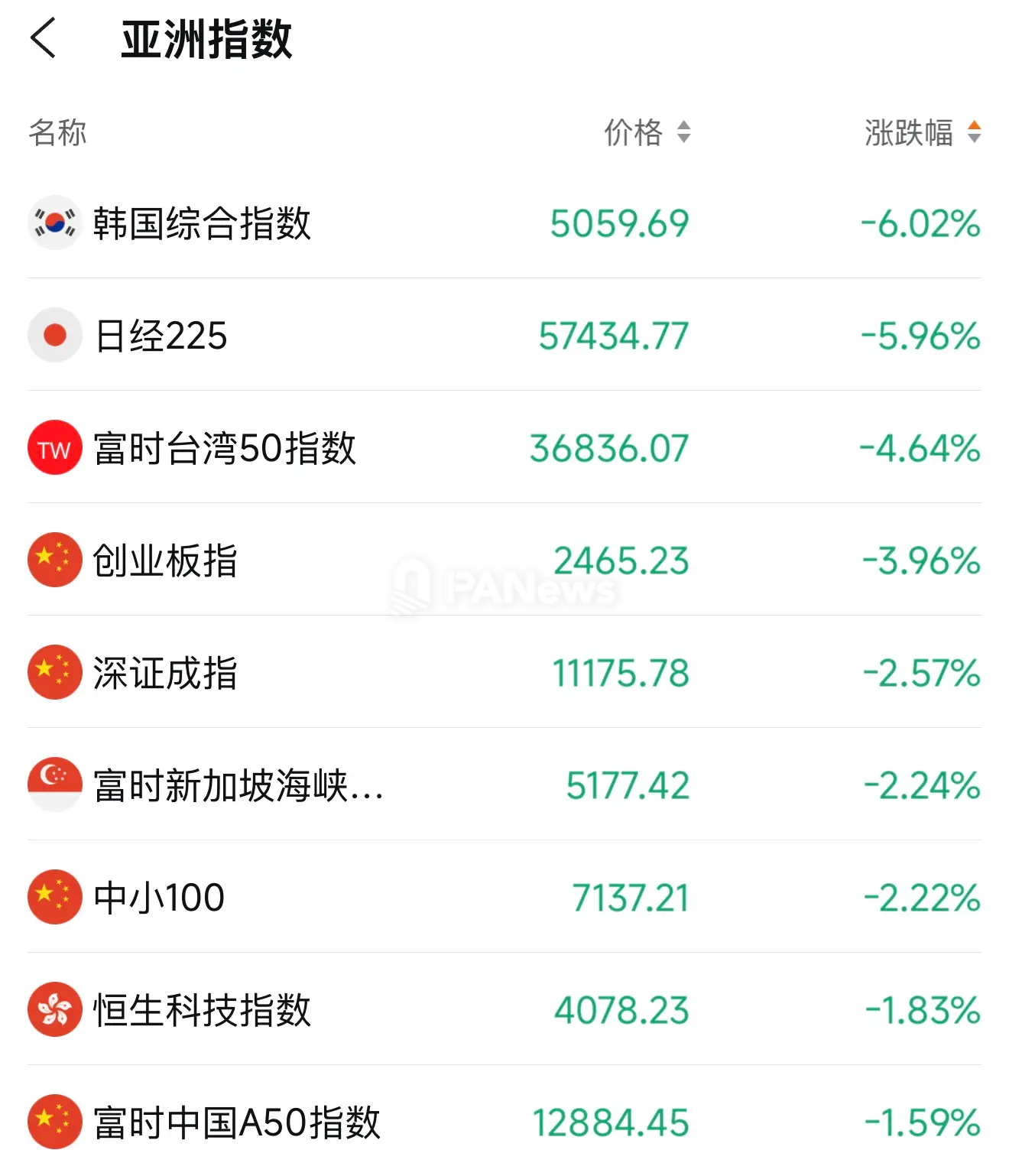
On Friday, the Asia-Pacific stock markets opened broadly lower, with the South Korean KOSPI triggering a circuit breaker during the day.
The cryptocurrency market was also not immune. Bitcoin briefly fell below $76,000, and Ethereum fell below $2,250, completely reversing the gains made after the midterm elections.
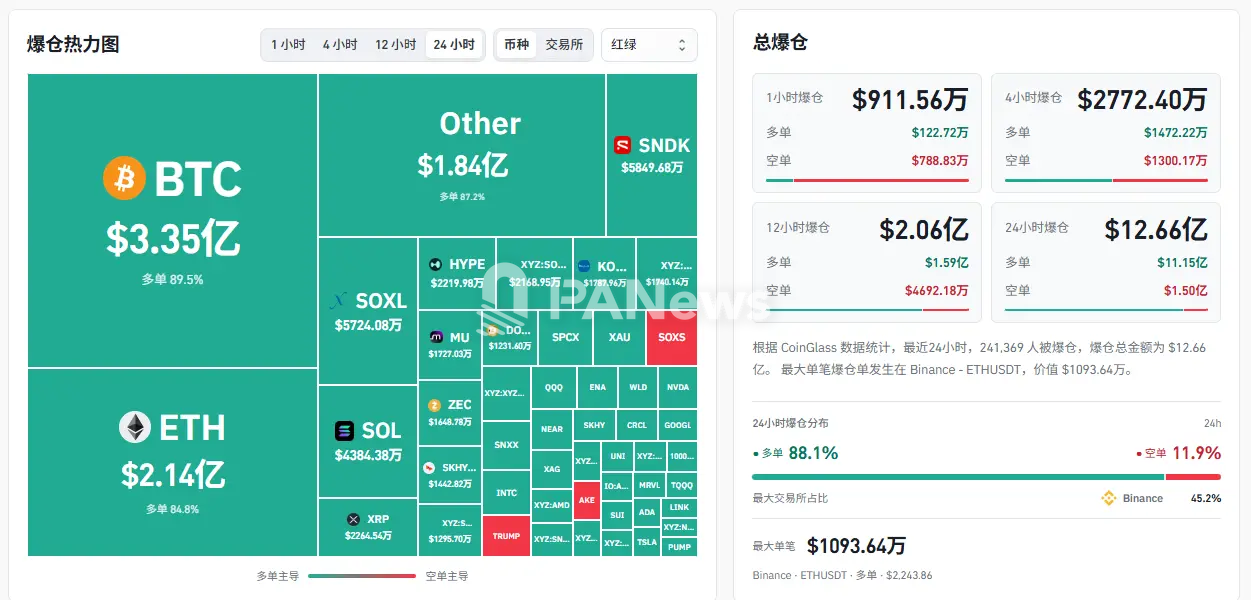
As of the time of writing, according to CoinGlass data, over $1.2 billion was liquidated across the network in the past 24 hours, with nearly 90% being long positions.
Wall Street turns bearish, AI sell-off spreads to Asia-Pacific
Just a day before the crash, Wall Street was generally bullish. After the election results were announced, the S&P 500 index rose nearly 2% on Wednesday, and the Dow Jones Industrial Average rose over 3%.
Institutions like JPMorgan, Nomura, HSBC, and Citadel Securities issued bullish reports, citing that the pre-election institutional positions had been significantly reduced, and there was ample room for capital replenishment once uncertainties dissipated.
Data from Citadel Securities also indicated that retail investors had net bought US stocks for 22 consecutive trading days, totaling nearly $33 billion.
The optimistic sentiment only lasted for one day. After the market opened on Thursday, it began to reassess the impact of the Democratic victory on the AI industry. The Democrats not only secured both the House and Senate but also won gubernatorial elections in data center strongholds like Texas and Georgia, where the new Texas governor, Gina Hinojosa, had called for an immediate halt to new data center construction.
UBS estimated that about 30% of the new data center capacity planned in the US for 2028 might be impacted by potential construction pauses.
The sell-off quickly spread from chip stocks. The Philadelphia Semiconductor Index fell 12.25% that day, marking the second largest single-day decline on record for that index, according to Reuters. Nvidia fell over 9%, and Micron and AMD both dropped about 17%.
By the close, the Dow fell 3.44%, the S&P 500 Index dropped 4.36%, the Nasdaq 100 Index fell 6.36%, and the total market capitalization of US stocks evaporated by about $3 trillion in a single day.
Nomura's cross-asset strategist Charlie McElligott described that the market was abandoning the leading stocks that had previously driven gains this year, with hedge funds eager to lock in profits before year-end. Retail investors also changed their habit of buying on dips; Vanda Research data showed that retail investors net sold individual stocks on that day in the largest scale since March 2020. The institution’s global macro strategist Viraj Patel believed this represented a full surrender by retail investors.
On Friday, the Asia-Pacific stock markets continued to decline. The South Korean exchange triggered a circuit breaker at 9:03 AM local time, halting trading for 20 minutes, with the KOSPI dropping as much as 8.8%, falling below 5,000 points for the first time in nine months. Samsung Electronics and SK Hynix dropped over 10% at one point. The Nikkei 225 Index fell over 6% at one point, and Taiwan stocks also dropped over 8% at one point.
Bitcoin falls below $76,000, leveraged funds suffer from a double whammy
The movements in the cryptocurrency market were almost synchronized with the US stock market. After the election results were clarified on Wednesday, Bitcoin surged above $80,000, leading to concentrated liquidations of shorts.
On Thursday, the situation completely reversed; according to CoinGecko data, when the Nasdaq fell nearly 4% intraday, Bitcoin plummeted from $78,767 to $75,986 within an hour. Bitcoin then fell below $76,000, marking a new low since mid-September and dropping below the 50-week moving average. Ethereum also fell in tandem, briefly dropping below $2,250.
For the entire day on Thursday, Bitcoin fell about 6%, comparable to the declines of the Nasdaq Composite Index at 5.52% and the Nasdaq 100 Index at 6.36%, and was significantly smaller than the Philadelphia Semiconductor Index's decline of 12.25%.
CryptoQuant analyst Darkfost previously pointed out that calculating over a 90-day rolling window, Bitcoin's correlation with the S&P 500 has risen above the historical average.
Regarding spot ETFs, SoSoValue data indicated that the US Bitcoin spot ETF saw a net outflow of $430 million on November 5th, with none of the 12 ETFs seeing net inflows. The total asset net value dropped from the previous day's $102.26 billion to $96.65 billion, falling below $100 billion.
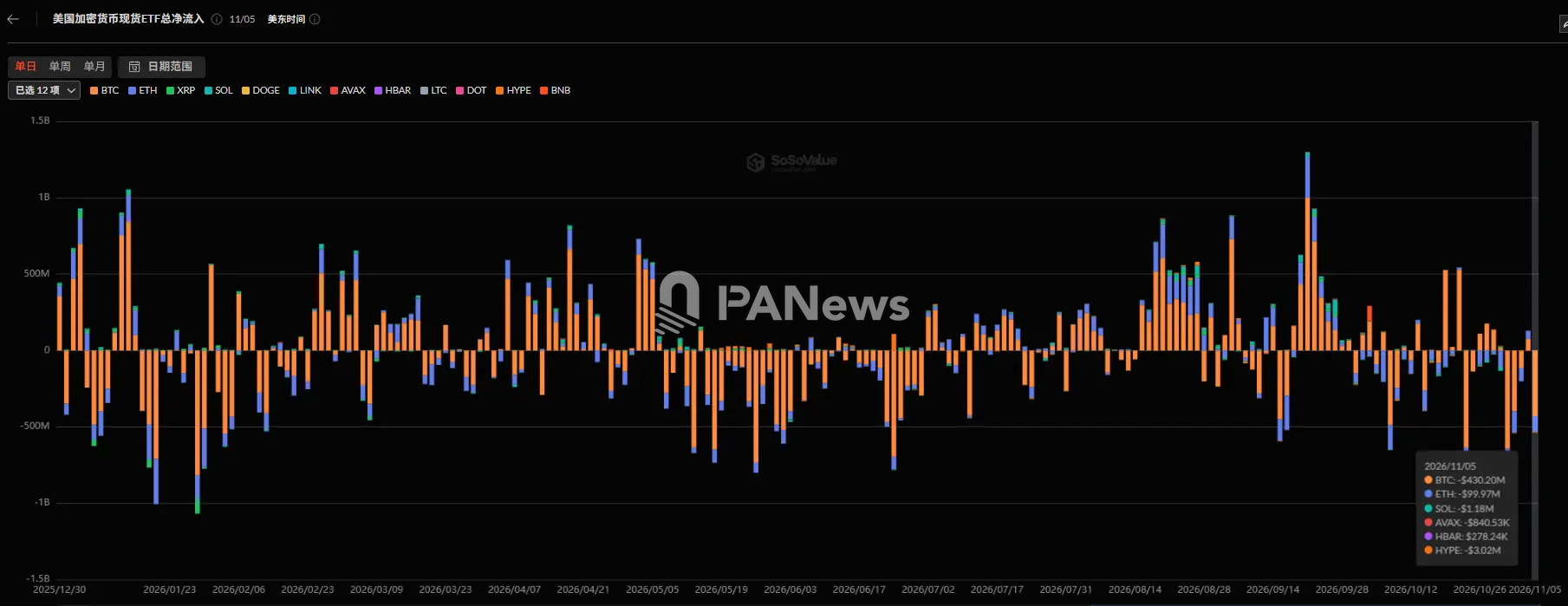
In fact, this round of capital outflow had already begun before the election. Over the five trading days since October 30, the Bitcoin spot ETF only recorded net inflows on November 4th, totaling a net outflow of about $1.51 billion. The Ethereum spot ETF fared worse, with a net outflow of $99.97 million on November 5th and only three days of net inflows in the past 16 trading days since October 15th.
In the derivatives market, unlike Wednesday, it was now the bulls who faced liquidation. CoinGlass data indicated that over the past 24 hours, $1.251 billion was liquidated across the network, with long positions accounting for $1.108 billion, making up 88.6%, affecting a total of 239,896 people.
Furthermore, the sell-off in US stocks transmitted directly to the cryptocurrency derivatives market through perpetual contracts. CoinGlass's liquidation heatmap showed that the liquidations of contracts related to SNDK and SOXL reached $58.32 million and $56.71 million respectively, both exceeding SOL's $43.25 million.
Market sentiment cooled as a result, with CoinGlass's fear and greed index dropping to 27 on Friday, falling 24 points from the previous day and entering the fear zone, while the average over the past 30 days remained at 50.
Cryptocurrency-related stocks suffer broad losses, mining companies hit hard
The drop in coin prices also dragged down cryptocurrency-related stocks listed in the US. Among platform and compliance companies, Coinbase fell 9.69%, Robinhood fell 10.32%, and Circle fell 8.72%.
Digital asset reserve companies saw declines generally exceeding the value of their held assets, with Ethereum reserve company Bitmine and SharpLink dropping 12.56% and 10.21% respectively, while Bitcoin reserve companies Strategy and Strive fell 9.29% and 10.17%, with declines greater than those of Ethereum and Bitcoin during the same period.
The biggest drop was seen among Bitcoin mining companies that have transformed into AI data centers over the past two years.
These mining companies, holding power resources and land, have been converting their mining facilities into AI computing centers, with valuations rising alongside the surge in AI infrastructure. SemiAnalysis estimates that Texas accounts for about 30% of the data center capacity planned to be operational in the US by 2028, far exceeding other states.
The decline for mining companies began on Wednesday, with Core Scientific dropping 11.6%, IREN falling 12.5%, and Cipher Digital plunging 21% that day.
Bernstein subsequently downgraded the target prices for seven mining companies, citing tightening financing and uncertain prospects in Texas. IREN's target was lowered from $100 to $55, and TeraWulf's from $36 to $20. The institution pointed out that among the companies covered, IREN, Riot, and Cipher have the greatest exposure to Texas.
On Thursday, the plunge in US stocks further expanded the losses for mining companies. Bitdeer dropped 18.68%, IREN fell 16.95%, CleanSpark dropped 16.47%, Cipher fell 14.62%, MARA fell 14.48%, and TeraWulf dropped 13.85%.
The market awaits Anthropic IPO and Nvidia earnings report
In the coming two weeks, tech stocks will face two critical junctures.
The first is the IPO process of Anthropic. Just a day before the crash, HSBC's Chief Multi-Asset Strategist Max Kettner regarded the Anthropic IPO as a true clearing event for tech stocks, believing that if completed smoothly, it could lead to a comprehensive bullish sentiment towards tech stocks. Now, this event itself has introduced uncertainty.
According to Reuters, four insiders revealed that potential investors are skeptical about whether Anthropic can begin its roadshow as planned in the week of November 9 and go public within November. If AI-related assets continue to be under pressure, Anthropic might delay its listing. Investors are also waiting for the company's revenue data from October, which remains blank in the updated S-1 filing.
Valuation expectations have also been lowered. The Wall Street Journal reported that three major investors planning to participate in the subscription believe the company will struggle to achieve the previously anticipated $1.5 trillion valuation post-sell-off, with one suggesting it could be closer to $1 trillion. Just over a month ago, the market discussion put the valuation near $2 trillion.
The other significant juncture is Nvidia's third-quarter earnings report, which will be released after the US stock market closes on November 17. The market's expectations for this earnings report are high. Nvidia provided guidance in August that this quarter's revenue would be around $108 billion, representing a year-on-year growth of about 106%, with analyst consensus expectations around $109 billion. This guidance does not include revenue from data center computing businesses in the Chinese market.
More than the performance numbers, the management’s outlook on demand prospects is what draws attention. Nvidia has already indicated in its quarterly risk disclosure that power shortages, financing constraints, and regulatory hurdles in data center construction may delay client deployment schedules and hinder revenue growth. After the Democratic victory, these risks have become the focus of investors' reassessment.
As the most core company in the AI infrastructure chain, Nvidia's stance will directly influence the market's judgment on the pace of data center construction, and the mining companies transforming to AI are also positioned within this chain.
From US stocks to Asia-Pacific and then to the cryptocurrency market, the main storyline of this round of declines has always centered on AI trading. JPMorgan strategist Nikolaos Panigirtzoglou previously suggested that hedge funds might need several weeks of market stabilization after experiencing the sell-off in October before re-establishing AI exposure. Hennion & Walsh Chief Investment Officer Kevin Mahn also believes that more market fluctuations will follow.
The Anthropic IPO roadshow and Nvidia's earnings report will both be revealed within the next two weeks. Their outcomes will not only affect tech stocks but will also determine whether this wave of interconnected declines spreading from US stocks to Asia-Pacific chip stocks and cryptocurrency assets can find a foothold.
Crypto critic Warren may chair the Senate Banking Committee, cryptocurrency legislation faces deadlock again
On the regulatory policy front, the Democratic victory may also have a significant impact on the cryptocurrency industry.
Although crypto-friendly House Financial Services Committee Chairman French Hill won re-election, with the Democrats taking over the House, he will hand over the chairmanship in January. According to Reuters, senior Democratic committee member Maxine Waters is a leading candidate to succeed him.
In the Senate, Elizabeth Warren, who has long held a critical stance towards the cryptocurrency industry, is expected to chair the Banking Committee. She previously wrote a joint letter to the Department of Justice and the Treasury, demanding an explanation regarding the investigation into the Trump family's cryptocurrency business.
Democrats have also insisted on including an ethical clause to restrict conflicts of interest for government officials in the CLARITY Act. According to Bloomberg, this disagreement has led to the bill being stalled. In September this year, the CLARITY Act failed to advance in a procedural vote in the Senate by a vote of 49 to 50.
Warren's stance on new types of cryptocurrency-related products is equally strict. On November 3rd, the CFTC announced that it would allow individual stock perpetual contracts to be traded on its registered exchanges, prompting Warren to issue a statement claiming that such high-risk products could foster insider trading and might lead to severe market volatility.
Many institutions believe that cryptocurrency legislation will be further delayed. Stifel's Chief Washington Policy Strategist Brian Gardner believes that the CLARITY Act has no chance of advancement within the remaining term of this Congress, and the likelihood of bipartisan compromise in the next Congress is also very low. He also expects Warren to investigate cryptocurrency companies. Compass Point analyst Ed Groshans pointed out that under Warren’s leadership of the Banking Committee, the popularity of cryptocurrency assets will largely depend on regulatory actions from the SEC and CFTC.
免责声明:本文章仅代表作者个人观点,不代表本平台的立场和观点。本文章仅供信息分享,不构成对任何人的任何投资建议。用户与作者之间的任何争议,与本平台无关。如网页中刊载的文章或图片涉及侵权,请提供相关的权利证明和身份证明发送邮件到[email protected],本平台相关工作人员将会进行核查。


