Author: Jae, PANews
In just two trading days, players in the US stock market experienced a rapid rollercoaster ride.
On November 5, the US stock market witnessed the strongest single-day sell-off in nearly 19 months, led by the AI industrial chain. Rumors of "hedge funds collectively facing liquidation" quickly spread on social media, as if a financial storm was imminent.
Unexpectedly, the reversal came very quickly. On November 6, chip stocks sounded the charge for a counterattack: the Philadelphia Semiconductor Index rose by 4.2%, AMD surged by 11%, and AI concept stocks like Nvidia also rebounded simultaneously; the Nasdaq rose by 1.1%, and the S&P 500 slightly increased by 0.3%.
This unexpected market movement may have already been foreshadowed a month ago. At the same time, a migration of capital across asset classes is quietly unfolding.
Deleveraging selling pressure eases, medium- and long-term risks unresolved
The rebound on November 6 actually showed signs in the last ten minutes before Thursday's close.
According to Vanda Research data, US retail investors significantly shifted to buying during the last ten minutes before the close on the previous day, with net purchases exceeding $100 million.
The key variable comes from leveraged ETFs. According to calculations by Nomura Securities, to complete the net asset value rebalancing on November 5, leveraged ETFs needed to concentrate on selling about $47 billion worth of stock exposure before the close. This marks the second largest single-day sell-off since records began in 2006.
Once this large amount of passive selling was completed before the close, the short-term selling pressure in the market was significantly released. The combined force of bottom-fishing capital, short covering, and institutional portfolio rebalancing promoted price recovery. JPMorgan noted in its after-hours commentary that Thursday’s intense deleveraging activity cleared some crowded trades, leading to a healthier market position structure.
In other words, last night's rebound is more of a technical correction at the short-term trading level, and medium- to long-term contradictions such as shifting policy expectations and questioning the returns of AI capital expenditures have not truly dissolved.
Liquidation narrative exaggerated, hedge funds reduced leverage a month in advance
In this round of turmoil in the US stock market, hedge funds once became the focus of market attention.
According to a report by Bloomberg on November 5, Tiger Global's flagship hedge fund lost approximately 8.5% in October, with year-to-date returns essentially flat; Walleye Capital fell about 5.9% during the same period, with year-to-date losses reaching approximately 6.8%; Lone Pine Capital lost about 8.8% in just one month.
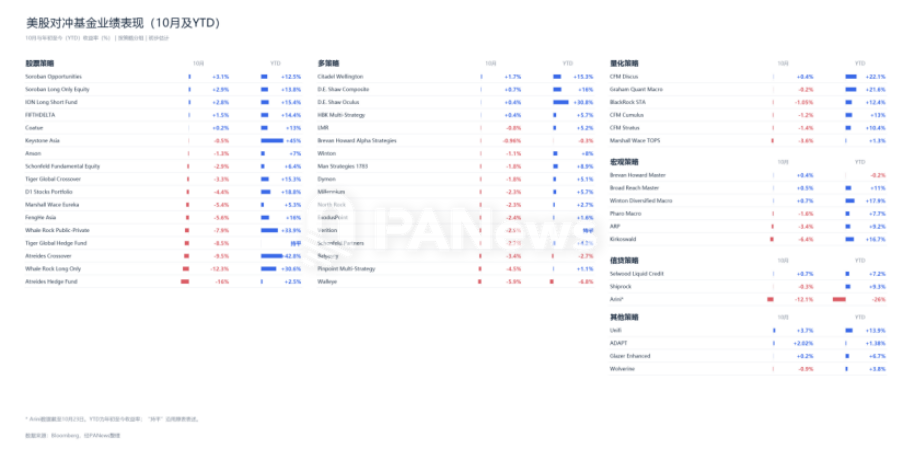
Social media was filled with panic narratives of "Wall Street hedge funds facing collective liquidation," with hedge funds such as Walleye Capital, Engineers Gate, and Samlyn Capital subsequently reporting team layoffs, streamlined strategies, and returning capital to investors, intensifying market concerns about institutional chain liquidations.
However, business contraction does not equate to liquidation; it is more about managers proactively controlling risk and adjusting business models, rather than insolvency type bankruptcies.
One timeline that is easily overlooked by the market is: Hedge funds began to reduce positions and leverage as early as October, and the crash on November 5 is more likely to be a concentrated realization of this process.
Goldman Sachs Prime Brokerage data shows that in October, global fundamental long-short equity funds suffered an average loss of about 3.5%, while systematic long-short strategy funds lost about 3.6%. This is the first time since Goldman began tracking in 2016 that both strategies experienced losses exceeding 3% in the same month.
More covert actions occurred in mid-October. In just two weeks, Goldman’s hedge fund clients net sold $20 billion worth of technology stocks; from October 8 to 14 alone, they erased all net long positions in AI stocks accumulated since early 2025. By the end of October, hedge funds’ net leverage ratio dropped to 73.4%, declining 4.2 percentage points in a single month, marking the largest monthly decline since March this year.
Morgan Stanley's data also reveals this change. Stock-picking hedge funds experienced their largest active position reduction in over a decade in October, with market exposure having dropped about 9% since June. By the end of October, over 40% of related funds had flat or negative year-to-date returns.
However, hedge fund performance also exhibited significant differentiation, not all sectors suffered losses.
Coatue Management recorded a positive return of 0.2% in October, Citadel rose by 1.7%, and Quantedge achieved a monthly gain of as much as 7.2%.
Some stumbled in crowded trades while others profited from market volatility.
Funds have not disappeared, just changed places
Behind the evaporation of trillions in market value in US stocks is a massive migration of capital.
Money does not disappear out of thin air; it simply flows out of high-volatility, high-leverage technology stocks and into safer, more liquid assets.
The primary destination is US Treasury bonds. On the day the US stock market crashed, the yield on 10-year US Treasury bonds briefly fell to 4.84%, reaching a new low since September. Price and yield move in opposite directions, indicating that large amounts of funds are flooding into the bond market.
The second stop is the US dollar. FxPro's chief market strategist Alex Kuptsikevich pointed out that panic in tech stocks dampened risk appetite, causing the dollar to regain significant support from safe-haven buying.
ING’s global market head Chris Turner also believes that investors are currently more willing to keep cash in US dollar assets temporarily, with the market leaning towards holding US dollar cash rather than fleeing it.
Just as the dollar is in demand, the undervalued South Korean won and New Taiwan dollar are also gaining attention.
Yesterday, Claudio Piron, head of Asian foreign exchange and interest rate strategy at Bank of America Global Research, pointed out that buying opportunities for the New Taiwan dollar and South Korean won arose after the sell-off in AI stocks. The substantial current account surplus in the regions of Taiwan and South Korea will provide "strong support" for investors to build long positions.
Another key judgment from Bank of America is that AI industry chain companies already have substantial capital expenditures and export orders and will not cancel them due to the decline in US stocks. Continuous export settlement over the next 6 to 12 months will create new underlying support for the New Taiwan dollar and South Korean won.
Peak selling pauses, position clearing may not be at an end
A rapid rebound after a crash is not uncommon; the real challenge lies in distinguishing whether it marks the end of the decline or a temporary recovery.
History does not repeat details but often follows similar patterns.
August 2007: Quantitative Funds De-leveraging
From August 6 to 9, 2007, multiple long-short equity quantitative funds experienced concentrated losses, resulting in a bloodbath in the market.
Research by MIT scholars Amir Khandani and Andrew Lo found that concentrated liquidations in crowded trades and a brief withdrawal of market-making capital jointly led to the liquidity anomalies at that time.
The most intense phase of the crash was concentrated over just four days, and strategies began to rebound after August 10, but the entire deleveraging process continued from July until the end of the year.
The crash was just a prelude; the actual clearing of positions and restoration of risk appetite could take months.
March 2020: Pandemic Triggers Comprehensive Selling of Risk Assets
From February 19 to March 23, 2020, the S&P 500 fell by about 34%, with the adjustment lasting for over a month, interspersed with many sharp single-day rebounds, until it regained lost ground in August of that year.
In the short term, the market movements in the first two days closely resemble the first scenario: the most intense concentrated selling may have passed, but the rebalancing of positions and restoration of risk appetite across the entire market is far from over.
The divergence in the market is precisely here.
Famous investor Jason Calacanis stated that the market bottom may have already appeared, but the valuations of tech stocks could still drop a further 10%, at which point it would be an ideal buying opportunity.
Optimist Tom Lee, chairman of Bitmine, believes that Thursday’s crash in US stocks resembles the aftershocks of a "blue tsunami" triggered by midterm election results, a combination of "last year's tariff shock + DeepSeek moment + this year's June Situational Awareness forced liquidation," and such concentrated sell-offs often plunge deeply within a few days, creating buying opportunities.
US stock analyst Mark Minervini offered a more cautious assessment. He believes that the decline in US stocks is unlikely to reach the levels of the 1987 stock market crash, but it could lay the groundwork for some form of market collapse, which could continue for one to two weeks. If the downward trend intensifies, the worst-case scenario for SPY would be a decline of 10%-15% from its peak. The Nasdaq may fall by 20-25%, potentially resembling a cyclical bear market similar to 1998.
For now, the rise in US stocks last night is far from sufficient to offset the declines of the previous day. After an asset drops by 20%, it needs to rise by 25% to return to its original point.
Meanwhile, the Nasdaq, which fell 5.52% on Thursday, still has a noticeable gap from its previous position, even with a 1.1% rise the next day.
After two days of intense volatility, the US stock market stands at a crossroads. The narrative that drove the surge in AI tech stocks over the past few months is now facing harsh reality tests. Short-term deleveraging may be coming to an end, but the medium-term game around industrial policy implementation and AI investment returns has only just entered deep waters.
免责声明:本文章仅代表作者个人观点,不代表本平台的立场和观点。本文章仅供信息分享,不构成对任何人的任何投资建议。用户与作者之间的任何争议,与本平台无关。如网页中刊载的文章或图片涉及侵权,请提供相关的权利证明和身份证明发送邮件到[email protected],本平台相关工作人员将会进行核查。


