More accurate, faster.
Written by: Mahe, Foresight News
On the evening of November 3, when mainstream television networks like CNN were still waiting for the slow advance of vote counting data and hesitated to call the race, prediction markets had already completed probability convergence and advanced pricing with real money positions.
On the night of the polls, Polymarket and Kalshi quickly raised the winning probabilities in key swing states, with Polymarket giving a 99% certainty judgment on the Michigan Senate race four whole hours before mainstream media made their official announcement. That night, the signals given by these two platforms with real money were faster and more decisive than the average of polls, forecasting models, and formal announcements from TV networks.
This is not the first time. In the 2024 presidential election, the two prediction market platforms had locked in the direction ahead of time while polls were still fluctuating. In the 2026 midterm elections, they proved once again that they were not just occasionally lucky.
$3 billion in liquidity leading the way
On November 3, the daily trading volume for Kalshi's election contracts, revealed by Paradigm co-founder Matt Huang, was $729 million, far exceeding the $244 million daily trading volume for the 2024 U.S. presidential election.
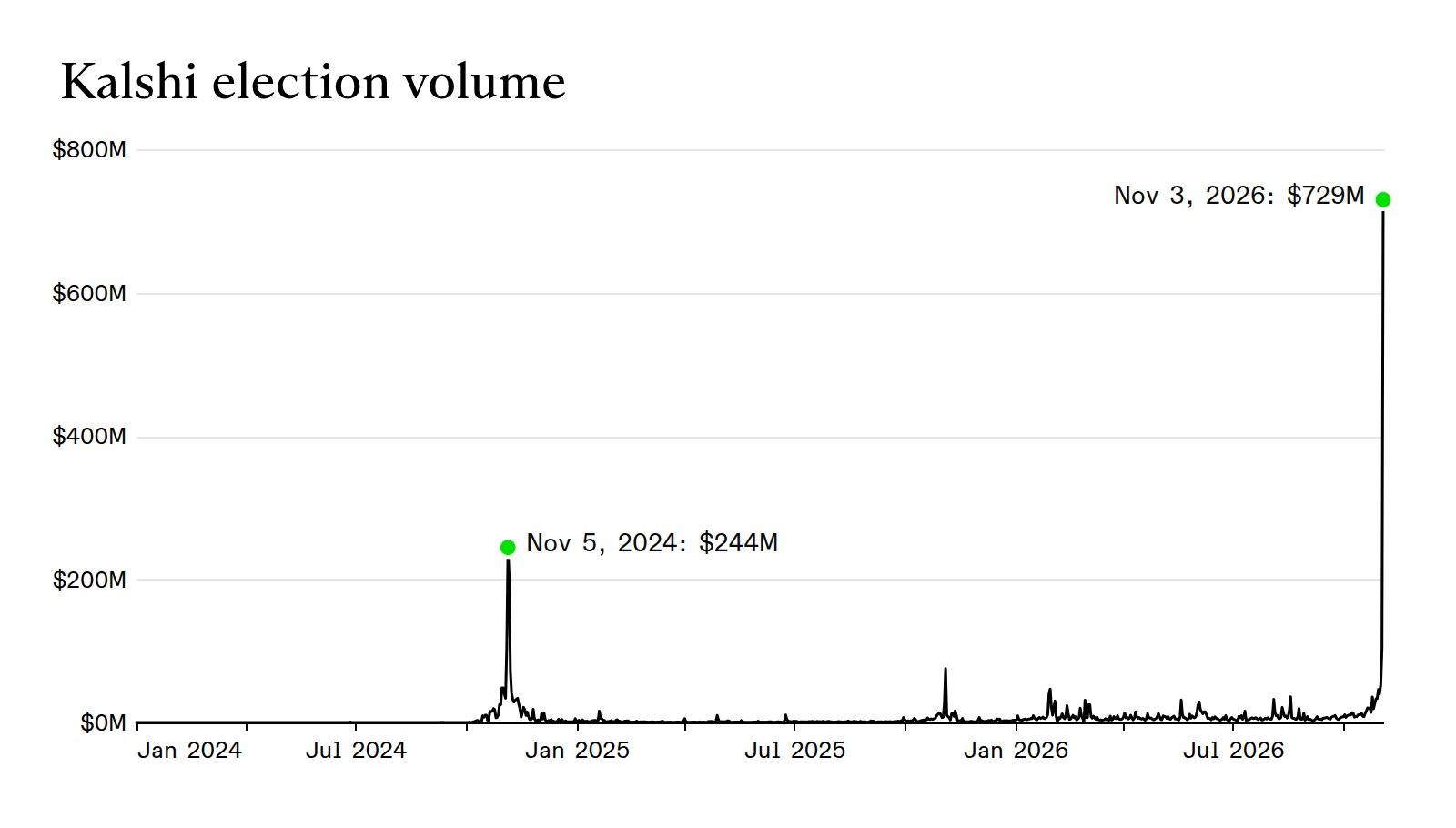
Once the dust settled in the midterm elections, Kalshi's official article revealed that the total trading volume in markets related to the 2026 midterm elections exceeded $2.5 billion, nearly double the $1.3 billion for the entire 2024 election cycle.
It is worth noting that Kalshi had only just won a lawsuit against the CFTC in October 2024 (one month before the election) to be approved for launching U.S. political contracts. While the true dominant player in the 2024 election was Polymarket (with a single presidential election contract reaching over $3.6 billion). Now, just two years later, the trading volume landscape in the election market has reversed.
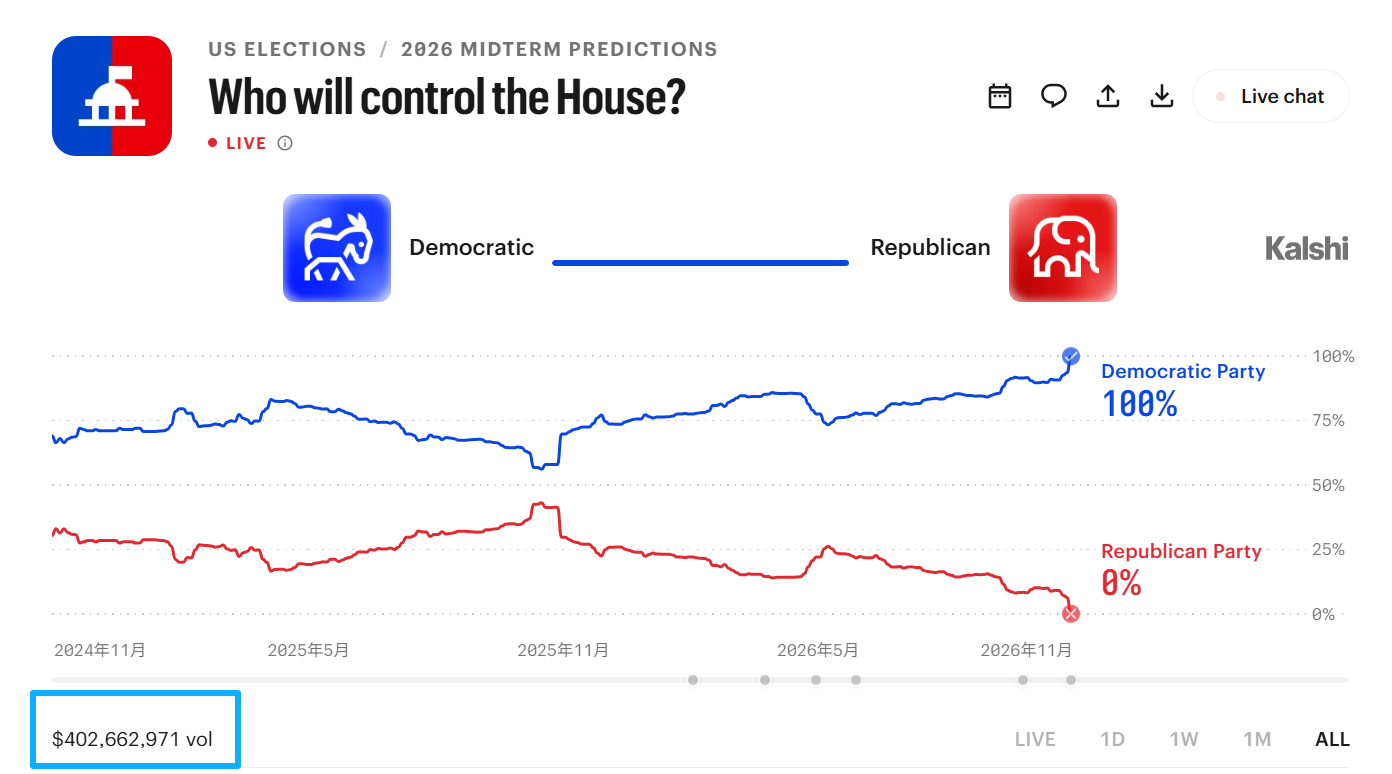
On Kalshi, the single prediction market for "Who will control the U.S. House of Representatives" alone accumulated a total trading volume exceeding $400 million.
Prior to the election, institutions like The Washington Post calculated that the combined total for Kalshi and Polymarket was close to $1.9 billion, with Kalshi accounting for about $1.3 billion and Polymarket about $600 million.
After and on election day, Kalshi's total platform nominal trading volume surged to $4.15 billion (including non-election contracts), with significant buy orders concentrated in key targets such as the Texas Senate (one day exceeding $100 million), House control, and the Texas governorship.
Polymarket, on the other hand, faced fragmentation in trading statistics due to the disparity between its onshore compliant version (Polymarket US) and offshore international version, with total trading volume ranging from $600 million to $700 million, and core trading volume also highly concentrated in the dual control of the two houses and the government-to-house power balance contracts.
Although election contracts account for a smaller share than sports and combination contracts on both platforms, the absolute scale of over $3 billion has transformed the midterm elections from a side issue to a main battlefield.
Accuracy over 98%
The figure provided by Kalshi shows that by 6:26 AM Eastern Time on November 4, in 487 races where results had been announced, the most popular candidates won 479 races, with an accuracy rate of about 98%.
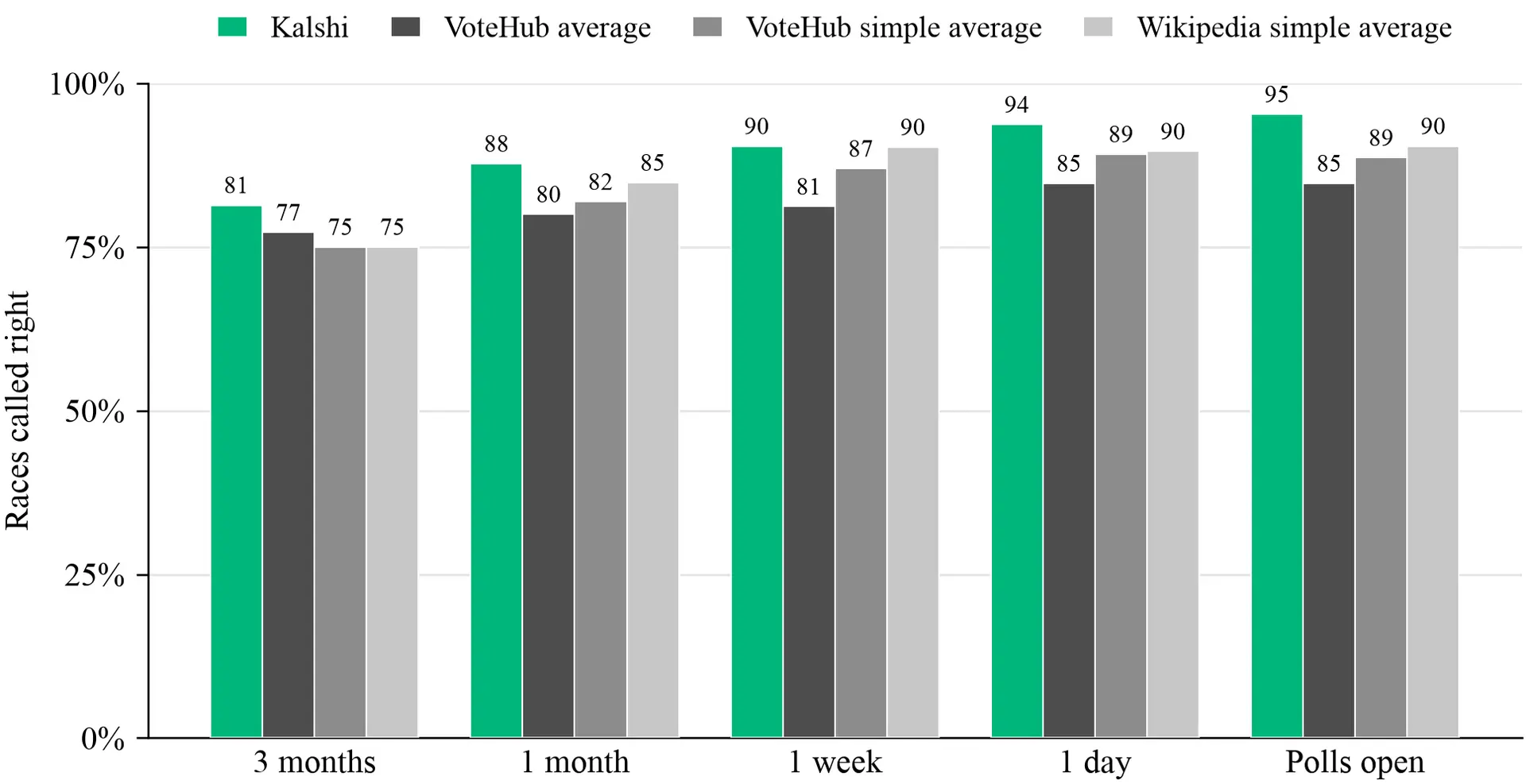
Kalshi's research team further revealed that its overall track prediction accuracy rose from 93.8% three months ago to 98.2% by the end of voting; even when compared to the average polling results from mainstream sources like VoteHub and Wikipedia, Kalshi maintained a clear leading advantage at various time points (reaching 95% at the time of voting, above the average polling range of 85%-90%).
Polymarket also disclosed data: The most popular candidates a day before the election won 419 out of 426 settled races, resulting in an accuracy rate of 98.4%, with 78 races still to be settled at that time.
Data pages showed that the direction accuracy rates for settled Senate, gubernatorial, and House races were approximately 97%, 97.1%, and 98.6%, respectively.
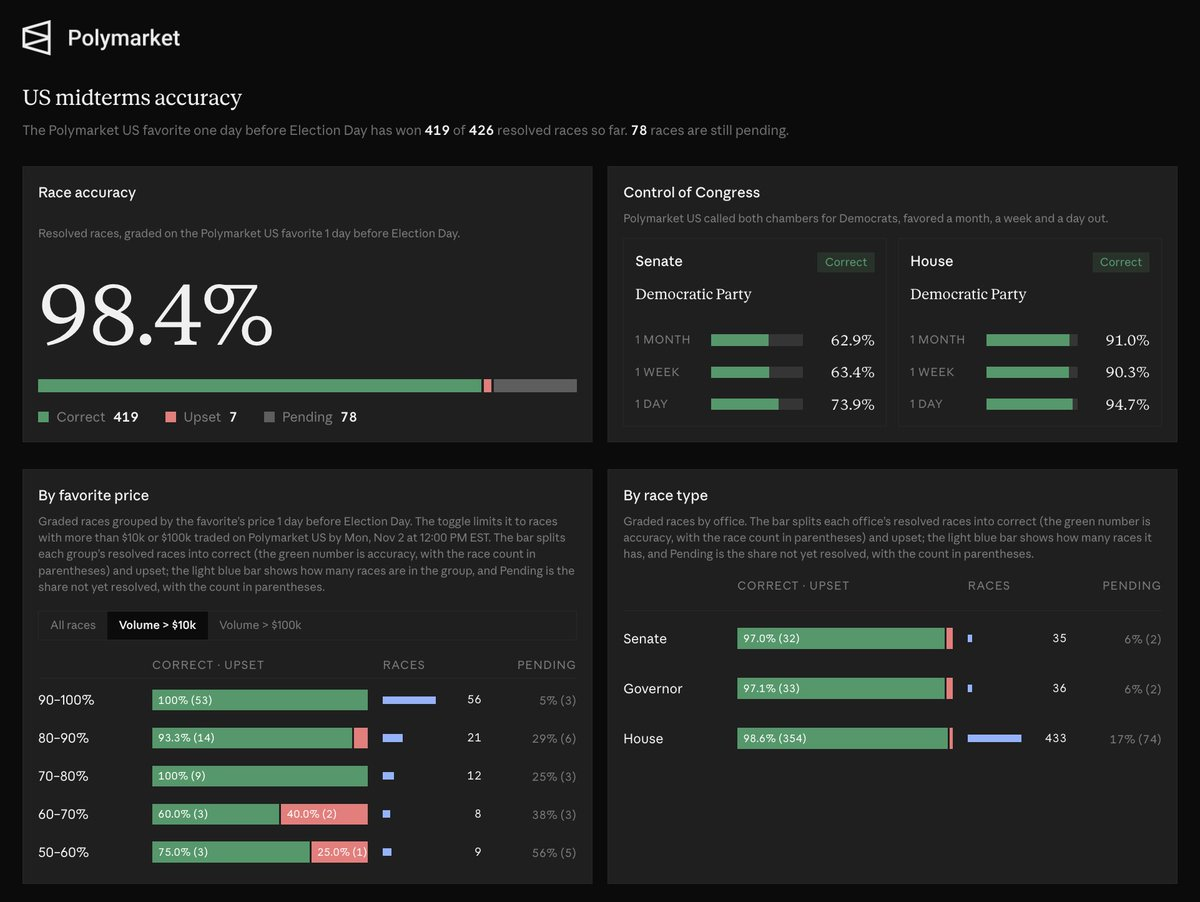
Both platforms had pegged the Democrats' chance of winning the House at around 94% and winning the Senate at about 75% before the polls closed, and both predictions were correct in direction.
However, accuracy in direction does not equal accuracy in magnitude. Third-party analysis pointed out that the implied Republican House seats in the market at the time of voting were around 192, while NBC's later seat calculation was 176. The surprising upsets mostly skewed toward the Democrats. Economist Koleman Strumpf gave a "B" when interviewed by Bloomberg, simply stating: the direction was correct, but “this was a historic blue wave,” which was difficult to read directly from market prices.
The sample itself also has some reliability concerns. Numerous non-competitive tracks raised the overall accuracy, and the truly competitive races in the 10-90% range are the hard battles. Some results from states like Alaska and Mississippi have not yet been fully settled, and direct comparisons across platforms must also consider timing and sample differences.
Faster than the news
Speed is something both platforms are eager to highlight.
Kalshi stated that in key Senate tracks, the market pushed the winning party to over 99% an average of about 115 minutes earlier than CNN made its formal announcement.
Polymarket provided specific comparisons for ten key races: The median time for it to publish a 99% judgment on X was 31 minutes earlier than CNN, Fox News, and the Associated Press, with Michigan Senate being about 4 hours ahead.
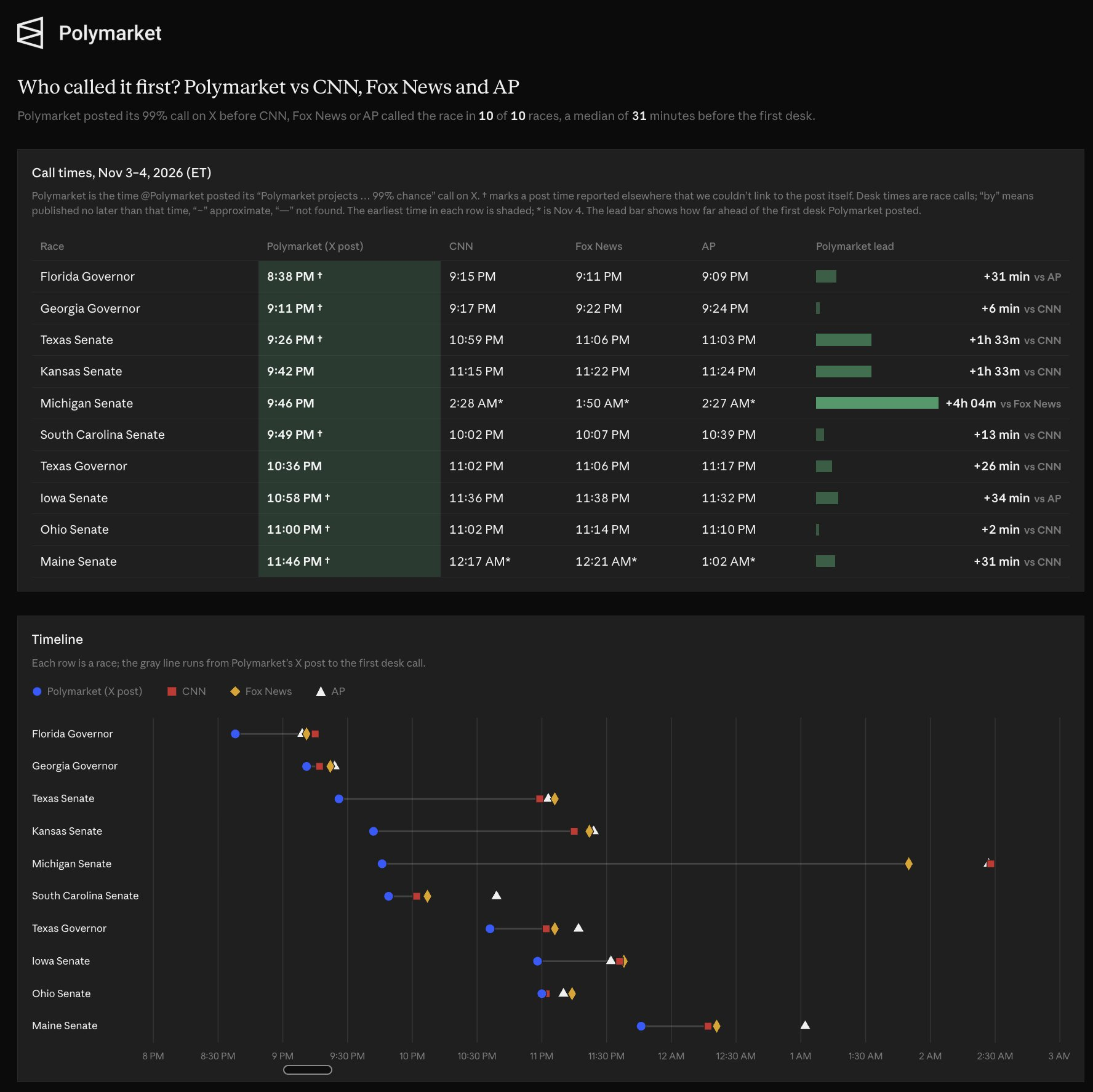
The process on election night further illustrates the point. As soon as results came in from early voting states, control contracts on both platforms began to move rapidly towards extremes, pushing the probability of the Democrats controlling both houses close to certainty by evening. This was more direct than waiting for new data from polls or rerunning weights in models.
While both are close in directional accuracy, Kalshi currently leads in trading volume, but Polymarket still holds its ground in international users and transparency on the blockchain.
After the winners
In this round of midterm elections, prediction markets proved once again that the continuous pricing mechanism incentivized by real money can aggregate dispersed information into highly forward-looking real-time signals. Mainstream media and Wall Street trading desks have begun to incorporate it into their core observation metrics, rather than seeing it merely as a speculative casino.
However, once the glow of election night fades, the pricing limits and underlying business logic of prediction markets become evident.
First, the high overall winning rate is somewhat diluted by non-competitive district samples, and the estimation error of House seats suggests that the binary options framework is highly sensitive in assessing "winning direction", but still encounters pricing friction in capturing "sweep magnitude". Second, if we step back from the pulse-like surges in daily trading volume and examine the distribution of open interest (OI) of outstanding contracts, we can better understand the true commercial fundamentals of prediction markets.
According to data from Paradigm as of November 4, after a large number of midterm election contracts were settled on November 3 and entered the delivery phase, Kalshi’s total open interest remained at a high of $2.5 billion. Among them, the political sector’s retained OI was $679.2 million (accounting for 27.1% of total OI), with funds rapidly rotating from the settled midterm elections to the upcoming “bipartisan presidential nominations” and pending gubernatorial seats; while the sector that truly supports the platform's daily locked positions is the sports events segment, which totals $1.5 billion (accounting for 59.9% of total OI).
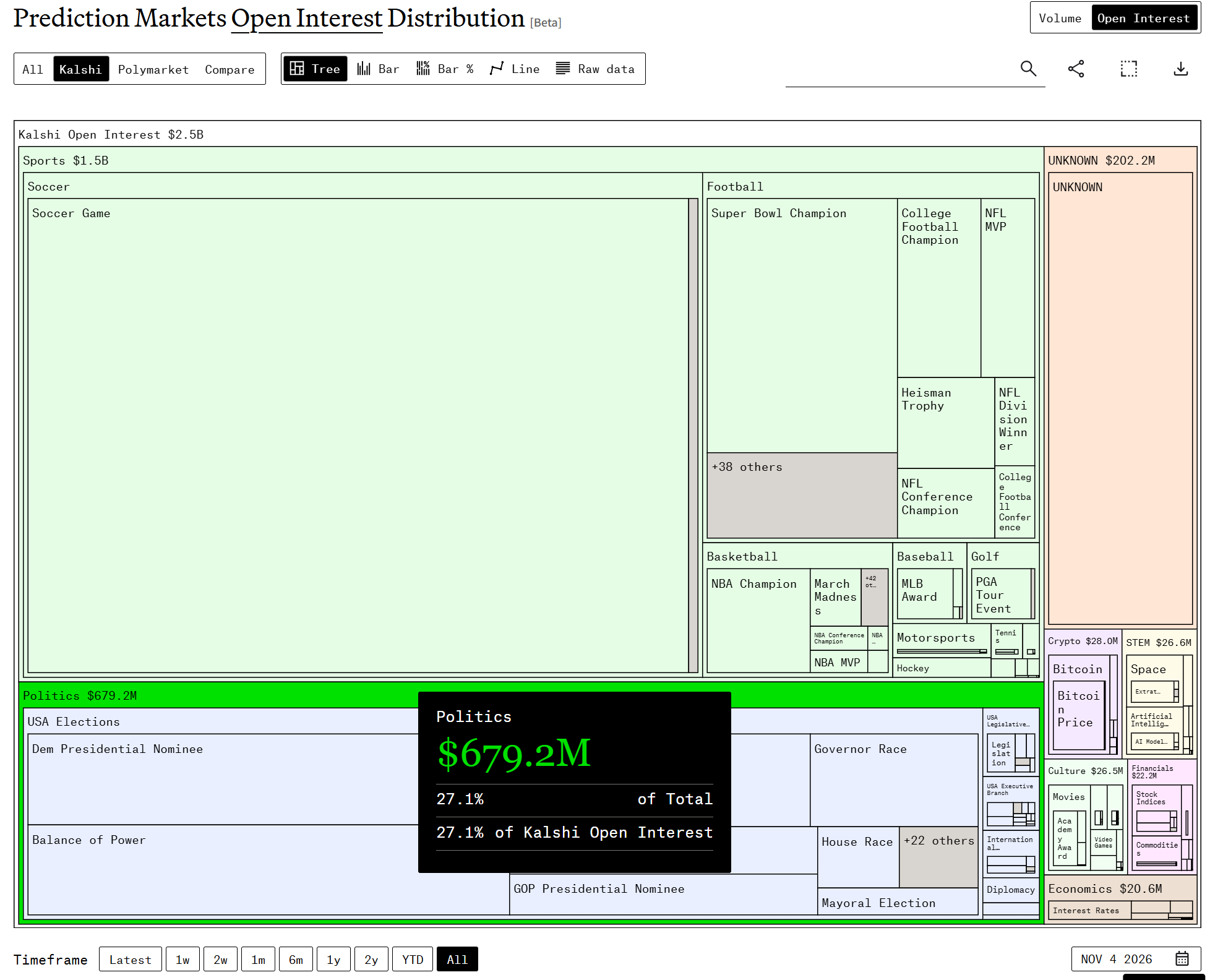
This structural insight reveals the core strategy of prediction markets breaking the cycle of election periods: treating biennial political elections as a low-cost customer acquisition funnel with significant breakthrough effects, and subsequently channeling the massive funds accumulated through high-frequency and high-turnover sports events and combination contracts (multi-condition combination prediction contracts).
As discussions on regulatory rules deepen after the U.S. midterm elections, prediction markets not only won the volume battle of the midterm elections, but are also accelerating their evolution into an alternative financial derivatives exchange that operates around the clock.
免责声明:本文章仅代表作者个人观点,不代表本平台的立场和观点。本文章仅供信息分享,不构成对任何人的任何投资建议。用户与作者之间的任何争议,与本平台无关。如网页中刊载的文章或图片涉及侵权,请提供相关的权利证明和身份证明发送邮件到[email protected],本平台相关工作人员将会进行核查。


