Author: Anthropic / Claude Official Team
Translation: Deep Tide TechFlow
Deep Tide Guide: In the process of the comprehensive advancement of AI applications into vertical scenarios, personal financial management has always been regarded as one of the most challenging areas to conquer. The high sensitivity of financial privacy, the complex cross-institution accounts, and the zero-tolerance requirement for fund security have kept traditional large models in this direction at a pure conceptual Q&A stage for a long time.
Anthropic's officially launched personal finance feature (Personal Finance in Claude) marks the first time that generative AI has entered the domain of mass personal finance in a system-level native manner. Through deep integration with Plaid, a foundational financial service provider in the United States, Claude bypassed tedious manual bookkeeping, enabling users to directly conduct unified inventory and dynamic tracking of assets scattered across different banks and institutions using everyday natural language.
More importantly, Anthropic has established an extremely restrained boundary in product architecture: insisting on pure read-only access and physical isolation, resolutely avoiding touch with transfers, payments, and investment management, and committing to never introducing any financial product commission advertisements or endorsements. This architecture not only sets a benchmark paradigm for AI financial assistants in terms of privacy and security but also explores a clear path for the future collaboration of large models with licensed professional financial institutions.
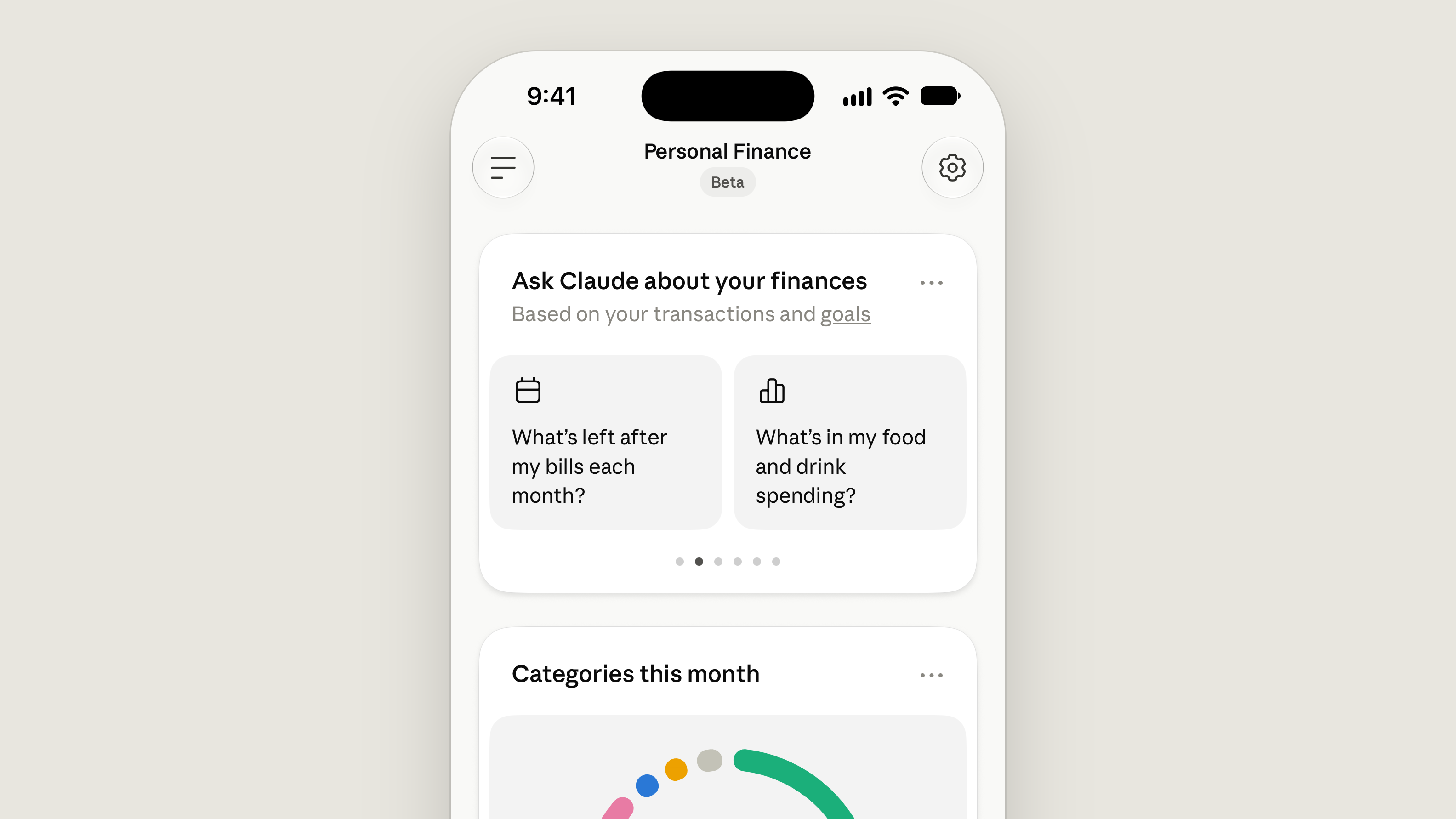
Ask Claude about your financial situation and get the most straightforward answers directly from your linked accounts.
Understanding your financial situation no longer means needing to open each mobile banking app one by one and manually calculate various accounts.
With the personal finance feature (Personal Finance in Claude) introduced by Claude, you can safely connect your bank and credit card accounts and ask any questions using your usual everyday language.
It should be emphasized that this feature's access permission is strictly in a pure read-only mode. Claude's personal finance feature absolutely cannot move, manage, or invest any of your funds.
Claude can answer your questions in plain and understandable natural language based on your account balances and transaction history, and clearly explain any financial terms you are unfamiliar with.
Like other functions of Claude, the personal finance feature does not contain any third-party commercial advertisements or sponsored recommendations. It does not promote credit cards, loan products, or high-interest savings accounts, so every question you ask about finances will only yield the purest, most objective direct answers.
Claude's personal finance feature will initially launch its beta version this week for users on the Pro, Max, and Ultra subscription plans in the United States.
Function Interface and Actual User Experience
Assuming it is now the end of the month, with exactly 10 days until the next payday.
When you ask Claude: "Where did my money go this month?" it will automatically summarize all the expenses from the accounts you have linked and accurately categorize them by spending type.
In this example, the total expenditure for the month amounts to $4309.37. More than half of the funds are allocated to rent and utility payments, with another $1024.51 spent on dining expenses.
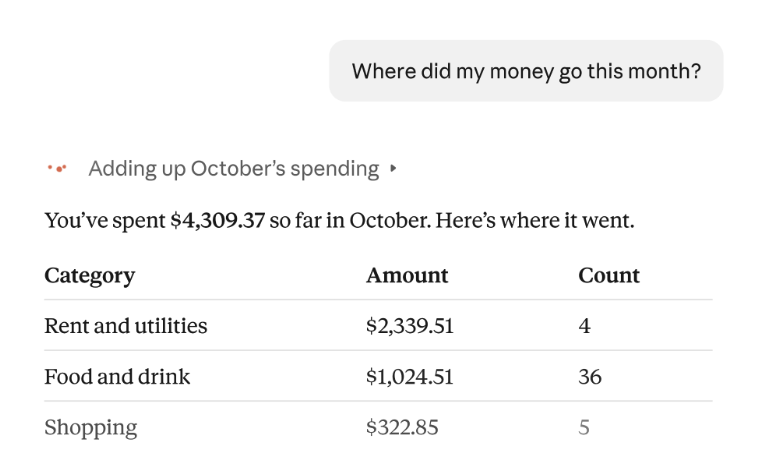
Image: Claude summarizes across accounts and displays monthly spending details by category
On this basis, you can continue to probe Claude with questions like: "Is this more than usual?", "Is there any expenditure I missed?", or "How much can I save before the next payday?"
Claude will automatically check the historical income and expenditure trends from previous months and point out a recently effective membership subscription renewal fee.
Then, Claude will clearly list the four scheduled expenses that will automatically be deducted from your checking account before payday, calculating your available funds at that time: $1393.22.
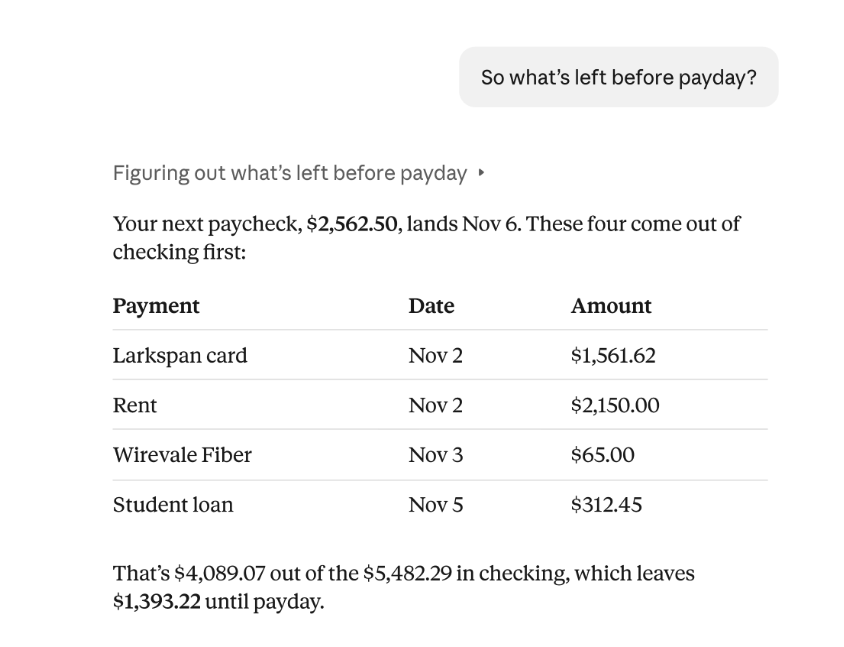
Image: Claude analyzes the upcoming deductions and available balance before payday
If you ask if there are any anomalies in the accounts, Claude will cross-compare all the linked accounts and sharply point out details that are often overlooked in daily life, such as duplicate charges, unexpected fees, or bills that have quietly increased over the year.
You can also throw more macro financial questions at it, such as: "Have my expenses exceeded my income?" or "What is the annual percentage rate (APR)? How much has it cost me this year?"
Claude will first break down this technical term in simple language and then automatically calculate the total interest you have been charged this year.
If you need weekly spending trend charts, due bill calendars, or a financial dashboard composed of indicators you select, just ask Claude, and it can quickly generate a dedicated visual interface that can be continuously fine-tuned based on your needs.
Security and Privacy Protection Mechanism
Claude's underlying access permission is strictly limited to read-only. The core positioning of the personal finance feature is to assist you in clearly understanding your own financial income and expenditure status, and its original intention is not to provide users with professional investment advice.
There may be deviations or errors in Claude's responses. Therefore, we recommend that you actively ask Claude to list the specific transaction details supporting critical data and verify important accounts with your bank.
Your financial accounts will only be formally connected when you log in to your bank institution via Plaid. Plaid is a mature fintech network that connects applications to traditional banks.
During the connection process, you will need to agree to its terms of service and grant Claude read-only access. Because of this, Claude will never request, nor can it ever access your bank password.
For the accounts you choose to connect (and only those accounts), the data Claude can access includes: bank name, account name for each account, account type and last four digits of the card number, real-time balance and credit limit, as well as historical transaction records for up to two years.
When you are conversing with Claude in the personal finance center, all dialogue content will not be used to train our underlying large language model.
As for any content you share with Claude outside of the personal finance center, it will be managed according to your general personal privacy settings.
You can unlink any account at any time and from anywhere. Once unlinked, Claude will immediately lose all access to that account's data. More specific information can be found in our privacy center.
How to Enable and Configure Usage
When you see the personal finance feature entry in Claude's sidebar, simply click to open it, connect your first financial account, and ask a simple everyday question.
For example: "Can I afford a vacation this spring?" or "How much can I save each month?"
For specific setup steps, as well as how your data is used and securely stored, you can refer to the complete guidelines in the help center.
Future Evolution Direction
The launch of the personal finance feature is just the first step.
In facing more significant critical financial decisions in life, we firmly believe that collaboration between Claude and trusted licensed professional advisors and regulated financial institutions will be able to provide the public with the highest quality professional services.
We are currently actively exploring how to realize this collaborative ecosystem within Claude. We look forward to hearing the ideas of numerous banking institutions, wealth management advisors, and financial service companies to jointly shape the future blueprint of AI finance.
免责声明:本文章仅代表作者个人观点,不代表本平台的立场和观点。本文章仅供信息分享,不构成对任何人的任何投资建议。用户与作者之间的任何争议,与本平台无关。如网页中刊载的文章或图片涉及侵权,请提供相关的权利证明和身份证明发送邮件到[email protected],本平台相关工作人员将会进行核查。


