The technology stocks in the U.S. stock market faced a fierce sell-off, and Bitcoin retraced gains made after the election.
Written by: ChandlerZ, Foresight News
The market, which had been rising due to the results of the U.S. midterm elections just a day before, suddenly encountered a sell-off.
In the early hours of November 6, U.S. chip and artificial intelligence stocks suffered a sell-off, with the U.S. stock market evaporating over $3 trillion in a single day. The Nasdaq Composite Index fell by 5.5%, the S&P 500 Index dropped by 4.4%, and the Dow Jones Index fell by 1,833 points, a decrease of 3.4%. Chip stocks were hit hard, with Nvidia down 9.3%, AMD down 17.3%, and the Philadelphia Semiconductor Index decreasing by approximately 12%.

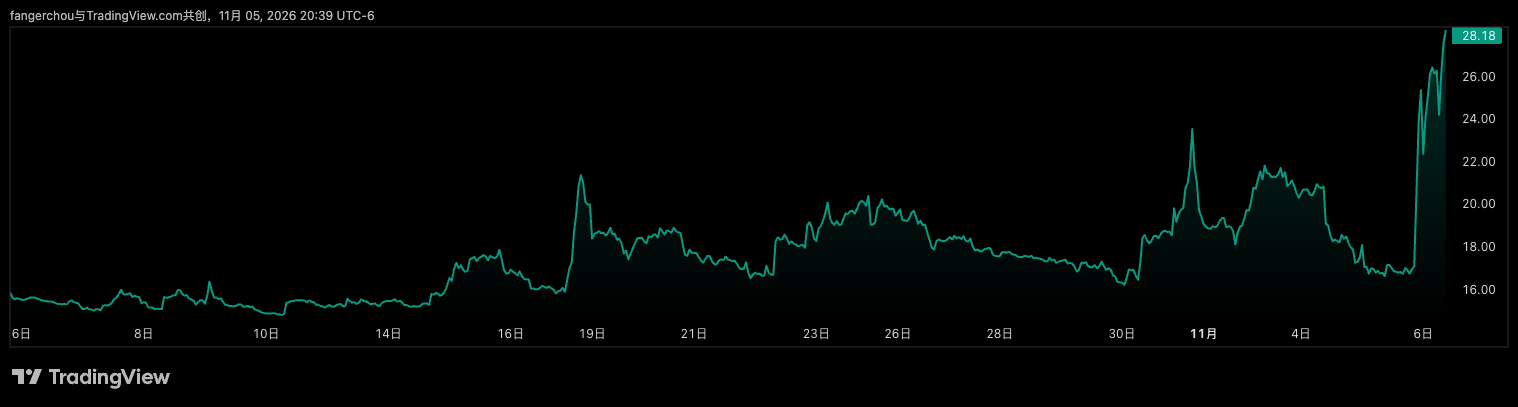
According to the Chicago Board Options Exchange, the market fear index VIX closed at 28.18, soaring 69.66% from the previous trading day's 16.61.
The sell-off quickly spread to the cryptocurrency market. Bitcoin fell below $76,000, giving back gains made after rising above $80,000. Around 11 a.m. on November 6, Bitcoin was reported at approximately $76,100, and Ethereum at around $2,241, with declines of about 5.4% and 7.6% respectively over the last 24 hours.
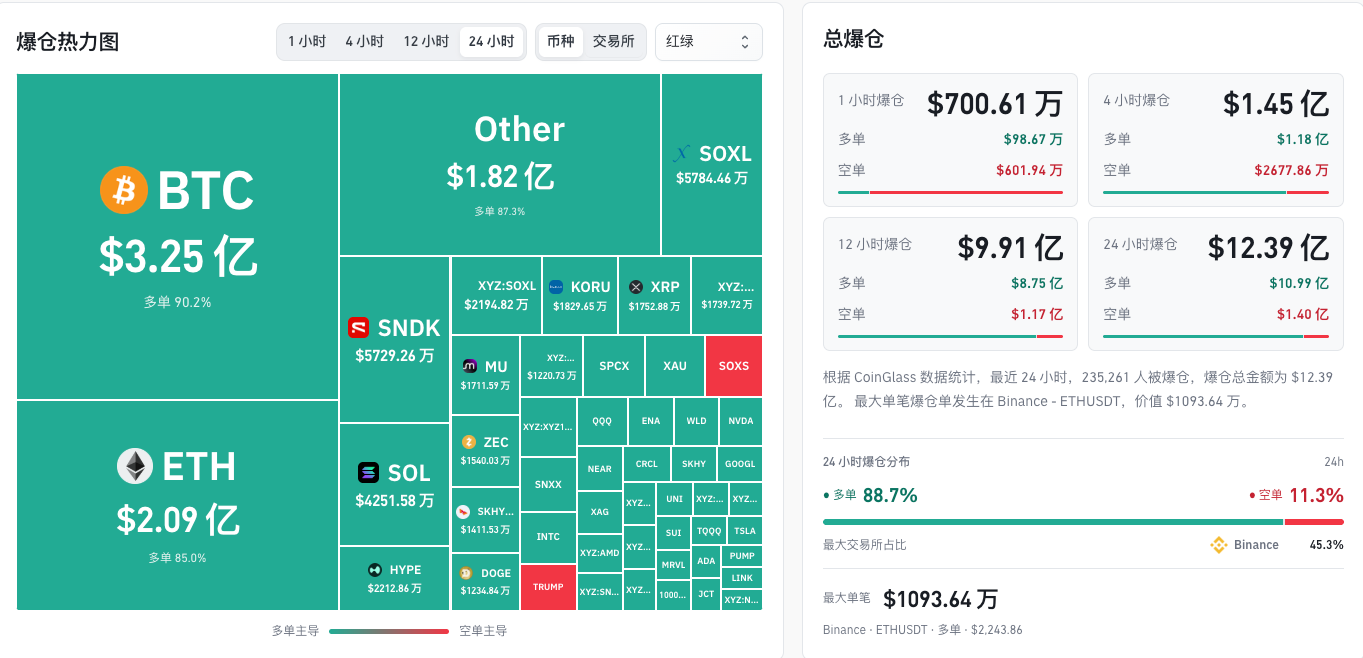
As the market declined, social media reported that several Wall Street hedge funds, such as Walleye Capital and Engineers Gate, were experiencing chain liquidations, accelerating the decline in U.S. stocks. The cryptocurrency derivatives market also saw large-scale liquidations, with approximately $1.239 billion in positions being forcibly closed in the past 24 hours.
Bitcoin Returns to $76,000, Longs Begin Liquidation
This decline came quickly. After the results of the U.S. midterm elections began to clarify on November 4, Bitcoin briefly rose above $80,000; by November 5, as U.S. tech stocks turned bearish, Bitcoin slid back toward the $76,000 range, nearly erasing the previous day's gains.
According to CoinGecko data, as of around 10 a.m. on November 6, Bitcoin was around $76,056, down approximately 5.7% over the last 24 hours, with a low of $75,230; Ethereum was around $2,239, down about 7.8% in 24 hours, with a low of about $2,209. Solana was approximately $90, down about 6.5% in 24 hours.
Leveraged longs faced concentrated forced liquidations during the decline, with CoinGlass data showing that as of press time, approximately $1.239 billion in positions were forcibly closed in the past 24 hours, including $1.099 billion in long positions and $139 million in short positions.
Why Did AI Trading After the U.S. Elections Suddenly Reverse?
The VIX, calculated by the Chicago Board Options Exchange based on S&P 500 options prices, measures market expectations for U.S. stock volatility over the next 30 days. This index soared from 16.61 to 28.18, closing at the highest level since the end of March this year, reflecting a rapid rise in investors' pricing of recent volatility.
The sell-off subsequently spread to Asian markets, and on the morning of November 6, the Korea Composite Stock Price Index at one point fell by 8.8%, triggering a trading halt; the Japan Nikkei 225 Index dropped by approximately 6.4%, with South Korean chip manufacturers Samsung Electronics and SK Hynix also suffering significant declines.
Previously, the market had begun to question whether technology companies could generate fast enough revenue and profit growth after investing hundreds of billions of dollars in building AI infrastructure. Construction of data centers is heavily reliant on external financing, and higher interest rates increase construction and debt repayment costs. Recent earnings reports and forecasts from chip companies have failed to fully dispel investor doubts, with Qualcomm's mobile chip sales data falling short of expectations, further dampening sentiment in the semiconductor sector.
After the November 3 U.S. midterm elections, the Democratic Party gained control of both houses of Congress. The election results initially brought about a rebound, but investors subsequently reassessed the prospects of building AI infrastructure, leading funds to withdraw from chip and data center-related stocks that had previously seen significant gains.
The U.S. midterm elections also added a layer of policy uncertainty to the market. After the Democratic Party secured a majority in both houses, some investors worried that data center projects could face more scrutiny related to power grids, water usage, energy prices, and environmental impacts, and local government approvals could slow down.
Additionally, Arizona Democratic Congresswoman Yasamin Ansari suddenly posted on X, advocating for placing "pausing advanced AI development, regulating out-of-control industries, and banning artificial superintelligence" at the top of the Democratic Party's agenda for the first day.

It's worth noting that the terms exceeded market expectations regarding "AI regulation." The proposed legislation calls for a comprehensive pause on all advanced AI research and development until a dedicated federal regulatory agency is officially operational, establishing clear regulations and model review mechanisms. Violating companies could face compulsory dissolution, while individuals found guilty could face up to 20 years in federal prison.
The legislation also lists "globally banning superintelligence" as a U.S. foreign policy goal, requiring export controls to block any potential development of super AI in any region.
Joshua Lim, co-head of global markets at cryptocurrency trading firm FalconX, noted that investors are beginning to reconsider the potential slowdown in data center construction. The initial post-election rebound had involved a significant degree of short covering. Carlos Guzman, vice president of research at digital asset trading firm GSR, pointed out that the market had previously been questioning the returns on massive expenditures for AI infrastructure, and the election results further increased uncertainty, with performance in chip companies adding extra pressure on stock prices.
This pressure has also affected mining companies. Some Bitcoin miners have recently expanded their AI computing businesses using power supply, land, and data center resources, with their stock prices being influenced by both Bitcoin trends and market expectations for data center revenues. CoinDesk reported that related mining stocks fell by approximately 15% to 20% during this sell-off.
Cryptocurrency-related stocks also saw significant declines. At the close on November 5, Eastern Time, Coinbase was down approximately 9.7%, closing at $136.82; Circle was down about 8.7%, closing at $69.48; and Strategy, which holds a substantial amount of Bitcoin, was down about 9.0%, closing at $129.30. During trading, all three companies experienced even larger declines.
Near $75,000, the market awaits spot buying
Bitcoin fell to about $75,300, reaching the vicinity of short-term holders' cost that institutions had previously focused on. Bitfinex estimated in a report on November 4 that the average cost for this group of holders is approximately $75,800. When the price falls below this cost, some investors who bought recently may face paper losses, and selling when the price rebounds could further increase pressure above.
At that time, Bitfinex predicted that before the futures expiration on November 6, Bitcoin might primarily fluctuate between $75,800 and $80,200; if the daily close is below the short-term holders' cost and the percentage of Bitcoin supply in profit drops below 58%, this could lead to a further decline to the $70,000 to $75,000 range.
Digital asset management firm 21Shares presented two scenarios in their report. In an optimistic case, if buying defends the $76,000 to $78,000 region, and ETF funds flow back in, Bitcoin could recover to $80,000 to $82,000 and then target around $87,000. In a pessimistic scenario, if the U.S. dollar strengthens, the credit environment continues to tighten, and ETF investors continue to sell, Bitcoin could further test around $73,000.
Whether the rebound can be sustained will also depend on whether there is funding to pick up outside the contract market. Farside Investors data shows that U.S. spot Bitcoin ETFs experienced net outflows of $399 million and $116 million on November 2 and 3, respectively, and turned into a net inflow of $74.6 million on the 4th. After the sell-off on November 5, by the morning of November 6, ETFs that had reported data saw a total net outflow of approximately $325 million.
Regarding the U.S. stock market, GSR still has concerns about the returns on AI investments and the prospects for data center construction; if technology stocks continue to be sold off, investors may continue to reduce their cryptocurrency holdings. On the other hand, Jasper De Maere, head of research at Wintermute, believes that cryptocurrency assets have demonstrated relative resilience during this round of AI stock declines, with industry adoption continuing to expand, and he remains optimistic about the mid-term outlook.
It is noteworthy that the U.S. non-farm payroll report for October will be released at 9:30 p.m. on November 6, and the October Consumer Price Index is scheduled for release on November 10. If employment and inflation data further reinforce market expectations for sustained high interest rates, both technology stock valuations and risk appetites in the cryptocurrency market may continue to feel pressure; conversely, if data eases, it could provide conditions for a rebound in risk assets.
免责声明:本文章仅代表作者个人观点,不代表本平台的立场和观点。本文章仅供信息分享,不构成对任何人的任何投资建议。用户与作者之间的任何争议,与本平台无关。如网页中刊载的文章或图片涉及侵权,请提供相关的权利证明和身份证明发送邮件到[email protected],本平台相关工作人员将会进行核查。


