Circle released its Q3 report before the market opened on November 4. Overall, this performance was mainly achieved through "better-than-expected" income from the sale of Arc tokens, but if this portion is excluded, the performance is actually average, confirming concerns about funding before the financial report.
Specifically:
1. Reserve interest income declined as expected
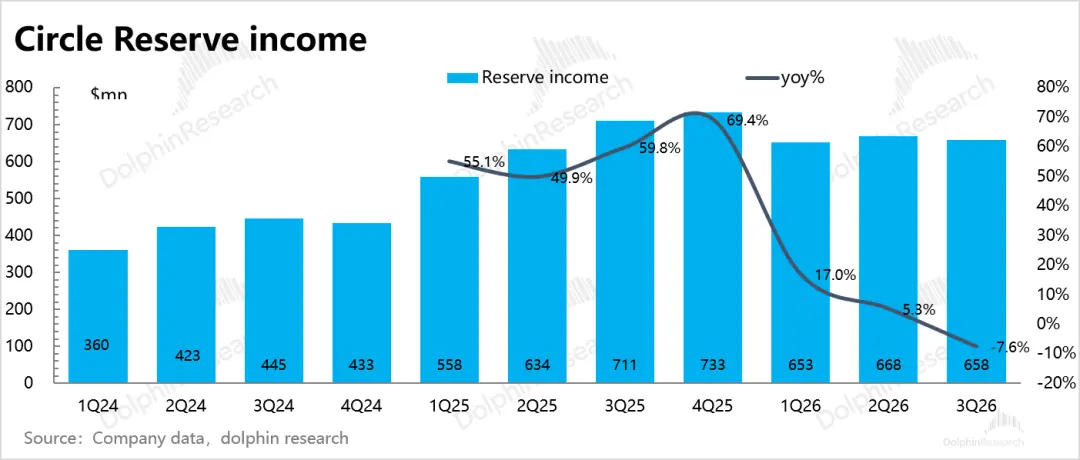
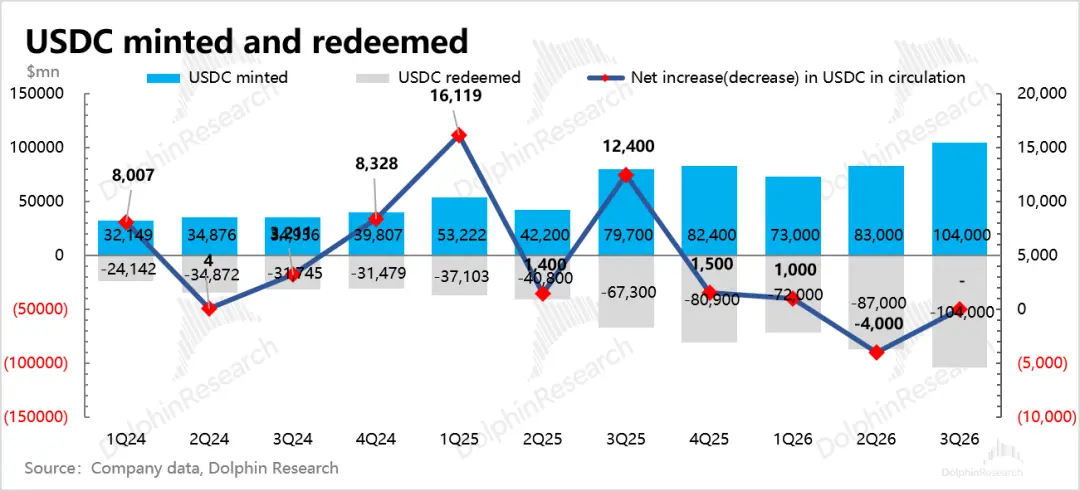
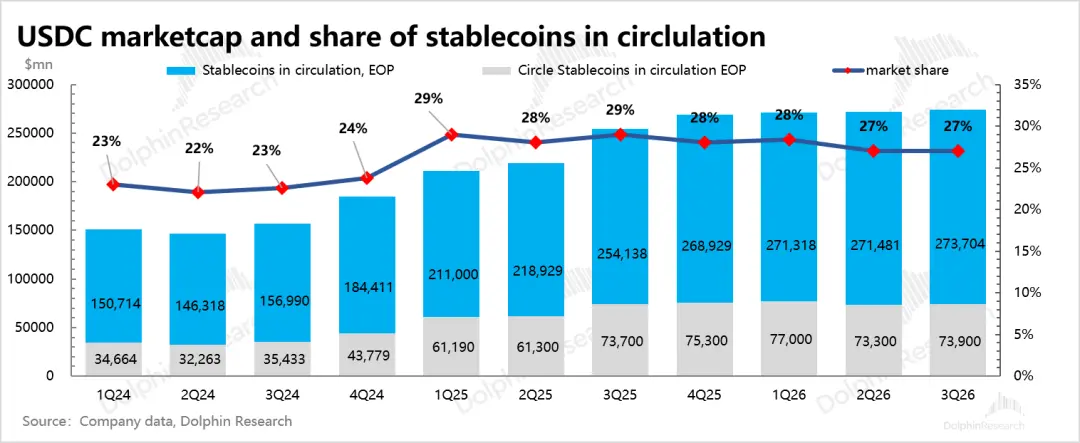
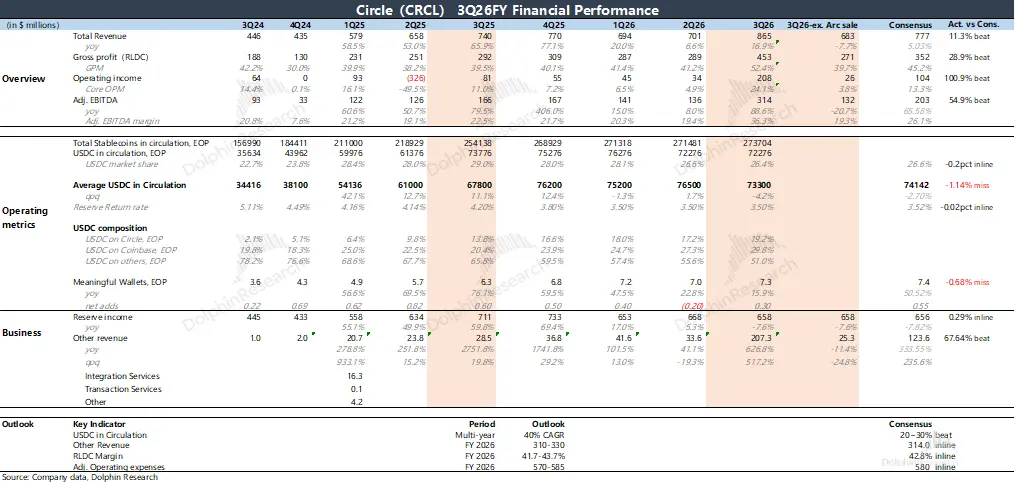
Q3 reserve interest income was 660 million, in line with expectations. In the context of an 8% year-on-year increase in USDC market value, it dropped by 8% due to a decline in interest rates, with USDC's average circulation scale in Q3 being 73.3 billion, a decrease of 4% compared to Q2.
2. The confirmation pace of Arc token sales was faster than expected
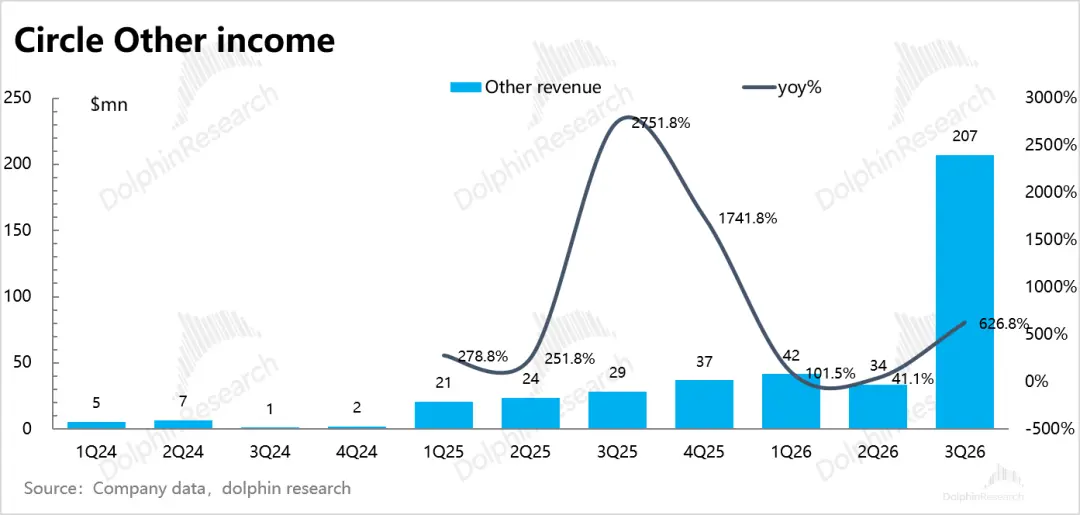
Other income in Q3 exceeded 200 million, of which income from Arc token sales was confirmed at 180 million, surpassing market expectations (which estimated 90 million) and the original annual guidance of 180 million.
However, this income is not stable or sustainable; it is more of a one-time income source. From the unchanged annual guidance for other income of 310-330 million, it is expected that there will be no such income in Q4. This year's two rounds of pre-sales totaled 224 million, and after confirming 180 million in Q3, only 40 million will be confirmed next year.
This Arc token pre-sale attracted numerous institutional funds. However, fundamentally, this is a "equity subscription" for future earnings of the Arc public chain asset, but Circle recorded it first as advance payment, and then confirmed it as revenue according to the development process of Arc chain products.
The equity subscription amount equals income, which is inherently strange and cannot provide a reliable outlook. Unless there are continuous token "financing", it is essentially a one-time income, lacking the characteristics of stable and sustainable business.
True sustainable income will have to wait until 2027, coming from trading fees, staking income, and CPN payment network fees from Arc. The ARC pre-sale merely realized part of the future value in advance.
3. Major channels 'rebel', increasing pressure on interest-sharing
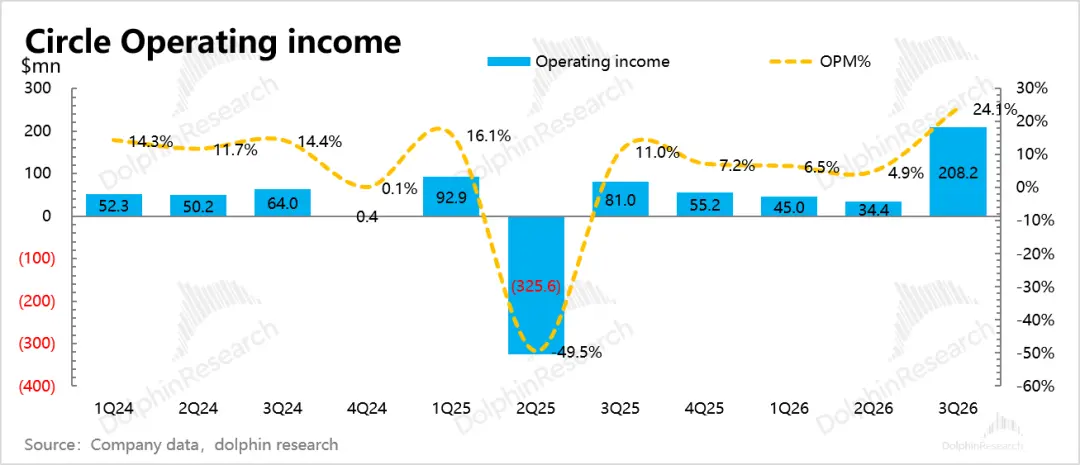
Because the cost of Arc token sales is basically zero, the 180 million effectively represents pure profit, leading to an "inflated" profit for Q3. When refined, the real profit trend is downward—due to decreasing income and relatively rigid expenses, the GAAP operating profit margin dropped by 1 percentage point from Q2 to 3.9%.
However, Q3 performance also reflected an optimization trend on the expense side due to layoffs. Close to half of Circle's expenses are personnel salaries; thus, the adjusted operating expenses (excluding layoff compensation costs) decreased by 5% month-on-month, reflecting a 5% reduction in staff during the quarter.
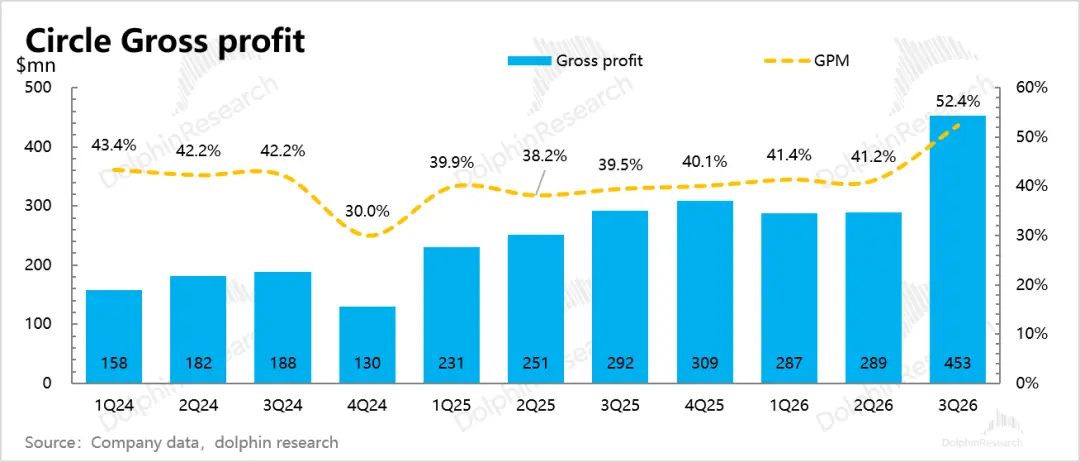
It is worth mentioning that from Q3, the profit side will gradually reflect the impact of Hyperliquid's interest distribution. Preliminary estimates suggest that for Circle, there is nearly 100 million less in gross profit directly each year, and starting from Q4, the pressure of income fluctuation due to channel resistance will become evident:
Hyperliquid is the largest on-chain perpetual contract trading platform, which has its own public chain. Users must deposit USDC as collateral for trading, so there is a large amount of USDC accumulated on the platform, approximately 6 billion USD. For Circle, this is one of the few large pools of USDC outside of exchanges.
Since September, amidst different stakeholders pulling over the CLARITY Act, Hyperliquid required Circle to return the reserve interest corresponding to USDC. However, this is complicated by an agreed profit-sharing agreement between Circle and Coinbase—where Coinbase retains 100% of the interest on USDC held within its platform, and for the interest on USDC outside of Coinbase’s custody, Coinbase takes 50%.
Therefore, to meet Hyperliquid's interest return requirements, it must go through Coinbase's channel. The results of this move are:
(1) Hyperliquid recovers most of the interest (estimated at 90%);
(2) Coinbase and Circle both receive 50% less in profit sharing, with this additional 90% of on-platform USDC custody scale (AUC) going to Coinbase, leaving Circle with 10%;
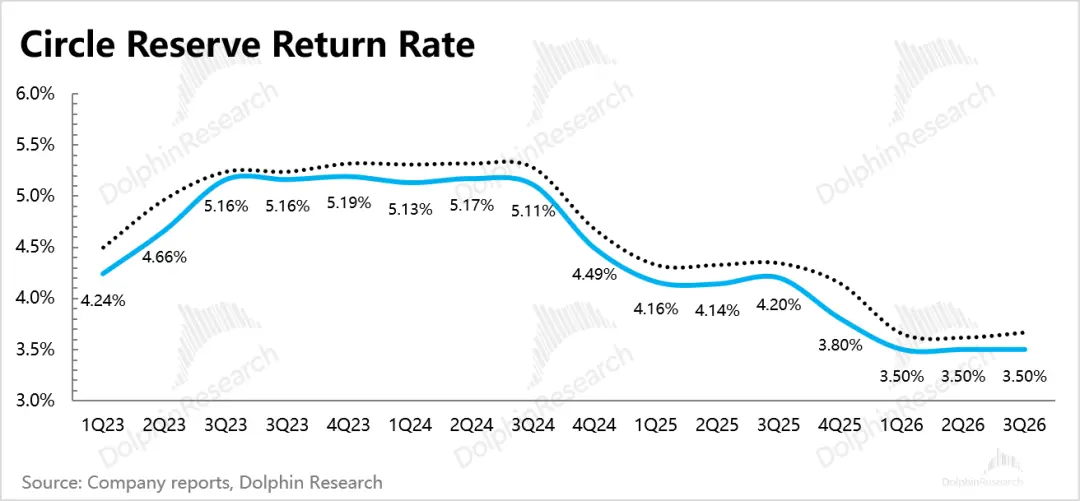
Currently, the total amount of USDC in the Hyperliquid ecosystem is 6.3 billion USD, at a 3.5% rate, leading to an annual reserve interest income of 228 million, from which Hyperliquid will take 90%, amounting to 200 million. The remainder of less than 30 million in interest will be split between Coinbase and Circle.
This means that the originally confirmable 228 million in interest income and 100 million in gross profit (excluding issuance costs and the previously scheduled 50% profit share with Coinbase) ultimately results in only 10 million of gross profit.
Q3 gross margin was 52.4%; upon removing the pure profit of 180 million from Arc token sales, the gross margin is 39.5%, showing some impact from Q2.
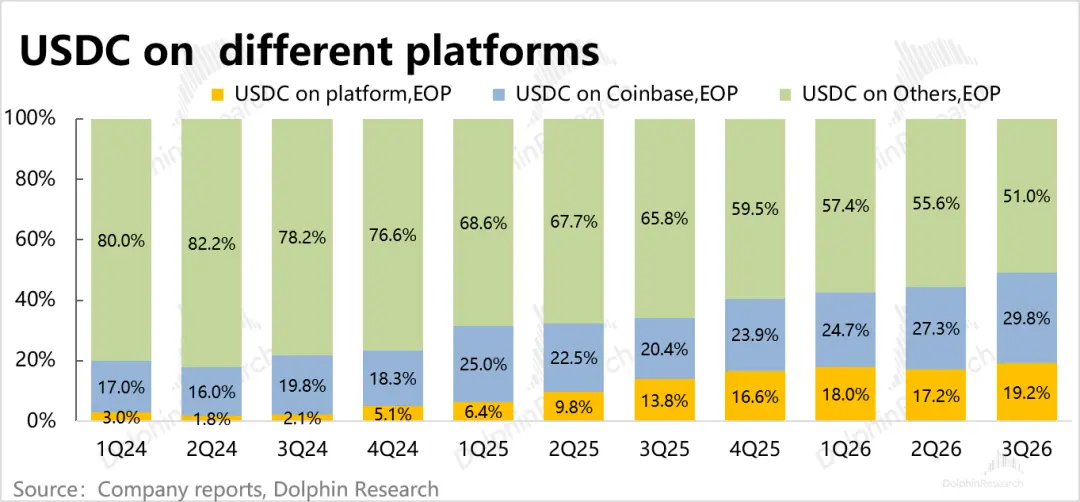
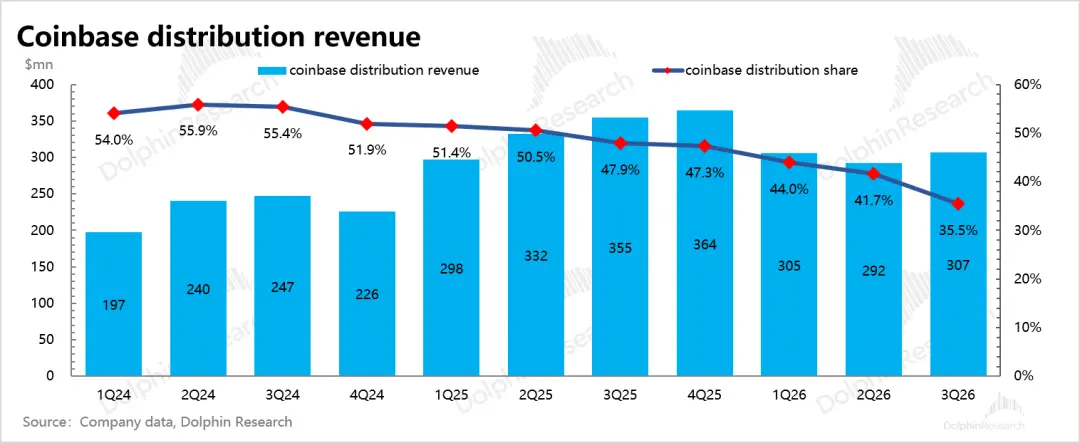
USDC's share in Coinbase has rapidly increased to 30%, yet its share of revenue in Circle's profit-sharing costs has quickly decreased to 35%, further confirming the impact of Hyperliquid's "rebellion".
4. Key indicators overview
Dolphin's Viewpoint
The Q3 performance merely reflects the "inflation" brought by differences in confirmation pace, thus it did not yield any real surprises.
The guidance remains unchanged for both income and profits. The RLDC profit margin (revenue minus distribution costs, similar to gross margin) is expected to maintain around 42% for the whole year, suggesting a gross margin drop to about over 30% in Q4, indicating further deepening of the impact brought by Hyperliquid.
However, the Hyperliquid incident was disclosed in September and its impact is quantifiable, so the market should be largely priced in. But the risk point lies in whether a second Hyperliquid will emerge in the future?
Additionally, competition among stablecoins is also intensifying. The advantages of USDC mainly lie in its collateralization with US treasury bonds and high compliance, simultaneously binding it closely to Coinbase, a major centralized digital currency exchange in the U.S. with a tougher regulatory relationship.
However, the power play among financial institutions is also changing. As USDC has strengthened its relationship with Binance—after Binance invested 100 million USD in Circle's equity, expanding and renewing their strategic partnership.
Although the cooperation with Binance primarily targets emerging markets, it inevitably tinges their relationship with Coinbase. Additionally, the Open USD alliance coin, launched by Coinbase and several traditional financial payment chain players, went live on September 30.
Nonetheless, Dolphin believes that aside from USDT, USDC still holds a significant advantage over alliance coins, which may fail to form an effective coalition due to the multitude of stakeholders involved. In comparison, other financial institutions’ constraints on Circle are more likely to be risks and impacts stemming from interest return requests by major channel stakeholders akin to Hyperliquid.
Therefore, although the management remains optimistic about the long-term guidance on the expansion of USDC circulation (with a CAGR growth rate of 40%), the short-term and even mid-term perspectives will heavily rely on the boom of the Crypto market (which is the main scenario for USDC) and USDC's ability to break through competition.
免责声明:本文章仅代表作者个人观点,不代表本平台的立场和观点。本文章仅供信息分享,不构成对任何人的任何投资建议。用户与作者之间的任何争议,与本平台无关。如网页中刊载的文章或图片涉及侵权,请提供相关的权利证明和身份证明发送邮件到[email protected],本平台相关工作人员将会进行核查。


