
Author: Jae, PANews
On November 3, the U.S. midterm elections were in full swing, and the regulatory battlefield of the CFTC also ignited with "conflict".
In the morning, the Commodity Futures Trading Commission (CFTC) approved the entry of U.S. stock perpetual futures into the regulated market in the United States, marking the first time that U.S. stock perpetual contracts received explicit approval from U.S. regulators. In the afternoon, the opposing voices rang out. The Capital Markets Alliance (CMA), supported by traditional institutions such as the Chicago Board Options Exchange (Cboe) and Citadel Securities, submitted a lawsuit to the Southern District Court of New York, seeking to overturn the CFTC's product approval.
The simultaneous opening and counterattack on the same day was no mere market incident. Previously, four crypto firms—Kalshi, Coinbase, Bitnomial (a Kraken subsidiary), and OG.com (under Crypto.com)—had their U.S. stock perpetual futures products in the works. A confrontation between old and new powers was unfolding over U.S. stock perpetual contracts.
CFTC Opens the Gate, Four Crypto Exchanges Rush to the Finish Line
Perpetual contracts have long been the most mainstream trading tool in the crypto market. They have no fixed expiration date, relying on a funding rate mechanism to anchor contract prices to spot prices. Traders can magnify their risk exposure through margin without holding shares, at the cost of lacking shareholder status and voting rights.
Now, this trading mechanism is being transplanted to the U.S. stock market. The CFTC's shift did not happen abruptly. On May 29, the CFTC first approved Kalshi's Bitcoin perpetual futures, BTCPERP, setting a precedent. Subsequently, the regulator issued a policy statement on perpetual contract listings, stating that different underlying assets, such as stocks and precious metals, needed to undergo "case-by-case review".
After that, institutional product applications quickly spread to U.S. stocks and ETFs: on September 18, Kalshi, Bitnomial, and Coinbase Derivatives submitted applications on the same day; on September 24, OG.com followed suit.
The first batch of underlying assets from the four crypto trading platforms is highly consistent, almost entirely anchored to large-cap tech stocks like Nvidia, Apple, Tesla, Microsoft, and mainstream index ETFs like SPY and QQQ. The assets with the best liquidity and highest recognition among retail investors are always the first stop for new categories.
From the trading mechanism perspective, these U.S. stock perpetual plans will trade continuously from Sunday evening to Friday evening, covering most of the time outside regular U.S. stock trading hours, but not the 24/7 availability of the crypto market. For ordinary investors, the most intuitive change is: in the future, they won't have to rely on traditional U.S. stock options to directly trade the price volatility of large tech stocks; shorting and hedging will also be more flexible.
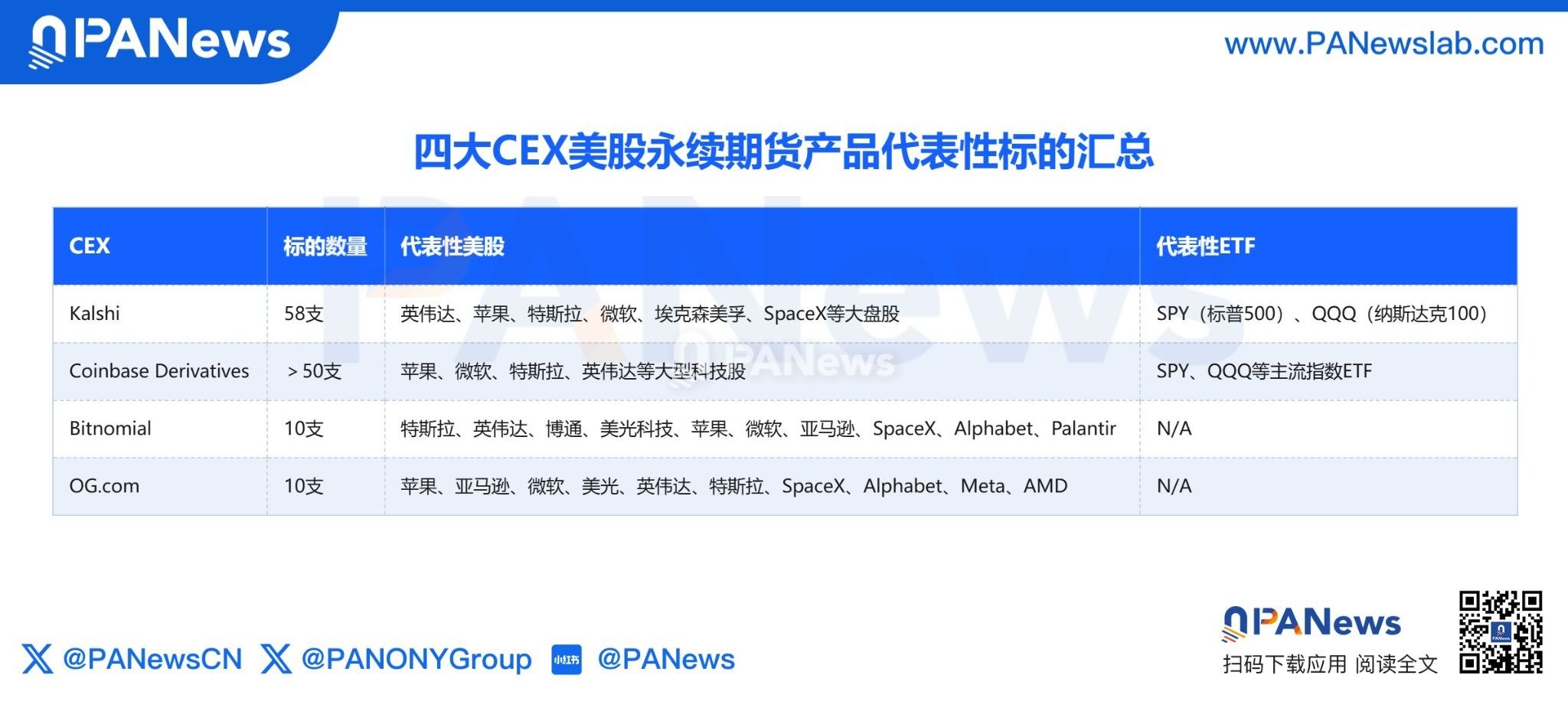
It is worth noting that the CFTC's approval is more based on the mechanism of "deemed approved after the review period expires", rather than issuing formal approvals or licenses to the four entities one by one. The initial 45-day review period for the first three has already expired on November 2, while OG.com will have to wait until November 8.
However, this admission does not mean that U.S. stock perpetual products are out of the surveillance of the Securities and Exchange Commission (SEC). According to the Commodity Futures Modernization Act of 2000, security futures fall under the joint regulatory scope of the CFTC and SEC. In addition to obtaining the designated contract market (DCM) qualification from the CFTC, platforms also need to complete registration with the SEC according to securities and futures trading venue rules.
Wall Street Financial Giants Sue CFTC; U.S. Stock Perpetual Faces Definition Dispute
The green light is on, but there are dissenters. On the afternoon that the CFTC approved the U.S. stock perpetual products, the CMA, supported by Wall Street giants, filed a lawsuit in the Southern District Court of New York, seeking to overturn the relevant approval.
The core of the CMA's lawsuit is a definitional issue: are U.S. stock perpetuals considered security futures or security-based swaps?
The CFTC classifies U.S. stock perpetuals as security futures, thus applying the shared regulatory framework of the CFTC and SEC. The CMA argues that the lack of a fixed expiration date and reliance on periodic funding payments to maintain price anchoring makes U.S. stock perpetuals essentially closer to security-based swap products.
In the U.S. regulatory system, securities-based swaps are subject to stricter restrictions, and there are special legal barriers to selling them to ordinary retail investors. If the court supports classifying U.S. stock perpetuals as securities-based swaps, the existing product access path will face fundamental challenges.
Behind the legal dispute are tangible business interests at stake. The reason why Cboe and Citadel Securities joined forces to counterattack is fundamentally to prevent U.S. stock perpetuals from disrupting their business moat.
For Cboe, the options business is undoubtedly a cash cow. In the third quarter of this year, its options business net revenue approached $470 million, a year-on-year increase of 23%, and its trading platforms accounted for 30.5% of the total trading volume in the U.S. options market. Besides trading fees, market data, access services, and clearing support are also its sources of income.
However, U.S. stock perpetuals demonstrate a high degree of substitution for options. For example, if an investor wants to leverage a long position in Tesla, previously they would need to buy call options while considering the expiration date, implied volatility, and strike price choices; in the future, they can simply obtain price exposure through U.S. stock perpetuals without managing rollovers or expirations.
For users who prefer short-term trading or leveraged bets, there is an overlap in demand between the two. Once U.S. stock perpetuals gain traction, the first to be siphoned off will be the retail trading volume in the options market.
For Citadel Securities, the impact will be on the core of market making. It holds about 30% of the market making share in the U.S. options market and accounts for 35% of U.S. retail trading volume, with its business model built on the order flow from traditional brokers and a mature pricing and hedging system.
If more and more retail traders move to crypto trading platforms for U.S. stock perpetuals, the order flow will bypass traditional trading channels, weakening Citadel Securities' market-making income and pricing power. Especially during after-hours and weekend periods, perpetual platforms can independently form quotes and transactions, equivalent to creating a second pricing market in traditional market gaps.
Deeper anxiety lies in regulatory asymmetry. Traditional stocks and options exchanges operate under strict SEC oversight, bearing high compliance costs. If centralized exchanges (CEX) can launch similarly functioning products merely through CFTC's DCM qualification and SEC registration, it would mean entering the same market with lower compliance costs. Cboe explicitly stated in its comments to the SEC: misclassification of products could leave room for "regulatory arbitrage" for new entrants.
In other words, the giants are not opposing U.S. stock perpetual products themselves.
Cboe CEO Craig Donohue emphasized: if it were just a business issue, Cboe could fully launch similar products on its CFTC-regulated trading and clearing platform. Cboe already has complete futures trading and clearing infrastructure, and its Cboe Clear U.S. possesses DCO qualifications, having also obtained temporary SEC registration for securities clearing this October. It's not that they can't enter the market; they simply don't want to compete under unfair rules.
Thus, this lawsuit is more like a defensive counterattack: if successful, it would cancel the existing approvals, forcing regulators to raise the threshold; if unsuccessful, it can use judicial procedures to prolong the implementation cycle, providing a layout window for the giants. For traditional institutions, rather than stifling new categories, promoting regulatory alignment of rules to compete on the same starting line with the runners is a better solution.
Perpetual contracts have introduced new trading mechanisms, and the crypto market has proven the demand for trading perpetual contracts among users, but whether U.S. stock perpetuals can establish a foothold in the market still depends on liquidity, trading costs, investor protection, and clear, stable regulatory rules. Whether product advantages can translate into competitiveness in the U.S. derivatives market remains to be seen.
The CFTC has opened the door to the U.S. stock perpetual market, but obtaining trading qualifications and truly winning the market have always been two different things.
免责声明:本文章仅代表作者个人观点,不代表本平台的立场和观点。本文章仅供信息分享,不构成对任何人的任何投资建议。用户与作者之间的任何争议,与本平台无关。如网页中刊载的文章或图片涉及侵权,请提供相关的权利证明和身份证明发送邮件到[email protected],本平台相关工作人员将会进行核查。


