
This quarter, each 1 dollar USDC was transferred approximately 190 times on average, nearly twice a day. The on-chain transaction volume of 13.9 trillion dollars increased by 49% compared to the same period last year, with nearly 80% of the entire market's stablecoin trading volume being USDC.
These transfers generated zero revenue for the issuer, Circle. Circle earns money from existing funds: whatever amount of USDC users hold, they exchange that amount of dollars for short-term U.S. Treasury bonds, keeping the interest for themselves. Whether a USDC is transferred twice a day or just lies in a wallet for an entire quarter, Circle earns the same interest.
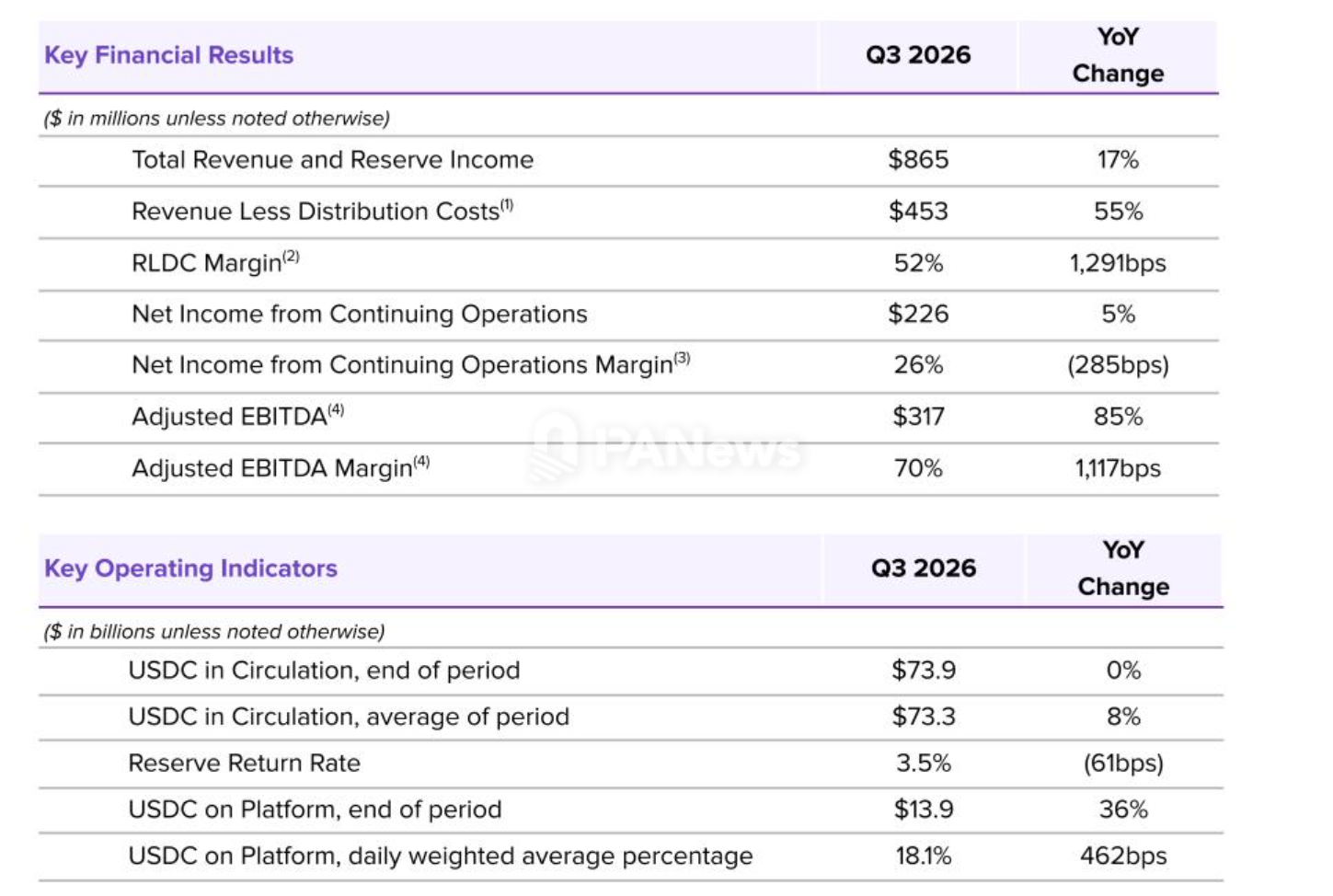
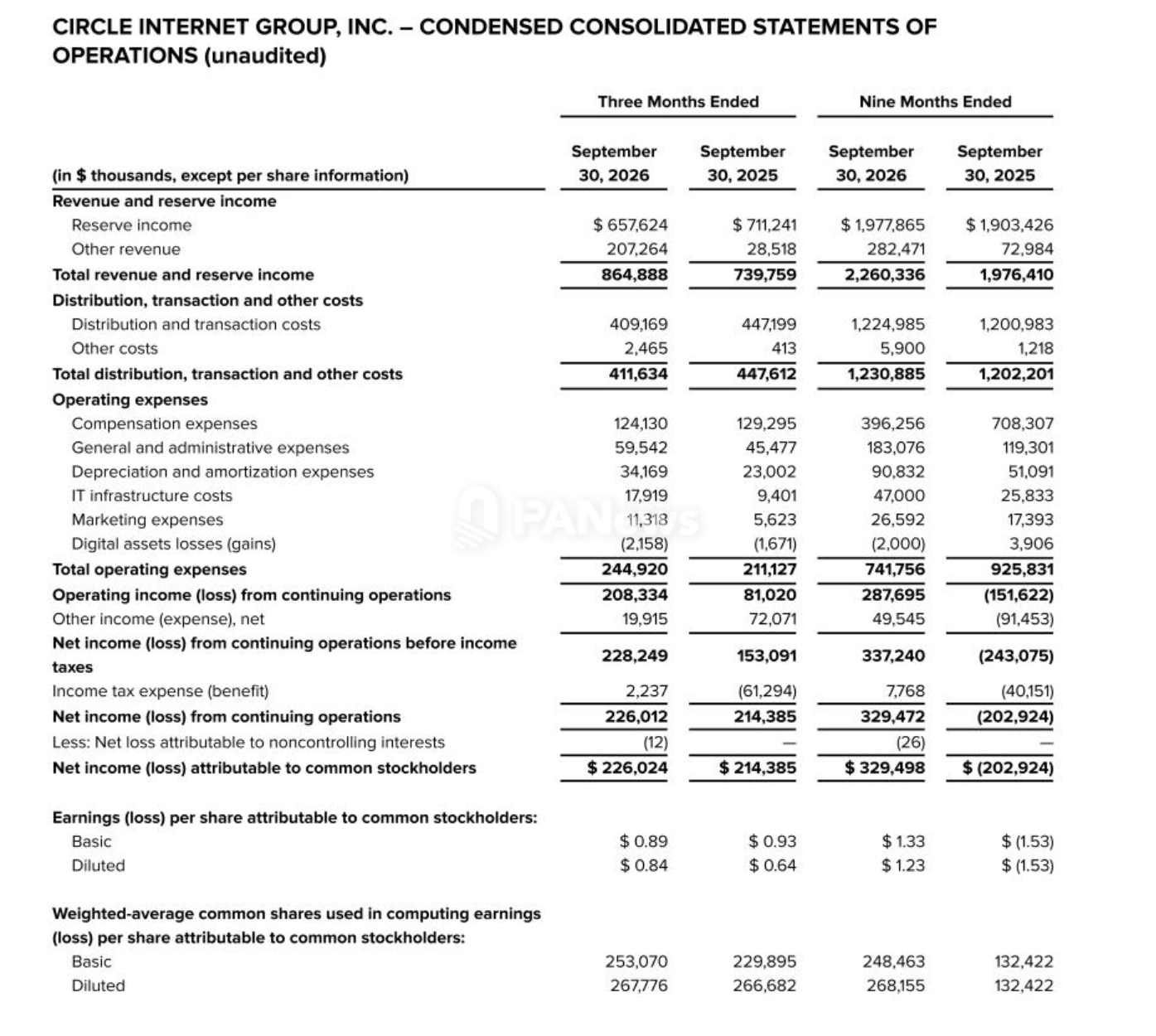
On November 4, before the U.S. stock market opened, Circle (CRCL) released its third-quarter financial report, reporting total revenue of 865 million dollars, a year-on-year increase of 16.9%, exceeding market expectations of approximately 778 million to 802 million dollars. Of this figure, 182 million dollars came from the presale revenue of Circle's own ARC tokens. Subtracting this amount, the revenue was approximately 683 million dollars, a year-on-year decrease of about 8%.
182 Million Dollars from Token Sales Exceeds Expectation
The ARC revenue is recorded in the "Other Income" category, increasing this category from last year's over 20 million dollars to 207 million dollars. Selling tokens has almost no costs and does not require sharing with exchanges and wallets; the revenue amount essentially translates to profit. Therefore, it only accounted for 20% of revenue but made up 57% of the adjusted EBITDA of 317 million dollars. According to Cointelegraph, after excluding ARC, the adjusted EBITDA was approximately 135 million dollars, down 21% year-on-year, also lower than the 143 million dollars in the second quarter.
The profit margin on RLDC (revenue after deducting channel sharing) that Circle values most was similarly boosted by this amount: the reported figure was 52.4%, but adjusted it was 39.7%, roughly the same as the same period last year, but 1.5 percentage points lower than the second quarter.
Management clearly did not view this amount as a norm. The guidance for the entire year remained unchanged, with other income projected at 310 million to 330 million dollars, already including ARC. In the third quarter, this amount alone reached 207 million dollars, leaving only 103 million to 123 million dollars for the other three quarters of the year.
The market reacted quickly. After the financial report was released, Circle's stock briefly surged to 78.02 dollars before retreating, opening at 74.04 dollars, below the previous day's closing price of 75.22 dollars, about 47% lower than the 52-week high of 140 dollars.
A company that relies on interest income propped up its finances in a quarter where interest income was declining by selling tokens. To understand its core business, one must look beyond the 182 million dollars.
Interest Business Squeezed from Both Ends
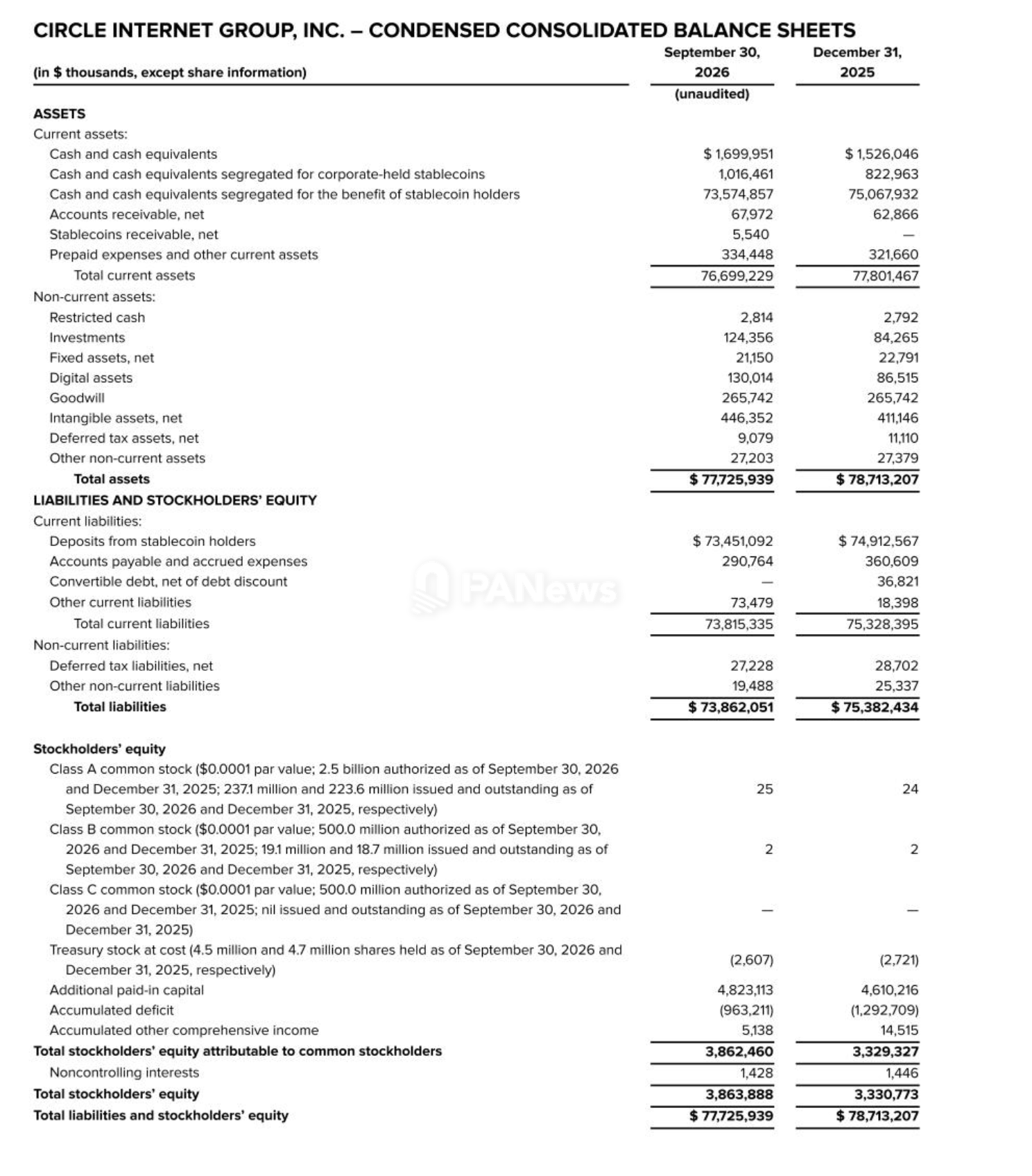
Once this amount is removed, the main source of revenue is almost entirely reserve interest. In the third quarter, reserve income was 658 million dollars, down 8% from the same period last year.
Breaking it down, balances and interest rates are pulling in opposite directions. The average circulation was 73.3 billion dollars, an increase of 8% year-on-year, bringing in approximately 57 million dollars more in income; however, the reserve return rate was 3.54%, down 0.61 percentage points year-on-year, resulting in a decrease of about 110 million dollars. The increase in balance does not compensate for the drop in interest rate.
Compared to the second quarter, the situation reversed. In September, the Federal Reserve raised interest rates by 25 basis points, leading to a 6 basis points increase in reserve return rates; yet, the average circulation fell from about 76.3 billion dollars to 73.3 billion dollars, and reserve income was still 10 million dollars less than in the second quarter. CEO Jeremy Allaire also acknowledged during the conference call that balances had remained relatively stable. According to Circle's metrics, USDC's market share among dollar stablecoins is 27%, down by 1.83 percentage points over the year.
Interest rates are a variable that Circle cannot control. On a balance of over 70 billion dollars, every basis point change in return rates results in approximately 7 million dollars of interest inflow or outflow annually.
On the other end is the channel. Most USDC users are not held by Circle but by exchanges, wallets, and on-chain platforms, requiring a significant portion of interest to be shared. In the third quarter, Circle's net reserve profit margin (the share of reserve interest remaining after sharing with channels) was 37.8%, down 0.8 percentage points quarter-on-quarter. The company explained that this was related to the revenue-sharing arrangements with Hyperliquid entering its first full quarter. Dolphin Research estimates that this arrangement alone costs Circle nearly 100 million dollars in gross profit annually.
On the Binance side, there’s also a long-term agreement. The two parties signed a five-year agreement, with Binance investing 100 million dollars in Circle, which issued approximately 1.237 million Class A shares at 80.84 dollars per share in September. CFO Jeremy Fox-Geen stated that the fourth quarter will be the first full quarter after the renewal of the contract.
Dolphin Research assesses that the coalition of stablecoin stakeholders led by U.S. financial institutions has too many interests and is hard to unify, posing limited threats to USDC; the real challenge comes from channels like Hyperliquid, which hold a significant number of users and demand interest return. This aligns with Circle's situation: its moat is its distribution network, which itself incurs costs. In quarters when interest rates decline, the total interest shrinks while the channel’s share increases, and operating expenses rose 16%, leaving profits after excluding ARC to decline.
Usage Does Not Convert to Income, Circle is Building Toll Booths
Returning to the earlier figures, the usage of USDC continues to grow: the transaction volume of 13.9 trillion dollars represents a year-on-year increase of 49% (slightly down from 14.8 trillion in the second quarter); the turnover data indicates USDC’s transactions are about 10 times that of the second largest stablecoin; its market share of the total stablecoin transaction volume has increased from 66% to 79%. Minting and redemption amounts to approximately 104 billion dollars each, totaling 208 billion dollars, a record; and there are 7.3 million wallets holding more than 10 dollars in USDC, an increase of 16% year-on-year.
When the two shares are combined: the existing share is 27%, still declining, while the transaction volume share is 79%, still increasing. Minting and redemption are almost equal, with money coming in and going out, without settling down. USDC is becoming increasingly like a frequently used channel and less like a sum of money being stored long-term.
There is an unfriendly extension for Circle here. The most frequently transferred places are often in trading scenarios, where the platforms have the most bargaining power. Channels that are used more can demand returns on interest. For Circle, the growth of usage does not convert directly into revenue and may even become leverage in negotiations over revenue sharing.
What Circle wants is to collect tolls on this channel. Its solution is the Circle Payment Network (CPN), a cross-border settlement network aimed at banks and payment institutions. As of the end of the third quarter, the annualized payment amount of CPN based on 30-day data was 41.3 billion dollars, up over 15 times year-on-year; by October 30, it exceeded 58 billion dollars, increasing approximately 40% in about a month. The number of registered financial institutions is 205, more than 4 times year-on-year.
At the same time, Circle announced the acquisition of the payment company Tazapay for Class A shares valued at 400 million dollars. The counterpart has an annualized payment volume of over 25 billion dollars, accounting for about 60% of CPN's size at the end of the third quarter, covering over 100 markets; transactions require regulatory approval and are expected to be completed by 2027, with related expenses of 7.7 million dollars accounted for in the third quarter. Another investment is in public recognition: USDC has become the main partner of Chelsea, appearing on the front of the jersey for the 2026/27 season.
None of this has yet translated into money. Fox-Geen stated during the conference call that CPN won't contribute significant revenue until 2027. Allaire described Circle's platform as a compilation of multiple overlapping growth flywheels; according to the current financial report, the only one genuinely turning and producing revenue remains the reserve interest.
The fourth quarter is expected to present a cleaner answer: without ARC pre-sale revenue, with Hyperliquid's revenue share and Binance's renewal both fully accounted. Before CPN truly starts charging, no matter how fast USDC is transferred, what Circle records on its books remains just balances and interest rates.
免责声明:本文章仅代表作者个人观点,不代表本平台的立场和观点。本文章仅供信息分享,不构成对任何人的任何投资建议。用户与作者之间的任何争议,与本平台无关。如网页中刊载的文章或图片涉及侵权,请提供相关的权利证明和身份证明发送邮件到[email protected],本平台相关工作人员将会进行核查。


