Source: Tiger Research
Authors: Ekko an, Ryan Yoon
Translation: BitpushNews
Key Points
- The Democratic Party has won a majority in both chambers, with 54 seats in the Senate and 228 in the House of Representatives. After two years of Republican leadership, the control of the digital assets legislative agenda will shift to the Democrats.
- Industry critics like Elizabeth Warren, Sherrod Brown, and Maxine Waters may lead key committees. Their influence will make it harder for existing digital asset bills to pass, and Congress is expected to turn its attention to investigations into World Finance Limited (WLF) — the Trump family’s digital asset business.
- Even centrist and crypto-friendly Democrats hope to establish conflict of interest rules for public officials. Negotiations around these provisions could delay the passage of the CLARITY Act beyond expectations.
- Republicans will focus on defending the GENIUS Act rather than passing new legislation. They can still leverage the Senate's 60 votes needed to overcome filibuster and the threat of a presidential veto to block Democratic proposals.
- Trump's pro-crypto agenda will face greater constraints, and the direction and pace of regulation will depend on how Democrats pursue the Trump family's business interests, as well as how the White House responds.
Overview of the U.S. Midterm Election Results
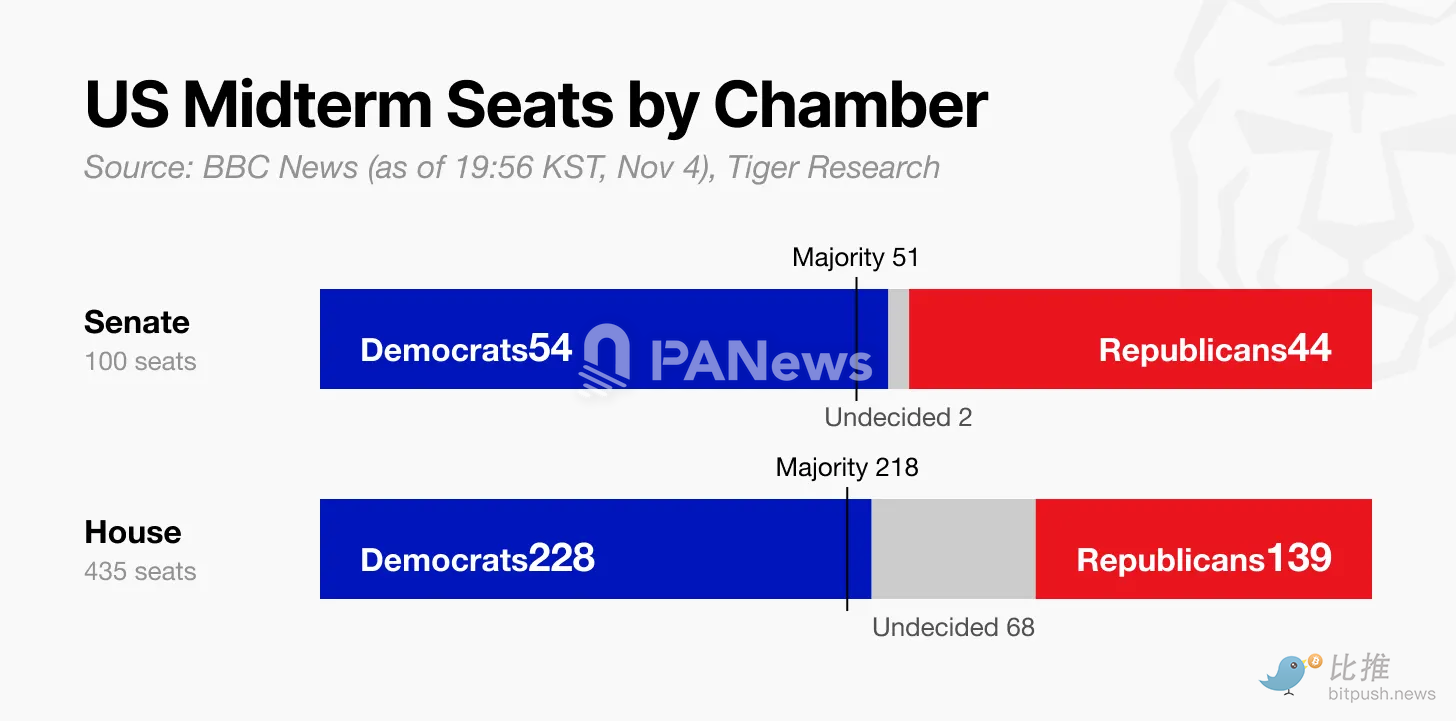
The Democratic Party has won 54 out of 100 Senate seats and 228 out of 435 House seats, exceeding the majority thresholds of 51 and 218 respectively. This outcome represents an increase of seven seats in the Senate and 25 in the House. Two Senate seats and 68 House seats remain unconfirmed, but Democratic control of both chambers is no longer in doubt.
When the new Congress convenes in January 2027, the Democrats will control the legislative agenda and committee chair positions.
This outcome is significant for digital assets, as Republicans dominated two major legislative efforts shaping the market over the past two years: the GENIUS Act and the CLARITY Act. The Democrats will now be able to block further legislation and re-evaluate the framework established by Republicans, which has broad implications for the market.
Positions of Elected Democrats on Digital Assets
Based on past statements and records, elected Democrats entering Congress can be roughly categorized into three groups:
- Traditional critics who view digital assets as an industry aimed at evading regulation.
- Centrists who support clear rules but insist on imposing conflict of interest limitations on public officials and strengthening consumer protections.
- A smaller pro-crypto group that seeks to integrate the industry into a regulated financial system through clear legal frameworks.
The challenge for the industry is that critics are likely to obtain committee chair positions that determine which bills can advance.
Centrists and pro-crypto Democrats are not unconditional allies either. They also want Congress to address the Trump family's digital asset business, making it unlikely that current bills will advance unaltered.
1. Critics May Lead Key Committees
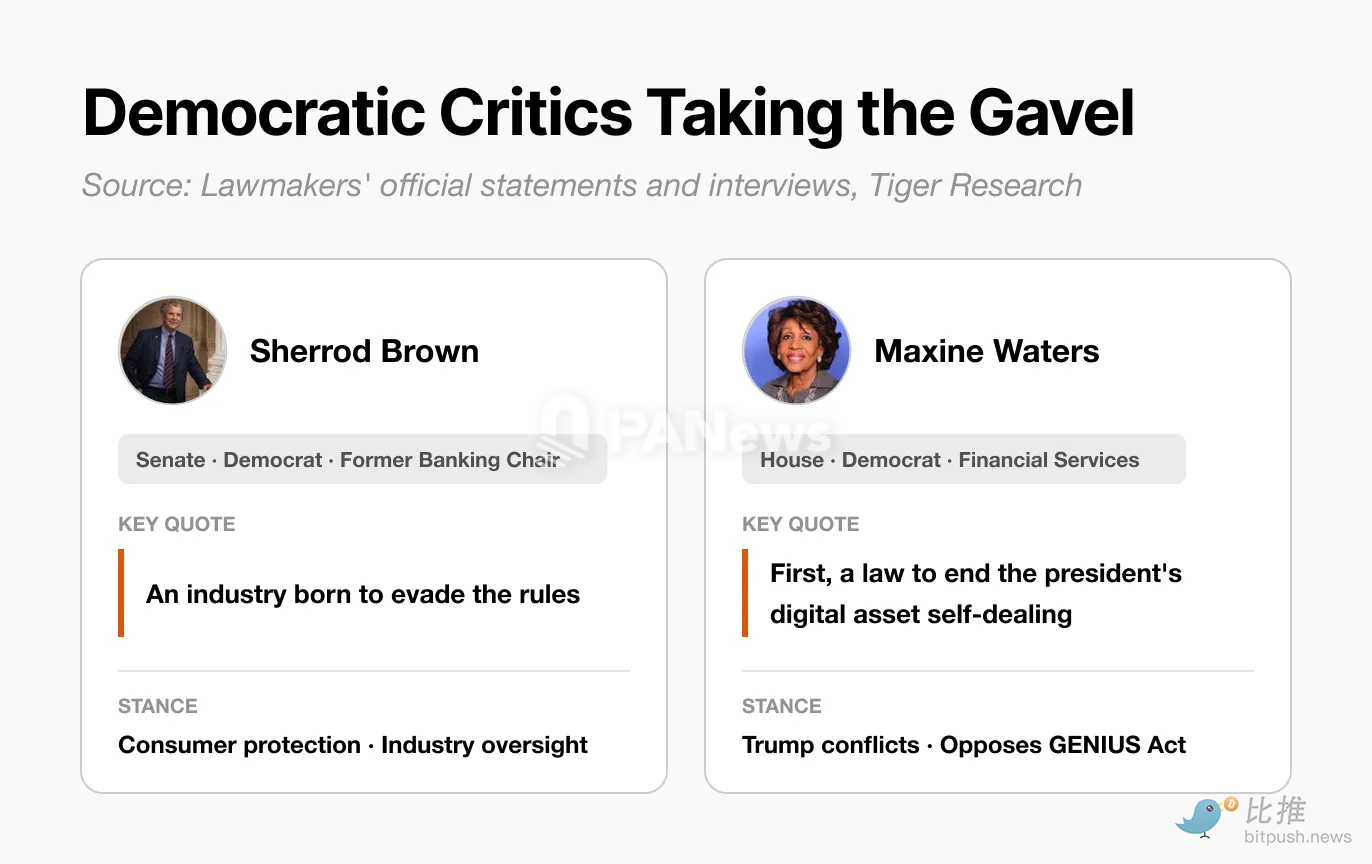
This election has strengthened the position of industry critics within the Democratic Party.
Senator Elizabeth Warren, who participated in the 2020 Democratic presidential primaries, considers digital assets an industry established to evade regulation. They have consistently opposed industry-friendly legislation. With the Democrats gaining a majority, these lawmakers are more likely to lead committees responsible for digital asset bills.
Incoming Senator Sherrod Brown is a former three-term senator from Ohio and the former chairman of the Senate Banking Committee, and is one of the most well-known critics of the industry. As committee chairman, he has previously blocked the progress of crypto legislation.
During a stablecoin hearing in 2021, Brown expressed that stablecoins are neither decentralized nor transparent. Despite political groups supporting crypto spending approximately $63 million trying to prevent his return to the Senate, he has now won. This history leaves little reason for the industry to expect friendlier treatment.
Congresswoman Maxine Waters, who has served in the House since 1991, is widely regarded as the leading candidate for chair of the House Financial Services Committee.
Waters is currently the ranking Democrat on the committee. She served as chair from 2019 to 2023, becoming the first woman and the first Black person to hold the position. With the Democrats retaking the House, she is expected to return to the position.
When the GENIUS Act passed in the Senate, Waters criticized the bill as fundamentally flawed, stating that despite its name, it was not “smart” at all. She also described the recent Binance hacking incident as a warning: the crypto industry cannot operate without strong accountability mechanisms.
With these lawmakers leading key committees, the digital asset agenda advanced by Republicans over the past two years will face greater resistance.
Their primary target will likely be World Finance Limited — the Trump family's digital asset business. Following reports that an investor associated with the Abu Dhabi royal family acquired 49% of WLF for approximately $500 million four days before Trump's inauguration, Democrats have called for a Senate hearing.
Congress may also scrutinize why the SEC has withdrawn over a dozen digital asset enforcement cases, with Waters calling for an investigation into this. Senate Democrats may further pressure regulators by delaying the confirmation of key SEC and CFTC positions.
Therefore, in the first half of 2027, news coverage in the digital asset space is likely to focus on investigations related to WLF’s associates and subpoenas for the SEC chair, with less attention directed at legislative progress.
2. Centrists Support Clear Rules, but with Conditions
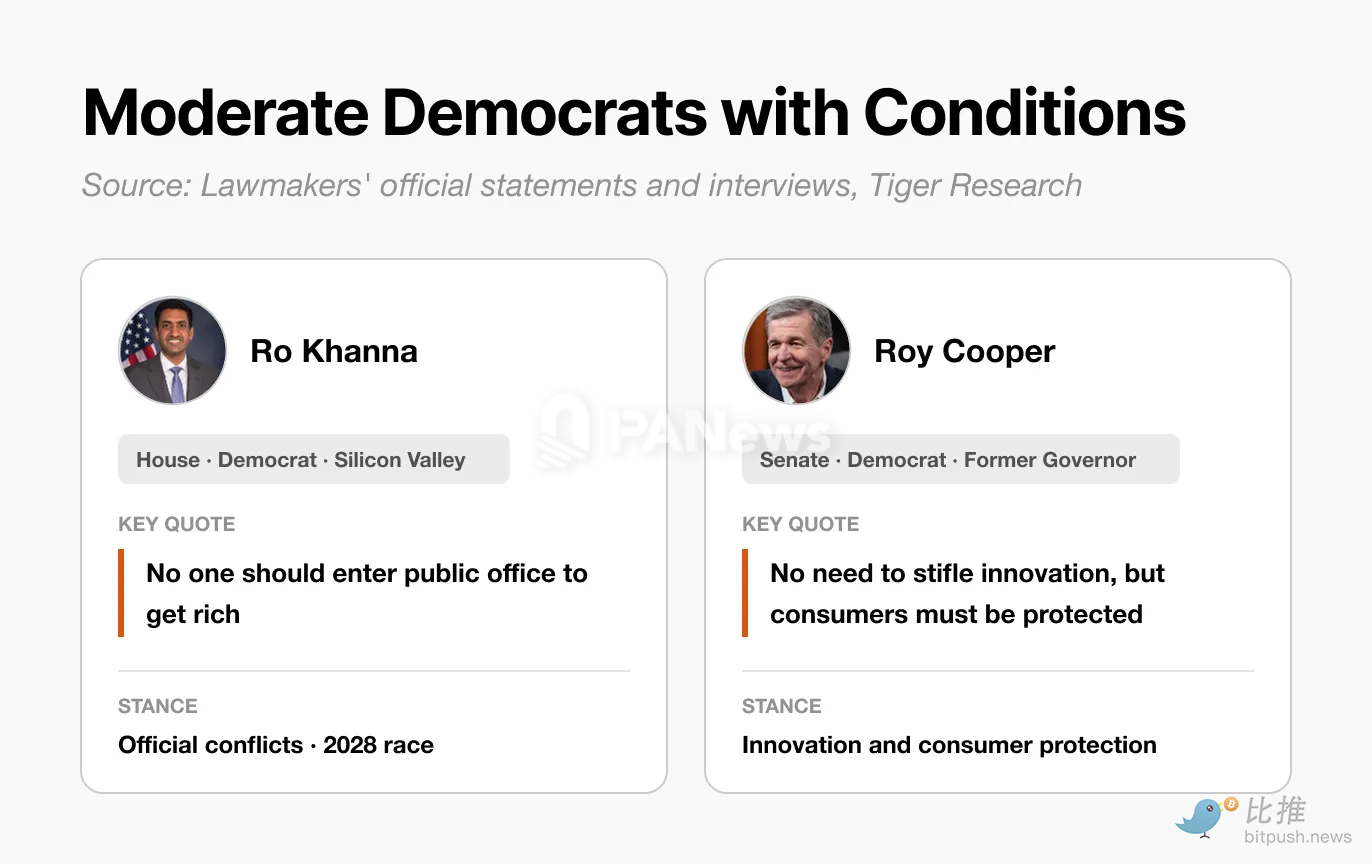
Centrists within the Democratic Party generally support digital asset legislation but also hope to enhance consumer protections and impose conflict of interest limitations on public officials. Should the CLARITY Act return to a Democrat-led Congress, their demands could determine its final form.
Congressman Ro Khanna has long supported the establishment of clear rules for digital assets. In 2022, he co-sponsored the Digital Commodities Exchange Act, emphasizing consumer protection and transparency. In 2025, he indicated Congress could pass stablecoin legislation and the CLARITY Act that year. However, in the same event, he advocated that elected officials should not hold meme coins.
Khanna is also discussed as a potential presidential candidate for 2028, which gives him more reason to emphasize the issue of public official conflict of interest.
Incoming Senator Roy Cooper, a former governor of North Carolina, has no federal voting record. However, during his campaign, he met with industry representatives and expressed that the industry wants to comply with the law. He argued that businesses just want to understand the rules and are assured that these rules won’t change constantly. His stance supports a combination of regulatory stability with an emphasis on consumer protection.
As these lawmakers enter negotiations, they may seek to amend existing bills.
Centrists might condition their support on including provisions to prevent public officials from using digital assets for personal gain. Khanna's legislation prohibiting crypto corruption is one such example. He has also launched an investigation requesting records of WLF’s dealings with the UAE.
Legislators like Cooper may push for additional safeguards against illicit finance and stronger consumer protections. However, provisions targeting the presidential family may prompt Trump to veto the legislation.
Thus, as lawmakers negotiate between the current text and amendments desired by Democratic centrists, the CLARITY Act may continue to stall.
3. Pro-Crypto Democrats
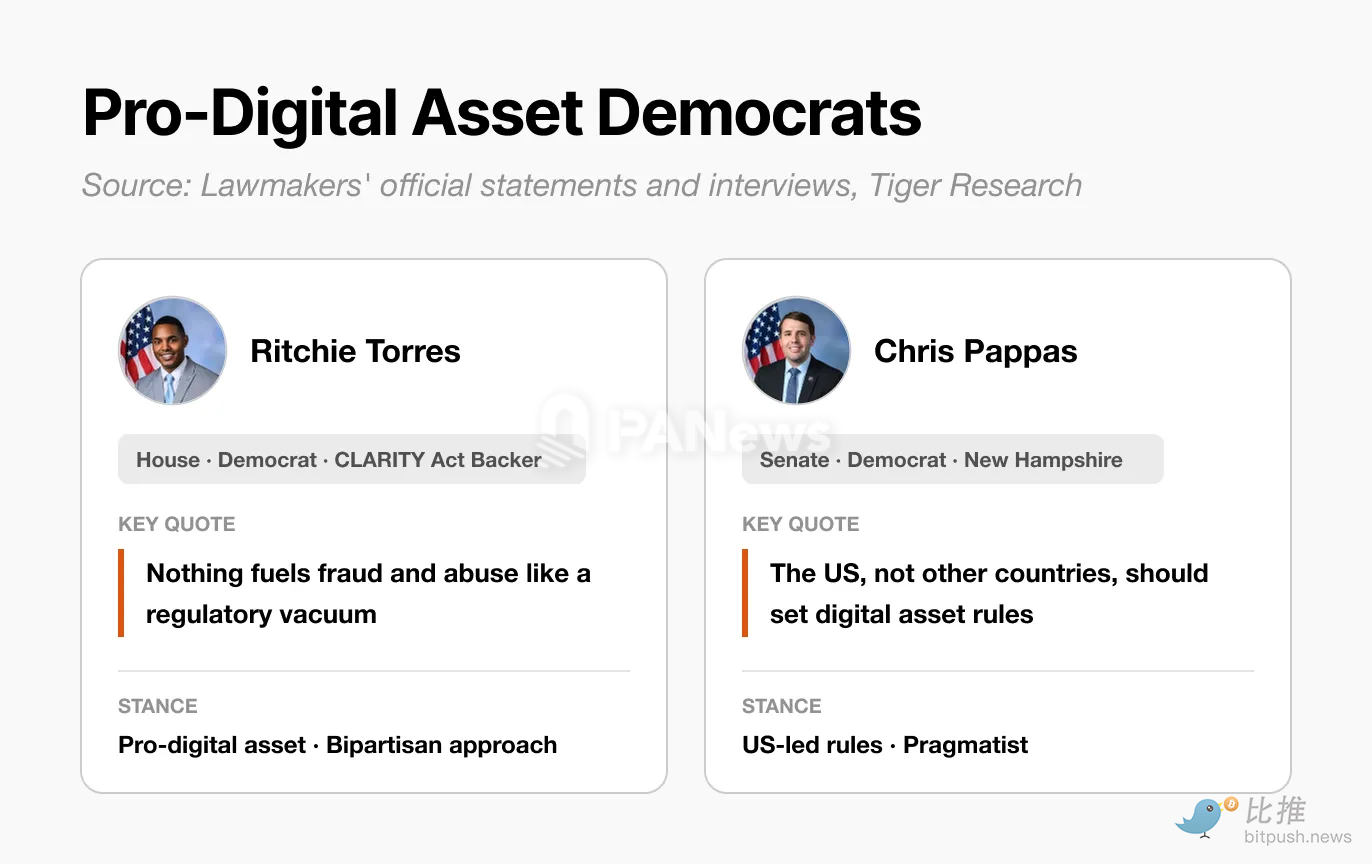
This group includes Congress members who voted in favor of the CLARITY Act and the GENIUS Act and those whose campaign platforms focused on establishing clear rules for digital assets. They provide potential allies for the industry within a Democrat-led Congress, although they are not yet in positions to lead related committees.
Congressman Richie Torres has been one of the most active advocates for digital asset legislation within the Democratic Party. He co-sponsored the CLARITY Act and the Blockchain Regulatory Certainty Act, and prior to the 2025 House vote, he led a letter urging Democratic colleagues to support the CLARITY Act, as well as voting in favor of the GENIUS Act.
At a SEC oversight hearing in February 2026, Torres stated he always believed in emerging technologies like digital assets and blockchain. However, his support also has its limits. Following the exposure of suspicious Polymarket trades betting on the downfall of President Maduro in January, he, along with 30 other lawmakers, proposed legislation to prohibit public officials from trading in prediction markets using non-public information.
Incoming Senator Chris Pappas voted in favor of both the CLARITY Act and the GENIUS Act during his time in the House. After voting, he argued that American leadership in innovation requires embracing new technologies and establishing clear rules and safeguards for digital assets. He described these bills as a starting point for consumer protection and supporting small business growth.
Meanwhile, Pappas has expressed deep concern over President Trump’s disregard of established ethical standards and legal requirements, calling for stronger anti-corruption rules for public officials. In May 2026, he also called for the House to investigate corruption and insider trading on prediction markets.
These lawmakers may seek to include conflict of interest provisions in the CLARITY Act to garner support from other Democrats.
Both Torres and Pappas support the bill, while insisting that public officials must be prevented from using their positions for personal gain. Concerns about the Trump family's digital asset business were a major barrier to Democratic support during the September Senate vote, when not a single Democrat voted in favor. Addressing these concerns would eliminate one of the primary reasons for the party’s opposition to the legislation.
However, their ability to lead this process remains limited. Industry critics are likely to control key committees, and provisions aimed at the presidential family may face resistance from the White House. For the industry, much of the outcome in the coming two years will depend on whether pro-crypto Democrats can reach a compromise acceptable to both parties using ethical provisions.
Elected Republicans: Same Agenda, Less Control
Elected Republicans entering Congress continue to support private stablecoins as a means to maintain the global dominance of the dollar. They also oppose government-issued Central Bank Digital Currencies (CBDCs).
However, after several industry-friendly Republicans, including Senator Jon Husted and House Digital Assets Subcommittee Chair Brian Steil, lost their races, their influence has been weakened.
1. Lawmakers Behind the GENIUS Act and the CLARITY Act
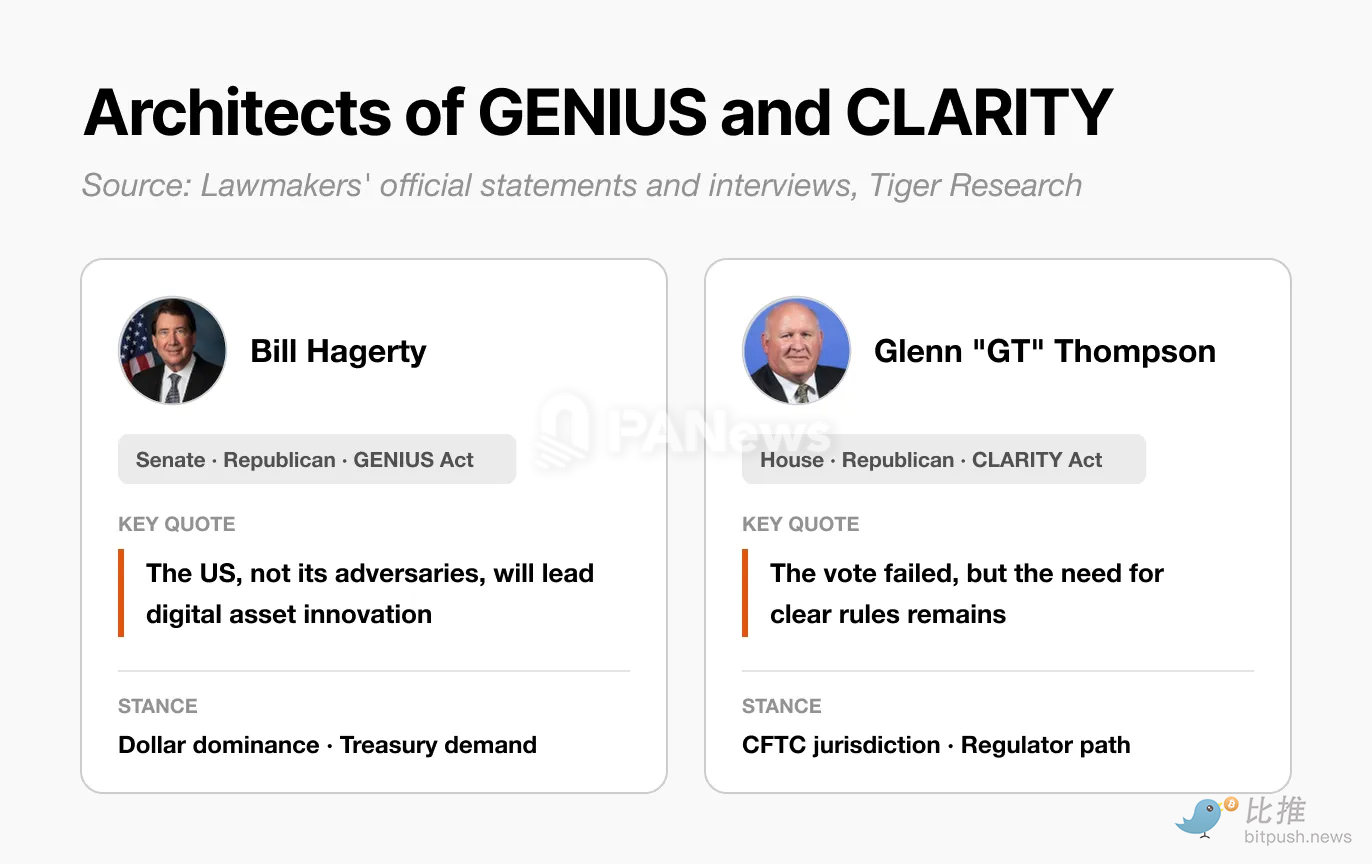
Senator Bill Hagerty, who successfully won re-election, and Congressman Glenn Thompson helped craft the framework behind stablecoin legislation and the CLARITY Act. As Republicans lose their majorities in both chambers, their priorities will shift to protecting the legislative achievements already made.
Republican lawmakers will now spend more time defending existing policies.
They may focus on protecting the GENIUS Act, using the Senate's 60-vote threshold required to overcome filibuster and the threat of Trump’s veto to block any efforts by Democrats to tighten regulation. They may also support the SEC and CFTC in crafting rules within their current authorities so that policy progress can continue without new legislation.
2. Firm Opponents of CBDC
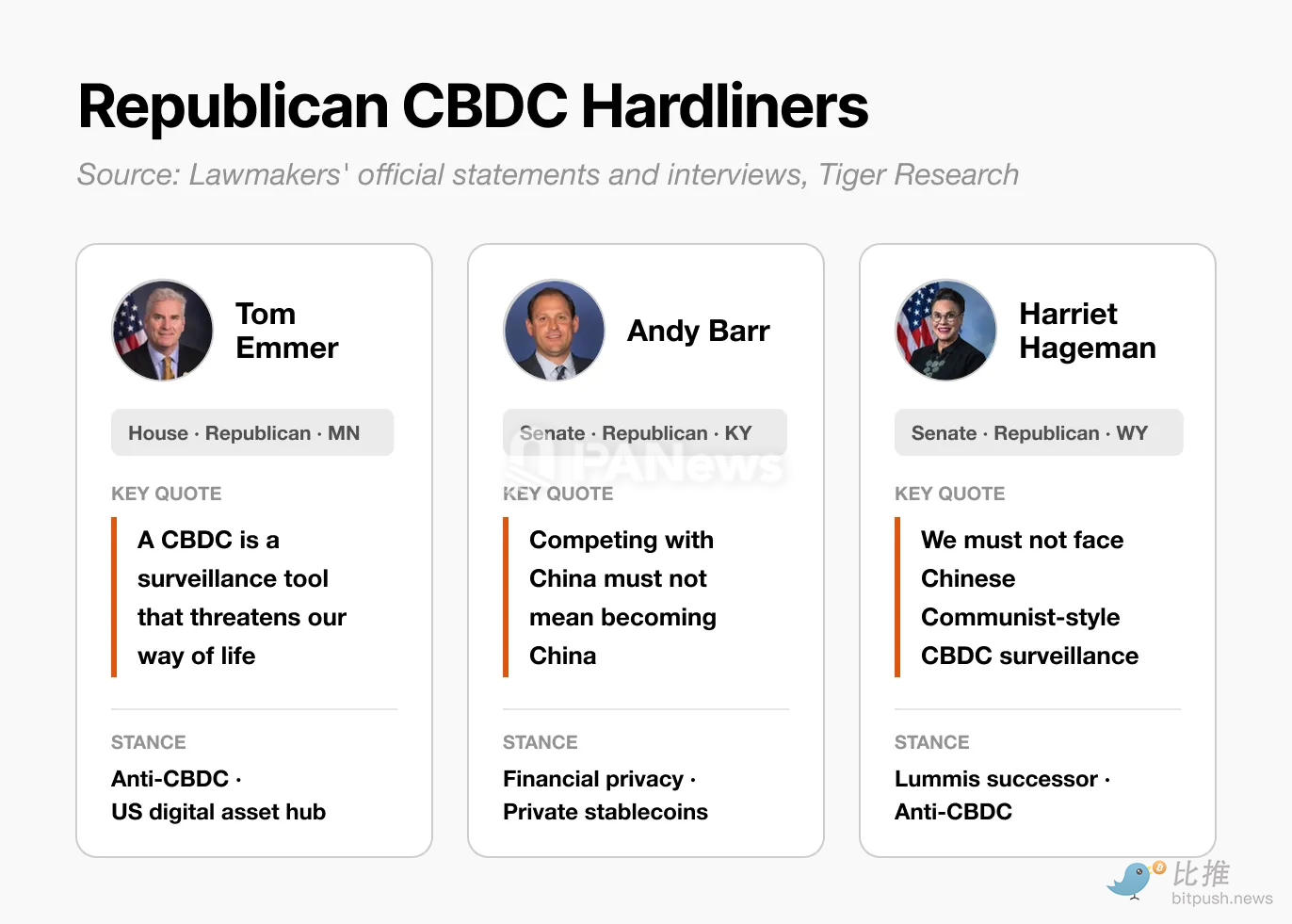
Opposing CBDCs is one of the clearest consensus points among elected Republicans. They view digital asset policy as a way to develop the industry while limiting government oversight over financial activities.
These lawmakers support private sector digital assets but are firmly against government-issued digital dollars. They view CBDCs as potential tools for monitoring individual transactions and lean towards private stablecoins as alternatives.
Their goal is to legislate a ban on CBDCs. With Democrats controlling Congress, this path is effectively closed off for the next two years.
President Trump’s executive order from January 2025 remains the main explicit federal prohibition against CBDCs in the U.S. As future presidents may revoke this order, Republican lawmakers have been seeking to codify the ban into law. Congressman Tom Emmer’s Anti-CBDC Surveillance State Act passed the House in July 2025 but failed to clear the Senate. Its prospects have further weakened with Democrats controlling both chambers.
Therefore, these lawmakers may focus on overseeing the implementation of the GENIUS Act. For example, they may review whether the Treasury's implementation rules introduce mechanisms allowing government oversight of stablecoin transactions.
As long as the executive order remains in effect, it is unlikely that a CBDC will be introduced during Trump’s remaining tenure (until January 2029). Thus, their attention may redirect towards protecting the privacy of stablecoin users.
Democrats Now Set the Congressional Agenda
The Democrats have won a majority in both chambers. The remaining election results will determine the scale of the majority, but control of Congress has already shifted.
Their current stance indicates that investigating the Trump family's digital asset business will take precedence over passing new legislation. Key Democrats on relevant committees had already listed these businesses as top investigative priorities before the election. As the majority party, they will have the authority to issue subpoenas.
Even if Democrats revisit the CLARITY Act, they may request stronger consumer protections and conflict of interest limitations on public officials. Concerns regarding the Trump family's digital asset businesses were a major barrier to support during the September Senate vote, when the bill received no support from any Democrats.
Republicans will focus on defending the GENIUS Act and blocking Democratic proposals to tighten regulation. Their minority status makes it difficult to pass new laws, but they still retain significant power to obstruct legislation. Most contentious bills require 60 votes to overcome a Senate filibuster, and Trump can veto any legislation sent to his desk.
The path for the CLARITY Act to pass is now more difficult. Trump has been the primary political force behind the government's pro-crypto agenda, and his maneuvering space will also narrow. The Republican policy objectives have largely remained unchanged, but the pace of progress may slow.
To gauge the direction and pace of regulation, the industry needs to monitor how leading Democrats pursue the Trump family's digital asset interests and how the White House will respond.
免责声明:本文章仅代表作者个人观点,不代表本平台的立场和观点。本文章仅供信息分享,不构成对任何人的任何投资建议。用户与作者之间的任何争议,与本平台无关。如网页中刊载的文章或图片涉及侵权,请提供相关的权利证明和身份证明发送邮件到[email protected],本平台相关工作人员将会进行核查。


