Written by: Rita
Hyperscale cloud vendors collectively accelerated in the second quarter, but their return paths have started to diverge. Bernstein, in its cloud quarterly report published on September 22, 2026, pointed out that Microsoft Azure grew by 43%, Google Cloud by 82%, and Oracle OCI by 121%. Google leads in AI cloud competitiveness, while Microsoft becomes a defensive target with its cash flow and self-funding capabilities. This report includes CoreWeave for comparison for the first time, and Bernstein assigns it an underperform rating.
Bernstein analyst Mark Moerdler noted that the hyperscale market has become the infrastructure layer supporting traditional cloud and generative AI, with capital expenditure growth significantly outpacing revenue growth. Google's vertical integration advantages are becoming apparent, Oracle is experiencing rapid growth from a smaller base, and Microsoft is forging an independent path through self-funding and first-party applications. The four major U.S. cloud vendors generated approximately $14.4 billion in new cloud revenue in the second quarter.
Microsoft Azure Accelerates Growth
Microsoft Azure grew by 43% in the second quarter, exceeding guidance by 300 basis points and market consensus by 200 basis points. Management guided for a 45% growth in the next quarter and continues to expect acceleration in the second half of 2026. The business remaining performance obligations (RPO) reached $678 billion, a year-on-year increase of 84%. All quarter-over-quarter growth came from enterprise customers, excluding new commitments from frontier model companies. Excluding OpenAI, RPO increased by 25% year-on-year.
Microsoft's capital expenditure for the second quarter was $41 billion, a 70% increase year-on-year. About two-thirds of this was directed towards short-term assets, mainly GPUs and CPUs. The capital expenditure guidance for the calendar year 2026 remains at $190 billion, adjusted to $175 billion after lease reclassifications. Microsoft extended the lifespan of its data centers from 15 years to 25 years, with some short-term financing leases converted to operating leases.
The defensive attributes of Microsoft come from three areas. The consumption of capacity by first-party applications is accelerating, with Copilot paid seats increasing by 50% quarter-on-quarter to 30 million. Third-party contracts come from OpenAI diversifying large enterprise customers, with contract terms matching equipment lifetimes. Management guided for positive free cash flow in fiscal year 2027, with no need for additional debt issuance. Bernstein gives Microsoft an outperform rating with a target price of $660.
Google Cloud Grows by 82%
Google Cloud's revenue increased by 82% in the second quarter to $24.8 billion. Operating profit was $8.8 billion, doubling year-on-year, with an operating margin of 35.6%, up from about 20.7% in the same period last year. Cloud backlog reached $514 billion, with over $50 billion added in the quarter. Management noted that even excluding the sales of tensor processing units (TPU) systems that began shipping this quarter, cloud growth would still accelerate significantly.
TPU monetization started this quarter. Google confirmed revenue from TPU system sales for the first time, with management emphasizing that the current contribution is still relatively small. Existing TPU agreements are reflected in the cloud backlog, with most related revenue expected to be recognized in 2027 as deployments ramp up. Google is the only hyperscale vendor with its own frontier models and customized TPU chips that are truly vertically integrated.
Enterprise AI adoption is widespread. Nearly 90% of the Fortune 100 use Gemini Enterprise. Nearly 500 cloud customers processed over 1 trillion tokens in the past year, with over 2,000 businesses consuming over 100 billion tokens. The model API handles approximately 22 billion tokens per minute, up from 16 billion last quarter and 10 billion two quarters ago. Google Cloud's capacity remains constrained, planning to utilize additional third-party infrastructure capacity in the third quarter. Bernstein gives Google a market perform rating, with a target price of $385.
Oracle RPO High Growth Capital Expenditure Under Pressure
Oracle Cloud Infrastructure (OCI) revenue reached $7.4 billion in the first quarter of fiscal year 2027, a year-on-year increase of 121%. RPO reached $664 billion, a 46% year-on-year increase, with a quarter-on-quarter increase of $209 billion. Most quarter-on-quarter growth came from prepayments or AI contracts with self-provided hardware, requiring very low cash outlays from Oracle. Capital expenditure in the first quarter was $28.5 billion, with net cash outlays of $18 billion after excluding customer prepayments. Guidance for capital expenditure in fiscal year 2027 is set at $90 to $95 billion, which includes $20 to $25 billion in customer prepayments, with net cash outlays of $70 billion.
Oracle completed $20 billion in equity financing this quarter, with $20 billion remaining in its financing capacity for the fiscal year. Management guides that no additional debt will be issued for fiscal year 2027. Oracle added 850 MW of capacity this quarter, currently exceeding 2 GW. Over the next three years, it has locked in over 10 GW of data center capacity, most of which has been contracted. Oracle does not build data centers; capital expenditure is mainly directed towards hardware. Bernstein gives Oracle an outperform rating with a target price of $325.
Amazon Accelerates Alibaba Profit Margin Improvement
Amazon Web Services (AWS) grew by 37% in the second quarter, the fastest growth in 18 quarters. Backlog reached $496 billion, with a quarter-on-quarter increase of about 50%. AI revenue has an annual run rate of $25 billion, up from $15 billion last quarter. Custom chip business has an annual run rate exceeding $25 billion, up from $20 billion last quarter. AWS management provided a returns framework, with server investments expected to break even in 2 to 3 years, corresponding to 5 to 6-year contracts. Amazon is leading in quarter-on-quarter net dollar growth, adding approximately $4.6 billion in the second quarter.
Alibaba Cloud's revenue increased by 44.9% in the second quarter, with an adjusted EBITDA margin of 11.6%, a quarter-on-quarter improvement of 250 basis points. AI-related product revenue has achieved three-digit growth for the twelfth consecutive quarter, accounting for 35% of external cloud revenue. Model as a Service (MaaS) and AI-native software subscription annual recurring revenue (ARR) reached 16 billion RMB, maintaining a target of over 30 billion RMB by the fourth quarter of fiscal year 2027. This quarter's capital expenditure was 67.6 billion RMB, significantly up from a previous run rate of 30 billion RMB. Bernstein gives Alibaba an outperform rating with a target price of $165.
CoreWeave Gets an Underperform Rating
Bernstein has initiated coverage on CoreWeave with an underperform rating and a target price of $74. CoreWeave's revenue in the second quarter was $2.58 billion, a year-on-year increase of 112%. Backlog was approximately $104 billion, a year-on-year increase of 246%. Management disclosed that more than $25 billion in net new customer commitments were signed at the beginning of the third quarter. Revenue guidance for 2026 was raised to $12.4 billion to $13.2 billion, and capital expenditure guidance was raised to $35 billion to $39 billion.
Bernstein believes that CoreWeave's business model acts as a temporary capacity provider between hyperscale vendors and large AI customers. It benefits in the short term from the scarcity of electricity and GPUs but faces long-term challenges due to high customer concentration, the evolution of buyer self-building incentives, and structurally limited return rates. CoreWeave's long-term goal is to have at least 8 GW of active power by 2030, currently at 1.5 GW. Its execution reliance is high and faces risks of delays, cost inflation, financing constraints, and supply chain disruptions.
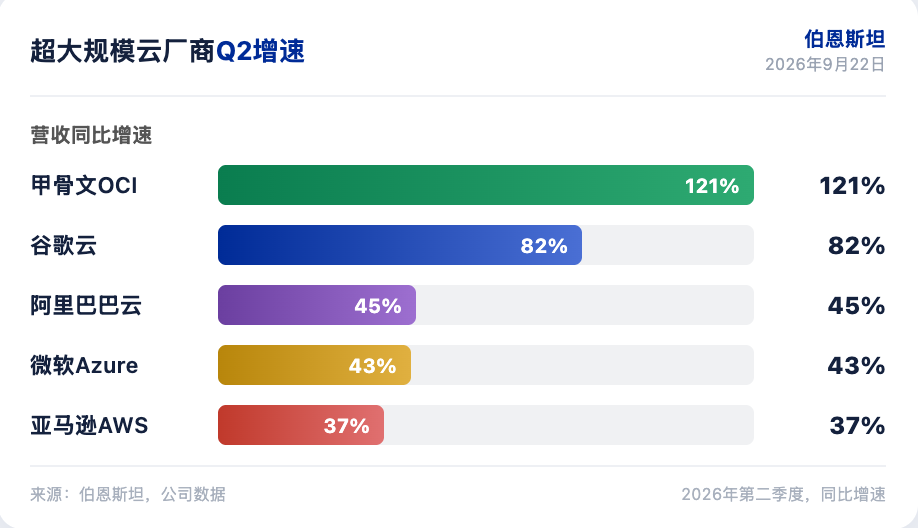
Hyperscale vendors are expected to reach approximately $600 billion in cash capital expenditure in 2026, approaching $800 billion if including Meta. Other vendors, except for Microsoft, have turned to external financing this year. Revenue and backlog have begun to accelerate in recent quarters, with demand consistently exceeding supply. Microsoft has become a defensive target through self-funding and first-party applications, Google leads in AI cloud competitiveness through vertical integration, Oracle supports growth through RPO visibility, and CoreWeave's supply shortage benefits face long-term tests.
Disclaimer
This article is a compilation and interpretation by Tide Research of the third-party brokerage report (Bernstein, September 22, 2026), in conjunction with public market information. The ratings, target prices, earnings forecasts, and related judgments cited in this article are the views of the analysts of the brokerage and only represent the position of their affiliated institution, not the views of Tide Research, and do not constitute any investment advice.
The market has risks, and decisions should be independent. This article should not be used as the basis for buying or selling any securities.
免责声明:本文章仅代表作者个人观点,不代表本平台的立场和观点。本文章仅供信息分享,不构成对任何人的任何投资建议。用户与作者之间的任何争议,与本平台无关。如网页中刊载的文章或图片涉及侵权,请提供相关的权利证明和身份证明发送邮件到support@aicoin.com,本平台相关工作人员将会进行核查。


