Written by: Gemini, Deep Tide TechFlow

U.S. retail investors are addicted to the game of 0DTE end-of-day options betting small for large returns, but may soon be incorporated into a compliant framework by a crypto-native tool.
On September 18, according to Forbes reported, Coinbase's licensed futures exchange, Coinbase Derivatives, officially submitted a self-certification application to the U.S. Commodity Futures Trading Commission (CFTC) seeking to launch single-stock perpetual futures that settle in cash within a compliant framework. The first batch of applications targets two major tech giants: Apple (AAPL) and Nvidia (NVDA), with plans covering 50 to 60 major stocks and ETFs.
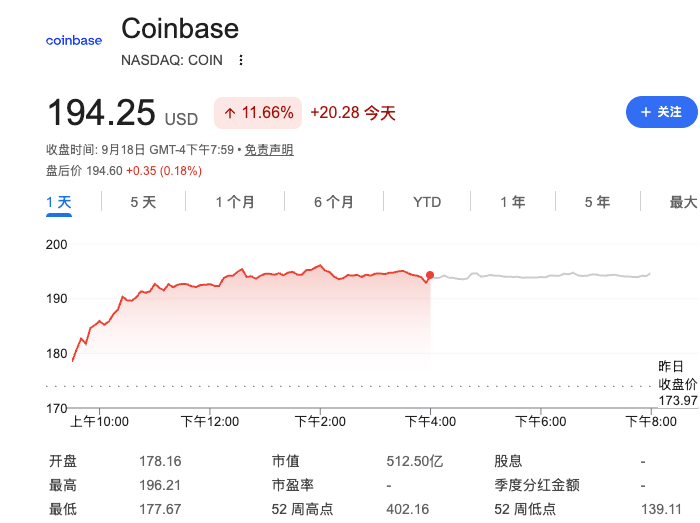
Catalyzed by this news, Coinbase's (COIN) stock price jumped sharply by 12% that day.
Following closely, the compliance event prediction market platform Kalshi also keeps pace. According to Cointelegraph reported, Kalshi has submitted a rule change to the SEC and filed with the CFTC, planning to launch perpetual derivatives on major stocks such as Apple, Tesla, and Nvidia through its clearing house Kalshi Klear.
Long-time crypto players immersed in blockchain are not unfamiliar with "U.S. stock perpetual contracts." From the U.S. stock orders on offshore DEXs like Hyperliquid and dYdX, to emerging chains like Robinhood Chain and Arc that create various synthetic assets through RWA mapping or even "coin-stock pairing," U.S. stock tokenization has long been a beaten path by various Degen players.
However, the core increment that Coinbase and Kalshi have unleashed in the market is not about "on-chain tokenization," but about compliant offshore turning domestic:
This is the first time a regulated U.S. licensed exchange attempts to formally introduce genuine crypto-native leverage tools to the legal table of tens of millions of local retail investors in the U.S.
Goodbye to Dog Tokens Synthesis: The "Regular Army Breakthrough" of Crypto-Native Leverage
Bringing U.S. stocks onto the blockchain or making them into contracts has gone through three stages in the crypto circle:
The first stage was the algorithmic synthetic assets of the Synthetix and Mirror era, which died due to poor depth and extreme decoupling; the second stage is the RWA tokenization of U.S. stocks and offshore DEX contracts that can be seen everywhere on-chain today, but they are constrained by the long-arm jurisdiction of the U.S., erecting geographical barriers to the largest local retail funding pool; even though this year various memes based on RWA pairing are hot, they essentially remain a transfer of hot money within the existing circle.
What Coinbase is doing is directly breaking through the traditional financial channels with a "regular army breakthrough."
The application it submitted has a very high operational precision: contracts settle in USD and USDC cash, without involving the delivery of underlying physical stocks; it employs a 24/5 continuous trading mechanism (from 8 p.m. Eastern Time Sunday to 5 p.m. Friday); the long and short funding rates are settled hourly, based on a sampling of the Underlying index every 3 minutes, with a funding rate ceiling controlled at ±0.10% per hour; the underlying clearing is directly connected to the regulated clearing agency Nodal Clear.
This completely hits the structural pain points of traditional U.S. retail trading:
Under the traditional brokerage system like Robinhood, U.S. retail investors rely almost entirely on end-of-day options (0DTE) to seek intraday leverage. However, this is an extremely harsh nonlinear tool: complex Greek letters, crash in implied volatility, and harsh time value decay often leave investors who correctly predict the direction with little to no capital remaining when time runs out. Moreover, traditional stock futures face fixed quarterly settlements and cumbersome switching between contracts.
In contrast, the linear profit and loss structure of perpetual contracts completely aligns with retail intuition; a 5% increase with 10x leverage is a 50% return, with no need to bear the risk of being wiped out at expiration.
More importantly, the earnings reports and sudden positive news from giants like Apple and Nvidia often occur after U.S. stock market hours, when the liquidity for after-hours trading from traditional brokerages is extremely poor, with large spreads. The 24/5 continuous operation of perpetual contracts just fills the vacuum of after-hours liquidity.
Coinbase's role in this business structure is very clear:
- Clearing and structure: The licensed entity Coinbase Derivatives sets the rules and connects with compliant clearing houses to establish isolated margin positions;
- Funding channels: Using USD and USDC as collateral, through Coinbase Custody, integrating stablecoins into a compliant futures collateral ecosystem;
- Distribution network: Directly activating over 100 million registered users and nearly one million Coinbase One subscribers, seamlessly merging crypto traders with tech stock speculation demand.
Kalshi's Rapid Follow-Up: The Boundary Between Event Pricing and Financial Derivatives Totally Collapses
Coinbase is not fighting alone; the second entity to jump on the bandwagon is not CME or Charles Schwab but the compliant prediction market platform Kalshi, known for betting on the presidential election.
Reportedly, Kalshi's submitted plan also targets large-cap stocks with market caps exceeding $100 billion and daily trading volumes exceeding $450 million, such as Tesla, Apple, and Nvidia, with each contract representing 100 shares, demanding a minimum margin requirement of 15% (about 6.7 times nominal leverage), and clearing through its own compliant clearing house Kalshi Klear.
This phenomenon reflects a rapidly unfolding industry reality: the technological boundaries between prediction markets and financial derivatives are completely disappearing.
Traditional prediction markets deal in discrete binary options, trading the probabilities of "whether the Fed will cut rates" or "whether someone will win an election" as yes/no outcomes. However, the essence of continuous financial assets is merely a series of micro-events occurring at high frequency.
After being approved for perpetual contracts for Bitcoin, oil, and other commodities, Kalshi tasted the benefits of 24/7 high-frequency trading. When it transitions "Will Nvidia's close today exceed $150?" from daily-settled binary betting into perpetual derivatives with funding rates, the prediction market platform has essentially evolved into a perpetual exchange in functionality.
Conversely, Coinbase is also vigorously developing the macro prediction and event contract section within its platform. The collision of both on Nvidia and Apple proves: regardless of whether they were originally tagged "crypto exchange" or "prediction market," as long as they hold a clearing license, the ultimate goal for all platforms is to capture the speculative margin in retail investors' wallets.
Valuation Rewrite: The Business Closed Loop of Coinbase's Universal Exchange
A single-day 12% stock price increase reflects Wall Street investors' heightened sensitivity to the transformative change in Coinbase's business model.
For a long time, Coinbase's valuation center was firmly pinned in the logic of "crypto high beta brokerage": in a crypto bull market, trading activity is fervent, and transaction fees soar; once the market turns bearish and retail investors exit, trading volume and revenue drop sharply. Although interest-sharing from USDC reserves in subscription and service revenue has provided some cash flow hedging, it still cannot escape the strong cyclical nature.
The "Everything Exchange" strategy that CEO Brian Armstrong has repeatedly emphasized is the key to breaking the deadlock:
- Volume anti-cyclical desensitization: Apple and Nvidia are the most liquid and intensely contested underlying assets globally. Even when the crypto market is trapped in a cold bear market, the earnings seasons and AI narratives of U.S. tech giants will still generate massive turnover. Coinbase can thus thoroughly detach from its previous awkward dependency on the crypto cycle.
- Margin interest reinvestment: Trading perpetual contracts on Coinbase requires substantial margin collateral (primarily in USDC). The larger the perpetual market, the deeper the pool of USDC retained on the platform, which directly transforms into a cash cow business shared with Circle from the underlying risk-free U.S. treasury interest.
- Valuation multiple reconstruction: Rising from relying on crypto market volatility to becoming a new financial hub with CME-compliant derivative clearing attributes and Robinhood-level retail distribution capabilities, enjoying valuation premiums from traditional financial infrastructure.
Regulatory Defense Line and Wall Street Counterattack
While expectations have indeed been preemptively taken by the secondary market, the implementation of U.S. stock perpetual contracts domestically still faces a difficult regulatory battle.
Under the current system, single stock futures are classified as "security futures products," under the dual regulation of both the SEC and CFTC. Over the past twenty years, due to prolonged disputes between the two regulatory agencies regarding cross-product penetration, market maker norms, and margin ratios, traditional single-stock futures have nearly shriveled to nonexistence. Coinbase and Kalshi's effort to revive them with perpetual contracts must directly contend with rigorous examinations regarding the risk of retail investor liquidation and leverage limits.
At the same time, traditional financial forces will certainly not sit idly by. Traditional derivatives giants represented by the CME Group have previously publicly questioned the introduction of perpetual contracts for traditional assets, and those heavily reliant on end-of-day option order flows, such as Robinhood and major market makers, will not sit back while core cash flows are diverted by crypto-native tools.
However, the front line has already been drawn. After conducting thorough stress tests in offshore markets and decentralized chains, the liquidity blade honed from crypto-natives is officially set to penetrate the core assets of the U.S. stock market under regulatory scrutiny.
免责声明:本文章仅代表作者个人观点,不代表本平台的立场和观点。本文章仅供信息分享,不构成对任何人的任何投资建议。用户与作者之间的任何争议,与本平台无关。如网页中刊载的文章或图片涉及侵权,请提供相关的权利证明和身份证明发送邮件到support@aicoin.com,本平台相关工作人员将会进行核查。


