Author: Cain Lee
Translation: Shenchao TechFlow
Senchao Introduction: The Federal Reserve raised interest rates by 25 basis points to 3.75%–4.00% on Wednesday, with unanimous support from twelve voting members, and hinted at possibly another increase within the year. Cain Lee believes that the expectations for interest rate hikes are basically priced in, with limited short-term downside; AI-driven growth and the abundant cash flow from tech giants are likely to make the Nasdaq and large-cap tech stocks more resilient compared to traditional interest rate-sensitive sectors.
Overview
The Federal Reserve just raised rates by 25 basis points on Wednesday, bringing the target range to 3.75% to 4.00%. This is the first rate hike in over three years, with unanimous support from all twelve voting members. Although the market has shown some downward pressure, I believe that the expectations for rate hikes have largely been digested in the past few weeks. After the August CPI was released, I mentioned that a rate hike was virtually a done deal; what was unexpected was that all voting members would align on the same side.
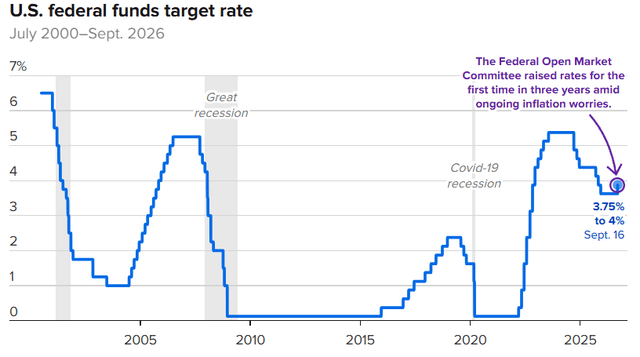
More notably, the latest dot plot indicates that the median committee members expect another rate hike within the year. This is interesting—just a year ago, most banks and analysts were betting that rates would continue to fall. I expect that rates are more likely to stay around 4.1% throughout 2027. The Fed's decision to raise rates also indicates that it does not intend to easily ease off under pressure from the Trump administration.
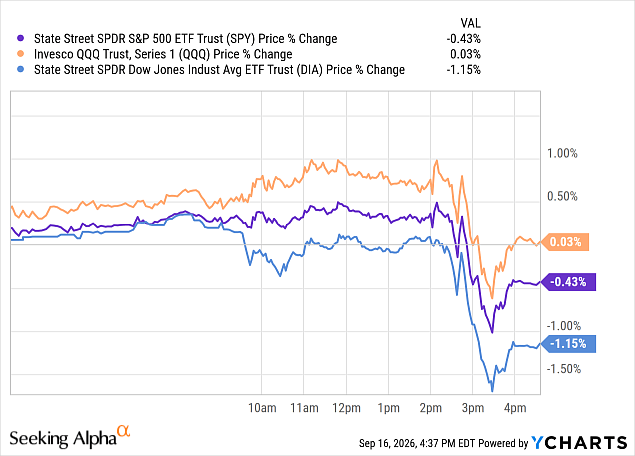
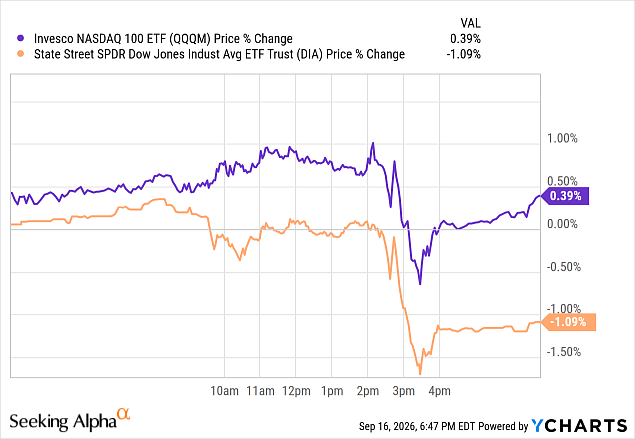
After the meeting, the market reacted with some skepticism. The State Street SPDR S&P 500 ETF (SPY), Invesco QQQ Trust (QQQ), and State Street Dow Jones Industrial Average ETF (DIA) all fell significantly at the close. Such selling pressure is always unpleasant but not unexpected. Fortunately, even as the market is still digesting the expectation of another rate hike before the end of the year, I still believe that the downside risks going forward are relatively limited.
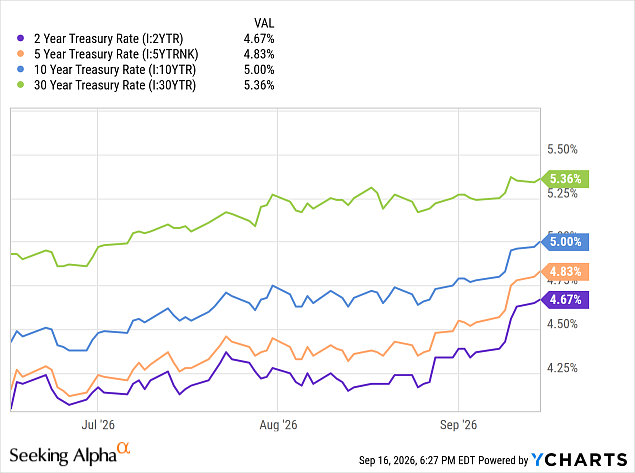
Bond yields are where I expect to see more significant fluctuations next. The two-year yield may approach 5%, while the ten-year yield is expected to remain in a similar range. For income investors, this means that short-term treasuries may maintain yields above 4% into next year, keeping the relative attractiveness of high-yield assets.
Next, let’s break down what the Federal Reserve actually said and how it will affect the recent stock market. Although there is some time before the next action, I believe investors should especially focus on two indicators: core PCE (Personal Consumption Expenditures Price Index) and oil price direction.
Dissecting the Fed's Statements
Spending remains strong, productivity is healthy, and capital expenditures are still at attractive levels. The economy continues to expand, and the job market is stronger than expected, which itself suggests that the market can withstand another rate hike. The official statement emphasizes that inflation is still elevated, and a rate hike helps return to the 2% target more quickly.
The Federal Reserve discloses projections of committee members on interest rates, growth, unemployment rates, and inflation targets every quarter. The upward revision of the actual GDP forecast explains why the committee is so calm about raising rates: the median GDP projection for this year is raised to 2.3%, with 2027 expected to be 2.4%. Regarding the unemployment rate, the Fed expects it to remain around 4.1% by the end of the year, while they previously thought it would be higher, landing at 4.3%.
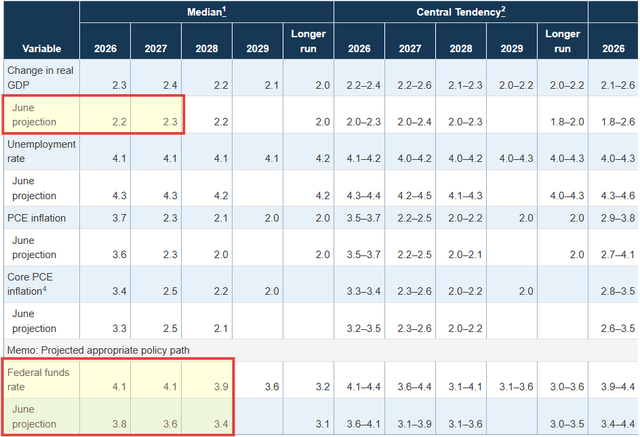
In the June forecast, the median projection was for a rate of about 3.6% at the end of 2027. I highlighted the lines that I consider most important: the last line shows that the median committee members expect a rate of 4.1% at the end of this year and 3.9% at the end of 2028—relative to their previous stance, this is a significant adjustment.
Fed Chair Warsh described it as removing "a dose of accommodation," which is straightforward: the interest rate was still too low before the rate hike. Core PCE is around 3.2%, and the probability of rising inflation moving forward is greater than that of falling inflation. Warsh also acknowledged that raising rates itself cannot lower oil prices but may prevent high energy costs from pushing up other prices.
Bond yields rose across the board, with the two-year around 4.67%, and the ten-year around 5%. The two-year saw the largest jump, but most of the momentum had actually started after Kevin Warsh's Jackson Hole speech. Locking money in the longer end does not provide much additional yield relative to the shorter end, so staying at the short end makes more sense before the end of the Fed's rate hike cycle.
What Will the Stock Market Do
On the surface, rising rates typically pressure the stock market. Of course, the transmission will vary for different sectors and the quality of companies, but higher borrowing costs mean that interest expenses on existing debt may increase. Small and medium-sized enterprises often feel this pressure the most because they rely more on debt to operate. Sectors like real estate also tend to remain under pressure when interest rates are high. Since the Fed still expects another rate hike, I do not anticipate these pressures will ease in the short term.
However, I believe that the growth related to AI and the positive momentum is strong enough to overshadow the negative impacts of rising rates. The index performance has already been driven by the strong profitability of tech stocks, and I do not believe this will easily reverse. Perhaps we will see an uncommon situation: funds treating technology as a safe haven against high rates. As long as AI growth—supported by data centers, the equipment market, and chip demand—continues to expand, investors may ignore rates and continue to flock into this sector.
After all, many giant tech leaders can fully finance themselves with ample cash flow rather than relying on leverage to expand production. This is also why today, the Invesco Nasdaq 100 ETF (QQQM) performed better than the Dow Jones. Over a longer period, this divergence may continue until the next round of rate hikes approaches.
Of course, this is on the premise that the market's concerns about capital expenditure and profitability do not resurface. The last quarter's earnings reports have already told investors that capital expenditures can translate into higher profits, but momentum and optimism may cool off at any time. Currently, the market's acceptance of high capital expenditures is higher, especially after leading companies have made their roadmaps more transparent.
Moving Toward the Next Rate Decision
There are two rate decisions left in 2026: one in late October and one in early December. My judgment is that there is a high probability that nothing will happen in October, with a real rate hike waiting until December. The Fed likely wants to observe the market's reaction to this rate hike before taking action too soon. The only circumstance that might bring the rate hike forward to October is if the core PCE continues to stay above 3%. If oil prices fall and inflationary pressures ease, it would actually be more favorable to push the next rate hike to December.
The core PCE excluding food and energy should not be directly affected by oil prices on paper. But as I mentioned in my CPI article, higher oil prices have already seeped into transportation sectors like air travel and shipping. Wages are rising, and companies have more reasons to raise service prices. If oil prices fall, airline tickets and shipping costs often follow, providing opportunities for the core PCE to decrease.
Conclusion
The long-awaited rate hike has finally occurred, in line with my expectations. All committee members voted in favor because the economy remains strong, also indicating that the Fed believes another hike may be needed before the end of the year. Warsh will not directly tell you when the next hike will be, but I expect it to fall during the December meeting. Short-term treasuries rose slightly, and the Nasdaq 100’s decline was less severe than that of the S&P 500 and Dow Jones. This is an interesting combination: despite the uncertainty brought by the rate hikes, the growth expectations for the tech sector remain solid. Thus, we may see a unique situation where the resilience of technology and large-cap stocks is stronger than many investors anticipate.
免责声明:本文章仅代表作者个人观点,不代表本平台的立场和观点。本文章仅供信息分享,不构成对任何人的任何投资建议。用户与作者之间的任何争议,与本平台无关。如网页中刊载的文章或图片涉及侵权,请提供相关的权利证明和身份证明发送邮件到support@aicoin.com,本平台相关工作人员将会进行核查。


