Author: Justin Sun
One
Nobel invented dynamite. Most of his wealth in his lifetime came from this item.
It is said that in 1888, a French newspaper mistakenly published his obituary, titled "The Merchant of Death is Dead." He read his own obituary and made a will a few years later.
Today, no one calls him the Merchant of Death anymore.
"Nobel" has become a neutral term, just like "volt" and "watt," devoid of emotion, merely a unit. He gave money to "the person who made the greatest contribution to humanity," the money returned to humanity, and his name also returned to neutrality, not through defense, but through over a hundred years of award lists.
I tell this story because I understand him. I know where money comes from and where it can go.
Two
My wealth is rooted in mathematics.
The blockchain industry is fundamentally built on several long-standing supported cryptographic constructs and security assumptions: the discrete logarithm problem on elliptic curves, irreversible hash functions, and difficulty of factorization of large numbers. In 1985, two mathematicians independently thought of using elliptic curves for cryptography, one in a university and the other at IBM, without knowing each other. That year, no one thought this was useful. What they wrote on the blackboard later became a trillion-dollar market, turning into something unprecedented — a person can have complete control over their wealth without needing anyone's permission. Neither of them made a penny from it.
This freedom is one of the most underappreciated gifts of mathematics to humanity. I have taken a lot from this gift. Establishing this award is, first of all, paying back.
Three
There is no mathematics prize in the Nobel Prize. This was an oversight over a hundred years ago, perhaps due to personal reasons, perhaps simply because it was not thought of.
Later came the Fields Medal, awarded every four years, for those under forty; and the Abel Prize, awarded annually for lifetime achievement. They are both good, but their rhythm is that of the previous era.
The mathematics community actually had another type of award. Erdős spent his life pricing problems, from twenty-five dollars to ten thousand dollars, and whoever solved them he would write them a check. Many people framed the checks and never cashed them throughout their lives. He passed away in 1996, and thereafter such checks were issued less and less.
Yet mathematics is entering a different era. AI may not be able to conduct experiments, but it can derive; AI finds it hard to build a collider for physicists, but it can explore ten thousand paths for mathematicians. Today, a conjecture can be proposed and solved in a matter of months or even days. An award that is given every four years appears like a clock that strikes every four years, hanging in an era that measures time by days.
Four
So the rules of the Justin Sun Prize are very simple.
The prize follows the problem, not the person. It does not wait for annual meetings, nominations, or age.
Each problem has two columns of names. One column records the prover, and the other records the formalizer, the person who moves the proof into the machine. The two columns can be the same person or two people half a globe apart who do not know each other. Humans can do it, AI can do it, humans using AI can do it, I do not care about the species in either column. The same name can appear again and again, in either column.
There is only one trigger for the money: the machine verifies the proof from the first line to the last line, step by step. Once verified, the names in the two columns are the prize winners for that problem. This standard is not one I invented. Scholze hung up his most important theorem and asked someone to formalize it; Fermat's Last Theorem is currently being moved into the machine line by line.
Before the machine has verified it, human proofs are not in vain. The mathematics community accepts it, names are hung up first, the money does not move a cent, and the status bar reads: Proven, Awaiting Formalization.
The money for the problem column is only paid out after it has been formalized. If it was solved before formalization, the prover's name remains noted, but the money only goes to the person who moved it into the machine. This award records what happens after it is established; it does not retroactively award prizes in the history of mathematics.
The division of labor is clean: names belong to the mathematics community, money belongs to the machine, and the funder has nothing to do with either side. Human judgment only remains in one matter: confirming that the problem written into the machine is that problem.
There is one last thing I get to decide: the problem list. Which problem is put up, at what price, is for my signature. Erdős's checks were written by him; no exceptions here. But once a problem is posted, it is locked in: problems can only be added, not subtracted, and money can only be collected, not refunded — including myself, no one can change it. A wrongly written problem is still paid for, then reposted.
My taste is entirely spent on this matter. Beyond pricing, verification, money distribution, and name listing, I have no stake at all.
The results speak for themselves.
Five
In this set of rules, what I like most is the word "wait."
When a problem is solved and accepted by the mathematics community, the money does not move immediately. The prover's name is hung up first, the formalization column is left empty, and the status bar reads: Proven, Awaiting Formalization. Whoever moves this proof into the machine, once the machine verifies it, the empty column gets a name, and the journey of the money's belonging begins at that moment.
In other awards, waiting is a delay, a process, a necessary evil. Here, waiting itself is a list.
Erdős's checks, many people framed and never cashed. The money framed looks back, it is a memory; the money on the chain looks forward, it is a call. That empty column, equals telling the whole world: here is a task, it has value.
Thus, this problem list also grows another thing: a public map, marking everything humanity has acknowledged, but machines have yet to recognize. This map does not exist today. It has only fragments, scattered in several places, never unified, and has never had a price.
Formalizers have never lacked enthusiasm; what they lack is a construction drawing with a price tag. Whoever fills in that blank gets the money. From now on, moving long proofs into the machine, enthusiasm still belongs to them, the bill belongs to me.
Six
I also want to talk about taste. This is what truly separates this award from the Nobel Prize.
Nobel was an inventor. Throughout his life, he believed that an invention must be useful, must land on earth, must be made, sold, and change people's lives. This is his taste, also etched in his awards: Physics, Chemistry, Medicine, Literature, Peace, each is a reward for the real world. For over a hundred years, this award has rewarded those who build on the ground.
My taste is different, and I do not intend to hide its source. I have read Dario Amodei's "Machines of Loving Grace" and deeply agree with the scene he depicts: a nation of genius housed in a data center.
I agree because I am doing the same thing. From day one, blockchain has been a kingdom built in the air: no factories, no mines, no territory, only consensus and mathematics. My work in artificial intelligence is also adding bricks to this kingdom. I believe that in this century, a significant portion of humanity's most important buildings will be built in the air, and the foundation of this kingdom in the air can only be pure reasoning. Hardy wrote in "A Mathematician's Apology" in 1940 that he was pleased that number theory would never have any practical application. Eighty years later, number theory is the foundation of my industry.
So I chose a different direction than Nobel. He rewards what is grounded; I reward what is suspended but perfectly fitting. This is not about who is right or wrong; it is about two eras, two tastes. I want to carry on this idea of a kingdom in the air through an award, year after year.
Seven
In the autumn of 2007, three people entered Peking University in the same year. One came from Shenzhen, holding an Olympiad gold medal, going straight into the Mathematics Department; one came from Guilin, initially studying Earth and Space Sciences, later switched to Mathematics; and one came from Huizhou, studying history.
Nineteen years later, the first two stood on the same podium in Philadelphia. Wang Hong and Deng Yu received the Fields Medal in 2026.
The third person was recently scrolling through Zhihu in the aircraft's sleeping quarter and came across this news. He put down his phone, and his first thought was not pride. It was: our generation has reached the time to do something.
They contribute with proofs. I cannot prove. What I can do is ensure that those who prove get paid.
Eight
In the past few years, I have made many scattered charitable donations. From now on, my focus on charity will shift to this award. The only reason is: this is the greatest contribution I can make to humanity.
The award currently only focuses on mathematics.
Nine
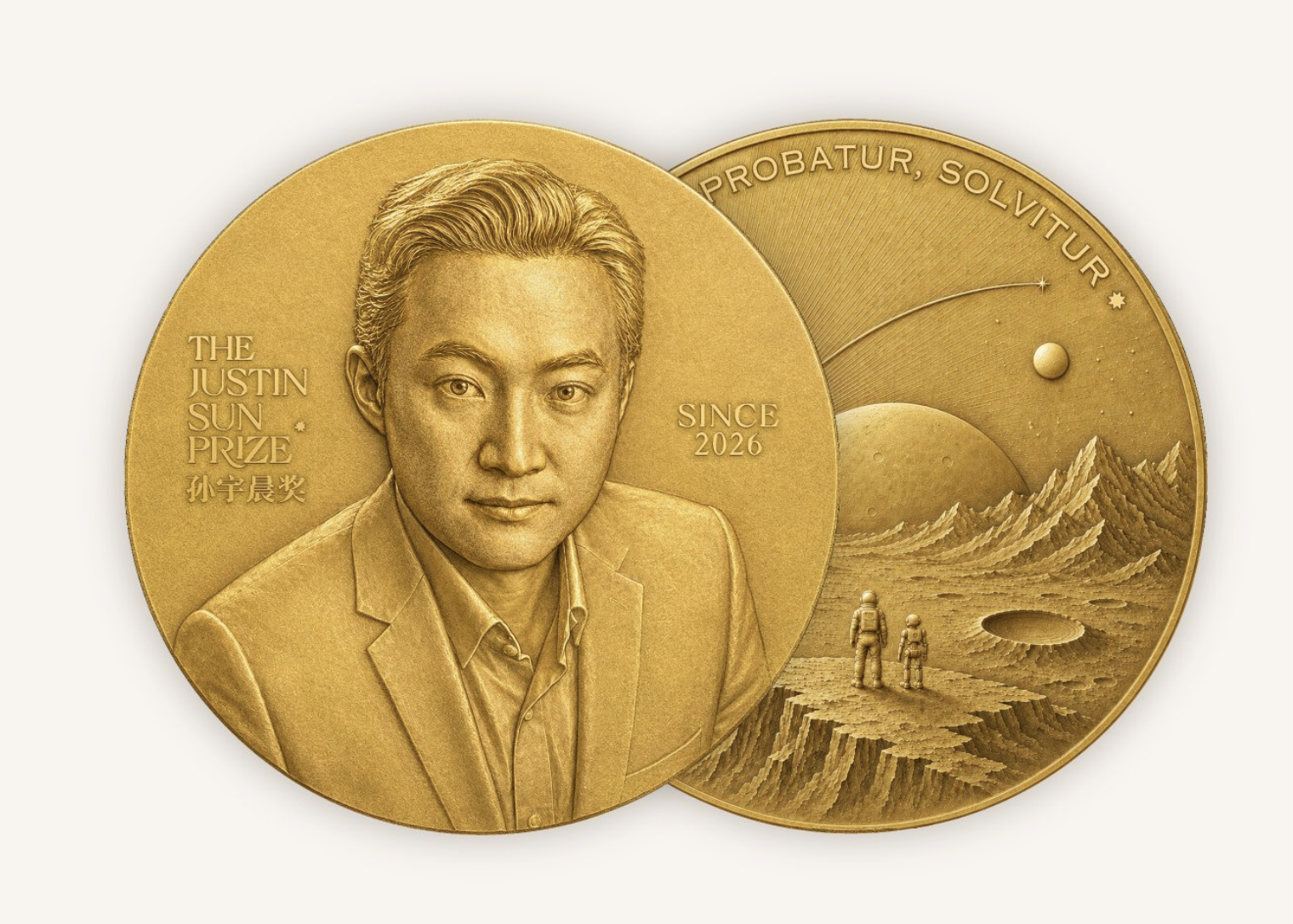
There is one more thing: why this award bears my name.
Two reasons.
First, awards named after people are the least political things in the world. Nobel, Fields, Abel, Turing, Wolf, the most enduring awards in mathematics and science are almost all a person's name. Countries may change, organizations may rename, companies may close, but once a person's name is engraved on the award, no one can change it again.
Second, it is an explanation for myself. I am thirty-six years old, and the wealth I have accumulated exceeds what I need. If one’s wealth has no direction, it will ultimately become a topic for inheritance disputes and auction records. I want to take this opportunity while still clear-headed to personally point a path for this money: it comes from mathematics, and it shall return to mathematics.
As for my own controversies, the list is the only answer. I do not require anyone to believe now.
The Justin Sun Prize can afford to wait.
Ten
One last thing. This award does not require anyone to trust anyone; you only need to believe in the machine's verification, and the machine only recognizes logic. The initial prize pool has already been injected into the blockchain, the address is public, and the balance is visible to the whole world. I only keep the right to add money to it.
Every awarded proof will be made public, and anyone can verify for themselves whether it holds, without needing to trust me or any committee. Each bonus disbursement will be recorded on the chain, public, unchangeable, and verifiable even a hundred years later. Once a proof is established, it remains established forever; I hope that the compensation for the prover is also of this nature.
I am not a mathematician. I am an observer, I pay. The rest is left to the proof.
Justin Sun
免责声明:本文章仅代表作者个人观点,不代表本平台的立场和观点。本文章仅供信息分享,不构成对任何人的任何投资建议。用户与作者之间的任何争议,与本平台无关。如网页中刊载的文章或图片涉及侵权,请提供相关的权利证明和身份证明发送邮件到support@aicoin.com,本平台相关工作人员将会进行核查。


