Author: JR Research
Translation: Deep Tide TechFlow
Introduction by Deep Tide: Alphabet's stock price has weakened since the summer, with the leading large model share falling behind OpenAI and Anthropic, as Meta's newly launched Muse agent further intensifies the competition. The author believes that Google's true strategic focus has shifted to Google Cloud and TPU: with cost-effectiveness advantages, chip sales, and cloud infrastructure options, it is expected to push revenues to around $730 billion by FY2028; maintaining a buy rating, viewing the current valuation near historical averages as an entry window before a TPU-driven rebound.
Key Points
- Alphabet's summer correction deepened, with the AI model track lagging behind OpenAI and Anthropic, and Meta's newly launched Muse agent further escalating competition.
- GOOGL's strategic focus is now on Google Cloud and proprietary TPU hardware, which offers better cost-effectiveness and is expected to open up revenue diversification outside of advertising.
- TPU sales and infrastructure options are viewed as critical growth engines, with Wall Street expecting revenues to reach about $730 billion by FY2028.
- The author maintains a buy rating, believing the current valuation is closer to historical averages, making it a suitable entry point before a potential TPU-driven rebound accelerates.
Google's "Summer Slump" is Not Over
Alphabet (GOOG) (GOOGL) investors have experienced quite a hot summer. Since the stock peaked in May, it has hardly regained momentum.
For the past three to four months, Google shareholders have been digesting whether the company can still sit in the front row after gradually loosening its grip in the leading AI race and amid dramatic environmental changes.
OpenAI and Anthropic have widened the gap, especially as OpenAI's programming model has grown increasingly popular since the release of GPT 5.6 and the upgrade to GPT 6 Astra.
Google’s AI Models Are Still a Distant Third
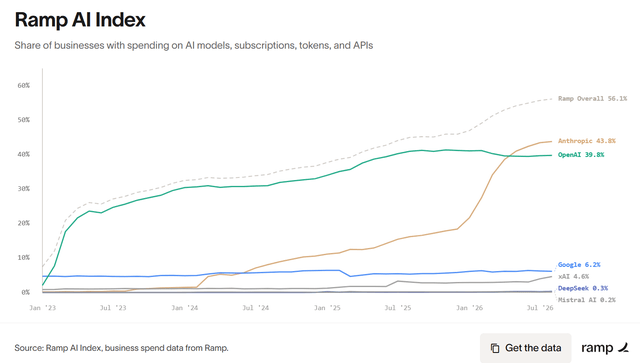
However, Anthropic remains firmly at the forefront of agent-based AI workflow transformation. This lead seems unlikely to be overturned by Google in the near term, where it remains a distant third in the leading AI model camp in the U.S.
Google's predicament has obviously deepened due to Meta (META) launching its personal AI agent Muse just this week.
The author believes this is a major step towards CEO Mark Zuckerberg's grand ambition for "personal superintelligence."
Where the Muse project will ultimately lead is still too early to conclude. However, Wall Street is increasingly convinced that it will elevate Meta's AI model engagement and open up more robust monetization possibilities through a free-to-use value-added tier. This week, it quickly rose to third place among free apps on the Apple iOS store.
In a previous Google update, the author mentioned that the market was highly concerned about its weakening free cash flow margins. However, management has made it very clear: Google Cloud is now the North Star driving the growth inflection point—not only serving Google’s own AI models but also opening up enormous growth options for deploying TPU-based infrastructure.
Google TPU Has Proven Its Cost-Effectiveness
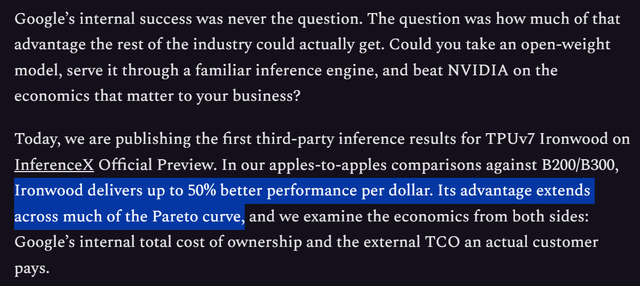
This has been verified: Google TPU is back in the spotlight due to its high cost-effectiveness. According to SemiAnalysis's InferenceX benchmarks, Ironwood (TPUv7) can deliver up to about a 50% increase in performance per dollar.
This naturally raises market expectations for transitioning to TPUv8 for both inference and training, opening dedicated scenario opportunities at both ends.
More importantly, Google is not only challenging Nvidia on hardware cost performance but is also attempting to weaken the advantage of the CUDA software stack.
If the current surge in AI capital expenditure continues unchecked, the world is starting to recognize that major tech companies may risk falling into negative free cash flow margins.
Cooling Token Spending May Benefit TPU Sales
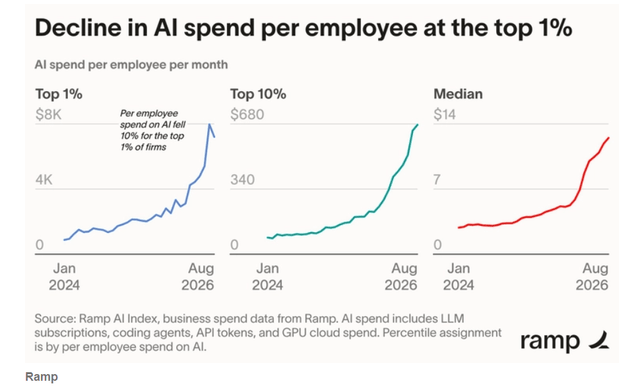
Ramp's recent update corroborates this: the top 1% of companies spending on AI have seen per employee expenditures drop from about $8,000 in July to just over $7,200 in August.
Therefore, Google's message is very clear—there is not just one way to access Google AI infrastructure. Google Cloud CEO Thomas Kurian emphasized these routes in a recent meeting:
- Access through subscription cloud services;
- Direct purchase of hardware and complete systems;
- Access through its "neocloud" channel developed in partnership with Blackstone.
TPU May Become Google's Largest Growth Opportunity
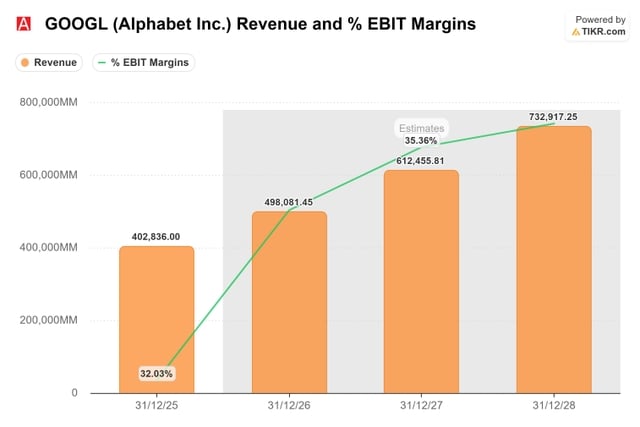
The options for chip sales will be a key driving force for Google to pivot from an advertising model to revenue diversification. According to updated consensus expectations from Wall Street, FY2028 revenues are expected to approach about $730 billion.
In the context of expanding AI computing supply, concerns about whether token pricing can hold may also prompt investors to examine Google TPU more closely—especially given its reported cost advantages.
During this episode of frenzied AI capital expenditure accumulation, free cash flow margins have been rapidly compressed, further emphasizing the importance of the TPU story.
Should You Buy or Sell GOOGL?
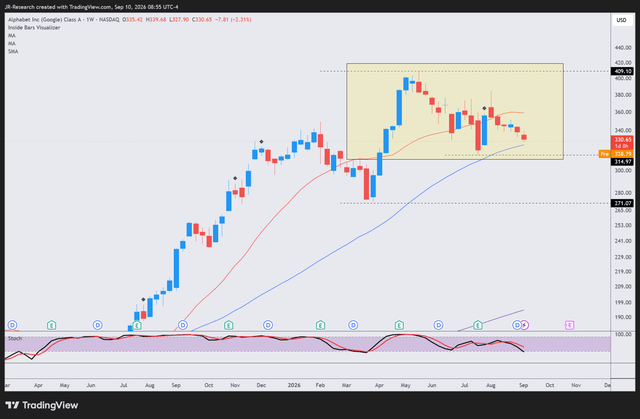
The market remains relatively indifferent to reentering Google stock: after spiking to around $400 in May, the stock price has significantly retreated.
This hesitation is largely related to the market still waiting for Google to prove—after the release of Gemini 3.8 Flash—whether its AI programming capabilities can truly improve.
This may explain why Google’s stock price still struggles to find momentum but is now getting closer to the low point in June, slightly below $315.
The author expects bottom-fishing capital to be more actively entering around this area: Google’s stock price has also significantly retreated to a level closer to the long-term five-year average forward P/E ratio of about 22.6 times, currently slightly below 25 times.
GOOGL is not exactly cheap, but it's also nowhere near as expensive as it was during the highs of May and June—when the forward P/E ratio once exceeded 30 times.
The author has not yet seen a rush of bottom-fishing, believing that investors are more inclined to observe how TPU business growth opportunities are realized.
As more cautious investors give the newly refreshed AI models more time to regain traction, the current moment should be seen as a timely buying window before an acceleration in reversals.
Rating: Maintain Buy.
Disclosure
Analyst Disclosure: The author/team holds beneficial long positions in GOOGL and META through stocks, options, or other derivatives. This article is written by the author, expressing their personal opinion. Apart from Seeking Alpha, the author has not received compensation for this article and has no business relationship with the companies mentioned in the text.
Seeking Alpha Disclosure: Past performance does not guarantee future results. This article does not constitute investment advice for any specific investor. The above views may not represent the overall position of Seeking Alpha. Seeking Alpha is not a licensed broker-dealer, agent, U.S. investment advisor, or investment bank; its analysts are third-party authors, including both professional investors and individual investors who may not hold any institutional or regulatory licenses or certifications.
免责声明:本文章仅代表作者个人观点,不代表本平台的立场和观点。本文章仅供信息分享,不构成对任何人的任何投资建议。用户与作者之间的任何争议,与本平台无关。如网页中刊载的文章或图片涉及侵权,请提供相关的权利证明和身份证明发送邮件到support@aicoin.com,本平台相关工作人员将会进行核查。


