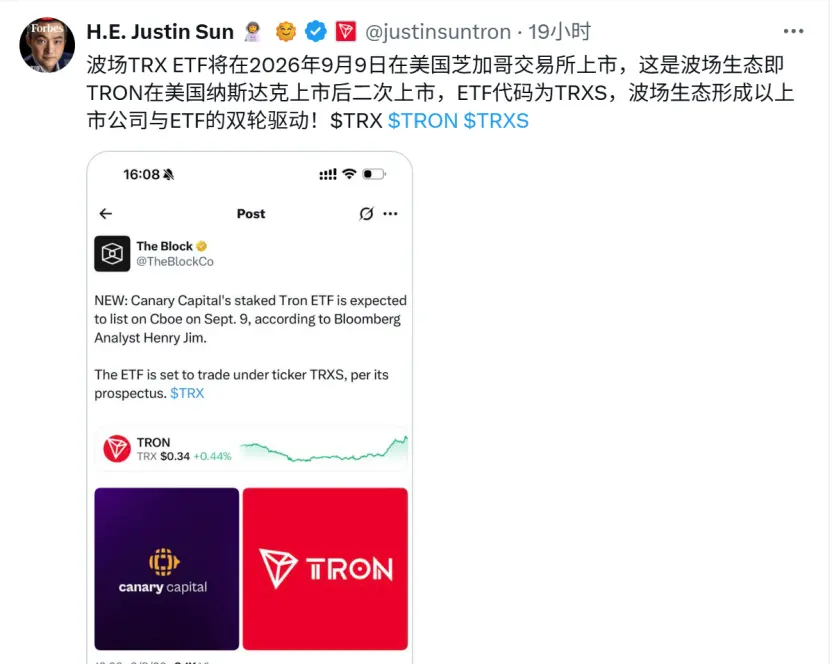
On September 8, TRON founder Justin Sun posted on platform X stating that the Canary Staked TRX ETF will be listed on the Cboe BZX Exchange in the United States on September 9, 2026, with the trading code TRXS. Following the entry of TRON Inc, a company related to the TRON ecosystem, into NASDAQ, TRX will also enter the mainstream securities market in the United States through the ETF. Justin Sun stated that the TRON ecosystem is forming a dual-drive pattern of "public companies + ETF".
For TRON, the significance of this ETF listing is not just an additional investment channel. Over the past few months, TRON's on-chain accounts, stablecoin scale, layout in the U.S. capital markets, and AI business have been setting new phase records, with several business lines achieving breakthroughs in the same period. This also indicates that TRON is shifting from on-chain scale expansion toward a broader stage of institutionalization and globalization.
TRXS does not only track TRX prices but also participates in on-chain staking
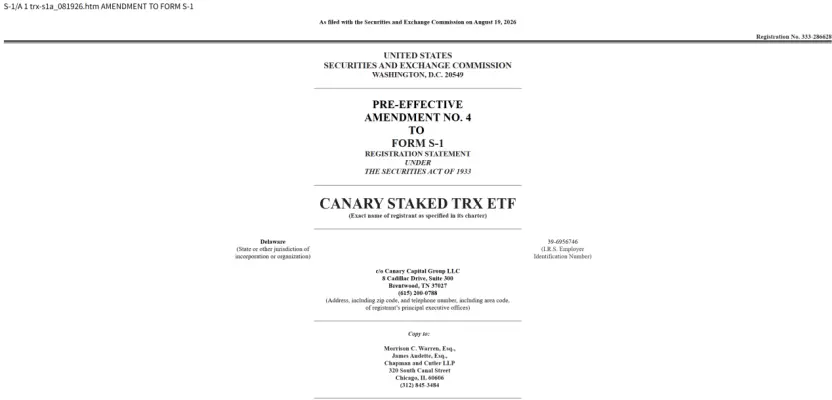
According to the S-1/A document submitted by Canary Capital to the U.S. Securities and Exchange Commission (SEC) on August 19, the primary goal of the Canary Staked TRX ETF is to provide investors with exposure to TRX prices while obtaining additional TRX by participating in staking on the TRON network.
From the product design perspective, TRXS differs from a conventional spot ETF that merely holds crypto assets. The document indicates that the fund plans to stake essentially all qualifying TRX, with the staking rewards accounted as fund assets after deducting related fees. Staking service-related fees are estimated to account for about 20% of the staking rewards, with approximately 80% retained by the fund. The attributable rewards will also be reflected in the daily net asset value (NAV) of the fund.
In other words, future earnings from traditional securities accounts will not be limited to just TRX price exposure; the staking income generated from the TRON network itself is also integrated into the ETF's product structure.
For TRX, this enables its on-chain staking mechanism to enter the broader traditional financial market for the first time through the ETF product.
Before TRXS, the TRON ecosystem had already connected with the U.S. public market through the publicly traded company TRON Inc.
TRON Inc. is traded on NASDAQ and uses TRX as its core digital asset reserve. The company has continued to increase its TRX holdings and plans to further participate in the infrastructure construction of the TRON network. As of early September 2026, TRON Inc. holds over 712 million TRX and is still expanding its TRX digital asset reserves.
After the listing of TRXS, the investor demand for the two types of products is not entirely the same. TRON Inc. is closer to being a public company centered around TRX reserves and ecosystem operations, while TRXS directly provides exposure to TRX assets and staking income.
Thus, rather than saying that TRON is "re-listing," it is more accurate to say that TRX has gained another important entry point into the U.S. capital market. Both stocks and ETF as public market instruments also provide traditional investors with more diversified ways to engage with the TRON ecosystem.
400 million accounts, $94.2 billion USDT, on-chain scale continues to break records
Outside of capital markets, the recent on-chain data of TRON is also reaching a new magnitude.
As of August 23, 2026, the total number of on-chain accounts on TRON officially surpassed 400 million. The network has processed over 15.4 billion transactions, with a total transfer amount approaching $30 trillion.
Stablecoins remain the core business foundation of TRON.
Currently, the issuance scale of USDT on the TRON network has reached $94.2 billion, surpassing other blockchain networks such as Ethereum, becoming the largest USDT issuance network in the world.
This data illustrates more about TRON's current usage structure than simply the number of accounts. A large number of on-chain activities on TRON revolve around USDT, from exchange deposits and withdrawals, personal transfers to cross-border payments, fund settlements, and DeFi; stablecoins have become the primary asset flow carrier on the network.
This advantage has been continuing to amplify this year. In the second quarter of 2026, the USDT transfer volume processed by the TRON network was approximately $2.1 trillion; previously disclosed data also indicated that TRON's daily USDT transfer volume reached about $25 billion.
From a stock of $94.2 billion to hundreds of billions circulating on-chain daily, TRON's competitive focus in the stablecoin market is no longer just about "how much USDT has been issued," but whether these stablecoins truly see high-frequency circulation. For payment and settlement networks, the latter is closer to real usage conditions.
B. AI daily Token throughput surpasses 1 trillion, AI business rapidly expands
Apart from the stablecoin business, the AI platform supported by TRON, B. AI, has also shown significant growth recently.
As of early September, B. AI's user count had surpassed 2.4 million, with the platform's daily Token throughput peaking above 1 trillion. Since the free activity launched on August 17, there have been over 220,000 new API users, with a cumulative throughput exceeding 10.9 trillion tokens, supporting over 8.956 million API calls.
This growth rate clearly exceeds the scale at the initial launch of B. AI. After its launch in April of this year, B. AI initially mainly provided large model aggregation and API services, gradually increasing its product capabilities with model integration, AI Agents, AI programming, etc., and expanding its customer base from ordinary AI users to developers and Agent scenarios.
B. AI and TRON currently belong to different business systems, but there is a noteworthy point of convergence: payment.
If AI Agents are to truly participate in commercial activities, they ultimately need to complete payments, settlements, cross-border transfers, and other actions. Traditional payment systems require accounts, banks, and human authorization, while stablecoins naturally support 24/7 operation and are easier to embed into programmatic processes. TRON has already supported over $94.2 billion in USDT, while B. AI is rapidly accumulating AI users, developers, and model calls, providing a realistic foundation for the future integration of AI Agents with stablecoin payments.
In recent times, TRON has continuously achieved progress in multiple directions, including on-chain scale, stablecoins, capital markets, and AI. The listing of TRXS has further broadened the channels connecting TRX to traditional financial markets, advancing TRON's ecosystem's globalization and institutionalization process.
As the core business foundation continues to expand and new businesses gradually scale, TRON's ecological boundaries are also being continuously extended. From public chain infrastructure and stablecoin networks to capital markets and AI scenarios, TRON is entering a more diversified stage of development.
免责声明:本文章仅代表作者个人观点,不代表本平台的立场和观点。本文章仅供信息分享,不构成对任何人的任何投资建议。用户与作者之间的任何争议,与本平台无关。如网页中刊载的文章或图片涉及侵权,请提供相关的权利证明和身份证明发送邮件到support@aicoin.com,本平台相关工作人员将会进行核查。


