Author: Deep Tide TechFlow
Today, there was a strange movement in the AI sector of the crypto market:
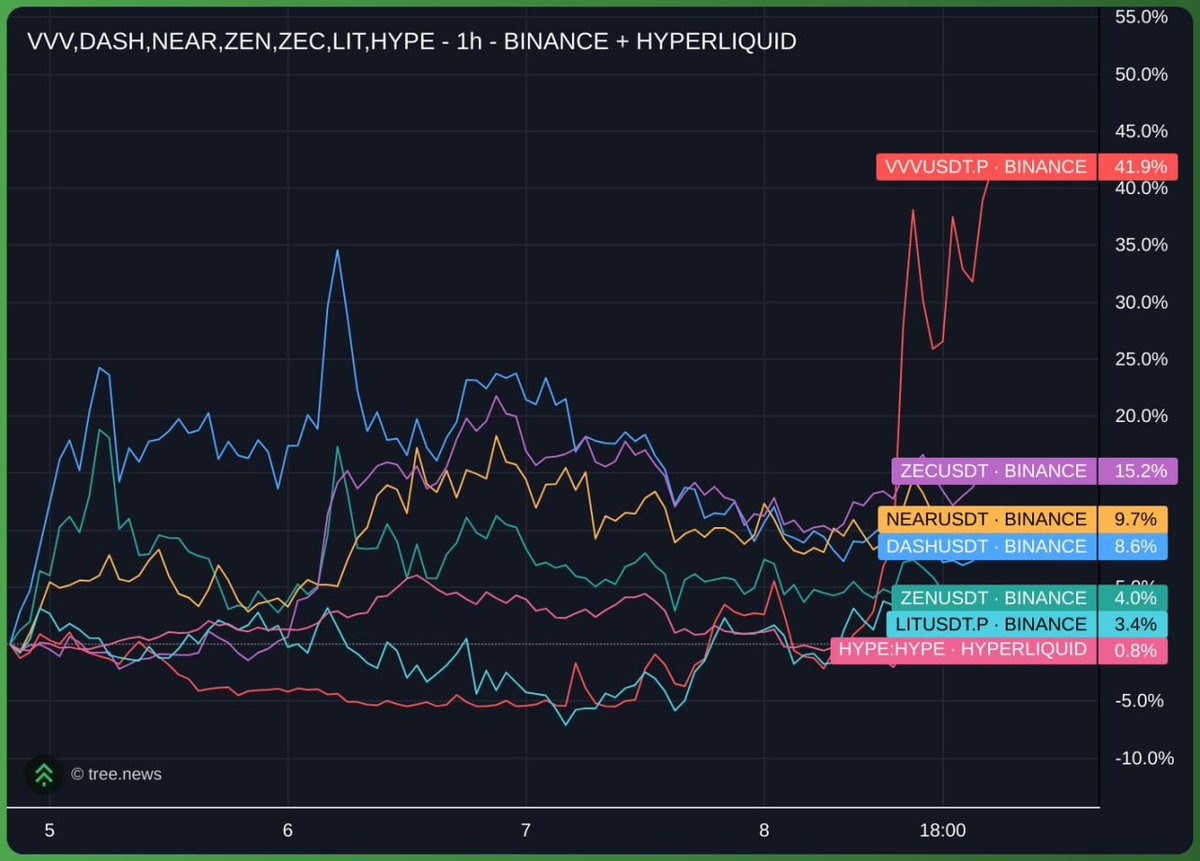
The privacy-focused Venice ($VVV) surged nearly 40% in a single day, with its price briefly surpassing $25, setting a new all-time high.
This also led to the individual who "defected" by liquidating their Ethereum holdings at the end of May this year ultimately making a considerable profit. David Hoffman, co-founder of Bankless, previously sold his ETH that he held for six years and then bought LIT, ZEC, NEAR, HYPE, and VVV.
Reference reading: The Bankless founder who liquidated ETH profited significantly in three months
In this portfolio, the only one that had not performed was $VVV. Thus, the mogul's new investment strategy completed the puzzle of "everyone surging".
Many players who focus on on-chain data might attribute this breakout to its strong fundamentals:
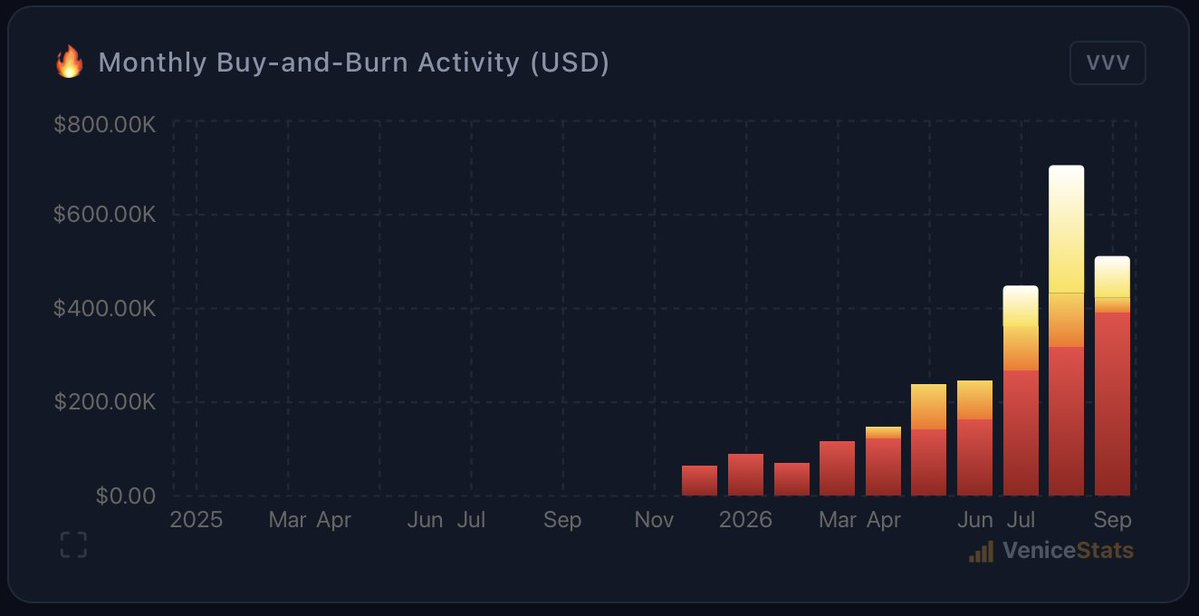
Venice just set a new record of $390,000 in token buyback and destruction in September. While the fundamentals are indeed solid, what truly ignited this violent surge was certainly the sensationalist narrative and emotions at play.
There is a voice on social media that suggests the rise of VVV is part of a conspiracy by foreigners. Excluding the jokes and conspiracy theories, they are indeed promoting the old “Private AI” narrative, but the direct trigger might be that the English crypto Twitter leveraged a sudden AI scandal to push the "Private AI" narrative back to the forefront of heat in the short term.
The catalyst for this old wine in a new bottle is the "academic spy gate" scandal that erupted over the weekend.
An academic "Rashomon" that awakens the old narrative of privacy AI
Privacy AI is not a groundbreaking new concept, but generally, it is often seen by the market as a lukewarm geek slogan due to its "lack of real pain points".
However, when a negative event occurs, people start to emphasize the importance of privacy again, and attention and liquidity will concentrate and flow into it, becoming the reason for the token to be hyped.
The core figures of this incident are two mathematicians (Tristan Buckmaster and Levent Alpöge).
Over the past year, the two have been advancing an extremely hardcore mathematical proof of fluid equations, and in the process, they fed a large number of unpublished drafts to OpenAI's code tool Codex.
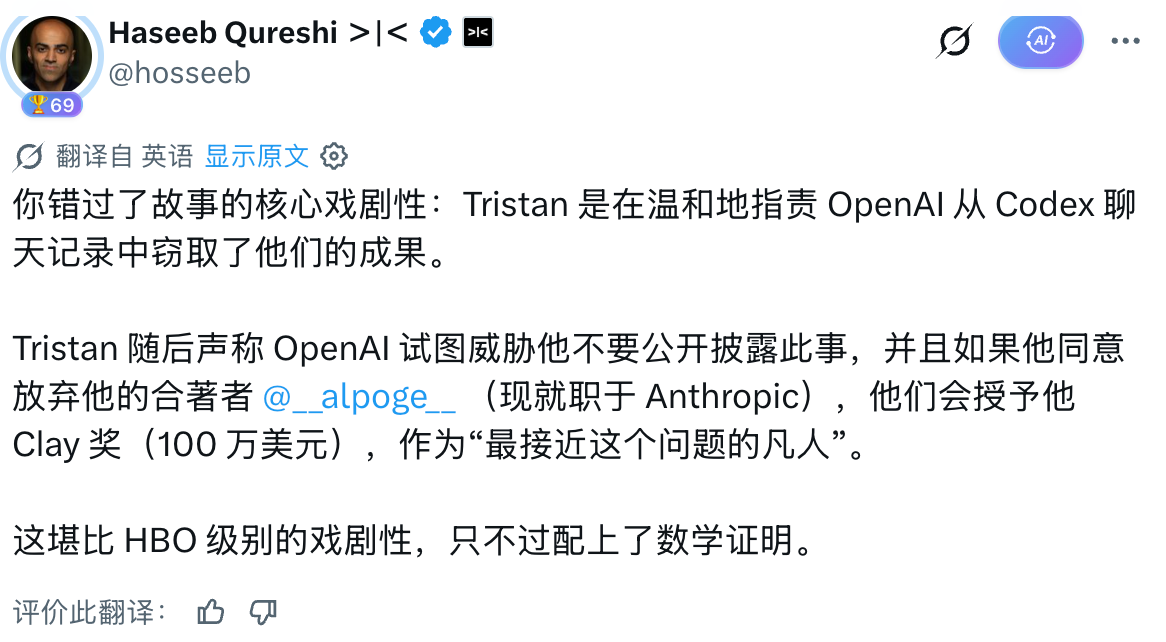
A dramatic scene unfolded in early September. When Tristan privately clarified the research to OpenAI, OpenAI’s researchers surprisingly claimed in a call a few days later:
That their internal model also proved it using the same extremely niche technical route, creating hundreds of pages of proof.
When questioned whether they had looked at user drafts in Codex, OpenAI was vague and avoided answering whether they had used training data.
According to reports, OpenAI even proposed an extremely domineering release plan during negotiations and allegedly used a $1 million "Clay Mathematics Institute Prize" to intimidate the mathematicians into silence, bluntly asking, "Why would you ruin your career?"
Although OpenAI later rushed to deny this, the Rashomon effect sparked a deep trust crisis between the tech and crypto communities.
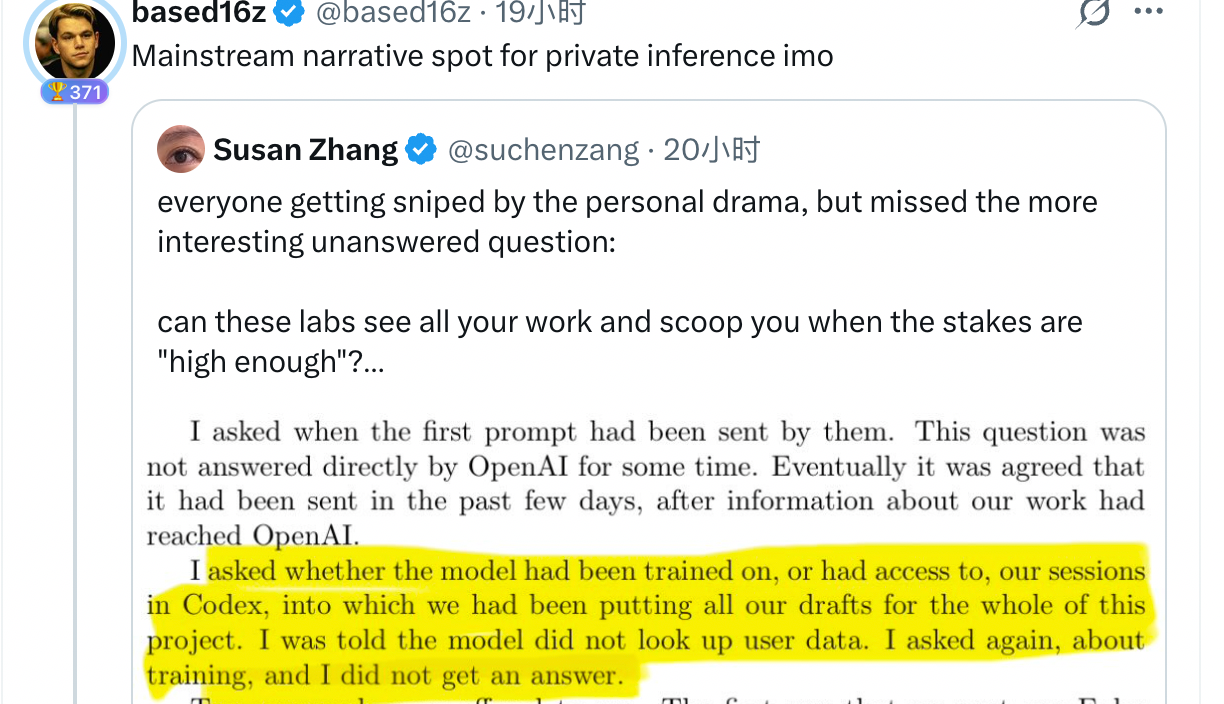
As former OpenAI and Meta engineer Susan Zhang pointedly noted, while everyone is busy watching personal disputes, they overlook the most fatal question:
When the stakes are high enough, can these top AI labs really not see your private work or even preempt it?
In the rush for privacy AI, who is selling shovels?
David Hoffman asserted on Twitter: "Frontier AI labs will systematically steal user data to gain an edge in competition. This is an arms race."
Of course, this statement stems from his holding of VVV and interpreting it as a narrative of resistance against closed-source AI labs.
Whether or not there is a conflict of interest, the collective panic over closed-source data hegemony has indeed become a mainstream sentiment on crypto Twitter today, combined with the surge of $VVV, a narrative of short-term attention and hype has emerged.
The VVV project focuses on end-to-end encryption, does not collect user data, is extremely rare among VC tokens to have real Web2 business revenue, and has achieved deflationary destruction for seven consecutive months.
These have all become reasons to be bullish on it after emotions ebb out.
However, after the explosive surge, VVV has peaked, and the risk of FOMO has increased dramatically. In this renewed excitement around privacy AI, who are the beneficiaries that have yet to be fully priced in?
Following Venice's business logic and digging to the core, the crypto community is looking favorably at an underlying infrastructure.
For Venice to achieve its touted "end-to-end encrypted privacy inference service", it requires extremely hardcore decentralized computing power and confidential computing infrastructure to support it.
An analyst pointed out that the underlying service provider for Venice is NEAR Protocol's AI Cloud. And benefiting from the surge in VVV's popularity, NEAR has openlyclarified this deep binding relationship:
Venice's end-to-end encryption runs on the NEAR AI Cloud, allowing users not only to anonymously exchange $VVV on NEAR but also to stake for premium services. The entire "confidential AI + DeFi" closed loop relies on NEAR's infrastructure.
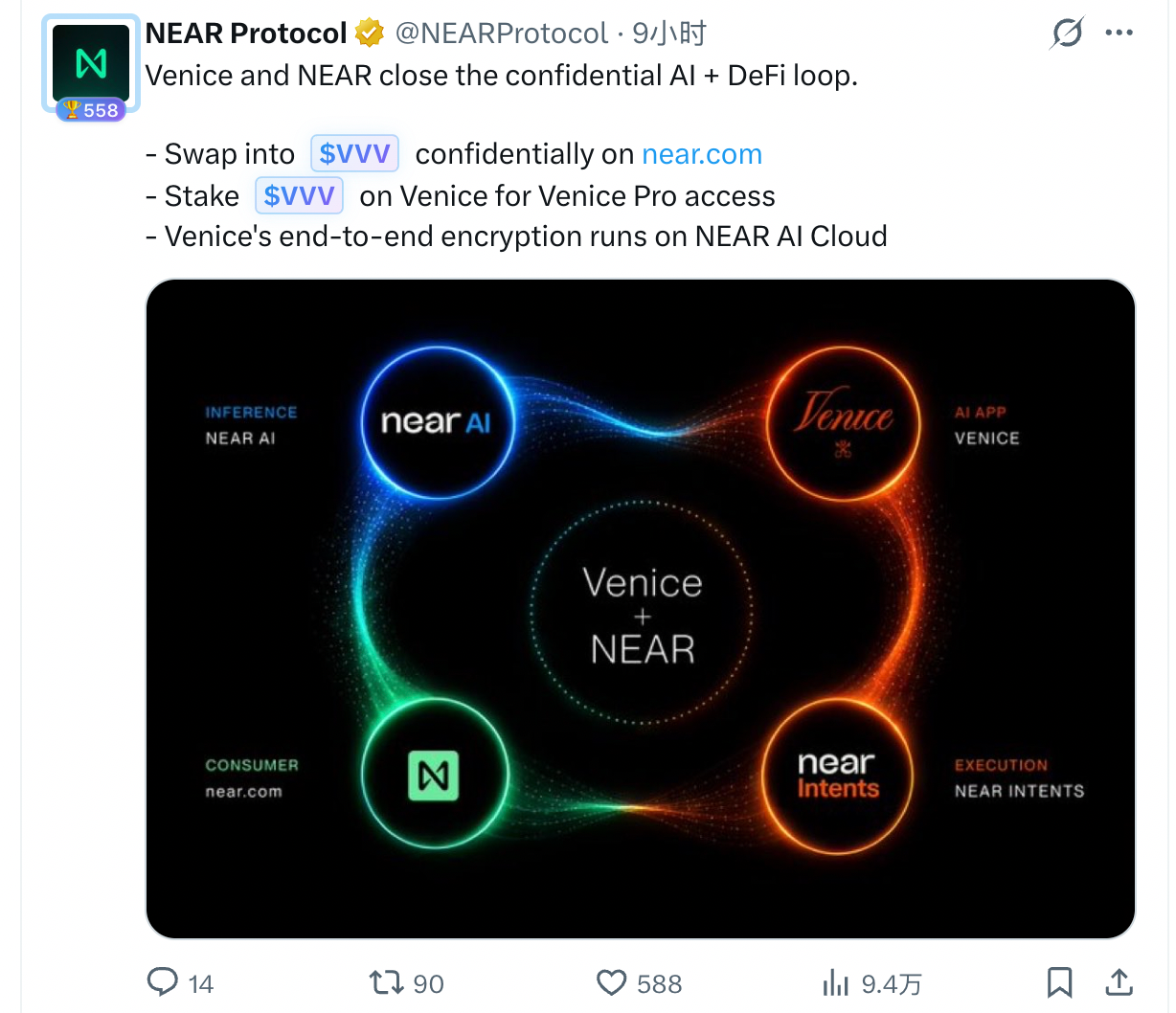
Of course, the above is just an emotional resonance in the heat of the narrative; whether any funds have actually entered a legacy token like NEAR still requires further on-chain analysis for confirmation or refutation. However, this reasoning of finding related assets when a leading token rises is applicable in every round of regional surges.
For instance, when Robinhood's Pons generated revenue due to the token issuance hype, and the token surged, many people considered positioning in Uniswap behind the token launch on the Robinhood chain and Arbitrum providing technical permissions for this chain; even after UNI confirmed its increase, some more Degen players even considered Sushiswap.
Upon deeper investigation, one may find that this logic does not hold 100% of the time, but making every effort to ride the wave in narrative rotations is indeed an effective approach.
Note: The above information is a synthesis from crypto social media and is not investment advice. Crypto tokens are highly volatile and carry significant risks; please DYOR.
免责声明:本文章仅代表作者个人观点,不代表本平台的立场和观点。本文章仅供信息分享,不构成对任何人的任何投资建议。用户与作者之间的任何争议,与本平台无关。如网页中刊载的文章或图片涉及侵权,请提供相关的权利证明和身份证明发送邮件到support@aicoin.com,本平台相关工作人员将会进行核查。


