Written by: Rita
The semiconductor capital equipment industry is continually breaking previous supply ceilings, but market interest in more upward movement is cooling.
On September 7, Morgan Stanley released a report on the SPE industry, presenting seven key debates. Morgan Stanley believes that the market is facing a critical divergence: WFE forecasts are being continually revised upwards, but investors are becoming increasingly unwilling to buy into incremental upside without clearer evidence of cycle sustainability. Morgan Stanley recommends targets that the market has priced as “peaking in 2027”, including AEIS, MKS, and ONTO. Morgan Stanley maintains a "Market Perform" rating for the US SPE industry.
Why SPE stocks are not rising: two explanatory frameworks
Morgan Stanley points out that the market's hesitation regarding SPE stocks arises from two interrelated but logically distinct frameworks.
The first is the AI capital return framework. SPE is part of the investment logic for AI infrastructure, where the expansion of semiconductor capacity directly correlates with the GW-level deployments of hyperscale vendors. If investors lack confidence in the pace of GW deployments, such as delays in data center construction or pressure on the bonds or credit default swaps of hyperscale vendors, then stocks related to AI infrastructure are hard to buy. Morgan Stanley believes that while the market's judgment on the fundamentals has not changed, the way these fundamentals are viewed has. Given Morgan Stanley's discomfort with the further upward revisions of WFE, it is adopting valuation multiples based on cycle bottoms for earnings per share for 2027 or 2028.
The second is the full expectations framework. Market expectations for WFE in 2027 and 2028 are nearing saturation, with buy-side expectations heard by Morgan Stanley around $230 billion and over $300 billion, while Morgan Stanley's forecasts are $223 billion and $254 billion. The market believes that the further upward revision space is limited, hence adopting valuation multiples based on cycle bottoms as well.
How WFE translates to computing power
Morgan Stanley updated the demand estimation of WFE corresponding to each GW of computing power. Although the specifications for the Rubin Ultra have not yet been finalized, Morgan Stanley estimates the WFE demand for each GW to be around $3.4 billion, meaning that for every $100 billion in AI capital expenditure, there corresponds about $7 billion in WFE demand. This estimate is lower than the $9 billion to $10 billion provided by Lam Research, as Morgan Stanley's analysis only focuses on Nvidia, not considering Google TPU or Amazon Trainium.
Based on this framework, Morgan Stanley's internet team predicts that hyperscale vendor capital expenditures will reach $1.2 trillion in 2027, corresponding to 29GW of computing power. This translates into incremental WFE demand of about $87 billion to $125 billion starting in 2025. Assuming the non-AI end market doesn't gain incremental capacity, this means WFE in 2027 will be around $204 billion to $242 billion, with Morgan Stanley's forecast at $223 billion, positioned in the middle of the range.
Previous bull market scenarios have largely been fulfilled
Several bull market drivers previously predicted by Morgan Stanley have largely been realized. Intel pointed out in its recent earnings report that capital expenditures in 2027 will be significantly higher than those in 2026 and raised $20 billion in equity. Kioxia's announcement of increased production with Solidigm in Dalian indicates that new NAND projects have been recognized by the market. Memory manufacturers are deploying capacity as early as possible, with Morgan Stanley expecting Lam Research, Applied Materials, and Tokyo Electron’s DRAM shipments in the December quarter to exceed $6 billion.
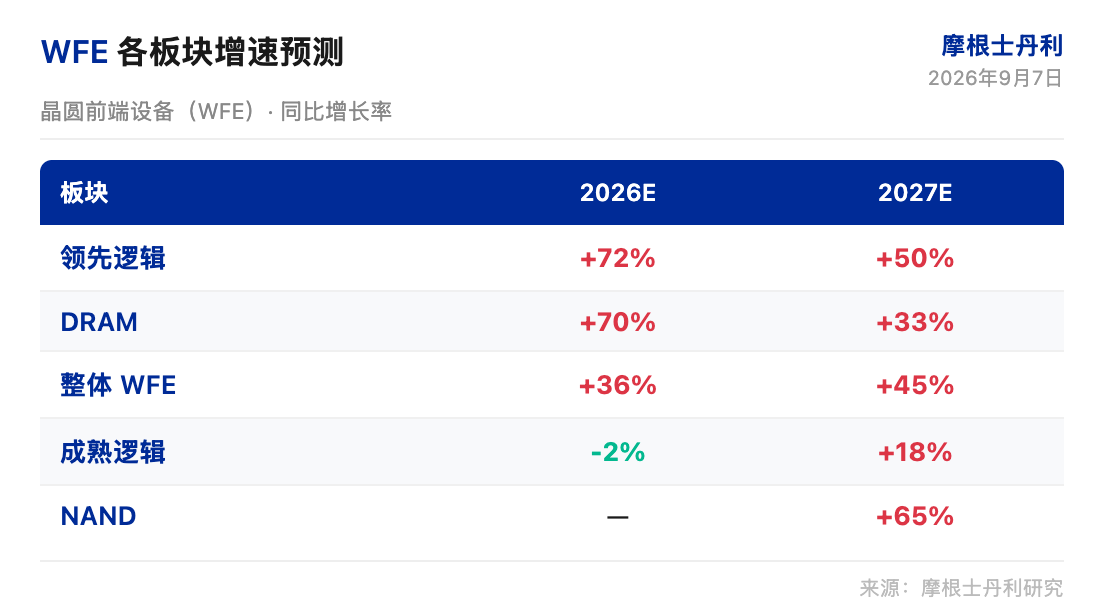
New increments may come from three areas. From Terafab, Morgan Stanley expects WFE contributions of about $2 billion per year from 2027 to 2028, increasing to $6 billion in 2029. In the mature logic area, Morgan Stanley predicts a 2% decline in mature logic in 2026, followed by an 18% increase in 2027. Morgan Stanley believes that the market is underestimating the resilience of the mature process recovery.
DRAM supply and HBM decoupling
DRAM bit supply has increased by 36% to date in 2026, with TrendForce predicting a growth of 31% for the entire year. Morgan Stanley's model shows that the bit supply growth for 2026 and 2027 is 32% and 38% respectively, with HBM bit growth at 55% and 57%.
The transition from 12-layer to 8-layer HBM has attracted market attention. Morgan Stanley points out that reducing from 12 layers to 8 layers does not mean that all processing steps decrease in proportion. SK Hynix has noted that chips stacked at 12 layers are 40% thinner and have 13% narrower gaps than 8-layer chips, significantly increasing control difficulty. Morgan Stanley believes that if the HBM roadmap cannot evolve to 16 layers and above, the demand for hybrid bonding will weaken, and the intensity of process control will be difficult to improve further.
Intel's share may face reshuffle
Intel has historically been an important customer for Applied Materials and Tokyo Electron, with both companies historically accounting for nearly the same share of Intel's capital expenditures. However, Morgan Stanley believes that since Pat Gelsinger took over as CEO of Intel and Naga Chandrasekaran began leading the foundry business in June 2024, Intel's manufacturing strategy has changed, potentially leading to a redistribution of supplier shares.
The most obvious example is the intensity of process control equipment. Morgan Stanley estimates that the share of process control in Intel’s WFE has risen from around 6% in 2023 to about 10% in 2026, with KLA and Onto Innovation already beginning to benefit from this.
Valuation misalignment between subsystems and OEMs
Morgan Stanley points out that the inventory dynamics of the current cycle are different from previous ones. The absolute inventory of Applied Materials and Lam Research has risen by 8% over the past two quarters, but inventory turnover days have decreased by 19 days, as both companies have consumed inventory to meet urgent orders from customers. Inventory turnover days have fallen to the lowest point since December 2021.
Morgan Stanley believes that the valuations of AEIS and MKS are misaligned. Subsystem suppliers are expected to perform better in this cycle than in previous ones, as OEMs do not have backlogged subsystem inventories to consume. When the cycle slows down, Applied Materials and Lam Research will not face the negative impact of subsystem inventory in the same way as in the last cycle.
However, AEIS and MKS's current valuation levels seem to be priced as "early cycle" stocks, while OEMs are valued based on 2028 earnings. Morgan Stanley believes this misalignment is mispriced, as the inventory de-stocking factors that led to the underperformance of subsystem suppliers in the previous cycle are unlikely to repeat to the same extent in this cycle.

Disclaimer
This article is a compilation and interpretation of the research report from third-party brokerage (Morgan Stanley, September 7, 2026) by Chao Xiang Research, in conjunction with publicly available market information. The ratings, target prices, earnings forecasts, and related judgments mentioned in the text represent the views of the brokerage's analysts and solely reflect the position of their institution, not the views of Chao Xiang Research, and do not constitute any investment advice.
The market is risky; decisions should be independent. This article should not be used as the basis for buying or selling any securities.
免责声明:本文章仅代表作者个人观点,不代表本平台的立场和观点。本文章仅供信息分享,不构成对任何人的任何投资建议。用户与作者之间的任何争议,与本平台无关。如网页中刊载的文章或图片涉及侵权,请提供相关的权利证明和身份证明发送邮件到support@aicoin.com,本平台相关工作人员将会进行核查。


