Tokenization is a multiplier that breaks various compliance rules and access barriers by encapsulating and standardizing global assets.
Written by: Aleks Larsen, General Partner at Blockchain Capital
Translated by: Chopper, Foresight News
The financial industry has long faced high costs of asset encapsulation. Each type of asset has its own carrier, operating within its own system: a mortgage consists of a collection of countless contracts, PDF files, databases, and service agreements; shares in private equity funds correspond to a subscription agreement and a line item in a transfer agent's form; stock holdings are dispersed across multiple records chains with brokers, custodians, and depository institutions, with numerous similar examples.
When assets flow between different institutions, it often requires breakdown verification, reconciliation, and then re-packaging to fit the receiving party's system. The root of the redundant work lies in the fact that different institutions maintain their own independent data records for the same underlying asset and收益凭证.
Looking globally, this market fragmentation generates huge implicit social costs. The world’s balance sheets harbor massive assets, yet the vast majority of these assets require tailored operational costs to flow freely across institutions. This friction hinders capital from flowing back into emerging businesses, infrastructure projects, residential real estate, and other areas with production value.
Tokenization fundamentally addresses this pain point. Tokens provide assets or financial收益凭证 with a standardized, machine-readable interaction interface. Once assets can be recognized and called in a shared network, exchanges, lending platforms, custodians, asset service providers, and applications can directly interface with the assets without repeatedly building a complete financial underlying architecture from scratch. Ultimately, capital markets will operate based on a universal programmable infrastructure, significantly reducing the friction costs of asset circulation, settlement, and activation.
To understand the logic of how tokenization reshapes the world, the shipping container is the most fitting analogy.
How Containers Catalyzed the Modern Global Supply Chain
Before the 1960s, the forms of cargo transportation were myriad: coffee packed in burlap sacks, machinery placed in wooden crates, cotton formed into bales, crude oil filled in barrels. Each type of commodity had its own unique loading and unloading requirements, with all cargo relying on manual labor for handling at the docks. Skilled dockworkers mastered a set of specialized techniques: tightly packing containers, balancing weight, securing cargo to prevent shifting or damage during sea transport. The fundamental reason for this cumbersome process was the lack of a unified loading container in global trade. The direct consequence was that ships spent far more time docking at ports than actually sailing at sea. Breakbulk cargo was frequently transferred, counted, and transported between ships, trucks, trains, and warehouses, leading to frequent incidents of damage, loss, or theft.
In 1956, North Carolina freight entrepreneur Malcolm McLean modified an oil tanker, the “Ideal-X,” sailing from Newark to Houston, carrying standardized containers. Upon arrival, trucks could directly take the containers away without the need to open them. The per-ton loading cost of Ideal-X was much lower than traditional breakbulk unloading methods, marking the birth of the modern shipping container.
In the following two decades, containers formed standardized ISO guidelines, and the entire supply chain restructured its divisions around the container, enabling specialized operations at each link. Ships were designed with vertical compartments to ensure safe stacking of containers; cranes were modified to high-speed lifting equipment suitable for standardized containers; truck chassis and railcars were produced according to unified dimensions and locking structures; ports evolved into massive transfer hubs, transporting standardized containers between various transportation modes.
The primary impact was a dramatic decrease in transportation costs (both time and money). The freight cycle from Australia to Europe was significantly shortened, and the carrying capacity of ships quadrupled. The types of traded goods began to shift towards finished products and intermediate goods, as companies split their production processes across different countries; new logistic service providers emerged, coordinating an increasingly complex global network, and the scale of supply chains expanded rapidly.
Furthermore, economic activity saw substantial growth. The World Bank estimates that within fifteen years after both trading parties adopted container shipping, the bilateral trade volume of developed countries increased significantly. With the restructuring enabled by containers and supporting infrastructure, global supply chains achieved scaled expansion, leading to rapid growth of the world economy.
Tokens are the Containers of the Financial Field
Tokens are the containers that carry financial收益凭证. What they carry is not physical goods, but various economic rights and operational states: asset ownership, circulation permissions, cash flow rules, access restrictions, and interaction logic callable by software programs.
Once assets have machine-readable standardized interfaces, exchanges can list them for trading, the lending market can use them as financing targets, custodians can be responsible for safeguarding assets, and wallets can automatically transfer cash flow. Various software applications can recognize assets and execute trading rules without needing to connect and develop separately with each cooperating institution. This is the essential difference between tokenization and merely electronic documentation or new database records: all market participants can treat tokens as a unified operational interface for assets. When this effect continues to accumulate across the entire ecosystem, the energy it releases will be immense.
Stablecoins are the most straightforward example demonstrating the potential of tokenization. Cross-border wire transfers through traditional banking systems often take days to transfer USD, while stablecoins can complete global transfers in seconds, with transaction costs nearly zero. The foundation for all this lies in the fact that numerous global exchanges, custodians, deposit and withdrawal service providers, payment institutions, and wallets recognize this set of token interfaces. They become a new kind of financial port, cranes, trucks, trains, and ocean freighters, relying on tokens to facilitate the transfer of value. This infrastructure was initially built for Bitcoin and Ethereum, and once the system is formed, stablecoins and other tokens can reuse this network. The prosperity of stablecoins also attracts more users, liquidity, applications, and infrastructure, while subsequently issued tokens will benefit from the continuously appreciating network effects.
Source: rwa.xyz
The results are evident, with a large-scale stablecoin circulating in the market, facilitating tremendous transaction flows, and the speed of capital turnover far exceeding traditional M1 and M2 money. The cost of cross-border remittances has decreased by an order of magnitude, enabling vast populations to access the USD payment system steadily. Stablecoins have validated the value of this USD network, achieving qualitative leaps in cost, speed, and coverage, significantly increasing the scale of economic activity leveraged by each dollar.
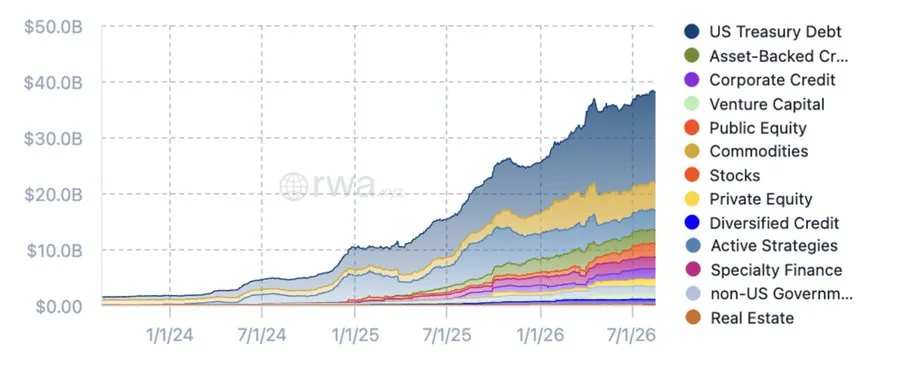
Now, this highly liquid pool of USD funds is attracting more assets to interface with stablecoin deposit channels. Currently, the size of RWA tokenized assets has grown approximately tenfold compared to two years ago, and the growth rate continues to accelerate. The subjects include US Treasuries, money market funds, commodities, private credit, stocks, and various fund shares, covering diverse global markets.
The Capital Market Will Be Reconstructed Around Tokens
Just as the global supply chain reshapes its structure around containers, the global capital market will also be rebuilt around tokens in the future. The DeFi sector has already begun showing its early form. One of the projects in our portfolio, Aave V4, allows qualified token holders to pledge assets to obtain floating rate credit in the lending market. The protocol contains a full set of trading rules, and the assets themselves determine the access thresholds. This completely disrupts the market structure of traditional lending. Nowadays, if individuals or enterprises wish to borrow by mortgaging assets, they must first connect with financial institutions. Institutions control the access permissions, reviewing borrowers according to their risk control processes and providing financial products through their channels. Financial services are reliant on institutional partnerships.
In the Aave ecosystem, the only criterion for access judgment is the asset itself. Smart contracts identify tokens, execute transparent rules, and connect directly to the funding market. The binding relationship between asset holders and financial services is fundamentally inverted: financial capability attaches itself to the asset itself rather than to the partnership between users and institutions.
In other words, tokens provide assets with executable capabilities akin to software. Once assets are connected to the public chain and recognized across the network, various applications can compete to provide layered value-added services: exchanges offer trading liquidity, lending markets provide financing capabilities, wallets automatically distribute cash flow, and so on. Asset issuers only need to complete a single on-chain process without needing to build separate systems for every application scenario.
This will fundamentally change the business models of financial institutions. Current banks, brokerages, and asset management companies bundle custody, underwriting, liquidity services, asset management, and compliance reviews, distributing within a closed product system. The encrypted network drives various businesses to be split and to operate independently with specialization. One institution handles credit disbursement and post-loan management, while other institutions provide funding, risk pricing, trade flow, insurance protection, or supporting application services. Assets freely circulate across modular services based on a unified interface without needing to re-input and build in every service provider’s system.
The focus of competitive advantages shifts from large institutions to open networks. In the traditional financial system, large institutions can cover a broader range of products because they can bear the fixed infrastructure costs corresponding to every type of asset and customer group. However, in a public chain encrypted network, a lot of underlying infrastructure is shared resources. New market entrants do not need to rebuild ledgers, exchanges, custodians, and settlement systems to connect assets, capital, and users, significantly lowering the startup and operational thresholds.
The network effect of stablecoins has entered a positive feedback loop. The capital market will gradually evolve into an open network with numerous specialized financial services revolving around tokenized assets. In this new paradigm, institutions will compete based on the quality of capital, underwriting capability, risk control levels, asset management, and distribution strengths, no longer competing on proprietary database ownership or monopolizing connections to the market for users.
Global Balance Sheets Will Eventually All Be On-Chain
The most critical outcome of this transformation is the creation of a boundary-less global capital market.
Currently, the capital market is bottlenecked by major institutions. The vast majority of individuals and enterprises cannot directly connect to the capital market and can only choose from a limited list of products that institutions are willing to provide. Institutions autonomously decide which customer groups to serve, which regions to cover, which asset classes to handle, and the transaction limits.
Investors likewise face reverse constraints; they cannot freely invest in all global assets but can only purchase items that institutions have underwritten, encapsulated, and distributed.
As a result, the vast majority of global economic value is isolated outside the existing capital market. Small accounts receivable, local infrastructure projects, private enterprises, emerging market credit, non-standard cash flows may possess economic value; however, the assets are too fragmented, geographically dispersed, and small in scale, causing traditional finance's high operational costs to inhibit financing for these assets. Investment opportunities indeed exist, and capital supply is also sufficient, but there is a lack of a connecting network between them.
Tokenization changes all of this by providing assets with a standard interface that allows them to be discovered on a global scale. When the financial system restructures based on this new interface, the participation costs for everyone will be significantly reduced. Finance becomes a software-native capability. Upper-layer applications can deeply explore niche asset classes and regional markets, reaching areas that traditional finance cannot cover. Business procedures that were historically unable to connect to high-end financial services can easily embed payment, operational financing, collateral management, and capital management functions, allowing a large number of dormant “sleeping assets” to enter the on-chain capital market. Objectively speaking, tokenization cannot magically provide funding support for assets that lack financing value, but many quality assets currently isolated from the system are expected to participate in market transactions in the future.
Artificial intelligence will further amplify this transformation, handling various operational tasks. AI entities can assess assets, price risks, allocate funds, manage collateral, and complete transaction settlements in a globally machine-readable market, continually driving down the cost of financial services. The combination of artificial intelligence and encrypted payment channels will transform formerly customized and intermittent trading markets into round-the-clock, global, automated markets, thereby creating more opportunities worldwide and breaking down institutional barriers to capital.
Capital allocation is the most fundamental regulatory tool of human society. It determines corporate expansion directions, scales of technology implementation, construction siting for housing and factories, and regional economic developmental patterns. For traditional financial systems, assets that are too small, localized, customized, or have excessive operational costs, once the costs of connecting, financing, and managing dramatically drop, are imbued with commercial underwriting value.
This too is a profound transformation brought by containers. Containers made new trading and production modes economically viable. Goods can be produced in the regions with the lowest costs, assembled elsewhere, and sold worldwide, significantly reducing the comprehensive costs of coordinating supply chains.
Tokens will replicate the same transformation for capital. In the coming decades, global balance sheets will transition from isolated records to an open market that can be autonomously traversed by software, as capital flows freely based on the inherent value of assets, no longer constrained by who controls financial channels. Stablecoins have already set an example: this system is expected to drive a massive expansion of the global capital market, reaching unprecedented realms.
免责声明:本文章仅代表作者个人观点,不代表本平台的立场和观点。本文章仅供信息分享,不构成对任何人的任何投资建议。用户与作者之间的任何争议,与本平台无关。如网页中刊载的文章或图片涉及侵权,请提供相关的权利证明和身份证明发送邮件到support@aicoin.com,本平台相关工作人员将会进行核查。


