The US debt surpasses 40 trillion, reigniting the age-old debate about mining energy.
Written by: Phil Haunhorst
Translated by: Saoirse, Foresight News
This weekend, Peter Schiff reignited the controversy over Bitcoin's value endorsement. He stated that the energy consumed in the mining process does not leave any products to provide a value base for Bitcoin.
Jeff Swanson, as a "Bitcoin maximalist" (a group that has extreme faith in Bitcoin, considering it the only valuable cryptocurrency, and denying the value of other public chains and altcoins), previously publicly declared that Bitcoin is the future of currency. Peter Schiff responded with rebuttals, and the debate between the two brought the most classic "source of currency value" dispute in the crypto circle back into public view.
Peter Schiff refutes the argument that Bitcoin has value support
Swanson initially posted the three major value pillars of Bitcoin, with energy consumption as the foremost, followed by a fixed issuance mechanism and extremely high computing power.
Schiff directly denied this set of reasoning. He wrote that energy dissipates completely at the moment it is consumed by miners, leaving nothing to maintain the network. In his understanding, mining activities consume value, rather than store value.

This gold advocate has maintained this view for years: gold continues to exist as a physical entity after being mined, while electricity ceases to exist once consumed.
The current state of the industry also provides an opportunity for his viewpoint. As many computing power operators redirected their electricity resources to AI businesses, Bitcoin's total network computing power has been declining for several months, and this year many miners have exited the Bitcoin network.
However, Schiff did not mention the critical point of Bitcoin's total supply limit throughout the discussion. This means that the arguments of Bitcoin value supporters can still only rely on this hard rule of total supply limit, rather than energy consumption.
The already ineffective 39 trillion dollar data
Swanson cited the US government debt size as 39 trillion dollars, but the US Treasury's public data contradicts this. The Treasury's daily statistics show that the US unpaid public debt surpassed 40 trillion dollars on August 18 and reached 40.10 trillion dollars by September 3.
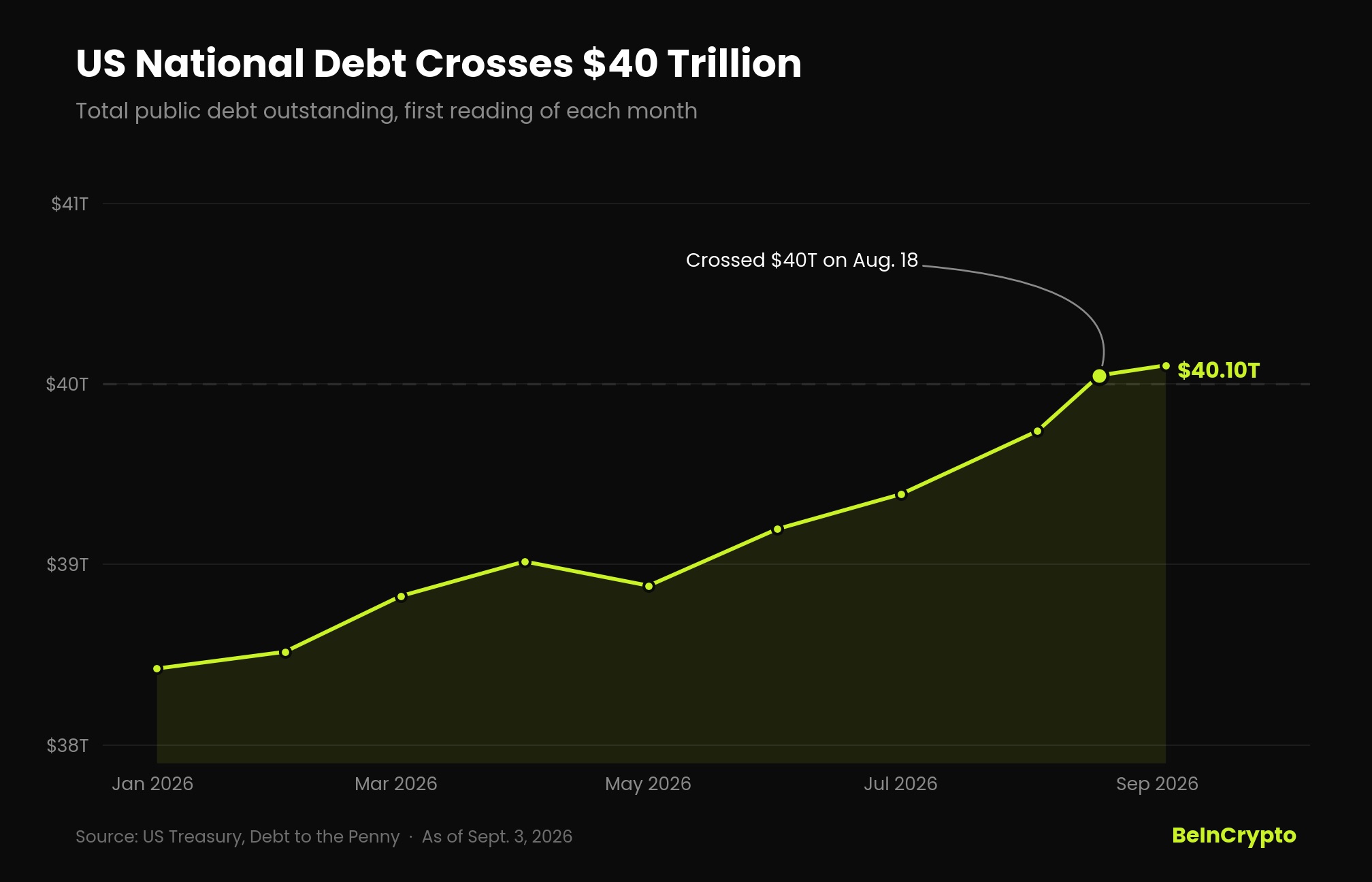
2026 US national debt surpassing 40 trillion dollar line graph | Source: BeInCrypto
This data deviation is crucial, as most of Swanson's arguments are built on comparisons of US debt data. After the US debt set a new high of 40 trillion dollars in August, the scale of US borrowing has not slowed down.
Swanson also tied Bitcoin's argument to the market's confidence in the dollar issuance agency, but Schiff did not respond to this part at all, only specifically rebutting the claim that "energy gives Bitcoin value."
Meanwhile, the market prices did not provide any favorable evidence for either side. On Sunday, Bitcoin (BTC) traded at about 79,600 dollars, with a 24-hour decline of about 1.5%. (Note: This is just a snapshot of the news article at the time, and does not represent the current market price)
Schiff's stance had shown slight loosening previously. Last month he admitted he missed out on Bitcoin's rising gains, but still insists that the actual returns for long-term Bitcoin holders are not as significant as they claim externally.
Neither side made any concessions during this clash. But as long as US debt hits new highs again, the question of "does Bitcoin have value endorsement" will be discussed again.
免责声明:本文章仅代表作者个人观点,不代表本平台的立场和观点。本文章仅供信息分享,不构成对任何人的任何投资建议。用户与作者之间的任何争议,与本平台无关。如网页中刊载的文章或图片涉及侵权,请提供相关的权利证明和身份证明发送邮件到support@aicoin.com,本平台相关工作人员将会进行核查。


