Written by: Little Cake
ZEC surged to $1200 on September 6, with a three-month increase of 370%. Grayscale's ZEC spot ETF (ZCSH) attracted over $460 million in assets within two weeks of its launch, marking the most aggressive pricing correction for privacy coins in a decade.
However, the hottest trading discussions on Crypto Twitter have skipped over ZEC itself and pointed to a more sophisticated logic: Instead of betting on ZEC's next move at the thousand-dollar mark, it's better to buy the "toll road" beneath it.
This road is called NEAR Intents.
Zashi Wallet and NEAR Intents: An Underrated Pipeline
Understanding this narrative requires first clarifying a key product linkage.
The Zashi wallet developed by Electric Coin Company is currently the most complete self-custody entry point in the ZEC ecosystem. In October 2025, Zashi launched its cross-chain exchange feature "Zashi Swaps" based on NEAR Intents, allowing users to directly exchange assets like BTC, SOL, and USDC for shielded ZEC. Shortly after, the CrossPay feature went live, establishing a payment channel from shielded ZEC to any asset on other chains.
This means that NEAR Intents is not only ZEC's "entry ramp" but also its "exit ramp".
Every cross-chain exchange initiated from Zashi, regardless of direction, must pass through the settlement layer of NEAR Intents.
On February 23, 2026, NEAR Intents activated the "Fee Switch". From that day on, all fees generated at the protocol level are uniformly collected as NEAR tokens, with 100% of the protocol fees used to repurchase NEAR in the open market. This constitutes a textbook value capture flywheel: The larger the transaction volume, the more fees are generated, the stronger the repurchase, and the lower the selling pressure on NEAR.
The chain of causation circulating on Twitter is as follows: Rising demand for ZEC → Increased Zashi cross-chain exchanges → Increased transaction volume for NEAR Intents → Protocol earns fees → Fees repurchase NEAR → NEAR forms structural buying pressure.
Data Verification
Let's verify this narrative with data.
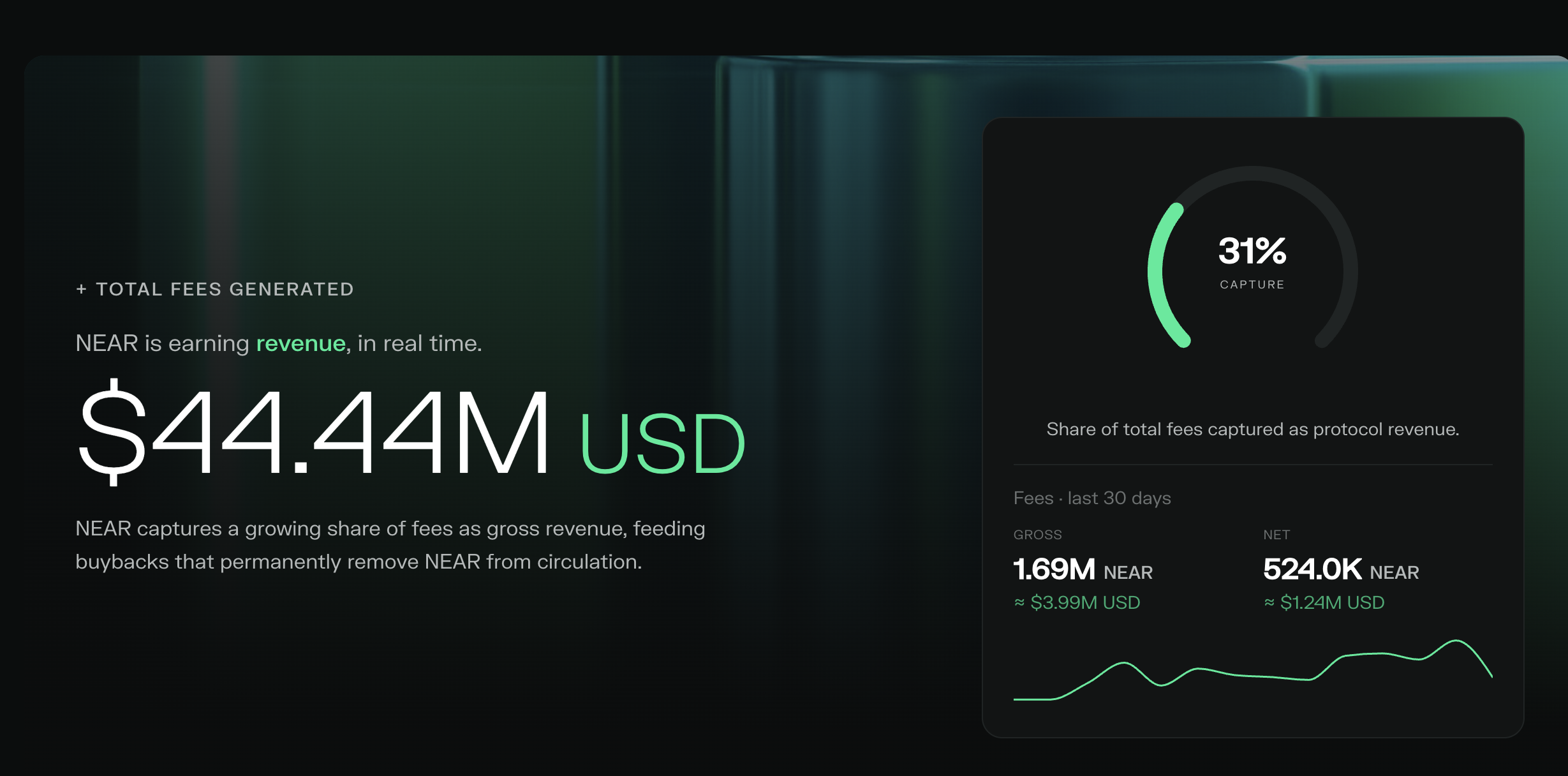
First, looking at the overall volume, the official data dashboard of NEAR Intents shows that as of early September, the cumulative transaction volume is approximately $27.6 billion, covering over 26 blockchains, generating approximately $45 million in fees, with a 30-day transaction volume of around $3 billion.
Next, let's see ZEC's share. Data from the end of 2025 shows that ZEC transactions account for about 10% of NEAR Intents' daily average transaction volume, equivalent to about $15 million daily. However, CoinGecko's trading pair data reveals a more aggressive reality: Currently, the USDT/ZEC trading pair on NEAR Intents accounts for 27.4% of the total trading volume, combined with USDC/ZEC (7.1%), SOL/ZEC (2.5%), and ETH/ZEC (2.2%), ZEC-related trading pairs collectively account for nearly 40% of the trading volume share.
The most crucial aspect is value capture.
DefiLlama data shows that NEAR Intents has cumulatively generated $45 million in fees, but only about $5.51 million of the actual "protocol revenue" flows into the protocol treasury for repurchasing NEAR, with about $910,000 in protocol revenue over the last 30 days, equivalent to an average monthly repurchase volume of about $900,000.
Early reports indicated an average monthly repurchase of about $3 million, which differs from DefiLlama's measure of "protocol revenue". The source of the discrepancy lies in the fact that the majority of the $45 million in fees went to solvers (market makers/settlement parties) and distribution channels (SwapKit alone accounted for over $4.4 million, and Zashi contributed about $760,000), with only the protocol fees truly entering the NEAR repurchase pool.
The fate of shovel sellers depends on how long the gold mine can be opened.
NEAR's narrative as ZEC's "shovel seller" is logically sound in its transmission.
The integration of the Zashi wallet with NEAR Intents represents a real product relationship, and the repurchase mechanism after the fee switch is verifiable on-chain, with ZEC's share in NEAR Intents' transaction volume being significant.
However, the transmission efficiency is actually far lower than the community narrative suggests and is highly dependent on the continued market performance of the single asset, ZEC.
If the inflow of funds into ZEC ETFs maintains its current pace over the next few weeks, this transmission chain can continue to operate; if ZEC enters a phase of significant volatility or correction, the distribution of transaction volume on NEAR Intents will reveal a higher concentration risk than what the "multi-chain infrastructure" narrative implies.
For traders, what truly needs to be monitored is not just whether NEAR Intents' cumulative transaction volume exceeds $30 billion, but also the trend of ZEC's share within that transaction volume. If this proportion drops from 40% to below 15%, while total transaction volume continues to grow, then NEAR has truly completed the narrative upgrade from being "the shadow of ZEC" to "cross-chain settlement infrastructure".
免责声明:本文章仅代表作者个人观点,不代表本平台的立场和观点。本文章仅供信息分享,不构成对任何人的任何投资建议。用户与作者之间的任何争议,与本平台无关。如网页中刊载的文章或图片涉及侵权,请提供相关的权利证明和身份证明发送邮件到support@aicoin.com,本平台相关工作人员将会进行核查。


